The Vivara Content Team
Nature Wellness in Costa Rica: Why the Environment Is Part of the Healing
Nature Wellness in Costa Rica: Why the Environment Is Part of the Healing
You've probably come back from a trip feeling exactly the same as when you left.
Maybe more tired. A little hollow. Like you did all the right things — disconnected from the office, slept in, maybe got a massage — and still came home feeling like you needed a real break.
That's not a failure of effort. It's a failure of environment.
Where you recover matters just as much as what you do while you're there. And Costa Rica isn't just a beautiful place to relax — it's one of the few places in the world where the environment itself is actively doing the work of restoration.
Here's what that actually means.
Why Nature Changes the Quality of Recovery
Your nervous system is always reading the room.
In a city — even on a quiet day — it's processing traffic noise, artificial light, crowded spaces, and the low-grade buzz of a device that never fully goes off. None of this feels dramatic. It just accumulates.
Research consistently shows that natural environments do something urban spaces can't: they bring the nervous system down. Reduced cortisol. Lower heart rate. Slower breathing. Not because you tried to relax, but because the environment told your body it was safe to.
There's also a cognitive side to this. Researchers call it Attention Restoration Theory. The basic idea: the kind of focus you use for meetings, decisions, and screens is a limited resource. You can burn through it and it doesn't refill automatically. What refills it is effortless attention — the kind that happens naturally when you're watching light move through a tree canopy or listening to water over rocks.
Nature doesn't demand anything from you. That's the point. And in that absence of demand, something starts to come back.
What Costa Rica Offers That Urban Wellness Spaces Cannot
Costa Rica holds about 5% of the world's biodiversity in a tiny fraction of its landmass. That's not a travel brochure fact — it shapes the actual sensory experience of being there.
The sounds are different. Birdsong, howler monkeys at dawn, frogs at nightfall, rain moving through a jungle canopy. These aren't ambient noise. Research on natural soundscapes shows they actively settle the nervous system in ways that silence in a spa room doesn't.
The light is different. Natural light filtered through tropical canopy — warm, shifting, gold-green through the day — regulates your circadian rhythm in a way no lighting system replicates. Better light means better sleep. Better sleep means you actually recover.
The air is different. Studies on forest environments document measurable immune and mood benefits from compounds released by tropical vegetation. Not metaphor — biochemistry.
And critically, the climate lets you live outside. On the Pacific coast, it's warm enough to be outdoors from morning until you fall asleep, without effort. That continuous exposure is what produces the cumulative effect that a two-hour nature walk or a weekend getaway can only hint at.
A spa hotel controls all of these things out of its environment because it has to. Filtered air, regulated temperature, managed light, contained sound. That works fine for a city. It doesn't work for genuine restoration.
Jungle, Light, Sound, Water, and Open-Air Rhythm as Healing Inputs
Think of these as specific inputs — not one vague thing called "nature."
Jungle canopy changes how your visual field works. When you're surrounded by living things instead of built structures, the attentional mode your brain defaults to shifts. You stop scanning for problems and start noticing what's already there. That shift is where recovery starts.
Natural light across the full day sets your hormonal rhythm in a way most people haven't experienced since childhood. A day that begins with natural sunrise light, moves through shifting afternoon sun, and ends in firelight and open sky dark will produce a quality of sleep that most people forget is possible.
Water holds attention without demanding it. A river, a waterfall, rain on leaves — these are the most consistent attention anchors found in nature research. They keep you present without effort. That's the whole game.
Sound landscape does the same. The layered acoustics of a biodiverse jungle — always present, always changing, never requiring a response — give your brain permission to stop monitoring. No alerts. No pings. Nothing that means anything requires action.
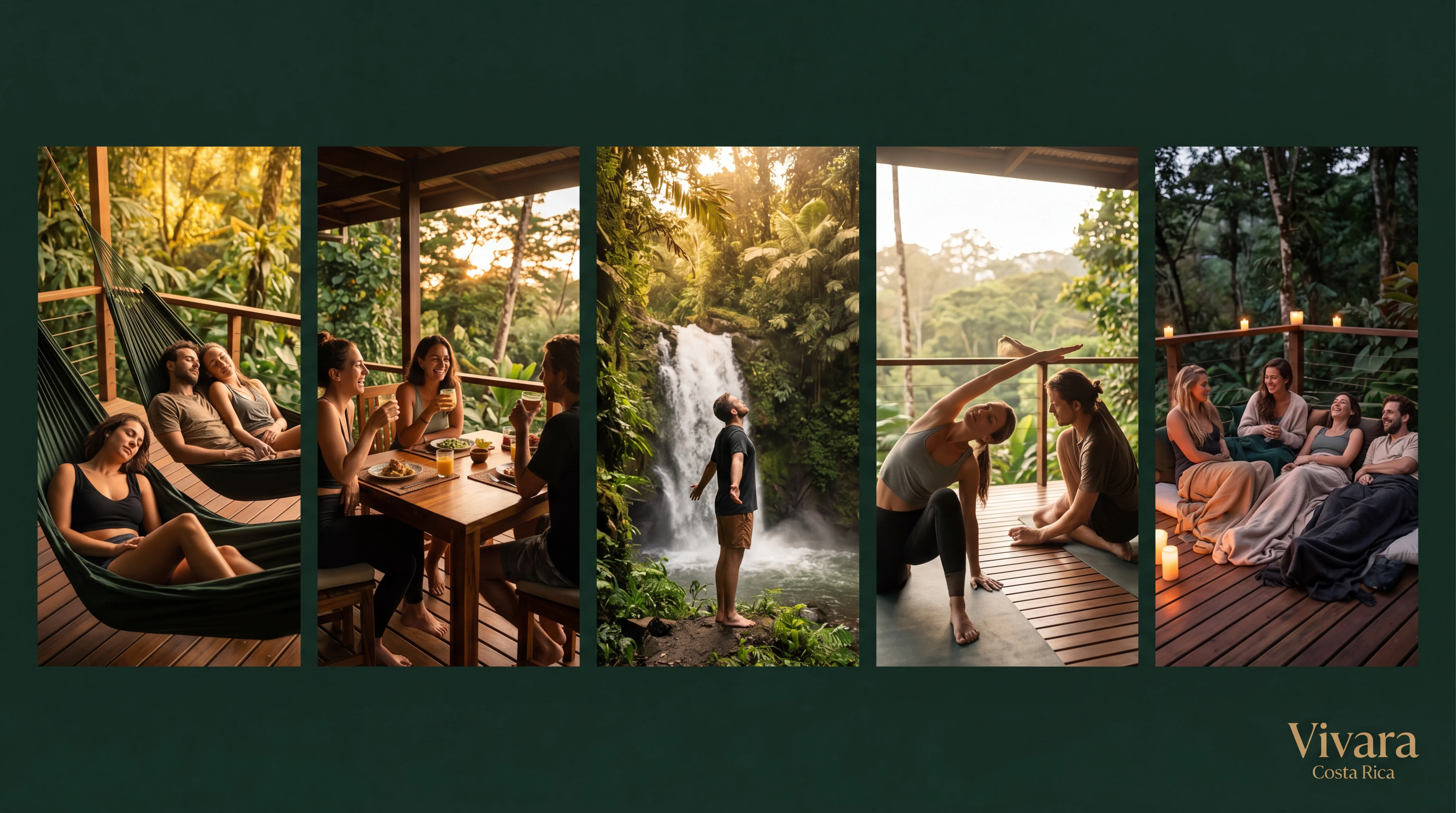
Open-air rhythm ties all of it together. When your meals, movement, rest, and social time all happen in contact with outside air and natural light, the day has a texture that's fundamentally different from anything indoors. Your body reads those cues and organizes itself around them.
Who Benefits Most from a Nature-First Retreat Environment
Honestly? Almost everyone who lives and works in a city.
But a few groups see the biggest shift:
Burned-out founders and executives aren't just tired — they've depleted the specific cognitive resource that makes clear thinking possible. A jungle does something a weekend hotel doesn't: it actually refills that resource. Not by pushing harder, but by finally stopping the drain.
Creative professionals and agency teams who've hit a wall often think the block is creative. It usually isn't. It's attentional. When directed focus crowds out diffuse thinking, original ideas go quiet. Nature reverses this — often within 48 hours of genuine immersion. If a full creative production retreat is what your team needs, Curating the Creator Camp covers how that model works at Vivara.
Friend groups and social circles in reset mode arrive to an environment that's already doing the emotional work before the first session begins. Something about being in a living landscape together shifts how people relate. If you're planning a group reset, the Friend Group Retreat Reunion Blueprint walks through exactly how that experience gets structured.
Multi-generational families navigating milestone occasions find that nature operates across every age simultaneously. A six-year-old and a seventy-two-year-old can be having completely different experiences of the same setting — and both deeply restored by it. See the Private Villa Buyout Family Vacation guide for how that works in practice.
Wellness retreat hosts evaluating venues should think about what the environment does before the programming starts. A yoga session inside a living jungle begins from a different baseline than one in a studio — and participants feel the difference without being able to name it.
How to Choose a Costa Rica Property That Supports Real Restoration
Not all Costa Rica properties deliver the same thing. A few things to look for:
Immersion, not access. Is nature woven into the property, or is it a view from a pool deck? The difference between glancing at a jungle and being inside one is the difference between decoration and treatment.
Open-air design. Are common spaces, dining areas, and living spaces open to the air? Or is everything climate-controlled? Open-air architecture isn't just aesthetic — it's the structural condition that makes continuous nature exposure possible.
Privacy. Recovery requires the absence of social demand. A resort with 80 other guests creates a background hum of social awareness that works against the restoration the environment is trying to deliver. A private buyout — one group, full property — eliminates that interference.
Programming that doesn't fill every hour. The best nature wellness properties protect open time. River hikes, waterfall access, guided jungle walks — yes. But also: unscheduled hours where the environment can do its work without competition.
Staff who get it. The job isn't to maximize your itinerary. It's to protect the conditions for recovery. That's a different philosophy, and you can usually tell within the first conversation.
Why Vivara Fits the Nature-Wellness Model
Vivara wasn't built next to nature. It was built inside it.
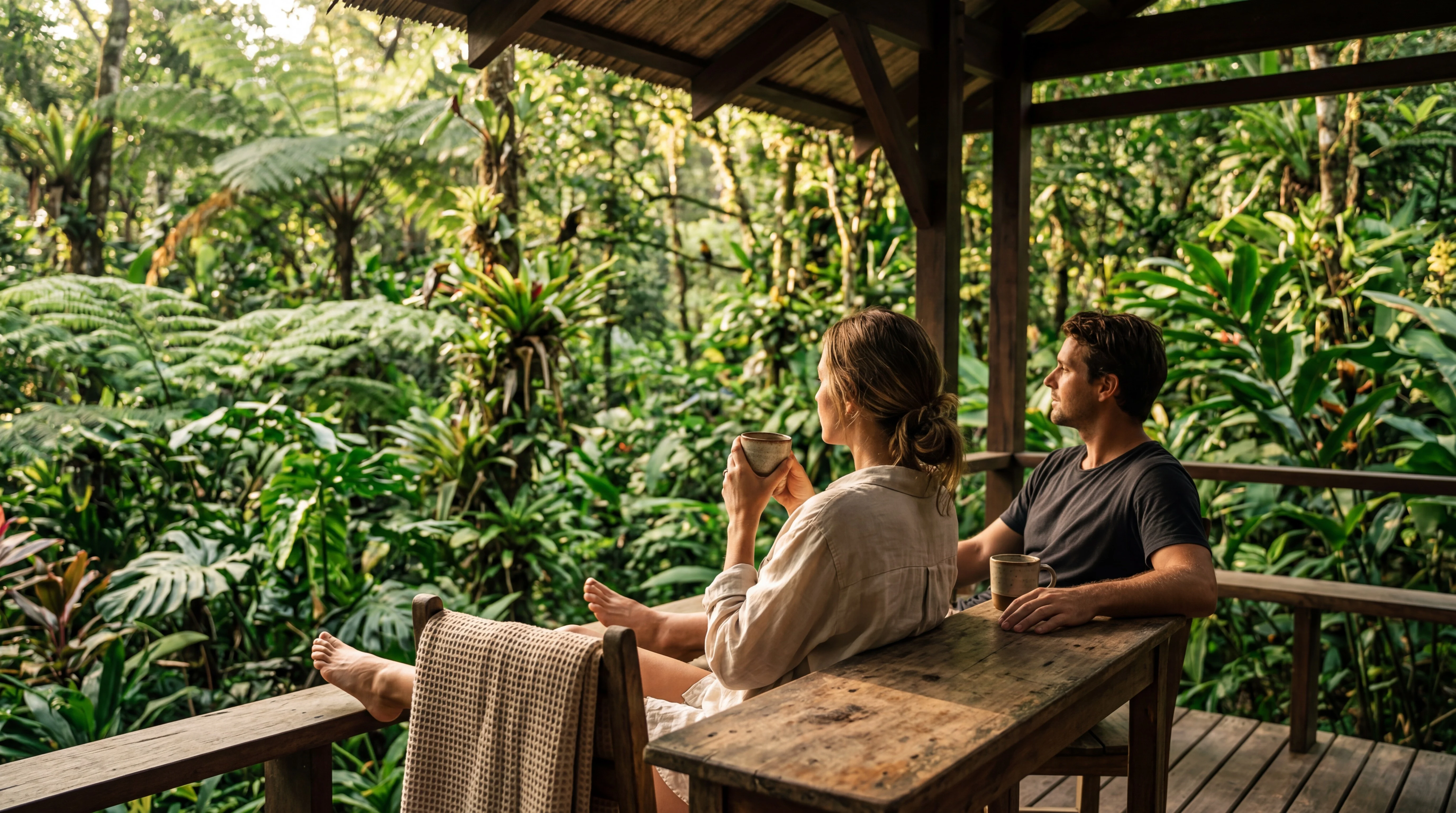
The architecture opens into the surrounding jungle. Light moves through the property naturally all day. Meals happen in open air. The sounds of the canopy, the river, the rain are present from the moment you wake up — not as background ambiance, but as the actual environment you're living in.
The surrounding ecosystem is among the most biodiverse in the world. You're not traveling to access it. You arrive and you're already there.
And because Vivara operates as a full property buyout, your group has the space to itself. No strangers. No resort buzz. Just the environment and the people you came with — which is exactly the condition that allows the restoration work to actually happen.
For a full orientation to the property, the rhythm of a stay, and what to expect on arrival, see What to Expect at Vivara Costa Rica.
The environment isn't the backdrop. It's the treatment.
Explore Vivara as a nature-immersive retreat setting →
Frequently Asked Questions
Why is Costa Rica considered a top destination for nature-based wellness retreats?
Costa Rica holds approximately 5% of global biodiversity in a tiny fraction of its landmass — producing a sensory environment that's genuinely rare. Dense jungle canopy, biodiverse soundscapes, moving water, warm natural light throughout the day, and forest air with documented mood and immune effects all combine to create conditions for restoration that most travel destinations can't replicate. The climate also allows continuous outdoor living, which is what produces the cumulative restorative effect that a single day in nature only hints at.
What is biophilic healing and does it actually work?
Biophilic healing is based on the idea — supported by decades of research — that humans have a built-in affinity for living natural systems, and that immersion in those systems produces measurable biological responses: reduced cortisol, lower blood pressure, improved immune function, and refilled attentional capacity. It's not a wellness trend. It's a documented physiological response. Applied to retreat travel, it means the environment is doing active restoration work — not just providing a pleasant backdrop.
How does nature immersion restore focus and creative capacity?
When you're operating on directed attention for extended periods — decisions, screens, back-to-back meetings — the capacity for voluntary focus gradually depletes. Natural environments engage effortless, involuntary attention, which lets the directed attention system recover passively. Most people notice the shift within 48 to 72 hours of genuine nature immersion: clearer thinking, less reactivity, ideas that start arriving without forcing them.
What makes a nature wellness retreat different from a spa hotel?
A spa hotel offers wellness modalities inside a controlled environment. A nature wellness retreat embeds those modalities inside a living environment that's already doing restoration work. The difference shows up in the baseline state of the nervous system before any programming begins. Two days of genuine jungle immersion creates a physiologically different starting point than arriving directly from an airport. The practices work harder when the environment is already doing its job.
How long should a nature wellness retreat be?
Research suggests measurable shifts in mood and cognitive capacity within 48 to 72 hours. But that's just the door opening. For the restoration to consolidate — to produce changes that last beyond the trip — four to seven nights is the sweet spot. Shorter stays initiate the process. Longer stays let it complete.
Who is a nature-first retreat at Vivara best suited for?
Vivara works best for private groups seeking a nature-immersive setting for recovery, creative reset, or facilitated wellness programming. This includes founders and leadership teams navigating burnout, creative and agency groups needing to reset their thinking, wellness facilitators evaluating host venues, and any group at a meaningful personal or professional transition point. The private buyout model means one group occupies the full property — protecting the restorative conditions that make the environment work.