The Vivara Content Team
Beyond the Boardroom: Redefining Team Innovation in Costa Rica
Beyond the Boardroom: Redefining Team Innovation in Costa Rica
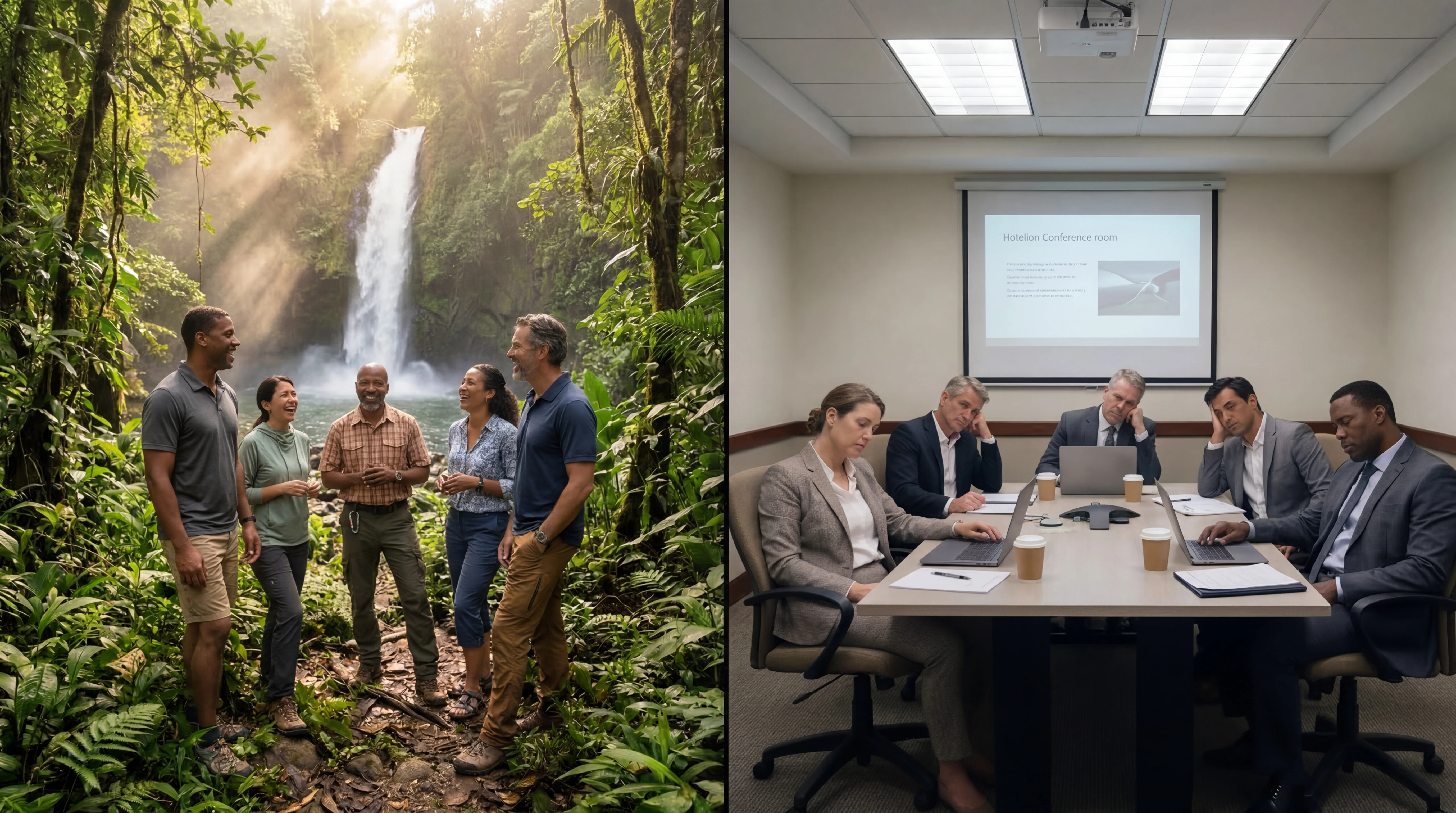
What if the most important strategic conversation your leadership team will ever have doesn't happen in a conference room — it happens on a rainforest trail at dawn, with howler monkeys echoing in the canopy overhead and the smell of wet earth replacing the recycled air of a corporate office?
That question sounds romantic. But it is, in fact, deeply scientific.
The global corporate retreat industry is worth over $35 billion annually, yet most organizations still default to the same formula: fly the team somewhere warm, book a hotel with a "business center," and run the same PowerPoint presentations in a room with a better pool view. The result? Minimal strategic breakthrough, modest team cohesion, and a return to the office that feels indistinguishable from the week before departure.
The most forward-thinking leadership teams in the world are abandoning this model. They are choosing environments — not amenities — as the engine of innovation. And increasingly, they are choosing Costa Rica.
This is not a travel article. This is a case for why nature, specifically the rugged, biodiverse landscape of Costa Rica, is one of the most powerful cognitive tools available to a senior leadership team — and how intentional, immersive retreats at destinations like Vivara are redefining what it means to think, lead, and build together.
The Neuroscience of Why the Office Kills Creative Thinking
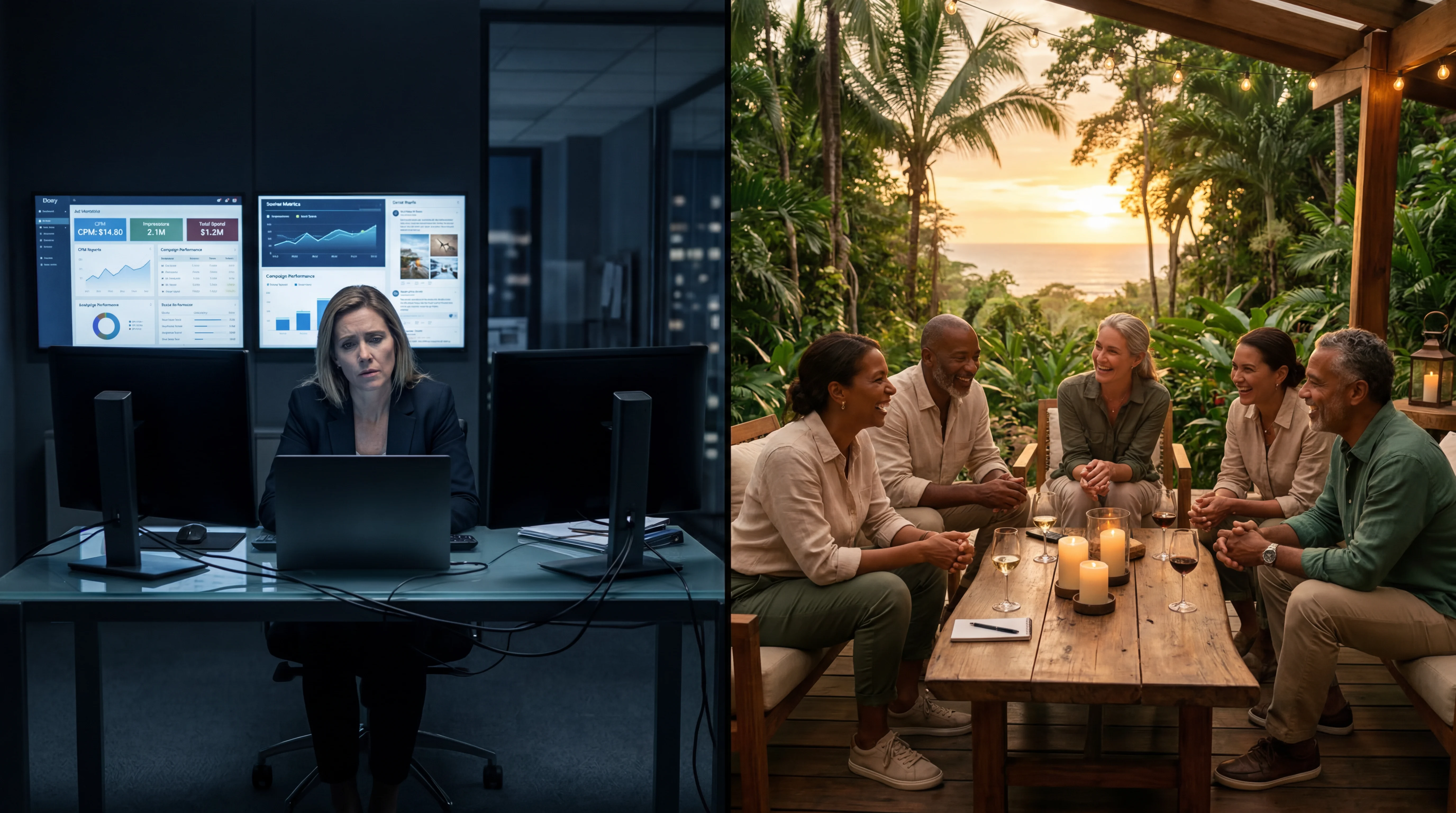
Before we talk about rainforests, we need to talk about your brain under fluorescent lights.
The modern corporate environment is, by design, a system of cognitive compression. Open-plan offices, back-to-back calendar blocks, constant digital interruption — these conditions are optimized for execution, not ideation. And there is a growing body of neuroscientific evidence to prove it.
Researchers at the University of Michigan, in a landmark study published in Psychological Science, found that participants who took a walk in a natural setting improved their performance on directed-attention tasks by 20% compared to those who walked through urban environments. The mechanism behind this is Attention Restoration Theory (ART), first proposed by environmental psychologists Rachel and Stephen Kaplan. The theory holds that natural environments engage what they call "soft fascination" — a gentle, effortless form of attention that allows the prefrontal cortex to rest and restore its capacity for higher-order thinking.
In plain terms: the forest gives your brain's executive function a chance to breathe.
But the research goes further. A 2012 study by psychologists Ruth Ann Atchley, David Strayer, and Paul Atchley, published in PLOS ONE, found that participants who spent four days immersed in nature — completely disconnected from digital devices — scored 50% higher on a standardized creative problem-solving test (the Remote Associates Test) than a control group. The authors attributed this to the suppression of the brain's default mode network (DMN) hyperactivity, which is associated with rumination and analytical over-processing, and the subsequent activation of divergent thinking pathways.
Divergent thinking — the cognitive mode responsible for generating multiple novel solutions to an open-ended problem — is precisely the mental state that leadership teams need when navigating competitive disruption, organizational transformation, or long-horizon strategic planning. And it is precisely the mental state that the typical corporate environment systematically suppresses.
Costa Rica's biodiversity — it contains approximately 5% of the world's total biodiversity in just 0.03% of the planet's surface area — provides a sensory richness that is neurologically unmatched by any hotel conference center, however well-designed.
The "High-Fidelity Pause": Why Disruption Is a Strategic Asset
There is a concept gaining traction among organizational psychologists and executive coaches: the High-Fidelity Pause. Unlike a vacation — which is passive recovery — a High-Fidelity Pause is an intentional, structured interruption of routine that is rich enough in novel sensory and social experience to catalyze genuine cognitive restructuring.
The distinction matters enormously for leadership teams. The goal is not rest for its own sake. The goal is cognitive pattern interruption — breaking the mental grooves that form when a team has been operating in the same context, with the same dynamics, solving the same categories of problems for months or years.
Dr. Adam Galinsky of Columbia Business School has published research demonstrating that exposure to foreign environments and novel experiences directly enhances cognitive flexibility — the ability to shift between different conceptual frameworks. His studies showed that individuals with more diverse environmental experiences generated more creative solutions and were better at integrating disparate ideas. The implication for leadership teams is clear: the environment you place your team in is not incidental to the quality of thinking they produce. It is foundational to it.
Costa Rica's landscape — where cloud forests give way to Pacific coastlines, where active volcanoes rise above thermal hot springs, where a single acre can contain more species of birds than all of North America — is not merely beautiful. It is cognitively destabilizing in the most productive sense of the word. It forces the brain to process new information, recalibrate its threat and reward systems, and engage with the present moment in a way that no urban environment can replicate.
What Happens to a Team in the Wild: The Social Architecture of Trust
Innovation is not a solo act. The most consequential strategic breakthroughs in organizational history have been the product of high-trust teams operating with psychological safety — the term coined by Harvard Business School professor Amy Edmondson to describe an environment where individuals feel safe to take interpersonal risks.
Google's landmark Project Aristotle (2016), a two-year internal study analyzing 180 teams across the organization, found that psychological safety was the single most important factor determining team effectiveness — more important than individual talent, compensation structure, or access to resources. Teams with high psychological safety were more innovative, more productive, and more resilient under pressure.
The challenge for most organizations is that psychological safety is extraordinarily difficult to build inside the same hierarchical environment where people are evaluated, promoted, and managed. The power dynamics of the office are embedded in the architecture itself — in who sits where, who speaks first, who has the corner office.
Adventure-based experiences in nature dissolve those dynamics with remarkable speed.
When a leadership team navigates a technical rainforest trail together, the CEO and the VP of Engineering face the same physical challenge. When a group completes a sunrise movement session on a volcanic hillside, the social scripts of the office — the deference, the performance, the careful self-presentation — fall away. What emerges is something rarer and more valuable: authentic human connection between colleagues who may have worked together for years without truly knowing one another.
This is not anecdotal. A 2014 meta-analysis published in the Journal of Experiential Education, examining 44 studies on outdoor adventure-based team interventions, found that these programs produced statistically significant improvements in communication, trust, cooperation, and problem-solving compared to traditional team-building activities. The effect sizes were particularly pronounced for senior leadership groups, where entrenched hierarchical norms were most in need of disruption.
The Corporate Retreat ROI Case: What the Data Actually Says
For executives who need to justify the investment to a board or finance committee, the data on corporate retreat ROI is compelling.
A study by Oxford Economics found that face-to-face meetings are 34 times more effective at generating long-term business relationships than virtual or digital interactions. The Harvard Business Review has reported that companies investing in structured off-site leadership experiences see measurable improvements in employee engagement, with engaged teams showing 21% higher profitability (Gallup, State of the Global Workplace, 2023) and 17% higher productivity compared to disengaged counterparts.
Perhaps most strikingly, research from the International Journal of Event and Festival Management found that organizations that conduct annual strategic off-sites report 25–40% faster decision-making velocity in the months following the retreat — a direct consequence of the trust, alignment, and shared mental models built during the off-site experience.
The math is not complicated: a leadership team that returns from a well-designed retreat with stronger trust, clearer strategic alignment, and enhanced creative capacity will generate returns that dwarf the cost of the investment within a single quarter.
A Published Case Study: Patagonia's Nature-Integrated Leadership Model
Few companies have been as deliberate about the relationship between natural environments and organizational culture as Patagonia. The outdoor apparel brand — now valued at over $3 billion — has long embedded nature immersion into its leadership development philosophy, famously encouraging employees and executives to take time in wilderness environments as a core component of their professional practice.
Patagonia's founder Yvon Chouinard has written extensively in Let My People Go Surfing (2005) about the direct correlation between time spent in demanding natural environments and the quality of strategic thinking and decision-making that followed. The company's leadership retreats are deliberately set in wild, challenging landscapes — not resort hotels — and are structured around physical challenge, shared experience, and unstructured reflection time.
The results are documented in Patagonia's organizational outcomes: the company has consistently ranked among the most innovative and resilient in its sector, with an employee retention rate that is the envy of the apparel industry and a culture of creative problem-solving that has driven decades of product and business model innovation.
Patagonia is an extreme example, but the principle it embodies is universally applicable: the environment you choose for your leadership team sends a signal about the kind of thinking you expect from them. A hotel ballroom says: execute. A rainforest says: imagine.
Why Costa Rica — and Why Now
Costa Rica occupies a singular position in the global landscape of executive retreat destinations. It is not merely scenic. It is strategically located (direct flights from major U.S. hubs under five hours), politically stable, and home to one of the most sophisticated ecotourism infrastructures in the world. Its government has protected over 30% of its national territory as national parks and biological reserves — a commitment to environmental stewardship that resonates deeply with the values of ESG-conscious organizations.
But beyond logistics, Costa Rica offers something rarer: genuine ecological drama. The contrast between Pacific and Caribbean coastlines, the transition zones between tropical dry forest and cloud forest, the thermal activity of the Central Valley — these are not manufactured experiences. They are real, ancient, and humbling in the way that only nature can be.
For a leadership team that has been operating at altitude — under pressure, in complexity, with the weight of organizational consequence — that humility is not a weakness. It is a reset. It is the cognitive and emotional recalibration that makes the next phase of strategic thinking possible.
The Vivara Difference: Nature as Infrastructure
At Vivara, the philosophy of the retreat is built on a foundational premise: the landscape is not the backdrop. It is the curriculum.
Every element of the Vivara experience — from the architecture that dissolves the boundary between interior and exterior, to the curated adventure programming that takes teams into the heart of Costa Rica's wilderness, to the sunrise movement sessions that begin each day by grounding participants in their bodies and in the present moment — is designed to activate the cognitive and social conditions that produce genuine breakthrough.
This is not a spa retreat with a team-building afternoon bolted on. It is a precision-designed innovation environment that happens to be built by nature.
When a leadership team arrives at Vivara, they are not checking into a hotel. They are entering a system — one where the morning trail run recalibrates the nervous system, the afternoon facilitated session capitalizes on the cognitive openness that physical challenge creates, and the evening gathering around a shared table cements the social bonds that will sustain high-performance collaboration long after the team returns home.
The rainforest does the heavy lifting. Vivara provides the architecture, the facilitation, and the intention that transforms a beautiful experience into a lasting organizational investment.
What Your Team Will Bring Home
The most important outcomes of a well-designed corporate retreat in Costa Rica are not the ones that show up in the post-retreat survey. They are the ones that show up six months later — in the strategic conversation that happens because two executives finally trust each other enough to be honest, in the creative solution that emerges because a team has learned to think together rather than alongside each other, in the decision made with confidence because a leadership group has shared a moment of genuine challenge and come through it together.
These are not soft outcomes. They are the preconditions of organizational excellence.
The neuroscience is clear. The organizational research is unambiguous. The case studies are compelling. The only question that remains is whether your organization is willing to invest in the conditions that make great leadership possible — or whether you will continue to hold your most important strategic conversations under fluorescent lights.
Take Your Team Beyond the Boardroom
Vivara is accepting a limited number of corporate retreat groups for the coming season. If your leadership team is ready to trade the conference room for a genuine innovation environment — one built by 5 million years of ecological evolution and designed for the demands of 21st-century leadership — we invite you to begin the conversation.
Because the best strategic thinking your team will ever do won't happen at a table. It will happen on a trail, at sunrise, in a country that has spent decades proving that the most valuable things in life are not for sale — they are for experiencing.