The Vivara Content Team
ROI of the Retreat: Swapping Digital CPMs for IRL Loyalty
ROI of the Retreat: Swapping Digital CPMs for IRL Loyalty

ROI of the Retreat: Swapping Digital CPMs for IRL Loyalty
Why the smartest growth leaders are trading fleeting impressions for measurable transformation—and building advocacy that no ad platform can replicate.
The new premium isn't reach. It's resonance.
A decade ago, marketing leaders could justify spend with clean dashboards: impressions, clicks, CPM, CAC. Today, the same metrics can feel like a beautifully designed mirage. In a saturated market, an "impression" is often a half-second scroll—registered by a pixel, forgotten by a human.
Meanwhile, the real competitive moat has shifted upward in the funnel, into territory most brands rarely own: trust, belonging, identity, advocacy.
That's where the Retreat ROI model begins—not by asking How many people saw us? but by asking a more strategic question:
How many people were changed by us?
Call it a new metric for an old truth: Cost Per Transformation.
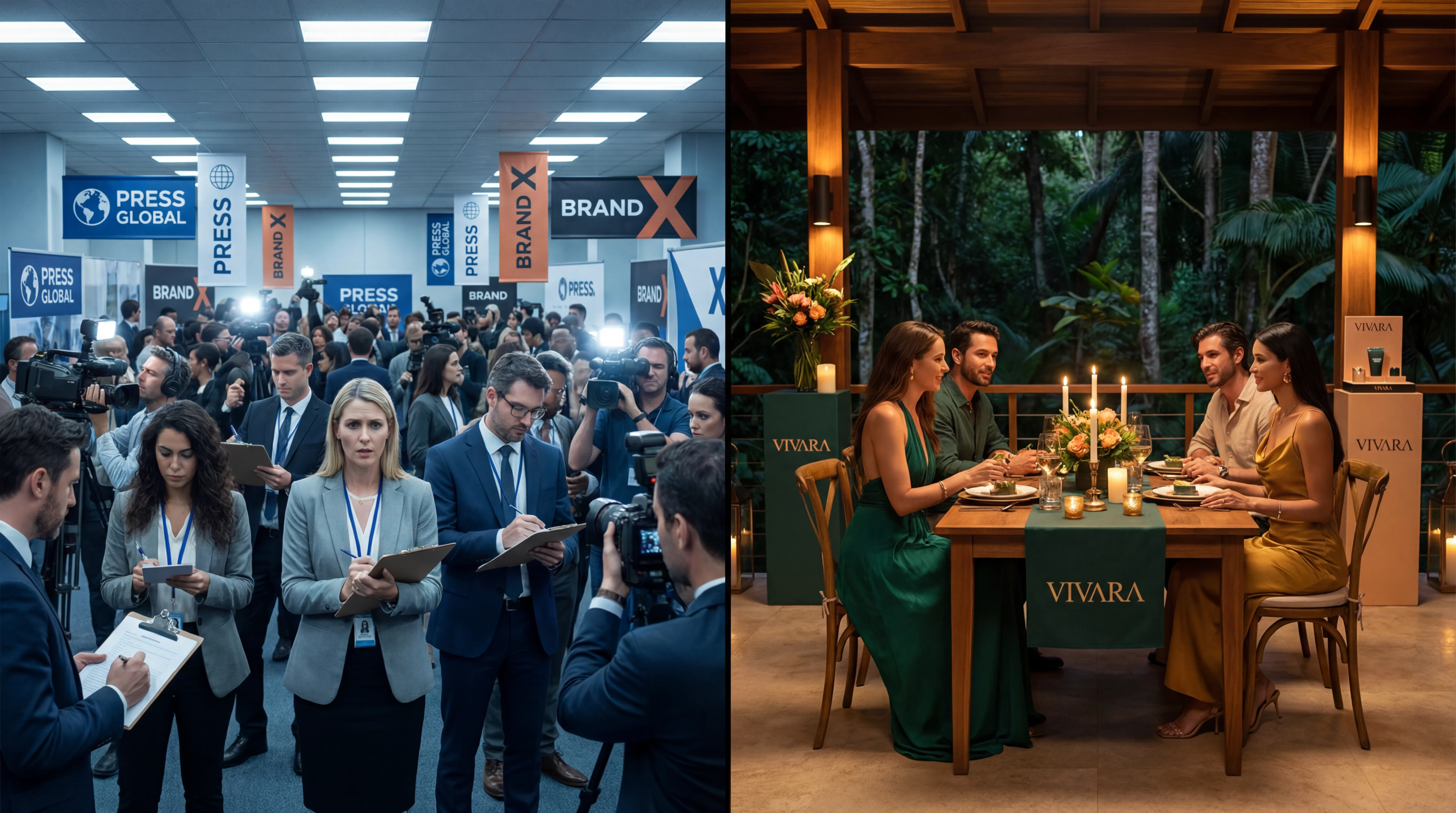
When a top-tier client, partner, or high-potential leader spends four days in a fully immersive environment—away from distractions, inside your brand's values—the resulting loyalty can outperform years of email sequences, remarketing, and content campaigns. Not because digital is ineffective, but because digital is crowded. Transformation is not.
1) CPM is a proxy. Transformation is an asset.
CPM has always been a means—a way to estimate how efficiently you can buy attention. But attention is no longer scarce. Meaning is.
In practice, many brands are paying for "visibility" while their category becomes more interchangeable by the quarter. When product differentiation compresses, the deciding factor becomes the emotional and social story people tell themselves about choosing you.
This is where experiential touchpoints change the equation. A retreat is not a campaign. It's an environmental advantage—a contained world where your brand isn't competing with five apps, 30 tabs, and a never-ending feed.
And unlike a digital impression, an immersive experience creates memory—the raw material of loyalty.
Bain & Company has long emphasized the economics of loyalty: increasing customer retention rates by just 5% can increase profits by 25% to 95%—a range that should make any CFO pause before cutting "relationship investments" first. (Bain & Company)
The point isn't that impressions are worthless. It's that impressions alone are increasingly incomplete—and the most valuable outcomes (trust, advocacy, retention) don't show up in a CPM report until it's too late.
2) The wellness economy proves the demand shift: from luxury goods to transformational travel
If you want to predict where loyalty is heading, watch where discretionary spending is flowing. The Global Wellness Institute projects the wellness economy will reach $2.1 trillion by 2030, propelled by consumers prioritizing health, purpose, and experience over status signaling.
This isn't just "self-care." It's a market-wide redefinition of value: people are buying who they become—not merely what they own.
In that context, retreats aren't a perk. They're the physical infrastructure of modern brand-building—an IRL epicenter where transformation is designed, facilitated, and measured.
And for growth leaders, the strategic insight is simple: If the market is rewarding transformation, then your marketing should create it.
3) Trust is the new brand equity—and it's built in rooms, not feeds
Every executive knows trust matters. The question is whether your growth plan treats trust like a soft concept—or a hard asset.
The Edelman Trust Barometer has repeatedly positioned trust as a decisive factor in brand choice and resilience. In an era of institutional skepticism and algorithmic fatigue, trust becomes a differentiator that compounds: it lowers acquisition costs, increases forgiveness, and converts customers into advocates.
But trust is not optimized through frequency caps.
It's built through proximity, consistency, and shared experience. A private retreat creates a trust environment that digital channels struggle to match:
Time — unrushed conversation, long-form thinking
Context — values demonstrated, not just claimed
Intimacy — smaller groups, higher signal
Embodiment — your brand felt, not just described
For decision-makers allocating serious budgets, the implication is profound: A retreat isn't a line item in marketing—it's an investment in credibility.
4) From retention math to advocacy math: the "Cost Per Transformation" framework
Most brand funnels stop at conversion. The real goal—especially in premium categories and high-consideration B2B—is advocacy: the point where customers market for you.
This is where retreat ROI becomes measurable. A simple Cost Per Transformation model can include:
Retention lift — renewals, repeat bookings, expanded contracts
Increased share of wallet — cross-sell, upsell, longer LTV
Referral velocity — introductions, word-of-mouth, social proof
Talent outcomes — retention, engagement, leadership cohesion
Partnership activation — co-marketing, strategic alliances
Harvard Business Review has consistently underscored the economics of retention: acquiring new customers is typically far more expensive than keeping existing ones—and loyal customers are more likely to repurchase and recommend.
Add the advocacy lens: Net Promoter Score research confirms that promoters don't just stay—they pull others in. Experiences that create personal meaning generate significantly higher willingness to recommend than transactional touchpoints.
Digital can nurture. But IRL can convert loyalty into identity—the moment your customer stops saying, "I bought from them," and starts saying, "I'm one of them."
That is the highest-leverage marketing outcome there is.
The Vivara Advantage: a private buyout as the ultimate transformation investment
A Vivara private buyout is not simply a beautiful setting. It's a strategic container—built for the kind of high-quality attention that leadership teams and premium clients rarely get anymore.
In four days, the right retreat can do what quarters of digital spend often cannot:
Turn top clients into true insiders
Turn partners into co-owners of the narrative
Turn executives into aligned operators
Turn your brand story into a lived experience
When you host in an environment that is intimate, immersive, and brand-aligned, you're not buying impressions. You're building an inventory of human capital: relationships, trust, and community intelligence that competitors trapped in the digital ad loop can't simply outbid.
That's the quiet power of Cost Per Transformation: it's defensible. It compounds. And it looks like loyalty—long after the campaign ends.
Build advocacy where it's strongest—IRL
If you're a C-suite leader, CMO, or founder scaling authority in a crowded market, it may be time to stop asking what your CPM is—and start asking what your transformation is worth.
A Vivara private buyout is designed for decision-makers who understand that the next era of growth won't be won by louder ads, but by deeper loyalty.
Explore a Vivara buyout and start building your Cost Per Transformation model—one unforgettable, high-trust experience at a time.