The Vivara Content Team
HOW COSTA RICA REGREW ITS FORESTS
HOW COSTA RICA REGREW ITS FORESTS
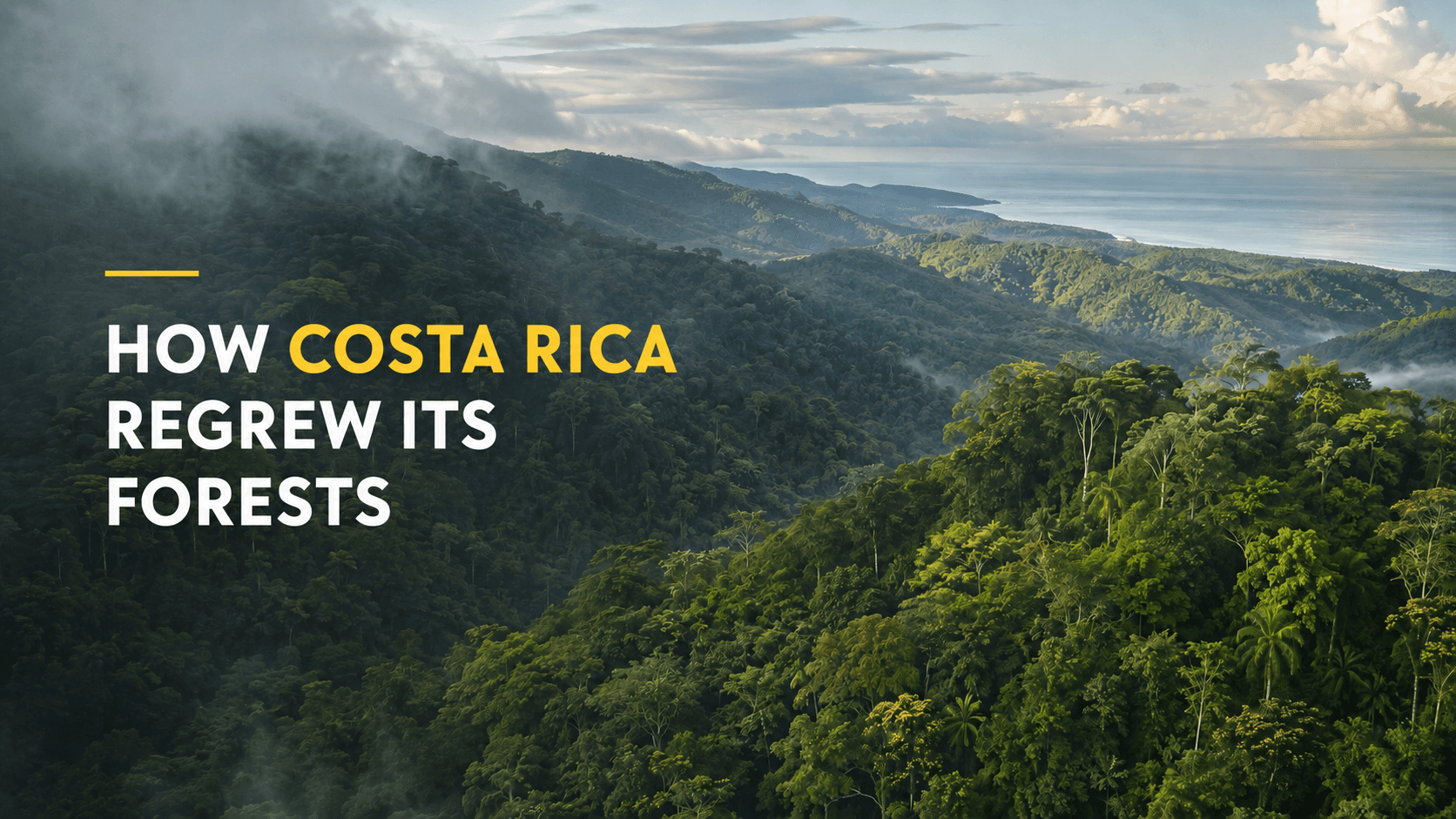
Costa Rica’s rainforest did not return because of one perfect law, one ambitious president, or one environmental campaign.
It came back because the country built a system.
Protected areas gave forests room to survive. New laws restricted destructive land use. Restoration helped damaged landscapes recover. Monitoring made progress measurable. Most importantly, landowners were given an economic reason to keep forests standing.
The result is one of the most important environmental recovery stories in the world.
According to the World Bank, Costa Rica became the first tropical country to reverse deforestation. Its forest cover, which had fallen to approximately 40% in 1987, now covers close to 60% of the country.
That transformation deserves attention. But it should not be treated as a finished story.
Before the Recovery, the Decline Was Real
It is easy to experience Costa Rica today and assume that the country has always looked this way.
The reality is less comfortable.
Large areas of forest were cleared during the twentieth century as cattle ranching, agriculture, logging, and settlement expanded. Forests that had evolved over centuries were converted into pasture and productive land.
By the 1980s, the consequences were becoming difficult to ignore. Habitat was disappearing, landscapes were becoming fragmented, and the country’s extraordinary biodiversity was being placed under increasing pressure.
Costa Rica had reached a decision point: continue treating forests primarily as land waiting to be developed, or begin recognizing the value created by keeping them alive.
The country chose the second path.
The World Bank describes Costa Rica as the first tropical country to reverse deforestation, with tropical rainforest now covering close to 60% of its territory.
That is an extraordinary reversal. It is also more complicated than planting millions of trees.
Protected Areas Gave Nature Room to Recover
One of the foundations of Costa Rica’s recovery was the creation and expansion of national parks, biological reserves, wildlife refuges, and other protected areas.
Approximately 26% of Costa Rica’s land is now protected, placing the country well above the OECD average.
Protection matters because a forest cannot recover if it is repeatedly cleared, divided, or degraded.
National parks created permanent strongholds for wildlife and mature forest. Biological corridors helped connect some of those protected landscapes, allowing animals, plants, and genetic material to move between habitats.
Private land also became part of the conservation structure. This is important because ecosystems do not stop at the edge of a national park. Rivers, watersheds, migration routes, and wildlife corridors frequently cross farms and privately owned property.
Costa Rica’s model therefore had to work beyond government-controlled land.
Conservation Started Paying People
Protecting public land was only part of the solution. Costa Rica also had to answer a difficult question:
Why should a private landowner preserve a forest when clearing it might generate more immediate income?
The country’s Payment for Environmental Services program, commonly known as PES or PSA, helped change that equation.
Administered by Costa Rica’s National Forestry Financing Fund, or FONAFIFO, the program provides financial recognition to participating landowners for environmental services created by forests and forest plantations.
Those services include carbon storage, water protection, biodiversity conservation, and scenic beauty.
In practical terms, the program recognizes that a standing forest produces real value—even if that value is not captured through logging, ranching, or construction.
The official FONAFIFO program compensates eligible landowners for protecting and improving environmental resources. Instead of asking rural communities to carry the financial burden of conservation alone, Costa Rica began treating environmental stewardship as something worth supporting economically.
That shift was crucial.
Conservation became more than an ethical request. It became a viable land-use decision.
Forest Laws Changed What Was Possible
Economic incentives worked alongside stronger regulation.
Costa Rica’s Forestry Law No. 7575 provided the legal foundation for recognizing environmental services and strengthening forest protection. The country also placed meaningful limits on clearing established forests.
This combination matters.
Payments without regulation may not provide enough protection. Regulation without economic support can place an unfair burden on rural landowners. Protected areas alone cannot safeguard every watershed or wildlife corridor.
Costa Rica’s recovery emerged because those tools began reinforcing one another.
The country created a system in which public protection, private participation, legal restrictions, environmental finance, and ecological monitoring could work toward the same outcome.
Regrowth Was More Than Planting Trees
The phrase “reforestation” often creates an image of people placing seedlings into empty ground.
That is part of the story, but it is not the whole story.
In many places, forest recovery happens through natural regeneration. Once grazing, repeated clearing, and other pressures are reduced, vegetation can begin returning on its own. Grasses give way to shrubs. Fast-growing trees establish shade. Birds, mammals, wind, and water disperse seeds. Over time, a more complex forest begins to form.
Other areas require active restoration, especially when soils have been badly degraded or the surrounding ecosystem has become too fragmented to recover easily.
Both approaches matter.
A young secondary forest is not ecologically identical to an ancient primary forest. It may take decades—or much longer—for comparable habitat complexity to develop. Forest-cover percentages also cannot show every difference in tree density, biodiversity, fragmentation, or long-term ecological health.
That is why the headline statistic should be treated as evidence of progress, not proof that the work is complete.
Monitoring Turned Good Intentions Into Measurable Results
Costa Rica did not simply announce a conservation strategy and walk away.
Forest monitoring, emissions measurements, land-use data, and independent verification have helped the country track whether its policies are producing real results.
That work has also allowed Costa Rica to participate in international programs that provide results-based climate financing.
In 2022, the country became the first in Latin America and the Caribbean to receive a payment from the World Bank’s Forest Carbon Partnership Facility for independently verified reductions in emissions from deforestation and forest degradation.
This creates another important principle:
Environmental finance should reward measurable outcomes, not just promises.
Monitoring makes those outcomes more credible. It also helps identify where forests remain vulnerable, where restoration is working, and where policies need to be adjusted.
A Global Success Story That Is Still in Progress
Costa Rica’s forest recovery is often presented as an environmental miracle.
It is better understood as sustained public policy.
The country protected large areas of land. It restricted forest clearing. It paid landholders for environmental services. It supported restoration and natural regeneration. It monitored outcomes and connected forest protection to international climate finance.
That system produced one of the world’s clearest examples of national forest recovery.
But recovery does not eliminate risk.
Regrowing forests can still be cleared. Wildlife corridors can still become fragmented. Climate change can alter rainfall, increase heat stress, and place pressure on ecosystems. Tourism can support conservation, but poorly managed development can also damage the places travelers come to experience.
The right lesson is not that Costa Rica solved deforestation forever.
The lesson is that decline can be reversed when a country makes conservation structural.
Experiencing Costa Rica’s Living Recovery
In Dominical and across Costa Rica’s southern Pacific region, the forest is not a distant attraction. It shapes the climate, the wildlife, the soundscape, the water, and the rhythm of daily life.
At VIVARA, guests experience that environment directly. The surrounding landscape is not scenery placed behind the property. It is part of what makes the experience possible.
Mornings begin with the canopy already awake. Scarlet macaws, toucans, monkeys, frogs, and countless less-visible species move through a landscape supported by decades of conservation work.
That proximity creates responsibility.
Travel should help people understand why these places remain alive—and why their future cannot be taken for granted.
For a closer look at how Costa Rica’s wetter months transform the landscape, read Green Season in Costa Rica: What It Really Means. You can also explore what a stay at VIVARA actually feels like.
A Comeback Worth Continuing
Costa Rica proved that large-scale environmental decline is not always irreversible.
Its forests returned because conservation became part of the country’s legal, financial, and cultural infrastructure. Protected areas mattered. Restoration mattered. Monitoring mattered. Rural landowners mattered. Long-term political commitment mattered.
There was no single magic policy.
There was a system—and people kept participating in it.
See the original How Costa Rica Regrew Its Forests Instagram carousel, and follow @costaricauntold and @vivaracr for more stories about the nature, culture, conservation, and communities that make Costa Rica extraordinary.
Call to action
Experience Costa Rica Where the Forest Meets the Pacific
Discover a private, nature-immersed stay in Dominical shaped around your group, your pace, and a deeper connection to Costa Rica.
Explore VIVARA or contact the VIVARA team to begin planning your stay.

