The Vivara Content Team
8 Trust Building Activities for Costa Rica Retreats
8 Trust Building Activities for Costa Rica Retreats
Trust is built in the space between activities, not by dropping a popular game into an otherwise disconnected itinerary. A trust fall can create a memorable moment, but it won't repair a strained relationship if participants feel pressured, physically unsafe, or unclear about why they're participating. The right choice depends on group history, comfort with vulnerability, physical ability, desired outcome, and retreat length.
Costa Rica gives retreat designers an unusually rich setting for connection. Nature, food, adventure, local culture, and unhurried boutique hospitality can reinforce the work instead of merely surrounding it. That matters because interpersonal trust remains limited across many markets. Ipsos' cross-country report found that 30% of respondents across surveyed countries said most people can be trusted in the 2022 trust data summarized by Questworks. Groups arriving at a retreat with weak prior ties need more than entertainment. They need carefully sequenced opportunities to rely on one another, listen, share, create, and reflect.
The eight trust building activities below are organized by the kind of trust they develop, from reliance and collaboration to storytelling and creative co-ownership. Use the planning lens of audience, intensity, facilitation, materials, itinerary placement, and value. An intimate setting such as VIVARA, an architecturally distinct, founder-led retreat in Dominical for up to 14 guests, can suit this work when the group wants customized experiences, private spaces, chef-led dining, and nature close at hand.
1. The Trust Fall and Spotted Exercise
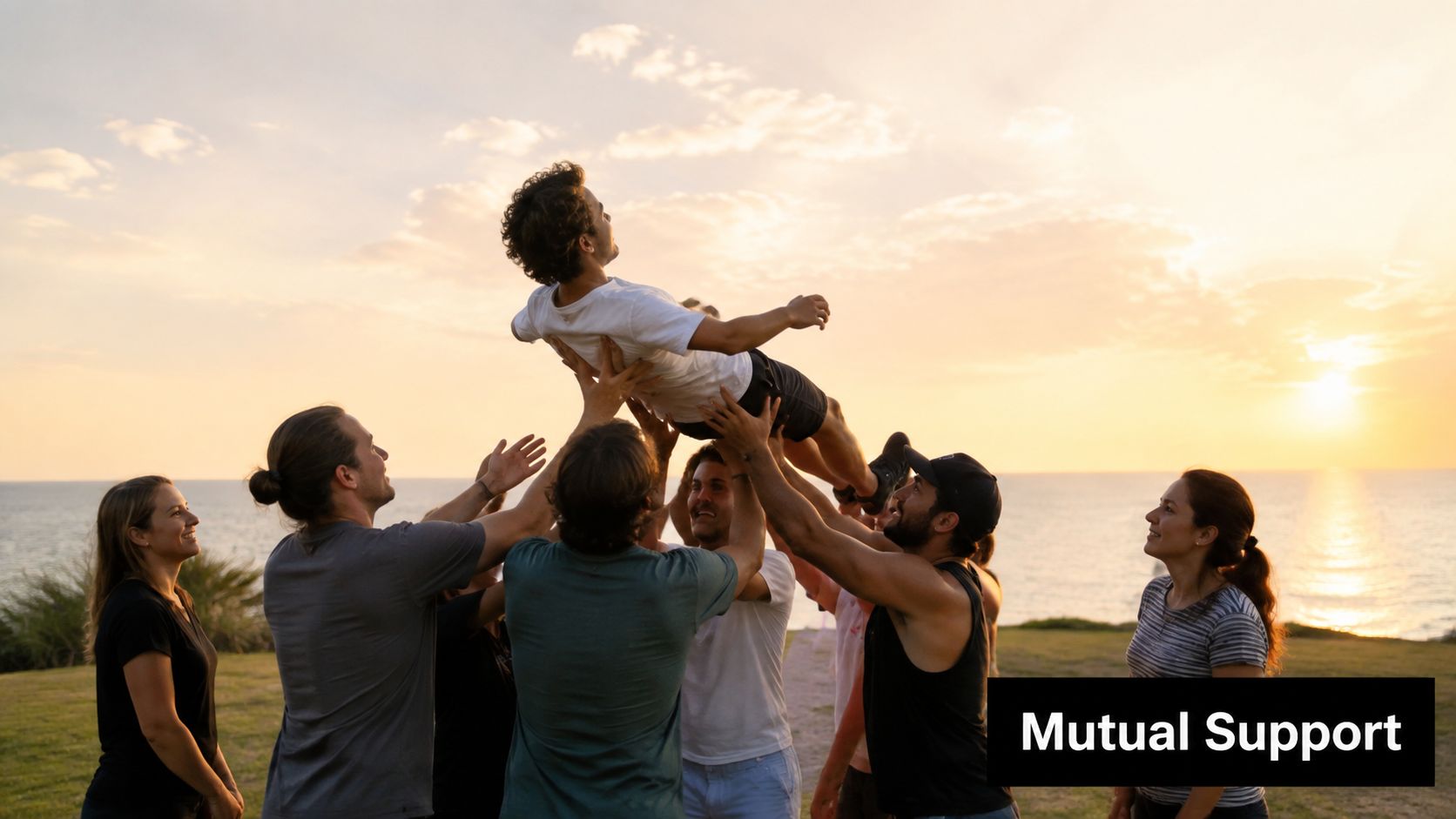
A trust fall is direct, embodied, and potentially confronting. One participant leans backward while others support and catch them, placing the faller in a position of controlled vulnerability while spotters practice attentiveness, responsibility, and coordinated care. The exercise develops reliance, but only when participants understand that consent matters more than spectacle.
It works best after a lower-pressure social activity, particularly for an intimate group of 8 to 14 guests, such as a small team rebuilding connection after conflict, a wedding party meeting across family circles, or friends reconnecting after a stressful period. The setting can add ceremony. A beachfront area at sunset or a jungle-facing space near one of VIVARA's villas may help the exercise feel intentional rather than like an improvised party game.
Make participation genuinely optional
Screen for spinal, joint, balance, and anxiety concerns before the exercise. A trained facilitator should demonstrate the catch, explain body positioning, establish a clear stop signal, and offer alternatives such as supported leaning, a seated version, or observation. Watching closely and reflecting can be meaningful participation. No guest should need to justify opting out.
Frame the activity as reciprocal reliance, not a test of courage. That distinction prevents the group from rewarding bravado or treating hesitation as failure.
Practical rule: Never use a trust fall to force intimacy. Use it to explore how people ask for support, provide support, and respond when control changes hands.
The debrief carries much of the value. Ask what participants noticed about resistance, communication, and responsibility. A corporate group might connect the experience to delegation and escalation. Couples might discuss where one partner tends to carry too much control. The activity is powerful, but it isn't universally appropriate, and a thoughtful facilitator must treat that limitation as part of the design.
2. The Marshmallow Challenge and Collaborative Build
The Marshmallow Challenge develops trust through collaboration, experimentation, and shared problem-solving, rather than physical vulnerability. Small groups build the tallest freestanding structure they can from simple materials, with a marshmallow placed at the top. The structure's success is visible, immediate, and easy to discuss.
That makes it a strong option for entrepreneurial teams, brand communities, and groups that are not ready for personal disclosure. A founder who tends to make every decision can see how quickly hierarchy narrows the solution space. A newly assembled team can notice who tests ideas, who protects a weaker proposal, and how the group responds when a design collapses.
Let the process reveal itself
Use materials that are easy to replace and safe to handle. Spaghetti, tape, string, and marshmallows create a familiar format, while bamboo sticks, local twine, or other responsibly sourced materials can connect the build to Costa Rica without removing the underlying challenge.
Before starting, invite participants to observe:
Decision-making: Who speaks first, and whose ideas receive attention?
Risk tolerance: Does the group test a small structure early or debate one plan?
Failure response: Do people blame, laugh, reset, or withdraw?
Role flexibility: Can someone who led the first idea support another person's approach?
The point isn't to crown the tallest tower. It's to make group behavior visible without attaching the lesson to a real workplace dispute. Host the activity in an open-air pavilion or beach-adjacent gathering space, then photograph each structure before it falls if everyone agrees.
A repeat session later in a longer retreat can reveal whether people now invite more voices, prototype sooner, or recover from failure more easily. Don't promise that a single build creates lasting psychological safety. Its value comes from the quality of the debrief and the behaviors the group carries into later conversations.
3. The Blindfolded Nature Walk and Sensory Attunement
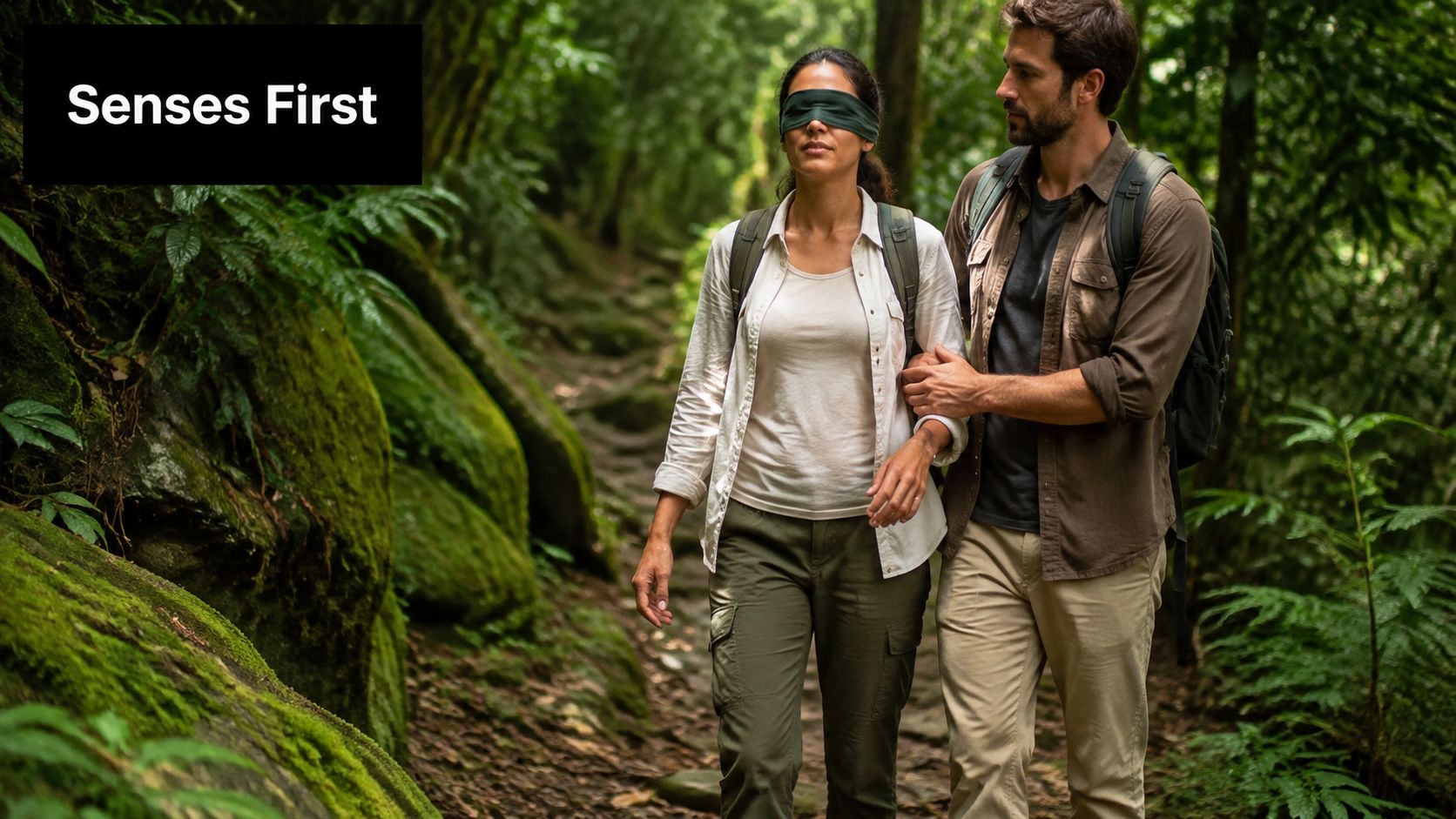
The blindfolded nature walk shifts trust from visual control to sensory attunement. In pairs, participants take turns being guided through a carefully scouted path using precise verbal direction, agreed touch, or both. The guide practices responsibility and clarity. The person being guided practices receiving information without trying to manage every detail.
Costa Rica's sound, scent, temperature, vegetation, coastline, and changing ground create a naturally layered environment for this exercise. A partner may describe soft earth, a change in slope, the sound of surf, or the scent of wet leaves. That detail is more useful than vague reassurance, and it gives the guided participant enough information to make an informed choice.
Build confidence before removing sight
Walk the route with eyes open first. On a later pass, participants can choose whether to use a blindfold, close their eyes, or narrow visual attention. Pairing shouldn't automatically follow romantic relationships. A couple may gain insight from the exercise, but strangers or colleagues can sometimes reveal communication patterns that familiar partners unconsciously accommodate.
Scout every section for roots, unstable surfaces, steep drops, insects, heat exposure, and emergency access. Include optional sensory stations, such as a place where the ocean can be heard clearly or a shaded area with distinctive plant aromas. When the blindfold comes off, a carefully chosen view can create a quiet moment of orientation without turning the experience into a reveal designed for applause.
Offer a silent integration period afterward. Tea, journaling, or a calm conversation without an agenda gives the nervous system time to settle. This is especially suitable for couples, teams recovering from communication breakdowns, and guests seeking a slower alternative to high-intensity adventure.
At VIVARA, a facilitator could use private jungle trails, beach access, and canyon views, provided the route is assessed for each group's mobility and comfort. Guests can also explore VIVARA's nature walks as part of a broader, nature-led retreat itinerary.
4. The Giving and Gratitude Circle
A gratitude circle builds appreciation through specific, witnessed recognition. Each participant offers a meaningful observation about another person, naming a behavior, contribution, or moment rather than delivering a general compliment. “You're kind” is pleasant but forgettable. “You stayed with me when I was overwhelmed and didn't rush to solve it” gives the recipient something concrete to receive.
This activity suits the closing phase of a retreat, when guests have enough shared context to make their appreciation credible. It can serve couples, families, small leadership teams, and brand communities that want to acknowledge the people who helped create a shared experience. In an intimate group, each person's presence has room to be noticed.
Protect sincerity
Explain the format before anyone speaks. Participants should know whether they're addressing one assigned person or choosing someone, how long they have, and whether written appreciation is available. A facilitator should model specificity and make it clear that people can pass.
A short written preparation period helps quieter guests. It also reduces the risk that the most articulate participant dominates the emotional tone. Keep contributions bounded so the circle remains generous rather than exhausting, while leaving room for pauses, tears, or laughter.
The facilitator should watch for hidden pressure. Appreciation must not become a disguised performance review, a popularity contest, or an opportunity to settle a grievance. If a family has unresolved conflict, private facilitation may be more appropriate than a public circle.
A sunset deck, central gathering space, or communal dinner can provide a fitting context at VIVARA. Provide water, tissues, comfortable seating, and a clear agreement about photographs. If participants want a lasting reminder, they can write messages in journals or on cards to take home. The most valuable artifact isn't a polished image. It's the experience of being seen accurately by people whose attention has mattered during the retreat.
5. The Fire Circle and Storytelling Ceremony
A fire circle builds storytelling, listening, and shared meaning when the group already has enough comfort for personal reflection. The fire slows conversation and gives everyone a common focal point. In Costa Rica, darkness, ocean air, or the sound of the jungle can create a distinct setting, but the environment should support the exchange rather than become a performance.
Choose prompts that match the group's trust level. A leadership team might discuss what brought it through a difficult transition. A family could reflect on a season of change. A creative group may name what it wants to protect or pursue. Stories do not need to be dramatic. Plain accounts of pressure, uncertainty, hope, or gratitude often create more connection than polished speeches.
Give the ritual a safe container
Explain the format before the fire is lit. A facilitator should acknowledge the cultural history of fire circles and avoid borrowing Indigenous or local ceremonial language as decoration. If local traditions are part of the experience, a qualified local guide should frame them respectfully.
Set clear agreements:
Confidentiality: Personal stories stay within the group.
Right to pass: Nobody owes a disclosure.
No fixing: Listeners do not rush to advise, diagnose, or compare.
Shared airtime: A talking piece can support turn-taking.
Careful pacing: Silence is welcome and does not need to be filled.
Prompts such as “What brought you here?”, “What is alive for you now?”, and “What shifted during this retreat?” provide direction without demanding a particular level of vulnerability. Keep shares proportionate to the group's size and energy. Blankets, cushions, tea, water, and a quiet place to step away help participants regulate if emotion rises.
At VIVARA, an oceanfront fire pit or jungle-facing gathering space may suit this practice, subject to local fire-safety requirements, weather, wind, and environmental care. A thoughtfully framed spiritual retreat in Costa Rica can use the setting for reflection while keeping the focus on consent and genuine attention. Confirm whether fire is permitted, assign a facilitator to monitor conditions, and agree in advance about photographs. The activity fits couples, families, small teams, and brand communities when participants can choose their level of disclosure.

6. The Partner Interview and Reciprocal Discovery
The partner interview develops listening by giving each person equal time, clear prompts, and a defined responsibility. Instead of hoping meaningful conversation emerges over dinner, pairs take turns asking and answering questions that move from accessible background to personal priorities.
A useful sequence might begin with origin stories, move toward a current challenge, and end with a question such as, “What do you need right now?” The interviewer's task isn't to fix, advise, compare, or tell a better story. It's to understand the person in front of them.
This format works especially well at the beginning of a retreat, when participants don't yet know how much disclosure is welcome. It also helps mixed-status groups, where hierarchy can make informal conversation uneven. A senior executive and a newer team member receive the same invitation to speak and the same obligation to listen.
Design for consent and equal voice
Give participants the prompts in advance. People should be able to skip any question without explaining why, and facilitators should avoid language that treats deeper disclosure as a higher achievement. Written prompts can make the experience feel prepared and nourishing rather than clinical.
Rotate pairings across retreat days if the group wants broader connection. Later activities can draw on what participants discovered, but facilitators must not expose private details without permission. An optional group reflection can ask what surprised people about the process, not what their partners revealed.
Host interviews in private but scenic spaces, such as an open pavilion, oceanfront seating area, or shaded jungle lounge. Tea and a small snack help create a sense of care. For couples, the interview can uncover needs that routine conversation skips. For families, it can let younger and older generations speak without interruption. For brands building community, it offers a practical reminder that genuine belonging starts with curiosity, not messaging.
7. The Group Challenge and Shared Adventure
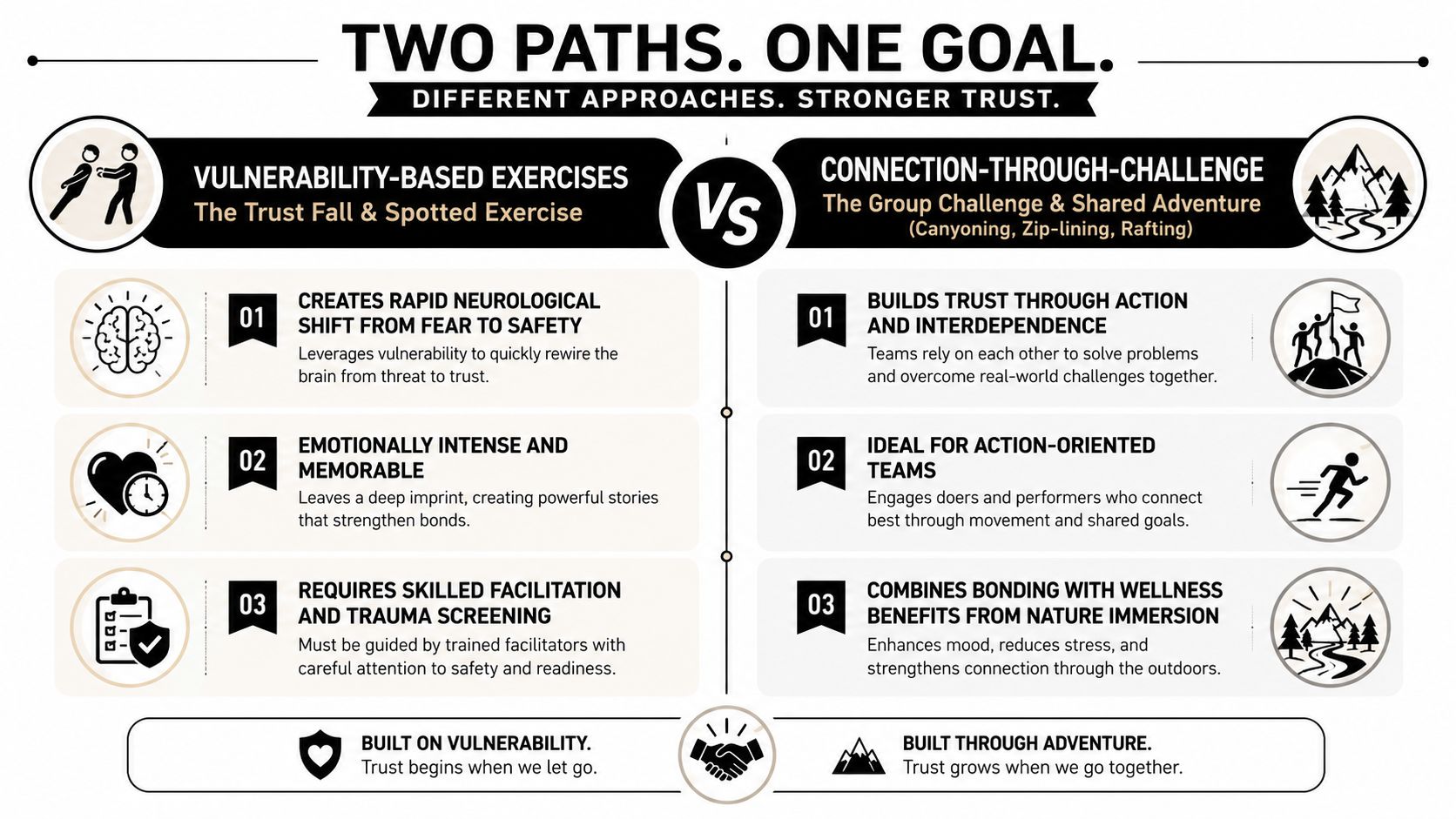
Shared adventure develops functional trust through reliance and coordinated action. Canyoning, zip-lining, rafting, horseback riding, and demanding coastal or jungle routes ask participants to communicate under moderate stress, follow safety systems, notice limits, and make decisions around one purpose.
This format suits action-oriented teams and friend groups who connect more readily through doing than formal vulnerability. Someone who resists a storytelling circle may participate fully while checking equipment, encouraging a nervous companion, or responding to a changing route. The task gives trust a practical setting.
Match intensity to the people, not the brochure
Offer genuine choice. Beginner, intermediate, and lower-intensity options let guests choose without shame. Before starting, the guide should explain physical demands, equipment, weather contingencies, communication signals, and the emotional experience. Technical skill matters, but clear consent and a credible exit plan matter just as much.
Costa Rica's marine activities require careful operator evaluation. Swimming or diving with cetaceans is prohibited. Boats may approach dolphins within 50 meters under specified conditions, and whales larger than 5 meters within 200 meters when feeding or socializing. In the observation area, speed is limited to 4 knots, only two boats may remain near the same group, and viewing time is capped at 30 minutes, according to Costa Rica's cetacean-observation regulations summarized by Ballena Jorobada Tours. Following these rules shows whether an operator treats wildlife, guests, and local standards seriously.
A shared challenge should test coordination, not a guest's willingness to ignore their own limits.
Debrief while details are fresh. Ask who communicated clearly, how the group handled fear or fatigue, and whether quieter participants had room to contribute. Pair the activity with journaling, dinner, or a fire circle so the experience becomes useful insight rather than a separate excursion.
For couples, the challenge can reveal how each person offers and receives support. Small teams can examine decision-making and role flexibility. Families may need shorter routes and more predictable conditions. Brands building community should choose an experience that reflects their values without turning participation into a performance.
VIVARA guests can consider adventure partnerships including whale watching, horseback riding, paragliding, and zip-lining in Costa Rica. The operator conversation should include environmental care, fair treatment of guides, and respect for local communities.
8. The Collaborative Art and Creative Expression Project
Collaborative art develops creative co-ownership. A group might paint a large canvas, compose music, create a sculpture, choreograph a short movement piece, or write a shared statement about the retreat's purpose. Unlike a tower-building challenge, the result doesn't need a single correct answer. Participants must negotiate taste, authorship, space, and meaning.
That makes the activity useful for creative teams, wellness professionals, entrepreneurs, families, and brands trying to define a community identity. Creative work exposes ideas before they're polished. A participant has to offer something personal, listen when the group reshapes it, and accept that the final piece will belong to everyone.
Make the artifact less important than the process
Start with a brief individual prompt before moving into the group project. Guests might sketch a place that helps them reset, write a word connected to belonging, or choose a texture that represents the retreat. The facilitator can then help the group identify patterns without declaring one person's interpretation correct.
Choose materials that suit the setting and the group's abilities. Natural pigments, responsibly sourced fibers, clay, found sounds, or recycled materials can connect the project to Costa Rica while avoiding careless removal of natural objects. A professional artist or local maker can guide technique, but shouldn't take over the group's decisions.
For a brand, the final work might become an internal installation or a community story, but participants should agree before it's photographed, published, or used in marketing. Consumers can recognize the difference between a shared creative experience and a branded activation that extracts content from guests.
The project works best after participants have built some familiarity, yet before the final appreciation ritual. It gives a multi-generational family several ways to contribute, including drawing, collecting ideas, observing, making music, or documenting. A finished piece can travel home with the group, but its deeper value lies in the decisions made together and the permission each person received to shape the result.
8-Activity Trust-Building Comparison
Activity | Implementation complexity 🔄 | Resource requirements ⚡ | Expected outcomes 📊 | Ideal use cases | Key advantages ⭐ | Facilitator tips 💡 |
|---|---|---|---|---|---|---|
The Trust Fall & Spotted Exercise | Moderate–High 🔄: needs trained facilitators, screening, choreography | Low ⚡: minimal equipment but requires attentive spotters and medical screen | Rapid sensory trust shift; immediate proof of reciprocal support; high emotional arousal | Small intimate groups, leadership retreats, friend groups rebuilding connection | ⭐⭐⭐⭐: fast breakthroughs; memorable; tactile proof of support | Screen participants; demonstrate first; offer opt-out; debrief thoroughly |
The Marshmallow Challenge & Collaborative Build | Low 🔄: simple rules, needs strong debrief to surface learning | Low ⚡: common materials (spaghetti, tape), indoor/covered space | Visible measurable outcomes; reveals communication, hierarchy, iterative learning | Entrepreneurial teams, multidisciplinary groups, low-risk retreats | ⭐⭐⭐⭐: safe, playful, repeatable; sparks experimentation | Frame goals; mix teams intentionally; use local materials; debrief and repeat |
The Blindfolded Nature Walk & Sensory Attunement | Moderate 🔄: requires path scouting, consent, somatic facilitation | Low–Moderate ⚡: eye scarves, safe trails, time for slow pacing | Deep sensory attunement; calming parasympathetic response; embodied trust | Couples, burnout-recovery, teams needing communication repair | ⭐⭐⭐⭐⭐: profound vulnerability without physical risk; restorative | Scout routes; start eyes-open then blindfold; pair intentionally; integrate journaling |
The Giving & Gratitude Circle (Appreciation Ritual) | Low–Moderate 🔄: structure and timekeeping required | Minimal ⚡: seating, time, tissues; facilitator to hold space | Increased belonging; felt recognition; cultural shift toward appreciation | Closing ceremonies, multi-generational families, friend groups | ⭐⭐⭐⭐⭐: inclusive, accessible, strongly bonding | Set specificity rules; time limits; model first; allow written notes; provide comfort items |
The Fire Circle & Storytelling Ceremony | Moderate–High 🔄: fire safety, permits, skilled emotional holding | Moderate ⚡: outdoor fire pit, seating, safety gear, contingency plan | Deep narrative sharing; communal belonging; highly memorable ritual | Transformational retreats, groups processing change, ceremonial closings | ⭐⭐⭐⭐⭐: potent ritual container for authentic storytelling | Honor indigenous context; establish agreements; use talking piece; prepare for intensity |
The Partner Interview & Reciprocal Discovery | Low 🔄: highly structured and repeatable | Minimal ⚡: prompts, private/semi-private seating, timer | Fast-tracked intimacy; balanced voice; increased empathy | Mixed groups that don't know each other, mastermind cohorts, teams | ⭐⭐⭐⭐: efficient, scalable; fosters curiosity and listening | Use progressive prompts; allow passing; rotate partners; provide written prompts |
The Group Challenge & Shared Adventure (Canyoning, Zip‑Lining, Rafting) | High 🔄: complex logistics, safety protocols, guide training | High ⚡: specialized gear, certified guides, permits, transport | Trust via functional interdependence; shared achievement; vivid memories | Action-oriented teams, adventure-focused retreats, groups bonding through challenge | ⭐⭐⭐⭐⭐: real-world reliance; strong bonding through achievement | Match intensity to group; ensure guides with group-dynamics skills; debrief; minimize environmental impact |
Collaborative Art & Creative Expression Project | Moderate 🔄: design facilitation required to manage creative process | Moderate ⚡: art materials, space, time, documentation | Collective meaning-making; tangible artifact; emotional expression and negotiation | Creative teams, wellness professionals, retreats seeking legacy artifacts | ⭐⭐⭐⭐: produces lasting symbol of cohesion; fosters creativity and shared authorship | Clarify purpose; allow multiple media; document the piece; hold reflective debrief |
Choose the Trust Practice That Fits the Group
The best trust building activities aren't necessarily the most dramatic. Choose according to the behavior you want to practice. Reliance calls for a carefully facilitated trust fall or a supported sensory exercise. Collaboration points toward the Marshmallow Challenge or a creative build. Listening benefits from partner interviews, while storytelling and integration belong later in the retreat, when the group has enough shared experience to make reflection feel grounded.
Intensity also matters. A trust fall and canyoning require more physical screening and clearer alternatives than a gratitude circle or partner interview. Shared adventure needs technically qualified guides, weather planning, equipment checks, and accessible options. Storytelling and appreciation need emotional containment, confidentiality, a right to pass, and facilitators who can sit comfortably with silence. Creative work needs materials, space, and permission for disagreement without turning every choice into a contest.
Group type should guide the sequence:
Couples: Begin with reciprocal discovery, add sensory attunement, and close with appreciation. These activities create space for curiosity without forcing a public disclosure.
Action-oriented teams: Start with a collaborative build, then introduce a shared adventure and debrief. Add storytelling only if the group has shown it can listen without fixing or performing.
Multi-generational families: Use partner interviews, flexible sensory activities, communal food, and collaborative art. Avoid treating physical intensity as proof of commitment.
Small teams and leadership groups: Combine a low-risk build with structured listening, then connect the debrief to real patterns around decision-making, delegation, and repair.
Brands building community: Design shared experiences around a genuine purpose. Food, local culture, nature, hospitality, and the brand's values should reinforce one another rather than turn guests into content.
A multi-day boutique retreat should have a progression, not a crowded schedule. Begin with a partner interview or low-risk collaborative build. Add sensory work or shared adventure after consent and familiarity have developed. Reserve the fire circle and gratitude ritual for processing, recognition, and closure. Repeated behaviors matter more than a single memorable exercise. A recent practitioner review emphasizes vulnerability, authenticity, reciprocal communication, responsiveness, co-learning, empathy, and quick wins as recurring foundations, while ranking purely fun formats such as trivia and escape rooms lower for lasting impact in its trust-building guidance.
Measurement can stay simple. A short trust pulse can ask participants to rate competence, concern for others, and commitment-keeping on a 1 to 5 Likert scale, using the structured trust survey format. Run it before and after the retreat, then use 30-, 60-, and 90-day follow-ups to test whether the group's new behaviors persist. A 2024 team intervention study reported attendance across trust-focused modules ranging from 69% to 94%, as summarized by Team Trust Survey. Participation is encouraging, but it isn't proof of lasting change. Follow-through is.
Costa Rica can make the experience feel restorative as well as purposeful. Wellness tourism reached $1 trillion in 2024 and grew 36% from 2020 to 2024, while 819.4 million domestic and international wellness trips were recorded in 2022, according to a summary of the Global Wellness Economy Monitor. Those figures describe a competitive category, not a guarantee of value. Compare retreats by group size, privacy, facilitation, inclusions, food, accessibility, local partnerships, and the amount of unscheduled time.
For nature-focused travelers, conservation credibility should receive the same attention as design. Tortuguero National Park is described as covering 31,187 hectares on land and 50,100 hectares in marine areas, and its nesting beaches support four sea turtle species classified as endangered or critically endangered in the conservation overview. A Costa Rica turtle-tourism case study estimated $6,714,483 in gross revenues in 2002 through lodging, transportation, souvenirs, park fees, and guided tours, showing how tourism can support conservation and local livelihoods through the documented Tortuguero example. Ask operators how their experiences benefit communities and ecosystems, rather than accepting broad claims about giving back.
Before booking, define the group's trust objective, choose two or three complementary activities, confirm safety and accessibility requirements, and compare intimate Costa Rica options by ideal duration, inclusions, and budget. VIVARA's up-to-14-guest format, customized experiences, chef-led dining, and stated regenerative commitments may suit couples, families, teams, and brands that want connection embedded into the whole stay rather than added as a single afternoon activity.
VIVARA offers intimate, founder-led stays in Dominical for up to 14 guests, with custom nature and adventure experiences, chef-led dining, and spaces designed for shared connection. Visit VIVARA to compare your group's trust objective, preferred retreat length, inclusions, and desired level of privacy.

