The Vivara Content Team
Restoration Retreat in Costa Rica: What to Expect
Restoration Retreat in Costa Rica: What to Expect

You land in Costa Rica thinking sleep will fix it. The flight was long, your inbox is worse than when you left, and your shoulders are still somewhere near your ears when the van door opens to humid air, jungle noise, and a view that's almost offensively beautiful. Then the familiar mistake shows up, you start treating beauty like medicine.
A beach chair, a nice dinner, and a spa appointment can help you feel better for an afternoon. They rarely touch the deeper problem, the kind of exhaustion that lives in your nervous system, not your calendar. That's why more travelers are looking for a restoration retreat, not another polished vacation with wellness branding on top.
When a Vacation Stops Being Enough
The arrival looks calm from the outside. Inside, it's usually a different story. Guests step out of the transfer van with airport stiffness in their backs, phones already lighting up with work messages, and a body that technically crossed a border but never left high alert.
The jungle helps, but it doesn't magically solve anything. Pacific surf rolls in, the air feels thick and warm, and yet the mind is still scanning for what's next. That's the telltale sign you're not just tired, you're overloaded.
The problem is usually the format, not the destination
Standard travel rewards motion. You book activities, chase meals, answer messages between excursions, and come home with good photos and the same fatigue. A week at an all-inclusive can be pleasant and still fail to restore you because it keeps feeding stimulation instead of reducing load.
Practical rule: if your trip depends on being entertained to feel good, it's probably not built for recovery.
The people who benefit most from a deliberately designed retreat are often the ones who've already tried the obvious fixes. They've done the spa day, the yoga class, the long weekend, and the “I just need a break” escape. What they need is a setting that changes how their body processes time, attention, and pressure.
That's the difference between scenery and restoration. One looks good on arrival. The other changes how you feel when you get home.
What a Restoration Retreat Actually Is
A restoration retreat is not a juice cleanse with nicer lighting. It's not a silent meditation boot camp, an Instagram wellness trip, or a spa vacation pretending to be something deeper. It is a deliberately designed environment for nervous-system recovery.
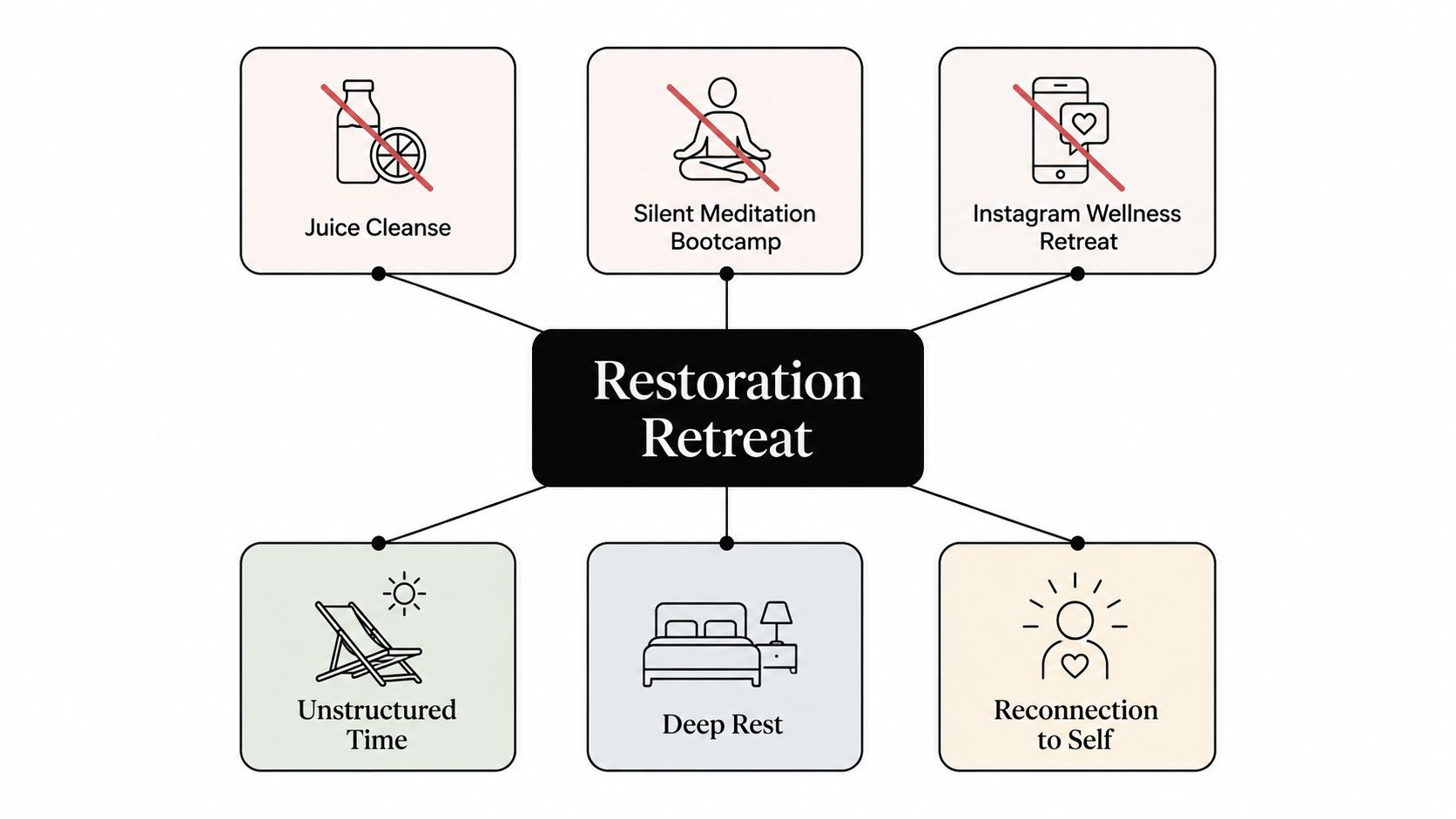
The version rests on four levers. First, a high dose of nature exposure, not just a pretty view from a balcony. Second, protected disconnection from work, alerts, and screen-based interruption. Third, structured rhythm, meaning meals, movement, and rest happen on purpose instead of drifting. Fourth, intentional social design, because some restoration happens alone and some settles in through low-pressure connection.
The evidence base points in the same direction. Spending at least two hours per week in nature is associated with higher self-reported good health and wellbeing, and broader nature-based intervention research links outdoor exposure to lower stress, anxiety, and psychological restoration. A retreat that really works doesn't leave nature to chance, it schedules it repeatedly across the stay, as noted in the RBG Victoria review of nature for health and wellbeing.
The same goes for disconnection. In a study of 268 attendees across 17 spiritual retreats, immediate restorative outcomes were predicted by relaxation and reflection, while sustained effects two weeks later were more tied to social activities. Disconnecting from information technology mattered for both immediate and lasting restoration, according to this retreat research from Bond University.
The clean definition is simple. A restoration retreat is a trip built to reduce mental noise, restore physical calm, and create enough structure for the body to reset without feeling managed.
Learn how healing-focused retreat design is handled at VIVARA
The Science Behind Real Restoration
Restoration is biological, not decorative. If the stay doesn't change the inputs, the body doesn't get the message. That's why the strongest retreat design works through repeated nature exposure, reduced digital stimulation, and a rhythm the guest can trust.
Nature works when it's repeated, not occasional
A single scenic moment is nice. It's not enough. The useful part of nature exposure is the dose, the steady contact with trees, water, light, and open space that gives the brain fewer threats to process and fewer decisions to make.
That's where Costa Rica has a real advantage. The natural setting does a lot of the work without forcing a program to overperform. Guests can walk, sit, watch, breathe, and feel their attention soften in a way that's much harder to manufacture in a city hotel. That's why the country fits this category so naturally, not because it's trendy, but because the environment itself supports recovery.
Disconnection changes the whole system
Phones keep the stress loop alive. Notifications, inboxes, and constant availability train the nervous system to stay on guard. A retreat that makes disconnection optional is only half-built.
The more effective version creates protected space where devices stay out of reach and attention gets a break from reactive switching. That isn't just about being offline. It's about letting sleep, reflection, and conversation happen without interruption.
Rhythm is the underrated lever
A lot of wellness travel feels loose in a way that's secretly exhausting. Too many choices, too much improvisation, too much pressure to “make the most” of the stay. Real restoration uses a different kind of luxury, predictability.
Meals on time. Quiet in the morning. Movement that doesn't feel like a performance. Social time that doesn't force participation.
That structure helps the body settle. It also makes the stay easier to sustain for guests who are burned out, not spiritually searching. A retreat can be beautiful and still be poorly designed. The difference is whether the design lowers cognitive load or adds to it.
See how nature-centered retreat experiences are framed in Costa Rica
Restoration Retreat vs Wellness Retreat vs Resort
The confusion is understandable because the labels overlap. They're not the same, and if you choose the wrong one, you'll leave disappointed.
Feature | Restoration Retreat | Wellness Retreat | Luxury Resort |
|---|---|---|---|
Core goal | Nervous-system recovery | Improve baseline health | Pleasure and variety |
Daily structure | Intentional rhythm, quiet, disconnection | Classes and treatments | Open-ended leisure |
Social energy | Small, controlled, low-pressure | Can vary by program | Often lively and social |
Food approach | Curated for nourishment | Often health-forward | Wide-ranging, indulgent |
Screen use | Protected disconnection | Usually encouraged to limit | Fully guest-controlled |
Main question | Recover | Optimize | Escape |
A wellness retreat usually centers on activities like yoga, spa treatments, and health-forward meals. That can be useful, but it's still activity-based. A restoration retreat is more exacting, because it's designed around what the body needs after too much pressure, not just what feels good in the moment.
A resort vacation aims at enjoyment. You can have a wonderful time at a resort and still come home exactly as tired as when you left. A digital detox fixes one input, screen exposure, but leaves the rest of life's noise in place.
The better self-check is blunt. Do you want to optimize, recover, or escape? If the honest answer is recover, you need a retreat architecture, not just a prettier itinerary.
The VIVARA Experience in Dominical
Dominical gives this kind of retreat the right conditions. The coastline is low-density, the jungle is close, and the whole place feels like it was built to slow the pace without deadening the day. At VIVARA, the setting matters because the design doesn't fight the environment, it uses it.
The arrival is intentionally quiet. Guests come into cliffside villas with the Pacific below, the green wall of the jungle behind, and the sort of dawn soundtrack only Costa Rica can pull off, howler monkeys, surf, birds, and wind through the trees. That's not decorative. It sets the tone for the whole stay.
The rhythm is what makes it restorative
A typical day works because it doesn't try to fill every hour. Breakfast happens slowly on the terrace, mornings can stay open, and guests aren't pushed into a packed schedule before they've had a chance to land. Afternoon nature immersion can be woven in, then dinner becomes a real meal rather than a production.
The kitchen approach matters here too. Food is treated as nourishment first, not theater. That's a better fit for burned-out guests than a menu designed to impress them into another kind of overstimulation.
What guests usually need most is less decision-making, not more options.
VIVARA's model also supports groups without making them perform being together. A small guest count preserves quiet. A full digital handoff on arrival helps the nervous system settle faster. The result is a stay that feels private, but not isolated, which is exactly where many couples, families, and leadership groups need to be.
Read what a stay at VIVARA feels like before you book
Sample Itineraries for Every Kind of Guest
A good retreat doesn't hand everyone the same schedule and call it personalized. It starts from the guest's real goal, then works backward.
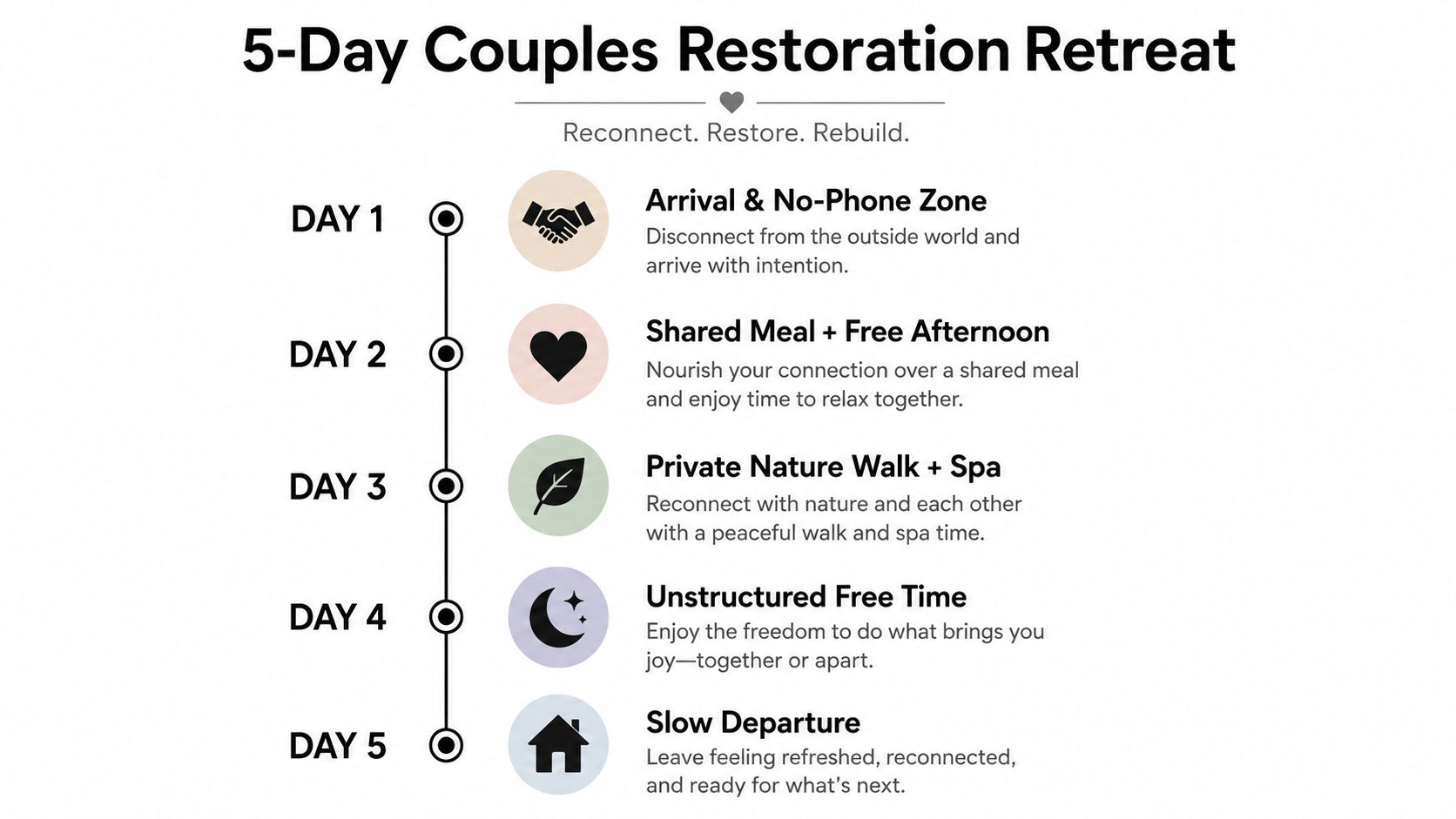
Couples who want privacy and reconnection
A 5-day couples itinerary should protect conversation, not crowd it. The best version leaves room for shared meals, quiet walks, and long pockets of unstructured time where nobody's trying to be “on.” Couples often come in thinking they need activities, then discover they mostly need uninterrupted space to talk and decompress.
Families who need both recovery and momentum
A 7-day family retreat works when the adults get recovery windows and the kids still have a good time. That usually means quieter mornings for parents, then afternoon excursions or nature-based outings that give children something memorable without turning the stay into a theme park. The schedule has to breathe, or everyone ends up irritated.
Teams and founders who need clarity
A 4-day team or leadership retreat should divide the day cleanly. Restorative mornings are for reset, movement, and reflection. Afternoons are for working sessions, alignment, and decision-making, because tired teams don't collaborate well no matter how nice the room is.
Milestone celebrations and buyouts
Anniversaries, weddings, and milestone birthdays need a different logic. Good planners don't start with a package, they start with the occasion. Buyout options, private meals, and custom pacing let the property support the event instead of forcing the event into a preset script.
That's the point of a real retreat team. They don't sell a fixed agenda. They design around the reason people came.
Pricing, Booking, and What Is Included
The cleanest way to compare retreat properties is to ask what's built into the rate. Some places look simpler on paper because they don't include much. Others look expensive because they include the things that matter.
Category | Typically Included | Commonly Upcharged |
|---|---|---|
Lodging | Private villa or room access | Premium villa upgrades |
Dining | House meals or chef-led meals | Alcohol pairings |
Programming | Curated experiences | Private boat charters |
Wellness support | Quiet spaces, guided rhythm | Spa sessions |
Special occasions | Basic planning support | Decor, photography, celebration add-ons |
Transport extras | Standard coordination | Private air charter or premium transfers |
Pricing usually shifts with villa type, guest count, and season. Private retreat economics are different for couples, families, and teams, so a headline rate without context doesn't tell you much.
Booking should feel structured, not vague. Ask about inquiry timing, hold deposits, payment milestones, cancellation windows, and how far ahead private buyouts are usually secured for busy seasons. If a property can't explain those clearly, that's a signal.
The most useful booking questions are practical. What meals are included, what changes at full buyout, which experiences are in-house, and which ones get billed separately. That's how you compare properties on value, not just on the first number you see.
Planning Tips and How to Choose the Right Fit
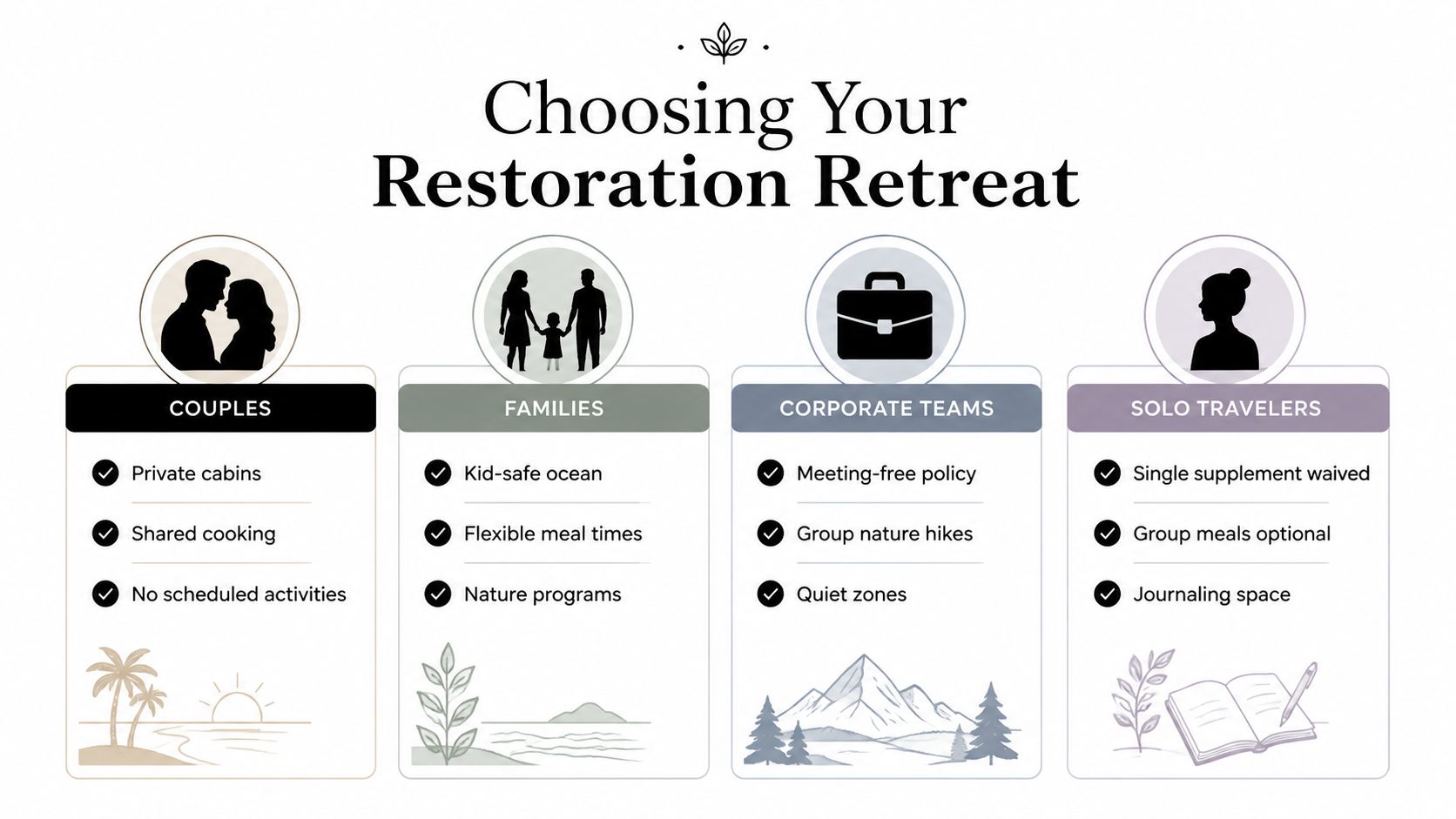
Choose the retreat that matches your actual life, not the one that sounds nicest in a brochure. Couples need privacy and pacing. Families need kid-safe water access, flexible meals, and enough room for everyone to stop pretending. Teams need meeting space that doesn't erase the restorative part. Event planners need coordination that can absorb moving parts without creating chaos.
Questions worth asking before you book
Staff-to-guest ratio: Who is available during the stay, and how responsive is the team when plans change?
Dietary handling: Can the kitchen adapt cleanly to allergies, preferences, and family needs without turning every meal into a negotiation?
Medical access: How does the property handle mobility concerns, urgent care, or simple things like getting someone to a clinic if needed?
Programming flexibility: What's fixed, what's optional, and what gets built around the group's energy?
Travel insurance isn't glamorous, but it's smart. Rainy-season tradeoffs matter too, especially for guests who want more outdoor time than indoor backup. Connectivity can also be a feature or a liability, depending on whether the goal is to unplug fully or stay lightly reachable.
The best next step is a direct conversation with the retreat team and a sample itinerary request. If the property listens well, answers cleanly, and designs backward from your goal, you're probably in the right place.
If you want a restoration retreat in Costa Rica that treats recovery as a design problem, not a slogan, start with VIVARA. It's built for intimate groups, custom pacing, and the kind of quiet, nature-rich stay that helps people reset. Visit VIVARA and ask for a sample stay that matches your trip, not a generic package.