The Vivara Content Team
Holistic Wellness Retreat: The Costa Rica Explainer
Holistic Wellness Retreat: The Costa Rica Explainer

Most advice about a genuine wellness retreat gets the decision wrong from the start. It tells you to scan for yoga, massage, healthy food, and a beautiful setting, as if a list of amenities proves anything. It doesn’t. A retreat can have all of that and still function like a polished vacation with wellness branding layered on top.
That distinction matters because this category is no niche anymore. The global healing and wellness retreat market was valued at US$ 295.8 billion in 2024 and is projected to reach US$ 622.7 billion by 2035, with projected 7.0% CAGR growth according to Transparency Market Research’s wellness retreat market analysis. As more properties enter the space, the gap widens between performative wellness and retreats that are designed to change how you feel, relate, rest, and live afterward.
Costa Rica makes that gap even more visible. This is a destination where nature can do real work in the experience. Jungle, ocean, biodiversity, fresh food, outdoor movement, and slower rhythms can support deep reset. But nature alone doesn’t create transformation. Good retreat design does. The right retreat uses Costa Rica as an active ingredient, not a backdrop.
If you’re comparing options for yourself, your partner, your family, or your team, the question isn’t “Which retreat looks best?” It’s “Which one creates a return that lasts beyond checkout?”
The Problem with 'Holistic Wellness'
The term 'integrated well-being' is one of the most overused terms in hospitality. In practice, it often means a hotel added a morning yoga class, renamed the smoothie menu, and photographed a candle next to a treatment table. That may still be pleasant. It just isn’t integrated care.
A true wellness retreat treats the guest as a whole system. Sleep affects mood. Food affects energy. Movement affects emotional regulation. Environment affects nervous system load. Community affects safety and openness. If the program ignores those links, it isn't comprehensive. It’s fragmented.
That’s why some guests leave a retreat saying they felt amazing for three days, then slid straight back into the same habits. The retreat delivered relief, not re-patterning. Relief has value, but it’s not the same as change.
Practical rule: If every guest gets the same schedule, the same intensity, and the same version of “wellness,” you’re looking at packaging, not personalization.
Costa Rica can expose this quickly. In a place with rainforest trails, ocean air, strong local food traditions, and easy access to adventure, weak retreat design becomes obvious. If the experience stays indoors, follows a rigid timetable, and treats nature as décor, the destination is being wasted.
The stronger question is this: does the retreat create conditions for lasting shifts in attention, energy, relationships, and daily practice? That’s the standard worth using. A beautiful room matters. So does a talented chef. But if the program never connects these pieces into a coherent experience, the wellness language is mostly marketing.
Here’s what usually doesn’t work:
Activity stacking: Packing the day with yoga, workshops, treatments, and excursions until guests feel managed instead of restored.
Food moralizing: Using restrictive language and rigid rules that create stress around eating rather than ease and nourishment.
Generic spirituality: Offering rituals with no context, no consent, and no sensitivity to the guest’s actual beliefs or comfort.
Luxury without substance: Beautiful architecture, weak facilitation, and no thought given to what happens after guests go home.
The best retreats feel simpler than the brochures. They know what outcome they’re trying to support, and every part of the stay serves that outcome.
The Four Pillars of a True Costa Rican Retreat
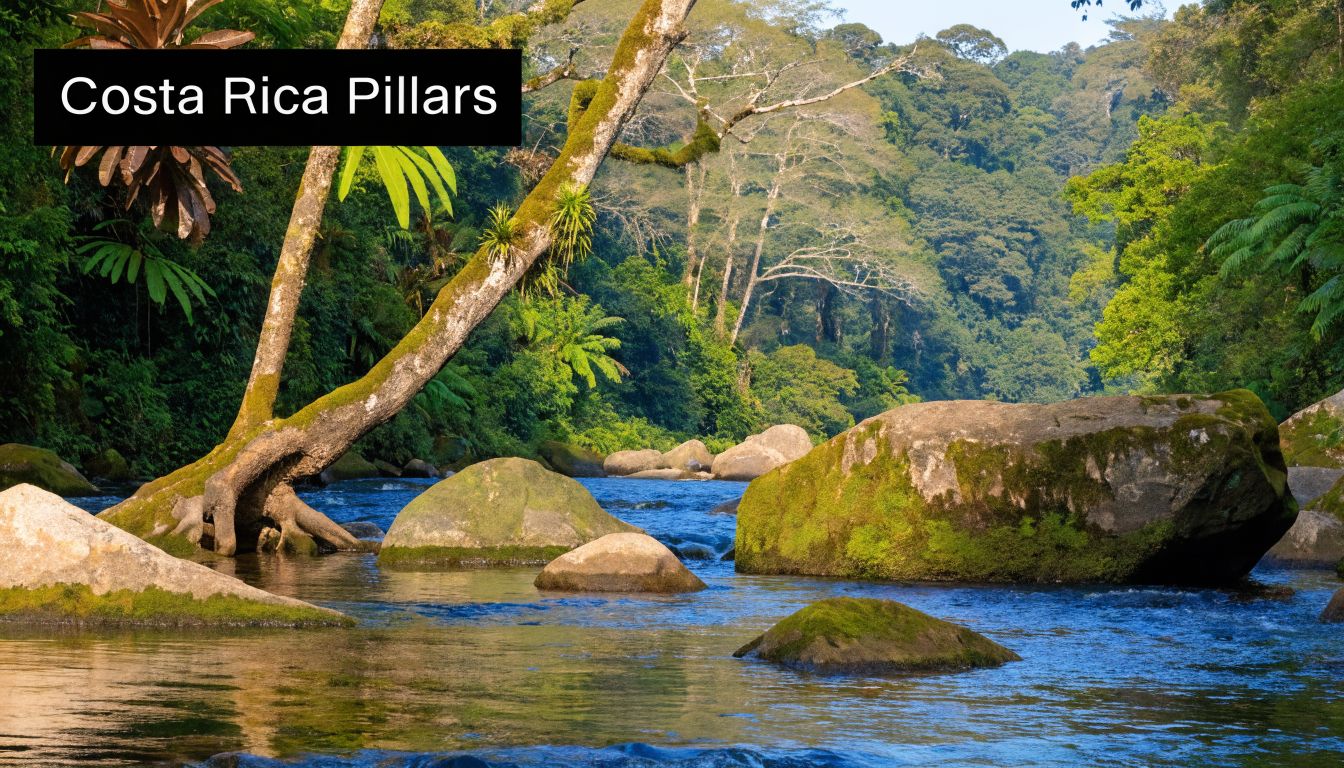
A meaningful retreat in Costa Rica usually stands on four connected pillars. Not every program will label them this way, but when the design is strong, you can feel each one at work. The retreat supports the mind, cares for the body, opens space for spirit, and uses the environment as part of the experience rather than a scenic extra.
A controlled trial of a 6-day integrative retreat found significant immediate increases in spirituality and gratitude, with gains sustained at follow-up alongside increased self-compassion and reduced anxiety, according to the NIH-published retreat study. That matters because it points to something many guests sense but struggle to name. Integrated retreat design can create measurable effects beyond simple relaxation.
Mind needs structure not just silence
Mental recovery isn’t just “doing less.” Many high-functioning guests arrive with overstimulated attention, fractured routines, and very low tolerance for stillness. Telling them to relax rarely works.
A better retreat builds mental downshift through sequence. That can include guided meditation, breathwork, journaling, quiet mornings before conversation starts, and thoughtful digital boundaries. It also means allowing enough unstructured time for insights to settle.
Costa Rica supports this well because the environment already shifts sensory input. Birdsong, moving water, ocean horizons, and open-air living can lower noise. But the retreat still has to frame those elements properly. A silent walk with intention will usually do more than a crowded “mindfulness activity” that feels obligatory.
For travelers weighing nature-rich options, this guide to wellness in nature in Costa Rica is useful because it highlights how place can support regulation when the experience is designed well.
Body responds to rhythm not punishment
The body doesn’t restore under pressure. Retreats that treat wellness like a performance challenge often miss the point. Guests don’t need to “earn” rest through punishing workouts or detox language.
The stronger model uses rhythm: movement, nourishment, hydration, sleep, and recovery in balance. In Costa Rica, that might look like mobility work before a guided hike, fresh meals built around local produce and seafood, time to rest in shade after heat exposure, and evening wind-down practices that support deep sleep.
A good sign is when the culinary side and movement side speak the same language. The chef understands energy and digestion. The fitness or yoga lead understands recovery, not just output. The day feels coherent.
Spirit grows through meaning and connection
“Spirit” doesn’t have to mean anything esoteric. In retreat work, it usually means your sense of connection. Connection to yourself, to the people you came with, to purpose, to gratitude, and to something outside your usual pace of life.
Intimate group size matters. Smaller retreats create room for honest conversation, real privacy, and facilitation that can adjust to mood and readiness. Large groups can still be enjoyable, but they often default to broad programming that keeps things surface level.
A retreat becomes memorable when guests stop performing competence and start feeling present.
In Costa Rica, this can happen through shared meals, open-air conversations after an excursion, a private dinner after a day of adventure, or enough quiet for a guest to hear their own thinking again.
A visual sense of how Costa Rica supports this blend of movement, stillness, and natural immersion helps here:
Environment is part of the intervention
Many properties talk about sustainability and natural beauty. Fewer use the environment intelligently. In a true holistic wellness retreat, the environment changes behavior.
Here’s what that looks like in practice:
Element | Weak version | Strong version |
|---|---|---|
Nature access | Nice view from the room | Guided, intentional immersion outdoors |
Design | Stylish but disconnected spaces | Architecture that encourages rest, airflow, privacy, and gathering |
Food sourcing | Generic healthy menu | Seasonal, local, place-specific cuisine |
Pacing | Same rhythm as city life | Schedule shaped around light, weather, and energy |
Costa Rica rewards this approach because the setting is so alive. Humidity, light, sound, terrain, and biodiversity all affect how people move and feel. A retreat that works with those conditions will always outperform one that imports a generic luxury formula into the jungle.
How to Evaluate Retreat Programming and Staff
The global wellness retreat market is projected to reach $363.9 billion by 2032, with growth driven in part by personalized fitness and stronger demand for mental wellness and mindfulness retreats, according to this wellness retreat industry outlook. That growth has improved choice, but it has also made comparison harder. Plenty of retreats now use the right language. Fewer deliver the right structure.
When I evaluate a retreat, I look at three things first: how the program adapts, who is leading it, and whether the place itself reduces friction or creates it.
Programming should adapt to people
A rigid schedule is often sold as premium because it looks organized. But wellness isn’t a conference agenda. The best programs have a clear framework with room to respond to energy, weather, group chemistry, and personal goals.
Ask direct questions before booking:
How personalized is the experience? Can meals, movement, downtime, and excursions be adjusted for different needs?
What happens if I want less? Some guests need challenge. Others need recovery. Good design can hold both.
Is there any intake process? If no one asks about sleep, stress, injuries, preferences, or goals, don’t expect a customized stay.
How much unscheduled time is there? Empty space isn’t a flaw. It’s where the retreat often starts working.
A useful comparison is this. If the retreat feels built for operational convenience, it will center the property. If it feels built for outcomes, it will center the guest.
For a concrete benchmark of what a thoughtfully hosted stay can include, review a detailed what to expect at a Costa Rica retreat stay. Even if you book elsewhere, that level of clarity is what you want.
Staff quality shows up in the details
The people shape the retreat more than the facilities do. A gorgeous property can’t rescue weak facilitation. On the other hand, excellent staff can enhance a simple setting by making guests feel safe, seen, and well-guided.
Look beyond titles. “Certified” can mean a lot or very little depending on the field. What matters is whether the team can connect expertise across disciplines.
Here are signs the staff is strong:
Facilitators know when not to push. They can read the room and adjust intensity.
Chefs understand context. They don’t just produce healthy-looking plates. They support the rhythm of the day.
Guides know place, not just route. In Costa Rica, that means ecology, conditions, pacing, and guest comfort.
Hospitality staff communicate cleanly. You shouldn’t have to chase basic answers around transport, timing, dietary needs, or privacy.
What works: A retreat team that collaborates behind the scenes so the guest experiences one coherent flow.
What doesn’t work is a stack of outsourced specialists who never align. One person is running breathwork, another is leading surf, someone else is cooking, and no one is thinking about the whole arc of the guest experience.
The setting should lower friction
Retreat settings aren’t neutral. Layout, noise, access, and privacy all affect whether the stay feels grounding or draining.
Use this quick screen:
Question | Good sign | Red flag |
|---|---|---|
Can you be alone easily? | Private nooks, quiet rooms, natural separation | Constant communal exposure |
Can groups connect comfortably? | Shared spaces that invite gathering without forcing it | Beautiful spaces that don’t function |
Does the setting support sleep? | Airflow, darkness, calm evenings | Noise, heat mismanagement, late-night activity |
Does nature feel integrated? | Easy movement between indoors and outdoors | Scenery admired from a distance only |
Costa Rica retreats vary widely on this point. Some are designed around ease, while others look impressive online but require guests to work around the property all week. That isn’t restorative. The best places remove small frictions so guests can use their attention for the experience itself.
Sample Retreat Itineraries for Every Traveler
A retreat becomes easier to judge when you can picture the day. Not the brochure day. The lived experience. How the morning starts, how transitions feel, whether there’s enough privacy, whether meals energize or interrupt, whether the activities fit the people there.
That matters even more because the market now includes a wider mix of travelers. A 2025 Skift Research survey found that 42% of wellness travelers are families or multi-generational groups, up 18% since 2024, while less than 10% of retreats offer child-inclusive comprehensive programs, according to Travel Noire’s reporting on wellness retreat demand. Many retreats still design mainly for solo adults and couples, then try to stretch the concept to everyone else.
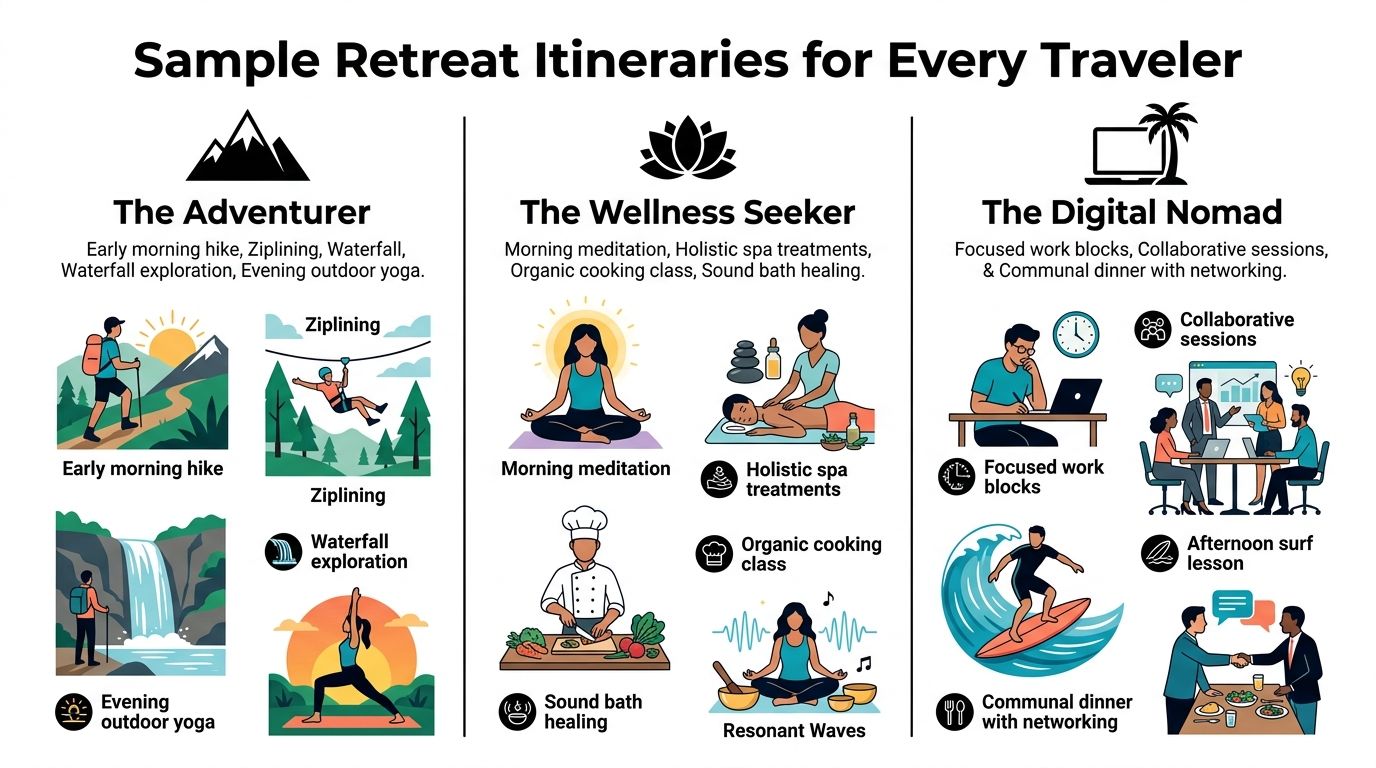
For couples who want reconnection not just romance
The best couples retreat doesn’t overload the relationship with forced intimacy exercises or nonstop activity. It creates the conditions for ease. That usually means a slower morning, good food, one meaningful shared experience, and enough privacy that conversation can happen naturally.
A strong Costa Rica day for a couple might look like this:
Morning: Coffee in silence, a light mobility or breathwork session, then breakfast with fresh fruit, eggs, local coffee, and time to linger.
Midday: A guided waterfall walk or ocean outing with a pace that allows both movement and awe.
Afternoon: Downtime. Separate massages, a nap, reading, or being off phones.
Evening: Sunset on the water or an outdoor dinner with food shaped to the couple rather than a preset menu.
The key trade-off is this: couples often think they want “more activities” because they don’t want to waste the trip. In practice, too much scheduling can crowd out the exact reconnection they came for.
For families who want shared memory without chaos
Family wellness programming fails when it copies adult retreat structure and expects children or grandparents to fit into it. It works when the day has both overlap and optionality.
A good multi-gen itinerary in Costa Rica often blends soft adventure with low-pressure ritual:
Time of day | Example experience | Why it works |
|---|---|---|
Morning | Easy nature walk with wildlife spotting | Shared attention across ages |
Late morning | Open breakfast followed by pool or rest time | No rush, no forced schedule |
Afternoon | Cooking class, chocolate workshop, or animal visit | Interactive and memorable |
Evening | Family-style dinner, stories, stargazing | Calm closure without overstimulation |
Intimate properties often outperform larger resorts in accommodating diverse family needs. Families need room to gather, but they also need room to retreat. Grandparents may want quiet. Teenagers may want movement. Parents may want one hour alone. The retreat should absorb those different rhythms rather than turning them into logistical stress.
Family-friendly wellness isn’t about adding a kids’ menu and calling it inclusive. It’s about designing shared experiences that don’t collapse under different ages and energy levels.
For teams and brands that want a real reset
A team retreat with wellness elements should not feel like a corporate offsite with yoga inserted into the margins. If the work goal is better thinking, stronger trust, or deeper community, the program has to support those outcomes directly.
That usually means fewer slide decks and more carefully chosen experiences. In Costa Rica, the environment helps because teams leave their default roles faster outdoors than they do in a meeting room. Shared challenge, physical movement, and open-air conversation can change group dynamics quickly when handled well.
A practical day might look like this:
Early focus block with clear intention, not endless presentations.
Facilitated discussion on decision-making, culture, or creative direction.
Adventure session such as canyoning, hiking, or a boat excursion that changes the energy of the group.
Long meal where the team has time to talk without performing.
Evening reset with breathwork, sound, or an early night.
This format also works well for founders, creators, and brands that want to build community with clients or collaborators. A retreat can become a powerful environment for relationship-building because people spend time together in a more human rhythm.
What doesn’t work is trying to maximize every hour. Teams don’t need compression. They need sequence, space, and enough care in the design that insight can turn into actual trust.
Decoding Value Regenerative Impact and Return on Experience
Many individuals compare retreat pricing too narrowly. They ask what it costs, then compare room categories, meal counts, and whether airport transfers are included. That’s sensible, but incomplete. For an all-encompassing well-being retreat, the more important question is what the stay changes and what kind of place your money supports.
Price matters but structure matters more
Transparent pricing is a quality signal. If a retreat makes it hard to understand what’s included, expect friction later. Good operators state clearly whether the rate covers meals, facilitation, private experiences, transport, wellness sessions, taxes, gratuities, or buyout privileges.
That’s especially important in Costa Rica, where the quality gap between “luxury-looking” and well-run can be large. One property may seem less expensive until you add private transfers, excursions, specialty meals, and the quiet premium of having space that fits your group.
Here’s a smarter way to compare value:
Look at inclusions in terms of energy, not just line items. Does the stay remove decision fatigue?
Look at group fit. A place that is perfect for a couple may fail for a family or team.
Look at pacing. Too many add-ons can make an expensive trip feel oddly stressful.
Look at follow-through. Are the services coordinated, or are you assembling your own retreat from separate vendors?
Regenerative impact is a quality signal
A retreat’s relationship to place tells you a lot about its integrity. Properties that pay living wages, support conservation, source thoughtfully, and respect local ecosystems usually operate with more depth across the guest experience too.
That doesn’t mean every retreat needs to use the same language around sustainability. It does mean the place should be able to answer basic questions. Who benefits locally from guest spending? How is the property reducing harm? Is the experience extractive, or does it contribute to the community and natural surroundings that make it desirable in the first place?
In Costa Rica, this matters because nature is a core part of the product. If a retreat profits from rainforest, coastline, wildlife, and local culture without participating in their protection, that’s not a small detail. It’s a design flaw.
For a thoughtful perspective on evaluating retreat value through both relationship-building and longer-term business or community outcomes, this piece on real-world retreat ROI and loyalty is worth reading.
Return on experience should outlast the trip
Very few retreats track long-term outcomes well. But available data suggests that format matters. According to BookRetreats coverage of wellness retreat outcomes, participants in adventure-integrated programs that combine nature immersion and mindfulness show 35% higher adherence rates to new habits, and intensive nature hybrids can outperform spa-only retreats by 28% in sustained cortisol reduction.
That lines up with what experienced retreat designers see on the ground. Passive pampering can help someone feel better briefly. But when a retreat combines movement, nature, reflection, food, rest, and meaningful social context, guests are more likely to take something home with them.
Don’t ask only whether the retreat was enjoyable. Ask what it makes easier afterward. Better sleep, cleaner focus, stronger connection, or a habit you can keep.
That is the true return on experience. Not a vague promise of transformation, but a stay structured well enough that some part of your life works better because you went.
Your Costa Rica Retreat Planning Checklist
The best retreat choice is rarely the one with the longest amenity list. It’s the one that matches your actual intention. A romantic reset needs different design than a family gathering, a founder offsite, or a personal recovery week. Costa Rica gives you exceptional raw material. The planning work is making sure the retreat uses that material well.
Before you book
Use this short filter:
Define the outcome first. Do you want rest, reconnection, creativity, family time, or a team reset?
Match trip length to goal. A short stay can refresh. Deeper shifts usually need enough time to arrive, settle, and integrate.
Ask how the property handles customization. Especially if your group spans different ages, fitness levels, or dietary needs.
Review the daily rhythm. If the sample schedule feels crowded on paper, it will feel more crowded in person.
What to pack and what to leave behind
Costa Rica retreat packing should support ease, not style performance.
Bring:
Light layers: Mornings, rain, sun, and air-conditioned transfers can all vary.
Good sandals and one real walking shoe: Many guests underpack for terrain.
Swimwear and sun protection: Ocean, waterfalls, boats, and outdoor recovery time are often part of the week.
A notebook: Useful for reflection, planning, and capturing insights away from your phone.
Leave behind:
An overfilled wardrobe: You’ll wear less than you think.
Work clutter you “might need”: If you must work, define the window. Don’t let work colonize the whole retreat.
Rigid expectations: Weather shifts. Energy shifts. The best retreat experiences often improve when the guest allows some flexibility.
How to make the retreat land well
Tell the host what matters before you arrive. Share the practical things, such as food needs, injuries, sleep concerns, and transport questions. Share the softer things too. Maybe you want privacy. Maybe you want your family to reconnect. Maybe your team needs room to think, not more activity.
A good retreat team can only personalize what it understands.
One final test helps. If the retreat mainly sells image, you’ll leave with photos. If it sells fit, care, and intelligent design, you’ll leave with a memory that keeps paying you back. That’s what makes a holistic wellness retreat in Costa Rica worth taking seriously.
If you want a Costa Rica retreat that blends intimate hospitality, nature-rich adventure, thoughtful food, and measurable give-back, explore VIVARA. It’s designed for couples, families, founders, teams, and private groups who want more than a nice stay. They want a place that feels personal, restorative, and worth gathering for.