The Vivara Content Team
Private Villa Rental in Costa Rica: What to Know
Private Villa Rental in Costa Rica: What to Know

You're probably not searching for another attractive address. You're trying to solve a week for people who travel differently, sleep differently, eat differently, and may not agree on what “restful” means. A private villa rental in Costa Rica can make that week feel effortless, but only when the property matches the group's logistics, not just its photographs.
The right estate gives one party exclusive use of the accommodation, grounds, pool, dining areas, and living spaces, while a capable team handles the details that usually fragment a group trip. The wrong one leaves you coordinating transfers, meals, activities, housekeeping, and bedtime conflicts from a beautiful location. Treat the decision as a fit and operations question, then evaluate the property with the same care you'd apply to an itinerary.
The Group You Already Have in Mind
Six couples are leaving cold cities for a milestone birthday. They want separate bedrooms, a long table for dinner, a pool that doesn't feel like a hotel amenity, and enough distance between the late-night drinkers and the couple who wakes for sunrise yoga. An ordinary resort can house them, but it splits the group across rooms, restaurants, and schedules. What they secretly want is a shared week that still gives every couple an exit.
A multigenerational family of fourteen has a different problem. Toddlers need reliable naps, teenagers want independence, parents want to hear what's happening near the pool, and grandparents need comfortable access without negotiating steep paths or distant bedrooms. The family isn't looking for a large house alone. They need sleeping flexibility, practical circulation, food that works across ages, and common areas where no one feels trapped.
Then there are four founders escaping Slack for a working offsite. They need strong internet, quiet corners for focused work, a dining table that can become a strategy room, and activities that reset the group without turning the week into forced team building. A resort conference room feels corporate. A standard vacation rental may offer a desk but no reliable support when the transfer, chef, or equipment fails.
Fit reveals itself in small decisions
These groups aren't shopping for square footage. They're choosing a container for their existing dynamics.
Ask questions that expose how the estate behaves under pressure:
Sound: Can the youngest guest be heard from the primary suite?
Sleep: Are early risers separated from late-night deck conversations?
Meals: Can one chef serve different dietary needs without turning dinner into a production line?
Movement: Can older guests reach the dining area, pool, and bedrooms comfortably?
Work: Is there a quiet place for a private call while the rest of the group socializes?
Retreat: Can someone disappear for an hour without leaving the property?
Costa Rica is especially effective for groups that want both restoration and activity. The country's official tourism board defines wellness broadly, combining movement, healthy food, nature, and practices that renew the mind, body, and soul, including forest bathing, hot springs, hydrotherapy, local food, and relaxation treatments through its wellness travel guidance. That breadth matters because a successful group stay rarely has one emotional objective. It has several.
What a Private Villa Rental Is
A group arrives at a property, closes the gate, and finds that the week runs on its terms. Breakfast can happen late, bedrooms can be assigned around family needs, and the pool, kitchen, grounds, and outdoor pavilions belong exclusively to one party. That is the working definition of a private villa rental: an entire estate reserved for one group, paired with a service model that may be fully staffed, partly staffed, or largely self-managed.
The property is only half the decision. The operating model determines whether the stay feels supported or leaves one guest managing groceries, repairs, transfers, and dinner reservations.
A branded five-star resort offers polished infrastructure, several restaurants, front-desk coverage, and established service systems. Guests also share facilities, book separate rooms, and follow a schedule shaped by resort hours and policies. A villa trades that institutional setting for one private environment, which suits groups whose shared time matters as much as individual space.
A peer-to-peer vacation rental, including homes listed on Airbnb or Vrbo, may provide exclusive use of a house. Its service layer varies sharply. One property may include cleaning and a reliable local contact. Another may leave guests handling groceries, maintenance, activity bookings, and the practical details the listing does not explain. Two properties can look similar online and deliver entirely different stays.
A small independent boutique hotel occupies the middle ground. It may provide personal service and a distinctive setting, yet other guests remain on the property. That arrangement works well for couples and solo travelers. A family, celebration group, or leadership team usually gains more from a setting where dining conversations and pool time remain private.
The category has moved beyond niche luxury
Market research estimates private villa rentals at $45.8 billion in 2024, projecting $93.2 billion by 2033 at an 8.1% CAGR. The same industry coverage estimates the broader vacation rental market at about $109.4 billion, with homes and villas representing 41.7% of revenue in 2025 in market research on private villa rentals. The figures support treating villa rental as an established hospitality category, not a small luxury sideline.
Inventory comes through rental agencies, owner-direct listings, and founder-led hospitality brands. An agency can offer broad distribution and consistent procedures. An owner-direct host may know the property intimately but have limited backup. A founder-led estate, such as VIVARA's Dominical property, can express a clear point of view if its founders have built dependable staffing and operational coverage.
Use this practical test: a private villa rental is exclusive accommodation plus a service model designed around one group. Judge the estate by both the house and the team behind it. That fit separates a memorable stay from an expensive house with avoidable logistics.
Private Villa vs Resort vs Vacation Rental
The rate sheet rarely tells the whole story. Compare the options by asking who controls the schedule, who solves problems, how the group shares time, and what the final cost includes.
Dimension | Private Villa Rental | Five-Star Resort | Vacation Rental |
|---|---|---|---|
Control | One group controls meals, pool use, quiet hours, and daily rhythm | Resort policies, restaurant hours, and shared facilities shape the day | High control, but guests manage most decisions themselves |
Service depth | May include a villa manager, chef, housekeeping, grounds team, and concierge | Broad professional infrastructure, usually distributed across departments | Highly variable, often limited to check-in and cleaning |
Group fit | Strong for multigenerational families, celebrations, retreats, and mixed-purpose travel | Strong for travelers who value choice, amenities, and predictable hotel systems | Strong for independent groups comfortable handling logistics |
Food and activities | Can be planned around the group, with costs itemized by the operator | Convenient but often charged per person or per experience | Guests usually arrange food and activities directly |
Sound and privacy | Can be designed around bedroom placement and exclusive outdoor zones | Other guests and public spaces remain part of the environment | Private in principle, but layout and neighboring properties vary |
Cost clarity | Best when accommodation, staff, meals, and extras are separated clearly | The room rate may exclude meals, excursions, beverages, and resort charges | Nightly price can look low before cleaning, food, transport, and support |
Best emotional outcome | Shared time without constant coordination | Effortless access to amenities and multiple service outlets | Independence, flexibility, and a residential feel |
A resort can look cheaper at first glance because the quoted rate often covers only the room. Add breakfast, à la carte dinners, excursions, beverages, transfers, and resort charges, and the group's actual spend becomes harder to compare. That doesn't make a resort poor value. It makes the comparison incomplete.
A generic vacation rental creates the opposite trap. The nightly rate appears attractive, but the group may still need to source groceries, coordinate a private chef, monitor housekeeping, rebook a canceled tour, and solve a broken appliance. A private chef can also discover halfway through service that the kitchen lacks the knives, refrigeration, or preparation space promised by the listing.
Practical rule: Compare the complete operating week, not the nightly accommodation rate.
In a Dominical-style property, the estate itself is the experience. Guests aren't merely sleeping near a beach or using a resort as a base. They're choosing a private setting where meals, recovery, conversation, and excursions can begin from the same place. That balance is the reason to choose a staffed villa, not the label alone.
The Four Things That Break When Groups Get Bigger
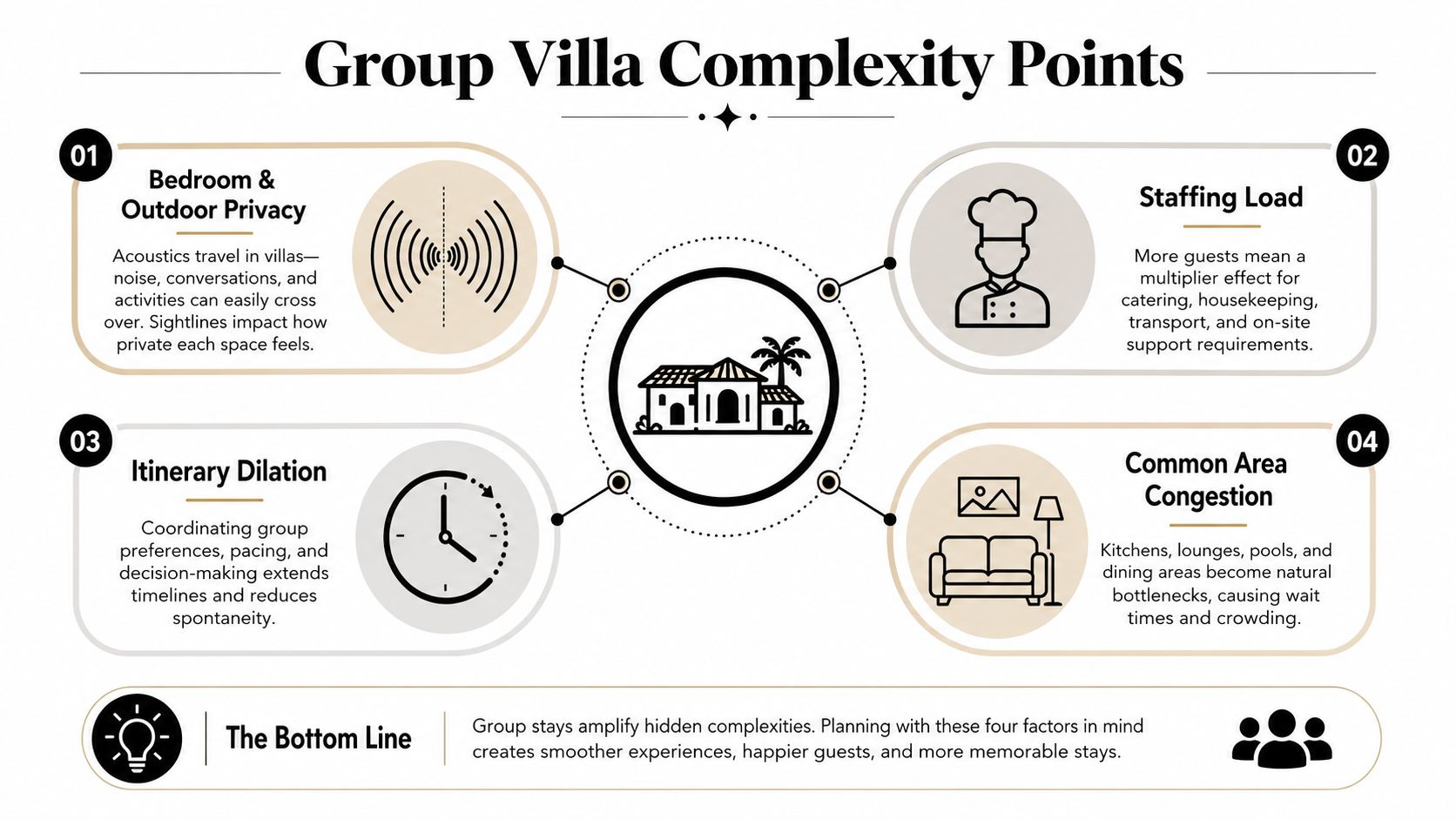
A villa can feel perfect for a small group and fail once the party grows. The problems rarely begin with the number of beds. They begin with sound, staffing, sleep, and shared-space pressure.
Privacy and acoustics
Outdoor living is a major reason to book a Costa Rican estate. It's also where poorly planned properties create friction. A bedroom close to the pool may suit parents who want to monitor children, but it won't suit guests who expect a quiet morning. A terrace that carries conversation toward every sleeping pavilion can turn a relaxed dinner into a negotiation over volume.
Look for bedroom pods, screened paths, separate levels, and clear sightline planning. A floor plan tells you more than a staged bedroom photograph. Ask where music, conversations, pool activity, and staff movement travel after dark.
Staffing load
One concierge can't realistically anticipate the needs of a large group across several meals, dietary requirements, transfers, activities, housekeeping requests, and changing weather plans. As headcount rises, the work multiplies because every decision affects more people.
The VIVARA property in Dominical is a useful example of the operating question. Its model uses a dedicated villa manager alongside a chef and grounds team, so one person isn't expected to carry the entire guest experience. That structure matters most during transition points, such as breakfast before an excursion, a late return from the coast, or dinner service for guests with different preferences.
Sleeping arrangements
A family suite can solve a problem that an impressive bedroom count cannot. Toddlers need proximity to caregivers, teens need separation, and older guests may need the easiest route to shared areas. Confirm bed types, bathroom access, stairs, railings, and the practical location of family rooms before booking.
VIVARA's family suite configuration demonstrates the principle. The question isn't whether every guest has a room. It's whether the sleeping plan works for the youngest and oldest people in the party without forcing everyone else into the same rhythm.
Shared space over a longer stay
A single dining table and pool deck may work for a weekend. Over 7–14 nights, people need variation. Some want a social breakfast, some want a quiet reading hour, and others need a private work call while the main group is at lunch.
A well-zoned estate absorbs that energy. VIVARA uses distinct areas, including a quiet library loft and a sunset terrace, so the group can remain together without being physically consolidated all day. That's the difference between an estate that supports a long stay and one that merely accommodates it.
Booking Logistics and Questions to Ask the Host
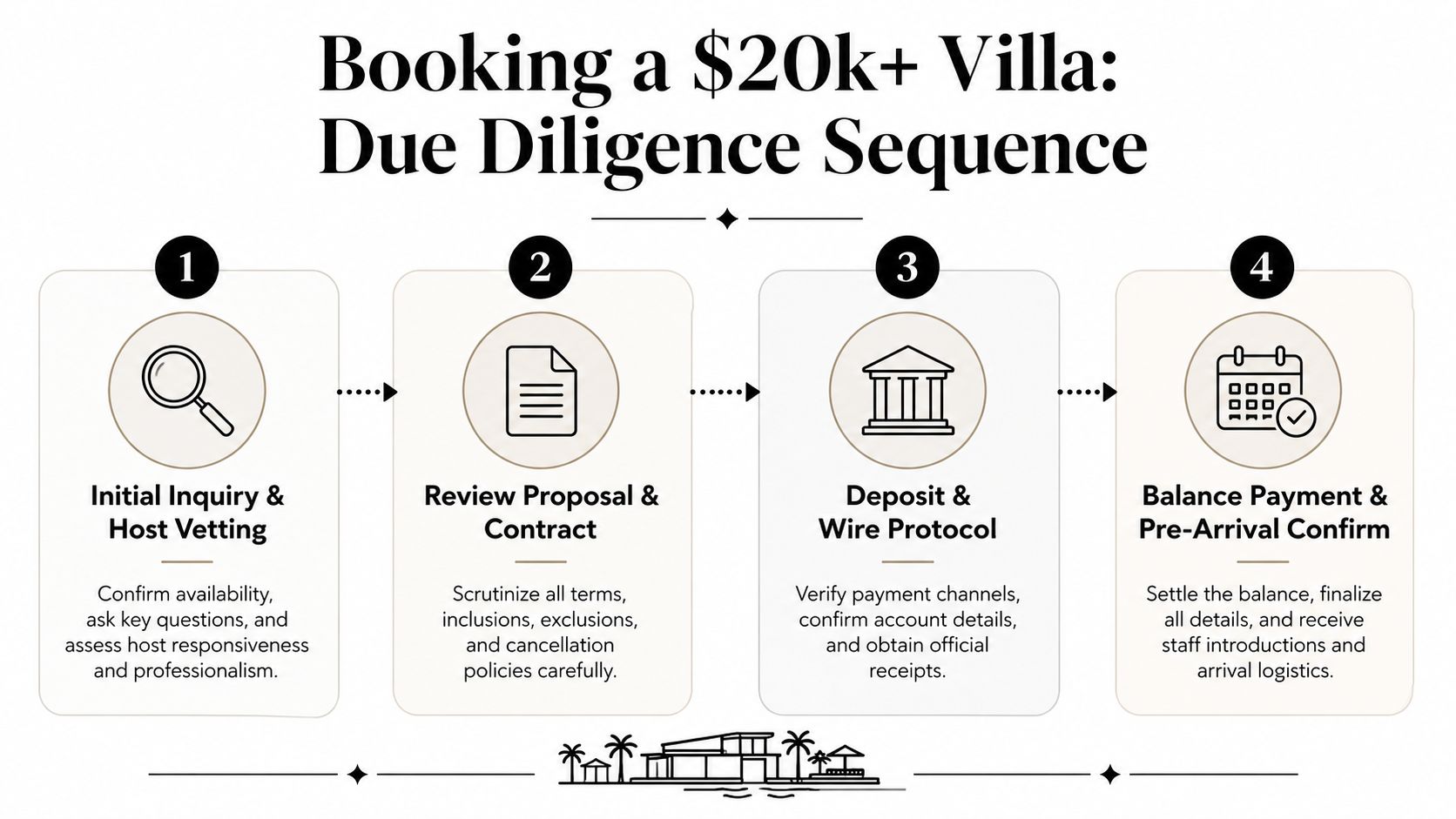
For a private villa rental priced at $20,000 or more per week, treat booking as a due-diligence process, not a casual online reservation. The sequence should move from an initial inquiry to a detailed proposal, contract review, deposit and verified wire process, balance payment, and pre-arrival planning.
Start by requesting a transparent weekly proposal. It should distinguish accommodation from full staff, daily housekeeping, chef-curated meals prepared from a stocked kitchen, and curated experiences. Gratuity, alcohol, and excursions should appear as separate line items, not as vague additions that surface after payment.
Ask operational questions before paying
A serious host should answer specific questions without defensiveness:
Staff coverage: Who is on site, what are their hours, and what happens overnight?
Chef capability: Who leads the kitchen, and how does the team handle allergies, religious requirements, children's meals, and changing preferences?
Utilities: Does the estate have backup power and a dependable water system?
Security: What access controls, safe-storage arrangements, and emergency protocols are in place?
Contingencies: What happens if a named chef, manager, or driver becomes ill?
Cancellation: What are the cancellation, rebooking, refund, and force-majeure terms?
Insurance: Does the host require travel insurance, and what coverage should it include?
Arrival: Who coordinates airport transfers, groceries, dietary intake, activity timing, and staff introductions?
The host's answers should match the contract. A polished proposal means little if the legal terms allow broad substitutions, unclear fees, or no workable response to weather disruption.
For a clearer picture of the guest journey, review what to expect at VIVARA before comparing proposals.
Payment red flags
Don't wire funds to a personal account without verifying the business, the contracting entity, and the recipient. Missing business registration, pressure to pay before receiving a contract, inconsistent bank details, and the absence of a published cancellation policy should stop the process.
A reputable operator can explain the payment channel, issue receipts, identify the contracting party, and provide a written process for changes. If the host won't explain what happens when plans change, assume the problem will become yours.
A Sample Week in Dominical
A strong week in Dominical alternates intensity with recovery. The point isn't to fill every hour. It's to sequence adventure, food, movement, and unstructured time so the group finishes energized rather than depleted.
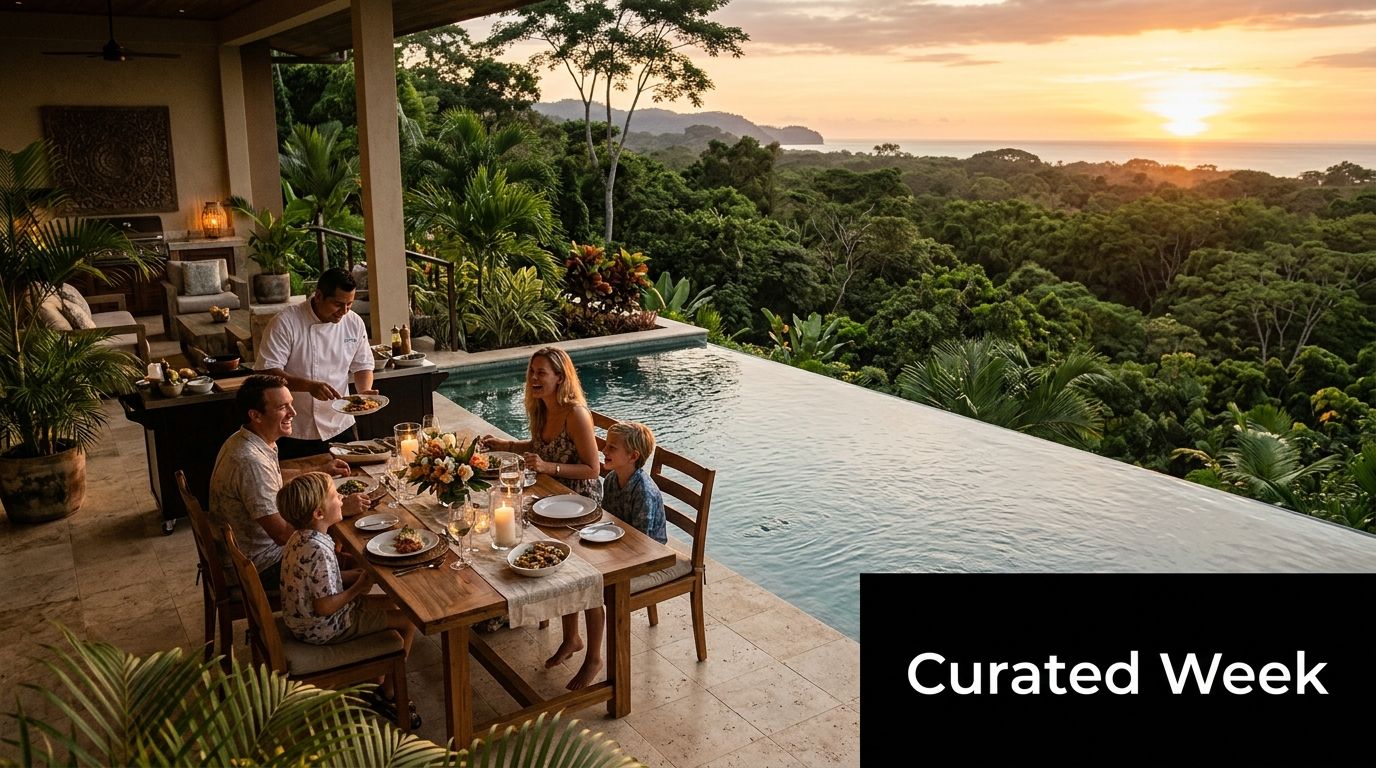
Day 1 begins in Quepos, with airport arrival, a coordinated transfer, and a quiet welcome dinner at the estate. Keep the first evening deliberately light. Guests need food, showers, and a chance to settle into the property before anyone asks them to perform enthusiasm.
Day 2 builds gradually. After breakfast, the group heads to Nauyaca for a waterfall rappel, then returns for a sunset on the terrace. The excursion provides the day's adrenaline. The estate provides the decompression, which is why the timing of dinner matters as much as the activity itself.
For guests ready to commit to the adventure, the Nauyaca waterfall experience should be evaluated alongside fitness, comfort with heights, and the needs of less active members. A good concierge doesn't sell the same day to everyone. They build parallel options when the group needs them.
Day 3 pairs movement with participation. Start with a morning surf lesson at Dominical beach, then return for a chef-led ceviche class. Chef Pilar's farm-to-table culinary program makes the meal part of the experience rather than a service delivered behind a closed kitchen door. Guests can also explore regenerative farm tours, connecting the food on the table with the surrounding environment.
The week needs a quieter pivot.
Day 4 combines a mangrove kayak with private yoga. The kayak offers active nature immersion, while yoga gives the body and conversation pace room to settle. The arrangement works for mixed groups because participation can be adjusted without making anyone feel excluded.
Day 5 is deliberately restorative. Schedule a morning jungle hike, then protect the afternoon for spa treatments, reading, naps, or a slow swim. Costa Rica's wellness offer supports this combination of activity and renewal, while Lonely Planet describes the country's wellness offerings through yoga retreats, spas blending modern and traditional approaches, and surf culture in its Costa Rica wellness coverage.
Day 6 goes offshore for a full boat-and-snorkel day at Isla del Caño. That's a demanding outing, so return to an easy dinner rather than another formal event. Day 7 closes with a family-style asado, live music, and a fireside cacao ceremony, giving the group a shared final ritual instead of a rushed packing-night meal.
Founder-led hospitality proves its worth here. Concierge-arranged excursions leave directly from the property, while the culinary team adapts the week to the guests staying there.
Events, Buyouts, and Purpose-Driven Stays
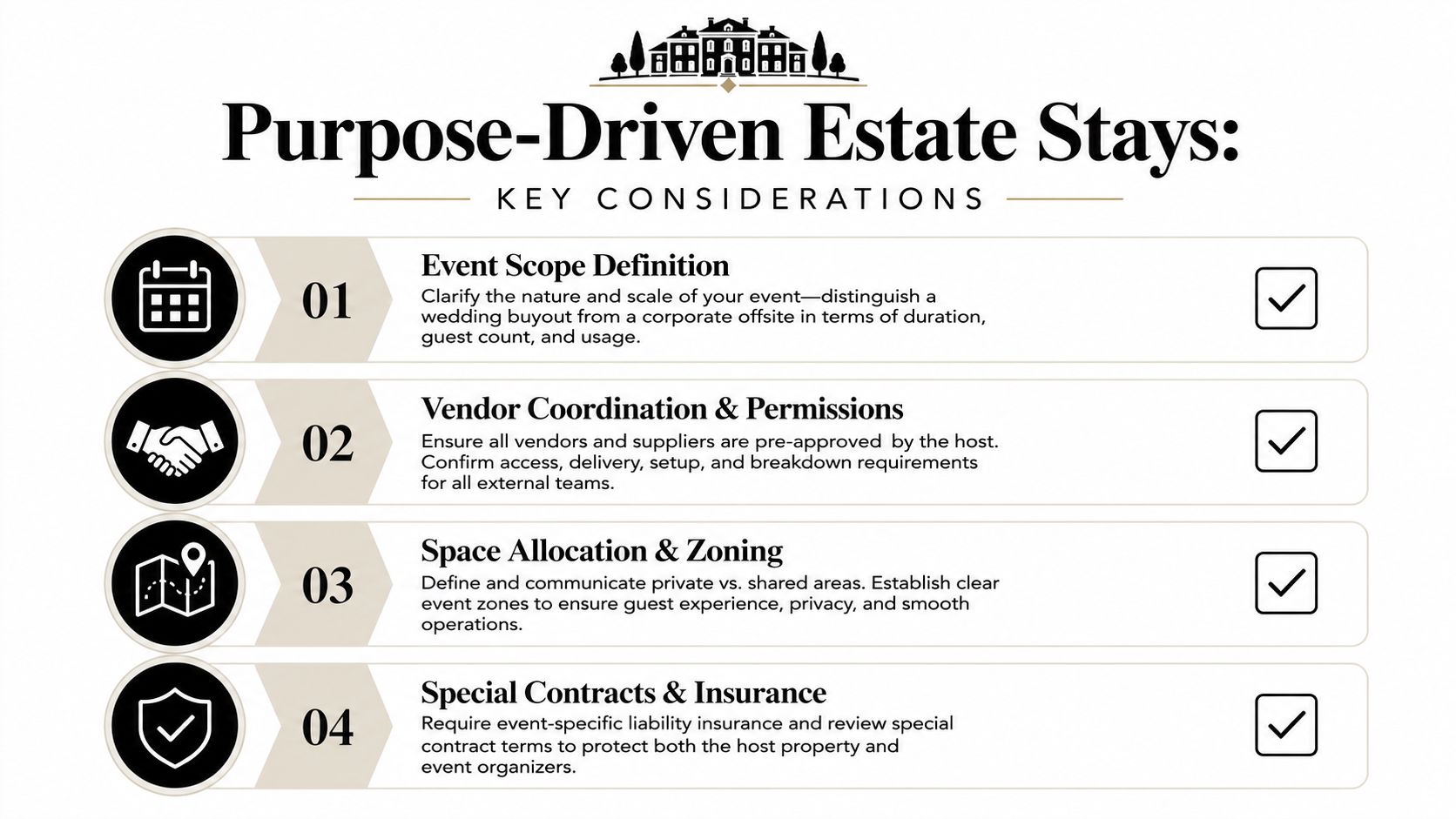
Private estates increasingly serve as venues for weddings, leadership offsites, milestone celebrations, wellness immersions, and brand gatherings. The reservation may look like a normal villa booking, but an event buyout usually carries a different contract, different staffing assumptions, and different risk.
Ask about the minimum-night clause, approved vendors, sound curfews, guest limits, setup and breakdown windows, transportation, and event fees. A property can quote an attractive accommodation rate while adding labor, rentals, security, cleaning, and production requirements that change the effective cost of the stay.
Define the purpose before the production
A wedding buyout needs ceremony flow, vendor access, weather contingencies, sound control, and guest transport. A founders' offsite needs reliable connectivity, work zones, confidentiality, and space for informal strategy conversations. A wellness retreat needs movement areas, quiet, food alignment, and a facilitator who understands the group's intended outcome.
Request the property's past event portfolio, liability framework, and a sample buyout addendum before committing. The addendum should identify private and event zones, approved suppliers, insurance obligations, restoration standards, and who carries responsibility for damage or injury.
Purpose-driven travel adds another layer. Costa Rica's current wellness positioning connects nature reconnection with mental health care and active longevity, highlighting settings such as Monteverde, Los Quetzales National Park, La Fortuna, Rincón de la Vieja, Santa Teresa, and Nosara for forest bathing, hot springs, yoga, mindfulness, and sound healing in coverage of the “Wellness Pura Vida” campaign.
The best estate stays connect luxury to a credible local system. That might mean reforestation, farm-to-table sourcing, protected-area education, local artisans, conservation support, or fair employment. The experience should remain comfortable, but its value extends beyond seclusion.
For families considering exclusive use, this guide to a private villa buyout in Costa Rica offers a useful reference point for evaluating the difference between a regular stay and a full-property gathering.
Choosing the Right Kind of Gathering
Most travelers begin with the villa. That's backwards. Begin with the gathering you're trying to create, then identify the estate features that can carry it.
A couples retreat needs bedroom privacy, multiple places to sit, and a dining program that supports long evenings. A multigenerational holiday needs family-suite logic, safe circulation, flexible meals, and quiet zones. A founders' offsite needs connectivity, work surfaces, confidentiality, and an itinerary that gives people both productive friction and physical recovery.
Gathering Type | Group Size | Must-Have Features | Ideal Setting |
|---|---|---|---|
Couples retreat | Several couples | Private bedrooms, acoustic separation, varied dining and lounge zones | Jungle estate with sunset and social terraces |
Multigenerational holiday | Extended family | Family suite, accessible routes, child-friendly planning, flexible meal times | Private property with short transitions between key spaces |
Founders' offsite | Small leadership group | Reliable internet, quiet work areas, chef support, privacy | Nature-rich estate with indoor and outdoor work zones |
Wellness immersion | Facilitated group | Yoga space, nourishing food, treatment coordination, restorative surroundings | Forest or coastal setting with protected quiet |
Milestone celebration | Friends or family | Event permissions, music plan, dining capacity, transport, contingency support | Full-estate buyout with distinct celebration and retreat areas |
Costa Rica works particularly well when the gathering needs both nature immersion and human connection. Its wellness offer isn't limited to passive relaxation. The tourism board describes practices ranging from trekking and forest bathing to local food, hydrotherapy, hot springs, and restorative treatments, which lets a group build a week around different energy levels rather than one fixed retreat formula.
The Dominical corridor is especially compelling for groups that want surf access, jungle immersion, and slow hospitality in the same trip. It supports the kind of schedule that leaves room for a waterfall day, a cooking class, a quiet afternoon, and an unplanned conversation that becomes the most memorable part of the stay.
Write a short brief before contacting a property manager or villa specialist. Include group size, dates, sleeping needs, purpose, food requirements, activity priorities, work requirements, accessibility concerns, and essentials. A good specialist can shortlist estates from that brief. A listing search usually can't.
A transparent budget should also distinguish the nightly or weekly accommodation cost from staff, meals, alcohol, gratuity, transfers, excursions, event production, and insurance. Eco-luxury wellness lodges in Costa Rica are listed at typical nightly prices of about $400 to $1,600, with most meals and activities included, while the country's CST program rates properties on a 1 to 5 leaf scale across environmental management, wildlife interaction policies, community relations, and service quality in this independent guide to eco-luxury wellness lodges. That isn't a direct comparison with a staffed estate, but it shows why travelers should compare inclusions, sustainability standards, and service design rather than price alone.
VIVARA is a founder-led Dominical property designed for up to 14 guests, combining architecturally distinct villas, private group use, chef-led dining, curated excursions, regenerative farm experiences, and purpose-driven hospitality. Visit VIVARA to share your group brief, compare the estate's fit with your priorities, and start planning a Costa Rica stay built around how your people want to live together.