The Vivara Content Team
Turtle Conservation Costa Rica: A Practical Guide
Turtle Conservation Costa Rica: A Practical Guide
Most articles about turtle conservation Costa Rica sell the same soft-focus fantasy, a moonlit beach, a hushed guide, and a hatchling release that feels meaningful because it looks emotional. That version is incomplete. Costa Rica's turtle story is bigger, stricter, and more uncomfortable, because protecting a nest on the sand does nothing if adults keep dying offshore and if tourism brands can't prove their money is changing outcomes.
The better way to read this topic is as a decision-making problem, not a feel-good excursion. Costa Rica's turtle programs sit on a long conservation timeline, from the founding of the Caribbean Conservation Corporation in Tortuguero in 1959 to the first hunting and egg-collection restrictions in 1963, then Tortuguero National Park in 1970 and the National Parks Act in 1975, which strengthened protection for the area Kupi history of Tortuguero. That history matters because the country became a foundational global reference for nesting-beach protection, but it also shows how hard recovery is when threats keep shifting.
Why Most Turtle Tourism Coverage Misses the Real Story
The postcard version of turtle tourism is easy to sell. A lodge arranges a guided night walk, a biologist points out tracks in the sand, and guests leave feeling they've helped. The problem is that this framing treats the beach as the whole battlefield, when the beach is only one part of the story.
Sea Turtle Conservancy has monitored Tortuguero for 50 years on its 21-mile black-sand coastline, and Tortuguero remains the nesting site of more endangered green turtles than anywhere else in the Western Hemisphere Sea Turtle Conservancy Tortuguero program. That's the kind of place where conservation is real and measurable. But a long-running critique of marine turtle protection in Costa Rica says beach stewardship alone doesn't solve leatherback survival, because adult turtles still face heavy mortality at sea, especially from fishing pressure and bycatch WIDECAST Costa Rica summary_Costa_Rica_Exec_Summary.pdf).
What travelers usually don't ask
Most visitors ask whether they'll see a turtle. Fewer ask what happens after the turtle leaves the beach, or whether the program they paid for can point to published nesting success, hatchling survival, or recovery trends. That's the gap that matters. A cute encounter doesn't tell you whether a project is solving the right problem.
Practical rule: If a program only talks about guided viewing and hatchery aesthetics, it's selling atmosphere, not conservation credibility.
Costa Rica's strongest turtle programs are valuable because they connect beach work to data, policy, and local stewardship. If a retreat or tour can't explain how it protects nesting females, manages light, supports local patrols, and accounts for marine mortality beyond the shore, it's incomplete. That's the standard I'd use before booking anything in this space.
The Sea Turtles of Costa Rica and How They Live
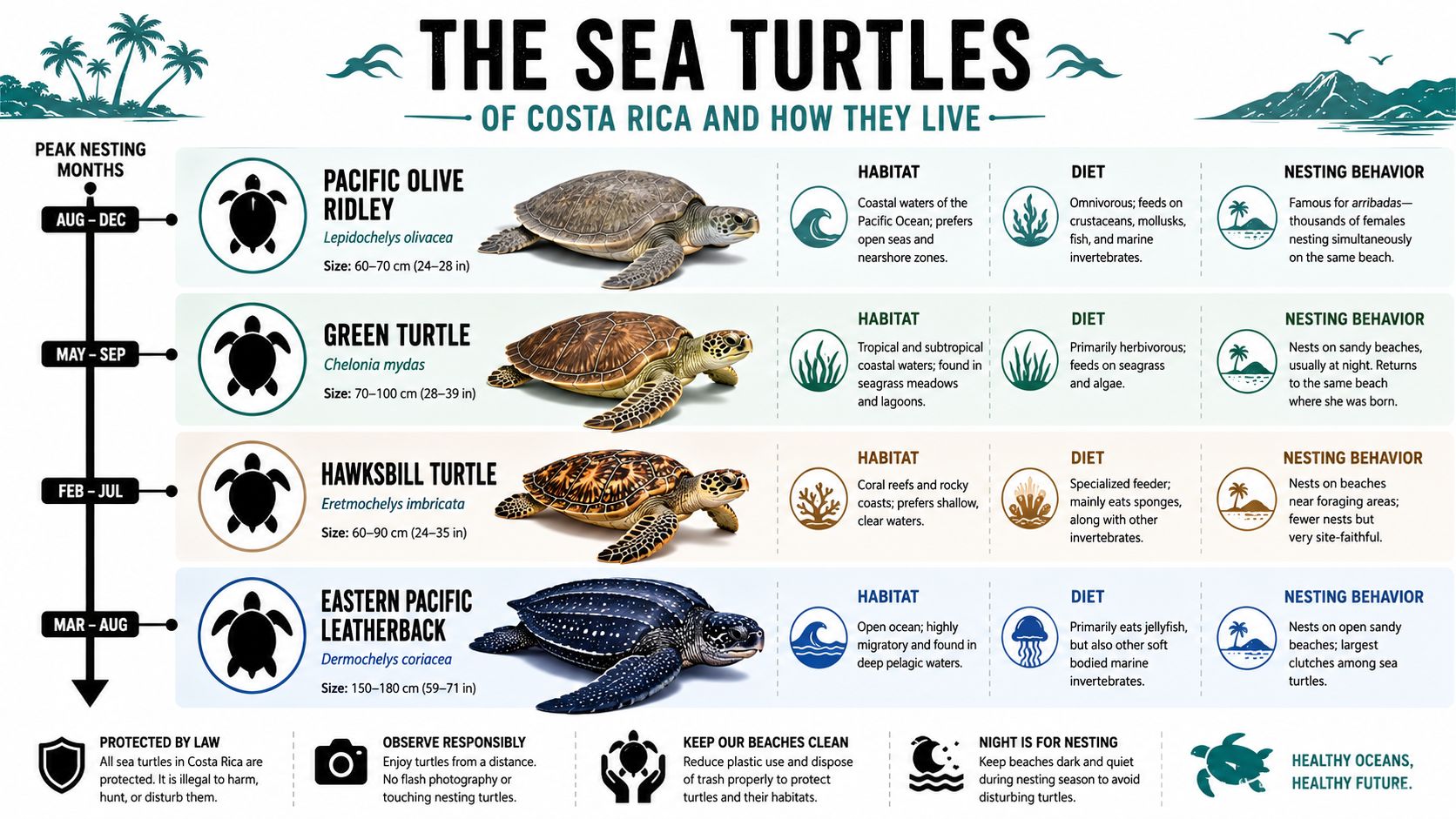
Costa Rica's beaches host a rare mix of species, and each one behaves differently. On the Pacific coast you're most likely to hear about the olive ridley, famous for arribadas, the green turtle, the hawksbill, and the Eastern Pacific leatherback. The loggerhead appears less often, but it belongs in the broader national picture.
Why the life cycle makes every adult matter
A nesting female is the visible part of a much longer life. She returns after years at sea, lays eggs, and the hatchlings sprint toward the water as if they already understand the odds. Only about one in 1,000 hatchlings survives to adulthood, a figure highlighted in Costa Rica-focused conservation reporting United Planet webinar summary. That's why every adult female matters so much more than the postcard image suggests.
The life cycle reads like a round-trip lottery ticket. One nesting female can represent decades of survival, while the hatchlings she leaves behind face predation, currents, food scarcity, and human-caused mortality. Costa Rica's data-rich beaches matter because they let researchers watch those cycles over time instead of guessing.
What happens on nesting beaches
Arribadas are the most dramatic nesting events, especially for olive ridleys. Greens and hawksbills tend to be more spaced out, while leatherbacks often demand strict management because their nesting behavior is easy to disturb. On the sand, the most important thing is not spectacle, it's restraint.
Costa Rica's value in this field is that visitors can still see the process without turning it into a zoo. At Tortuguero, for example, the nesting season runs from June to October, and beach access is restricted from March 1 to October 31 between 6 p.m. and 6 a.m. to protect sea turtles SINAC Tortuguero rules. That's not tourism theater, it's a working conservation perimeter.
If you want a trip that feels meaningful, choose a destination where the biology is visible and the rules are strict. That's where the experience becomes more than a walk on a beach.
The Threats No One Sees From the Beach
The shoreline gets the attention because it's where people stand, but it isn't where most of the damage happens. Costa Rica's turtle threats fall into two tiers, and the second tier is the one many tourism operators dodge.
Threat Category | Nesting Beach Threats | Offshore Threats |
|---|---|---|
Main Risks | Egg poaching, beachfront lighting, coastal armoring, erosion, dogs, coatis, beach driving | Longline and shrimp trawl bycatch, ghost gear entanglement, plastic ingestion, climate-driven shifts in current and prey availability |
What Visitors Usually See | Patrols, hatcheries, guided walks, relocation pens | Almost nothing, which is part of the problem |
What Strong Programs Track | Nest protection, hatch success, false crawls, nest relocation outcomes | Bycatch records, fisheries policy pressure, marine mortality patterns |
Why the beach-only story is too small
Costa Rica has real nesting-beach pressure. Artificial light can disorient both nesting females and hatchlings, erosion can erase nests, and human traffic can crush the calm a beach needs at night. Those are serious, visible issues.
But offshore mortality can undo beach success fast. That's why the historical collapse of East Pacific leatherbacks is so important. A World Bank legal exhibit cited an assessment showing Costa Rica's population of East Pacific leatherbacks fell from an estimated 800 to 1,250 nesting females in 1996 to 117 in 1999 Kupi history of Tortuguero. Another Tortuguero analysis found leatherback nesting declined by 67.8% between 1995 and 2006 Earthwatch field report. Those numbers tell you exactly why sand-only protection isn't enough.
The offshore blind spot
Fishing pressure matters because adult turtles must survive long enough to return and nest again. If they die at sea, the beach work becomes a holding action. That's the conservation failure too many romantic stories skip.
You should also be skeptical of any operator that talks about “saving turtles” without mentioning fisheries policy, bycatch mitigation, or coordination beyond the nesting beach. If they can't explain the marine side, they're not telling you the whole story.
Where and When Turtles Nest Across Costa Rica
Travelers usually plan by region first, species second. That's the right approach. You're not choosing a turtle, you're choosing a coastline, a season, and the kind of access you want.
Region / Site | Dominant Species | Peak Nesting | Access | Guide Required |
|---|---|---|---|---|
Tortuguero, Caribbean coast | Green turtle, leatherback | July to October | Boat access, then village and beach walking | Yes, for turtle viewing under official rules |
Gandoca-Manzanillo, southern Caribbean | Hawksbill | March to July | Coastal access by road and local transport | Guided access is strongly preferred for responsible viewing |
Osa Peninsula and Corcovado, Pacific | Olive ridley | July to November | Remote access, often boat and rugged road logistics | Guided visits are the norm |
Ostional to Junquillal, northern Pacific | Olive ridley, year-round nesting with August peak | Year-round, with August peak | Paved and coastal access varies by site | Some visits can be self-arranged, but nighttime access should be verified |
How to read the map like a traveler
Tortuguero is the classic choice if you want a structured, highly regulated experience with real conservation depth. The rules are strict, and that's a good thing. Costa Rica's official guidance says visitors may not enter nesting areas, including beach dunes, and must use a tourism agent or local authorized guide Visit Costa Rica turtle observation guidance.
Gandoca-Manzanillo suits travelers who want the Caribbean side without the heavier tourist traffic. Osa fits birders, photographers, and fit travelers who don't mind rougher logistics. Ostional is for people who want a Pacific nesting experience with a stronger chance of large-scale olive ridley activity, but timing is everything.
The best turtle trip is the one you time correctly. Arrive a few weeks off peak and you'll miss the laying, the hatching, or both.
For broader trip timing, especially if you're pairing turtle viewing with greener scenery and easier road conditions, the green season guide for Costa Rica is worth reading before you lock dates. Turtle seasons and weather patterns don't always align cleanly, so build the itinerary around the beach, not the other way around.
Reputable Organizations and Volunteer Opportunities Worth Your Time
Not every turtle project deserves your time, and the right fit depends on how much fieldwork you want. Some programs are research-heavy. Others are community-facing and better for travelers who want a shorter, less demanding commitment.
Five programs that are worth a closer look
Sea Turtle Conservancy, Tortuguero. This is the reference point for long-term monitoring. It's strongest for people who want to understand green turtle research and are open to longer stays. Its value is continuity, not casual participation, and the work is built around nest monitoring and beach data rather than performance tourism Sea Turtle Conservancy Tortuguero program.
LAST, Latin American Sea Turtles, Playa Junquillal. Good for first-timers who want bilingual staff and a shorter commitment. The beach setting is simpler, and the focus is on patrols, conservation support, and field learning. If you're new to this kind of work, it's one of the more approachable options.
Osa Conservation, Osa Peninsula. This is a research-station model, not a resort activity. It fits travelers who are comfortable with patrols, data collection, and a more rugged rhythm. The mix of turtle work, forest conservation, and bird monitoring makes it a stronger fit for people who want ecosystem context, not just nest viewing.
Conservación Osa and the Turtle Restoration Project, Matapalo and Guanacaste. These are useful if you want community-based work with clearer conservation and hatchery components. They tend to appeal to travelers who want direct involvement and don't mind field routines that are repetitive but important.
Community-led projects near Puerto Jiménez and Drake Bay. These are the ones many glossy articles skip, yet they often have the strongest local legitimacy. They connect tourism revenue with schools, local employment, and beach protection in ways that feel less polished but more grounded.
What to verify before you go
Ask for the daily schedule. If a program won't tell you how much of the day is patrol, hatchery work, and data entry, keep looking.
Ask who gets paid. Local patrollers and biologists should be named, not hidden behind vague “community support” language.
Ask what they measure. False crawls, hatch success, bycatch records, and nest relocation outcomes are all better signs than marketing copy.
I'd also treat conservation-tied hospitality as a valid option when it's transparent. One example is VIVARA's conservation-linked stay model, which fits travelers who want a premium base while keeping the trip grounded in wildlife and local impact. Don't book that kind of stay for the label, book it because the property can show you exactly how the guest experience supports conservation work.
How to Watch Turtles Without Hurting Them
Costa Rica's turtle rules are simple enough to follow if you take them seriously. The country's guidance is not about spoiling the experience, it's about protecting a fragile moment that can be ruined by one careless guest or one glowing phone screen Visit Costa Rica turtle observation guidance.
The non-negotiables on a night patrol
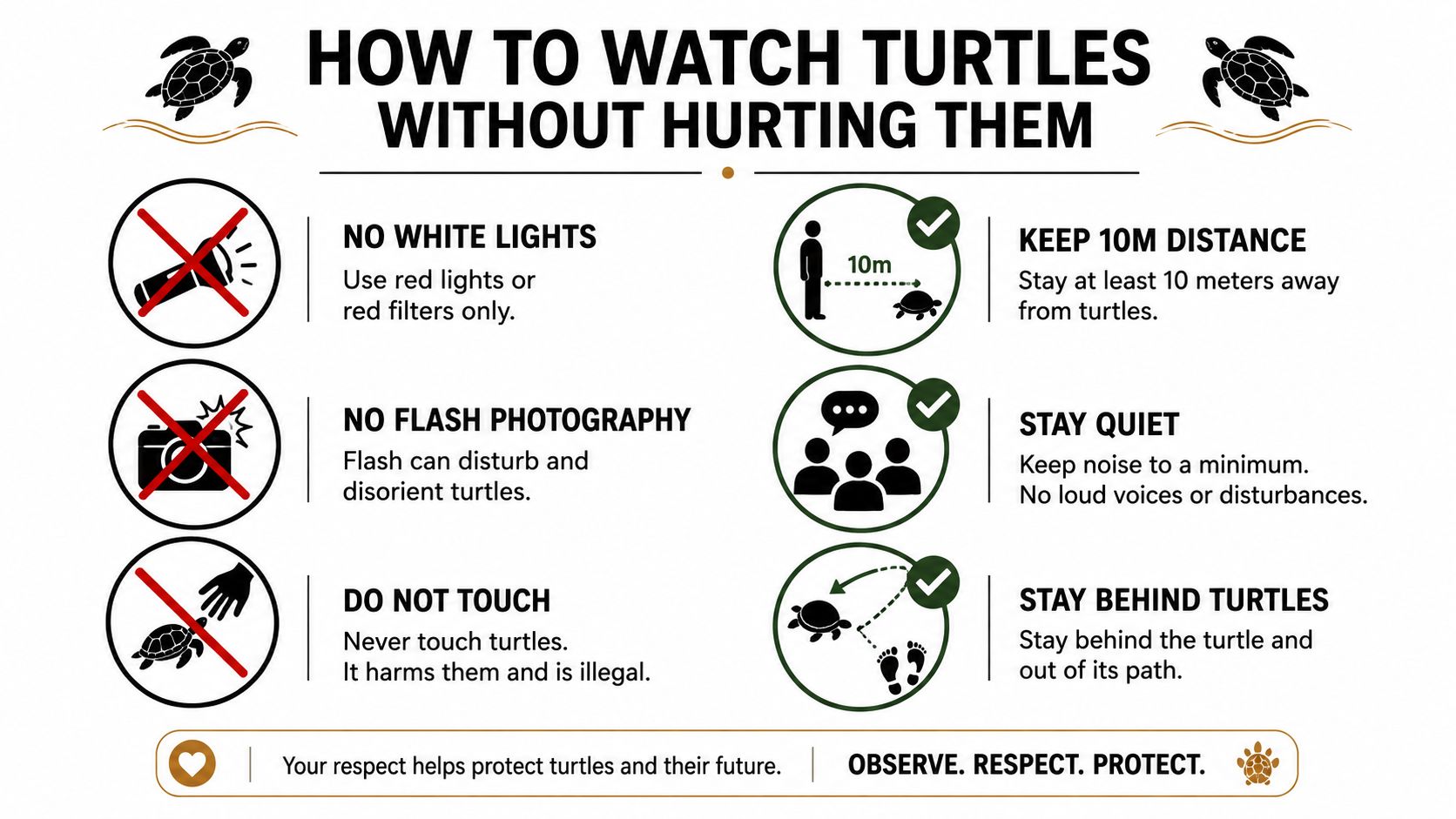
No flash photography. No white light, only red filters. No touching the turtle. No crowding the laying female. Stay behind the back flippers and keep quiet. Guides at Tortuguero also enforce a maximum group size of 8 people per guide, and visitors wait in a designated area until a confirmed nesting female is reported Tortuguero guide rules.
Those rules exist because turtles are sensitive to light and disturbance. One flashlight really can matter, not because it's the only source of harm, but because many small violations create cumulative light pollution that disorients both hatchlings and inbound females. That's why “just one photo” is the wrong mindset.
What to wear and how to show up
Choose neutral-colored clothing and proper footwear. Rocky Pacific beaches need different shoes than flat Caribbean sand, and you don't want to fumble around the nest line in sandals. Leave insect repellent off the nest area, and don't bring extra gear you won't use.
Official guided patrols with trained biologists are the standard I'd recommend. Some lodges offer informal turtle tours that may be legal, but legality isn't the same as research competence. If the guide can't explain nesting behavior, light discipline, or hatchery protocol, the experience is too thin.
Hatchery etiquette people still get wrong
Never dig a nest to check the eggs. Never pick up hatchlings to “help” them. Never chase disoriented hatchlings away from artificial lights with your hands and feet. Your job is to reduce interference, not to manage nature like a stage crew.
For a second field reference point, compare turtle etiquette with another marine activity that depends on the same restraint, the Cano Island snorkeling guide. The principle is the same, stay small, quiet, and observant.
Screenshot checklist for the beach
Use red light only and keep the beam low.
Stay quiet and move slowly.
Keep distance from the turtle and the nest.
Never touch the turtle or hatchlings.
Don't block the turtle's path.
Follow the guide's instructions immediately.
What Meaningful Support Looks Like
A conservation trip should do more than make guests feel involved. It should move money, labor, and visibility toward a program that can show where the benefit lands. If a project cannot explain its outcomes, the work functions more as marketing than conservation.
Four signals that separate substance from greenwashing
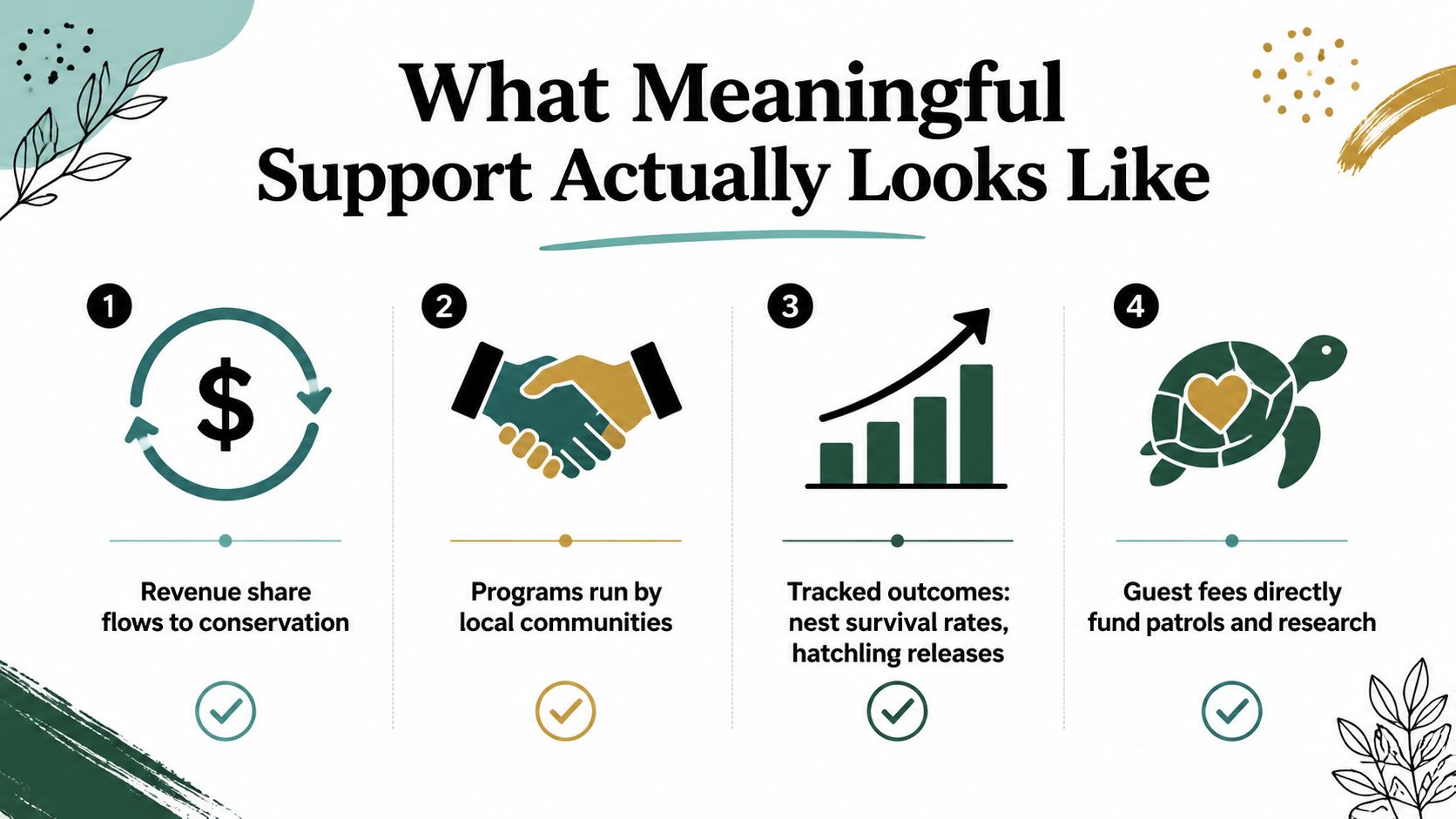
Published nesting-success data. Look for hatch success, nest protection results, or long-term trend reporting. If a program never publishes outcome data, it is hard to know whether it is helping.
Named recipient organizations. Do not accept vague “we support conservation” language. Ask exactly which local group gets the funds and what work they perform.
Local employment. Strong programs hire local patrollers, guides, cooks, and biologists where possible. That keeps knowledge in the community instead of outsourcing it to visiting volunteers.
Transparent contribution figures. Operators should be able to explain what the guest fee supports, even if they do not publish every internal line item.
What a credible guest-funded model looks like
VIVARA is one example of how a stay can be tied to conservation without turning the property into a fake research outpost. The brand says guest stays fund turtle conservation in Costa Rica, and that each villa sponsors a rescued animal. It also says guest presence supports lifeguard training and living wages, which matters because conservation tourism should strengthen the local economy instead of merely borrowing its scenery.
That is the difference between a vague promise and a model travelers can evaluate. A credible operator does not just say it cares about turtles, it can explain where support goes and why it matters to the beach, the community, and the field staff.
Questions to ask before you book
Ask for a recent impact report. Ask which nests were protected, which local partners received support, and how the program handles data collection. If the answer is just a glossy brochure or a social media reel, keep shopping.
Ask whether visitor activity changes nesting success. That is the key test for conservation tourism. The industry loves guest numbers. I care more about whether the program can show that access, spending, and behavior support the beach.
Choosing How to Show Up and Where to Go Next
The right move depends on your time, your budget, and how hands-on you want to be. Not everyone should volunteer, and not everyone should book a night patrol. Some travelers should visit once, learn a lot, and leave the rest to the people doing the daily fieldwork.
Pathway | Time Required | Typical Cost | Measurability of Impact | Best For |
|---|---|---|---|---|
Short ethical visit | A few hours to one night | Moderate | Medium, if the operator shares protocols and receipts | Couples, families, and first-time visitors |
Multi-week volunteer placement | One week or more, often longer | Higher in time and energy | High, if the project publishes data | Students, gap-year travelers, committed conservation guests |
Direct donation | Minutes | Flexible | High, if the organization reports outcomes | Busy travelers, brands, and donors who want efficiency |
Conservation-tied stay | Several nights | Premium but value-driven | Medium to high, if the property names its partners and outputs | Retreat guests, groups, and travelers who want comfort with purpose |
A simple decision rule
If you want the lightest lift, book an ethical night viewing with a licensed guide and leave the rest of your time for rest, food, and nature. If you want your trip to become real field experience, choose a volunteer placement and accept that patrols can be late, repetitive, and physically demanding.
If you're pressed for time but still want to help, donate directly to a vetted local organization. That's the cleanest way to support conservation without pretending you can do the field job from a beach chair. If you want comfort and purpose in the same trip, choose a conservation-tied stay that can explain its impact in plain language.
Where to keep learning
Read scientific papers on nesting trends and bycatch. Review Costa Rican Ministry of Environment and SINAC regulations. Look at NGO annual reports from the organizations you're considering. If you want a deeper policy lens, start with publications that connect nesting-beach protection to fisheries reform, because that's where the hard work lives.
The traveler who wins here is the one who asks better questions and books with more discipline. That's how you turn a vacation into support that counts.
If you want a retreat in Costa Rica that keeps nature, hospitality, and conservation in the same frame, VIVARA is worth reviewing as a base for a more intentional trip. Its guest-funded model connects a premium stay with turtle conservation and local impact, and you can explore it directly at VIVARA.

