Written by Adam Hua
Barra Honda: The Costa Rican Mountain That Rose From the Sea
Barra Honda: The Costa Rican Mountain That Rose From the Sea

Barra Honda does not look like the bottom of an ocean.
It rises above Guanacaste’s dry forest, its rocky summit overlooking the Tempisque lowlands. Monkeys move through the trees. Iguanas warm themselves near the trails. From the surface, it looks like another rugged Costa Rican hill.
But the rock tells a stranger story.
Barra Honda is built from ancient reef limestone—material formed in a marine environment, lifted above sea level by tectonic forces and slowly hollowed out by water. Beneath the forest lies a vertical system of caves filled with stalactites, stalagmites and chambers that remained hidden long after people had settled around the mountain.
Nineteen caves have been discovered. Only a small part of that underground world is open to ordinary visitors.
This is Costa Rica without the postcard filter: hot, steep, dark and millions of years in the making.
Yes, this mountain was once underwater
Calling Barra Honda an ancient coral reef sounds like social-media exaggeration. It is not.
The mountain is made primarily of limestone associated with old coral reefs. That material accumulated in a marine environment before tectonic movement pushed it above the surrounding landscape. Costa Rica’s official tourism authority describes Barra Honda Peak as old reef material raised by tectonic faults.
Once exposed, the limestone met rain.
Rainwater absorbs carbon dioxide from the atmosphere and soil, becoming mildly acidic. As it enters fractures in limestone, it slowly dissolves calcium carbonate. Small cracks widen. Water follows the easiest routes downward. Given enough time, those routes become shafts, passages and chambers.
This is karst geology: a landscape shaped by the dissolution of soluble rock.
The same water builds the cave’s most recognizable features. Mineral-rich droplets leave tiny deposits behind. Deposits hanging from a ceiling become stalactites. Deposits growing from the floor become stalagmites. When they meet, they can form columns.
No instant catastrophe carved Barra Honda. Water did it one drop at a time.
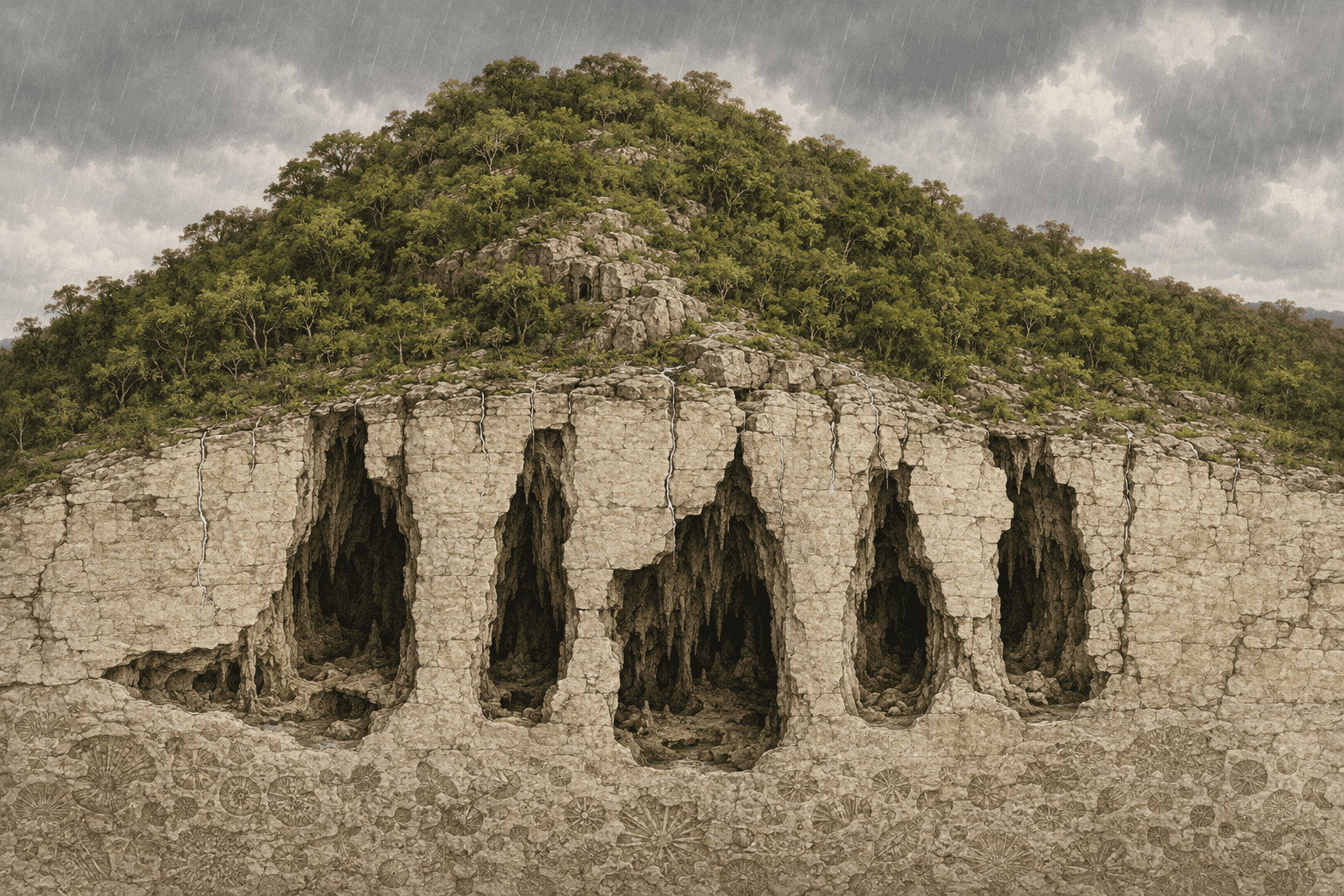
Barra Honda’s caves formed after reef limestone rose above sea level and rainwater began dissolving paths through the rock.
Nineteen discovered caves—and far less open to visitors
Costa Rica’s tourism authority states that 19 caves have been discovered beneath Barra Honda. The number describes known caves, not 19 attractions that travelers can freely enter.
Most of the system is restricted because cave environments are fragile, technically difficult or still being studied. Even a hand on a formation can leave oil behind and interfere with mineral growth. Bats and other cave life also need darkness and limited disturbance.
Terciopelo Cave is the principal cave identified for public access because it is the easiest of the known chambers to reach. “Easiest” is relative.
Visitors do not stroll through a wide, illuminated tunnel. The experience involves an uphill hike, protective equipment, a guide and a descent into a vertical limestone chamber. Current access can change with weather, staffing and conservation conditions.
That controlled access is a feature, not an inconvenience. Barra Honda is a protected geological system—not an underground theme park.
What it feels like to enter Barra Honda
The experience begins above ground, usually in heat.
Guanacaste’s tropical dry forest is very different from the wet jungle many travelers picture when they hear “Costa Rica.” During the drier months, trees may shed their leaves, sunlight reaches the trail and the limestone radiates warmth. The climb toward the cave area requires more effort than the distance alone suggests.
Then the temperature, sound and scale change.
A helmet and headlamp replace open sky. The entrance narrows your field of view. A secured ladder leads downward. Inside, pale limestone formations catch the beam of a headlamp while the rest of the chamber stays black.
The darkness is not decorative. Turn off the lights and there is no ambient glow, no horizon and little sense of distance. It is one of the few travel experiences where the absence of something—light—becomes the main event.
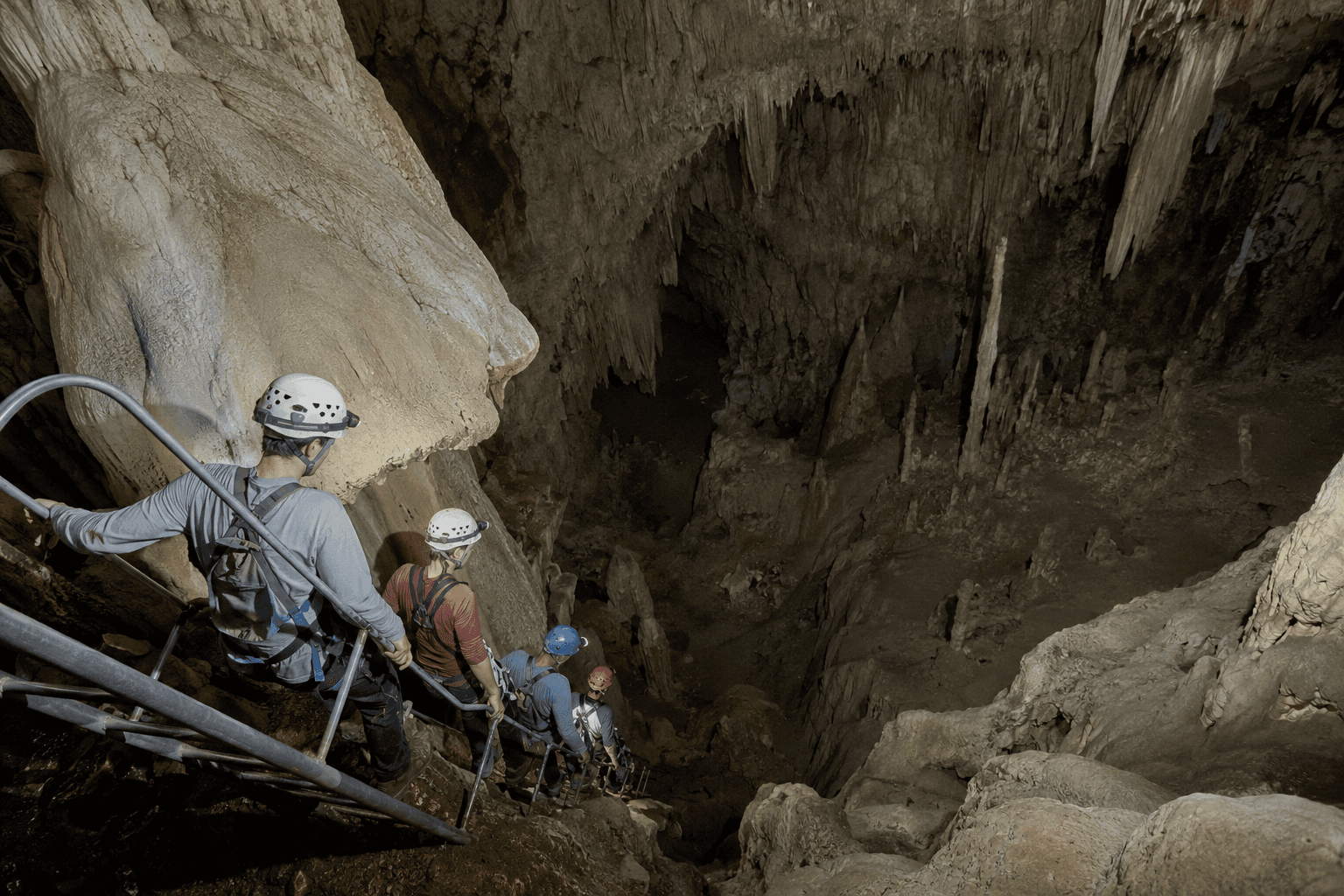
Cave access is guided and involves safety equipment, a steep approach and a controlled descent. AI-generated editorial illustration.
This is an adventure, not a casual cave walk
Barra Honda rewards preparation. Before reserving, be honest about the following:
Heights: The cave experience includes a ladder descent into a vertical space.
Enclosed spaces: Darkness and confined sections can feel intense even if you are normally comfortable indoors.
Fitness: Reaching the cave requires an uphill hike in a hot climate before the underground portion begins.
Mobility: Uneven trails, ladders and cave surfaces make this unsuitable for some travelers.
Weather: Rain can alter trail and cave conditions. Access may be restricted for safety.
Wear closed hiking shoes with real grip, light clothing that can get dirty and enough sun protection for the exposed sections. Carry water for the hike, but follow the guide’s rules underground. Leave jewelry and unnecessary gear behind.
Most importantly, do not arrive assuming admission guarantees a cave descent. Contact the park in advance, confirm the current reservation process and ask about age, health, clothing and equipment restrictions.
What else is inside Barra Honda National Park?
The caves are the headline, but the park above them deserves time too.
Barra Honda protects roughly 5,000 acres of tropical dry forest. Trails lead through a landscape that can hold howler monkeys, white-faced capuchins, deer, coatis, armadillos, iguanas and numerous birds. Wildlife sightings are never guaranteed, but early starts improve the odds and reduce the heat.
Lookout points offer broad views toward the Tempisque River and surrounding lowlands. Those views make the geology easier to understand. Barra Honda is not a cone-shaped volcano. It is an uplifted block of limestone standing above a much flatter landscape.
Travelers who do not want to descend underground can still hike, visit the viewpoints and experience one of Costa Rica’s less familiar ecosystems.
When to visit Barra Honda
The park can be visited throughout the year, but the experience changes with the seasons.
The drier months generally bring clearer trails and the stark, open character of Guanacaste’s dry forest. They also bring heat. Start early.
The green season brings fuller vegetation and a different landscape, but rain can make access more complicated. Cave availability must always be confirmed directly rather than inferred from a weather app.
The official published schedule currently lists general park admission from 8 a.m. to 4 p.m. and cave visits from 8 a.m. to 2 p.m. These hours are not a promise that a cave tour will be available when you arrive. Reserve ahead and verify the current rules with the park.
How to get there
Barra Honda National Park sits northeast of Nicoya in Guanacaste. The final approach leaves the major highway and passes through smaller communities. Road conditions can change, especially during the rainy season, so check the route and vehicle recommendation before departing.
The park is approximately 80 kilometers from Liberia International Airport and works naturally as part of a Guanacaste itinerary. It can also be combined with Nicoya, Sámara or the northern Pacific coast.
From Vivara near Dominical, Barra Honda is roughly 300 kilometers by road and commonly around five to six hours each way, depending on the route, traffic and seasonal conditions. That makes it a poor day trip—but a smart beginning or ending to a longer Costa Rica journey.
A practical route would be:
Fly into Liberia and explore Barra Honda and Guanacaste.
Travel south through the Pacific region.
Finish at Vivara near Dominical for ocean, rainforest and space to slow down.
Or reverse it: begin with the South Pacific, then move north for the caves before departing from Liberia.
For the rest of the trip, explore Costa Rica experiences and activities, browse our adventure ideas, and read what to expect at Vivara. If your visit falls during the wetter months, our guide to the green season in Costa Rica will help you plan realistically.
A different version of Costa Rica
Costa Rica is usually sold from the surface: beaches, canopy, volcanoes and wildlife.
Barra Honda asks you to look down.
The mountain carries evidence of an ancient sea. Rain turned solid limestone into open space. A dry forest grew over the top, largely hiding the caves beneath it.
You can see the story that inspired this article in this Instagram post from Costa Rica Untold. Follow @costaricauntold for more stories hiding beneath the surface—and @vivaracr for a different way to experience Costa Rica.
Would you climb down, or is seeing the entrance close enough?
Explore Vivara or contact us to build the South Pacific side of your trip.
Frequently asked questions
How were the Barra Honda caves formed?
Ancient reef limestone was lifted above sea level by tectonic forces. Mildly acidic rainwater then entered cracks and slowly dissolved the limestone, creating vertical shafts, passages and chambers over millions of years.
How many caves are at Barra Honda?
Costa Rica’s official tourism site says 19 caves have been discovered. Most are not open for general tourism.
Which Barra Honda cave can tourists visit?
Terciopelo Cave is the principal cave identified for public access. Entry is controlled and requires a guide, safety equipment and suitable conditions.
Do I need a guide or reservation?
Cave entry is guided, and travelers should reserve in advance. Contact the park directly to confirm availability, restrictions, prices and the current booking process.
Is the Barra Honda cave tour difficult?
It can be physically demanding. Expect an uphill hike in heat, a secured ladder descent, darkness, uneven surfaces and enclosed spaces. It is not suitable for every visitor.
Can I visit Barra Honda without entering a cave?
Yes. The national park also offers tropical dry-forest trails, wildlife opportunities and viewpoints across the Tempisque landscape.
What are Barra Honda National Park’s hours?
The currently published schedule lists park admission from 8 a.m. to 4 p.m. and cave visits from 8 a.m. to 2 p.m. Verify those hours and cave availability before traveling.

