
The Vivara Content Team
Find Your Ideal Healing Retreats Costa Rica in 2026
Find Your Ideal Healing Retreats Costa Rica in 2026

A lot of travelers arrive at the same realization in a tired, expensive way. They book the beautiful hotel, add the massage, sleep a little more than usual, and still go home with the same nervous system they arrived with. The scenery changes. Their habits don't.
That's usually when the search shifts from “Where should I go?” to “What do I need?” If you're looking into healing retreats in Costa Rica, you're probably not chasing distraction anymore. You want a setting that supports rest, but also helps you reset your routines, your energy, your relationships, or your sense of direction.
Costa Rica works well for that because nature isn't just a backdrop here. Rainforest, ocean, volcanic terrain, wildlife, and a slower cultural rhythm shape the experience itself. The strongest retreats use that well. The weaker ones merely borrow the language of healing and deliver a polished vacation.
Beyond a Vacation The Search for Real Renewal
You arrive in Costa Rica carrying more than a suitcase. Your sleep has been uneven for months. Your mind is still running through work, family, or a decision you have been postponing. You book the ocean-view room, schedule the massage, and realize by day three that comfort alone is not changing much.
That is usually the point when a healing retreat starts to make sense.
The people who benefit most are not looking for entertainment or a packed itinerary. They want a setting that reduces noise, gives the day some structure, and supports a real reset. I often see this with burned-out executives, couples who need steady time together without social obligations, and solo travelers who know they need distance from routine before they can hear themselves clearly again.
A resort stay can be pleasant. A well-designed retreat is built around an outcome.
When rest alone stops working
Frequent luxury travelers already know how to book a beautiful break. They can choose the right villa, private transfer, and chef-led dinner without much effort. What they cannot always get from a standard holiday is the right container for recovery.
That difference matters.
If your days are crowded with alerts, meetings, parenting logistics, and constant low-grade stimulation, an attractive room and a few treatments may help you slow down, but they rarely change the pattern you return to. A stronger retreat puts rest inside a framework. Time is protected. Meals support steadier energy. Practices are repeated enough to show you what is helping. The setting is used with purpose instead of being treated as decoration.
In practical terms, that may look like morning movement, unhurried time outdoors, fewer decisions, guided reflection, earlier nights, and less digital input. None of that is flashy. It works because it removes friction and gives your nervous system a chance to settle.
Practical rule: If your last few vacations felt good for a weekend and then disappeared the moment you got home, the issue is probably not destination quality. It is trip design.
Why Costa Rica keeps coming up
Costa Rica works particularly well for this kind of trip because the country offers several distinct wellness environments within a relatively manageable travel footprint. Dry coastal zones suit travelers who need sun, rhythm, and spaciousness. Mountain and volcanic areas tend to work better for people who want grounding, cooler air, and quieter routines. The southern coast often appeals to travelers who want a wilder, less polished atmosphere and are willing to trade some convenience for depth.
That range creates a real advantage. It also creates confusion.
Many travelers search for healing retreats in Costa Rica as if they were all versions of the same product. They are not. A group yoga retreat in Nosara, a hot-springs-based reset near Arenal, and a private, nature-led stay in the southern zone can produce very different experiences. One may help you rebuild discipline. Another may help you rest. Another may give you enough privacy to think clearly again.
For a useful overview of how an integrated retreat model differs from a standard wellness getaway, this guide to whole-person wellness retreats in Costa Rica is a helpful reference.
A better way to choose
The better approach starts with diagnosis, not property photos. Ask why you are going, then match that reason to a retreat style, a modality, and a region.
Someone dealing with exhaustion may need simplicity, sleep support, nourishing food, and very little social demand. Someone in a life transition may benefit more from coaching, journaling space, and a setting that invites reflection. A couple trying to reconnect often does better in a place with privacy and shared rituals than in a highly social group retreat.
This is the trade-off many people miss. Community can be supportive, but it can also feel draining if you are already overstimulated. Privacy can be restorative, but it may feel too unstructured if you know you need accountability. The right choice depends less on what looks impressive online and more on how you recover, process, and travel.
What Is a Costa Rican Healing Retreat
A Costa Rican healing retreat isn't just a spa trip with yoga on the side. At its best, it's an intentional stay designed to help you regulate your body, clear mental noise, and return home with practices you can maintain.
That sounds simple. In practice, it creates a clear dividing line between serious retreats and stylish wellness marketing.
What makes it different from a spa holiday
A spa holiday usually focuses on comfort and treatment. You relax, eat well, get a massage, maybe attend a class, and leave refreshed. There's nothing wrong with that. But the experience is mostly additive. It gives you pleasant inputs.
A healing retreat is more integrative. The schedule, food, setting, movement, rest, and guided experiences are meant to work together. Instead of asking, “What services are included?” the better question is, “What is this stay designed to help me shift?”
That shift might be stress regulation, better sleep, emotional processing, creative clarity, improved connection with a partner, or relearning how to be present without constant stimulation.
A useful overview of this more integrated model appears in this explainer on holistic wellness retreats in Costa Rica.
Why nature is part of the treatment
Costa Rica has a major advantage here. Its natural setting does real work. In stronger retreat programs, the rainforest, ocean, and mountains aren't there for aesthetics alone. They shape the daily rhythm and influence how people feel.
One good example is forest bathing, or Shinrin-yoku. Costa Rican spiritual retreats increasingly integrate forest bathing as a nature therapy practice where immersion in lush rainforests lowers stress, reduces cortisol levels, and improves overall well-being through guided walks and outdoor meditations, as described by Stay in Tamarindo's guide to spiritual retreats in Costa Rica.
That matters because it changes the tone of the experience. Instead of going from room to class to treatment room, you're invited into a slower sensory environment that supports downshifting.
The best healing retreats don't ask you to consume wellness. They help you practice it.
What's usually included
Most healing retreats in Costa Rica share a familiar structure, even when the style differs:
Accommodation: Boutique rooms, casitas, villas, or eco-luxury lodging.
Meals: Usually three daily meals, often with a whole-food or plant-forward approach.
Core practices: Commonly yoga, meditation, facilitated healing work, or breathwork.
Nature experiences: Waterfall hikes, hot spring visits, jungle walks, or ocean-based excursions.
Additional modalities: Often sound healing, cacao ceremonies, massage, cold plunges, or hot springs.
What matters most isn't how many activities appear on the itinerary. It's whether the retreat has a coherent point of view. If the schedule looks like every wellness buzzword has been thrown into a blender, be cautious. More modalities don't automatically produce a better outcome.
What often doesn't work
Travelers tend to struggle with three things.
Too little structure: If you're depleted, a retreat with no real guidance can feel vague rather than freeing.
Too much structure: If every hour is programmed, your body never gets the spaciousness it came for.
Misaligned group energy: A retreat for beginners feels different from one built for experienced practitioners, and neither is wrong unless you book the wrong one for yourself.
The Five Paths to Wellness in Costa Rica
A traveler lands in Costa Rica feeling depleted, books the prettiest retreat on Instagram, and spends five days doing classes that never quite address the core issue. The setting is beautiful. The fit is wrong. That is why the better question is not which retreat is popular, but which path matches your reason for coming.
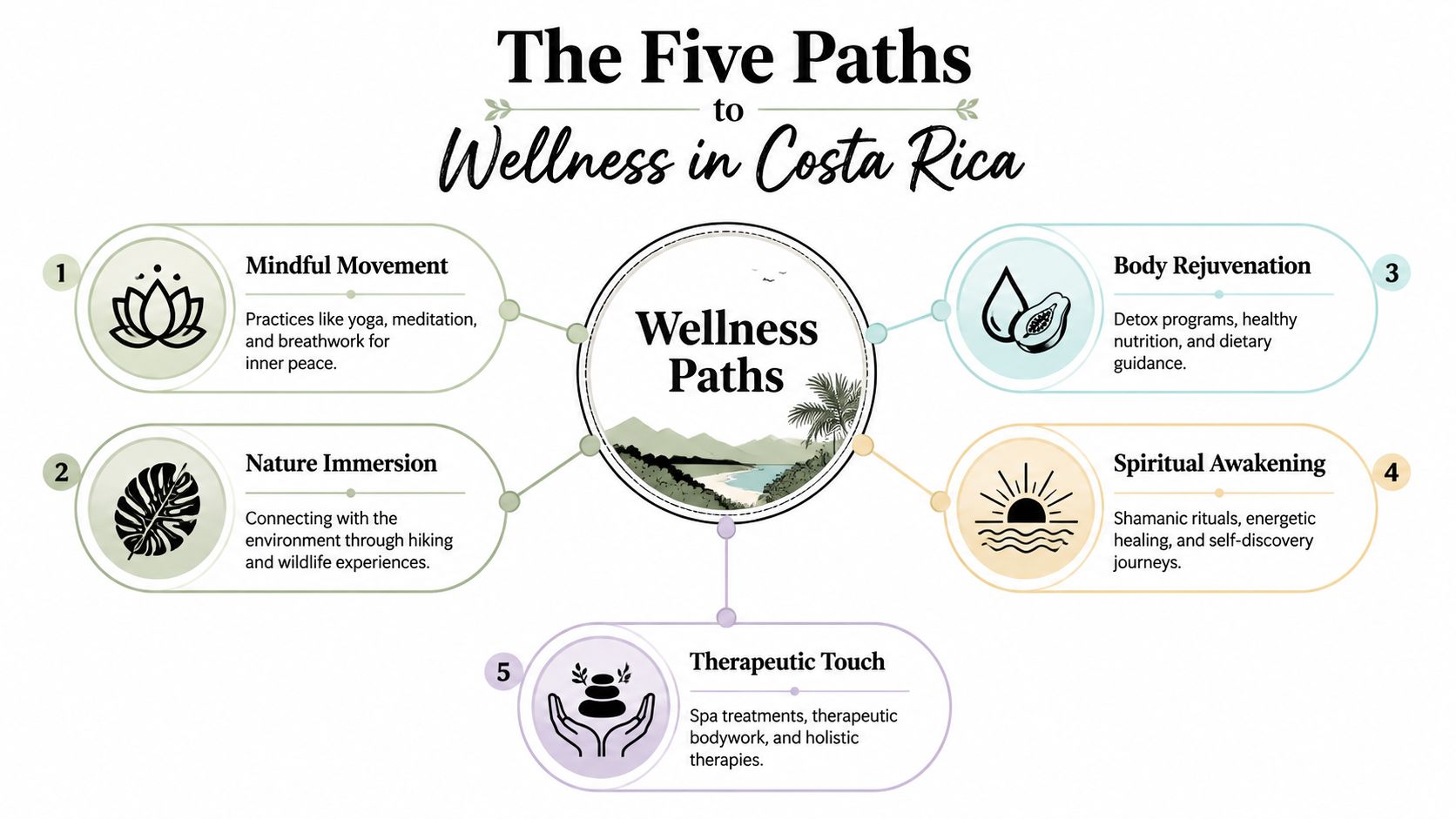
Costa Rica tends to deliver wellness through five distinct modalities. Each one asks something different of you. Each one produces a different kind of result. Choosing well means diagnosing your why first, then matching it to the right retreat style and, later, the right region.
Mindful movement
This is the most accessible path for first-time retreat guests. Yoga, meditation, and breathwork programs give structure without demanding that you adopt unfamiliar beliefs or jump into emotionally intense work. They often suit solo travelers who want steadiness, couples who want shared reset time, and busy professionals whose nervous systems respond well to routine.
The trade-off is depth.
A weak program gives you pleasant classes, healthy meals, and little else. You go home rested for a few days, then slide back into old habits. A stronger one builds in silence, reflection, recovery time, and teachers who know how to pace a group with mixed experience levels.
Nature immersion
Some travelers regulate best through movement, weather, water, and distance from screens. For them, healing happens faster on a jungle trail than on a meditation cushion. In Costa Rica, this path can include guided hikes, waterfall swims, surf sessions, wildlife observation, and outdoor practice that treats nature as part of the method, not just scenery.
This approach works especially well for people who feel mentally overstimulated or physically numb. It often creates faster traction than a studio-based retreat because the body is involved from the start. Retreats built around nature-based wellness experiences in Costa Rica can be very effective for guests who resist anything that feels overly packaged or performative.
The caution is simple. Adventure is not the same as restoration. If the itinerary is too active, the body stays in output mode and never settles.
Body rejuvenation and longevity
This path draws travelers who care less about ceremony and more about measurable improvement in how they sleep, eat, move, and recover. Good programs in this category focus on nutrient-dense meals, circadian rhythm, mobility, stress reduction, and enough downtime for the system to absorb the benefits.
Costa Rica has become a strong match for this style in part because of the interest around Blue Zone living. As reported in Condé Nast Traveler's coverage of the Blue Zone retreat in Costa Rica, the country has drawn increasing attention from travelers seeking longer-life habits in a setting that supports them.
This path works well for guests who want something grounded and evidence-aware. It works less well for anyone expecting profound emotional breakthrough from food, sleep, and spa treatments alone.
Spiritual awakening
This category deserves the most discernment. It may involve energy work, ceremony, intensive introspection, or plant medicine-centered experiences. For the right person, with the right preparation and support, it can be profoundly meaningful. For the wrong person, or in the wrong container, it can be destabilizing.
Ask harder questions here than you would anywhere else. Who is facilitating? What training do they have? How are guests screened? What support exists before and after the retreat? How is cultural respect handled if the work draws from Indigenous or ceremonial traditions?
Retreats in this category should be clear about pace, safety, contraindications, and integration. If the website sells transcendence and says very little about care, choose another option.
Choose the modality that matches your readiness, not the one with the most dramatic language.
Therapeutic touch and restorative care
This path centers on massage, bodywork, hydrotherapy, rest, and gentle movement. It suits travelers who are overextended, touch-deprived, physically tense, or uninterested in processing their lives in a group circle. It also fits couples and multi-generational trips, where people want shared renewal without committing to a single intensive format.
Its strength is immediacy. The body often responds quickly to skilled hands, warm water, quiet sleep, and less stimulation.
Its limitation is durability. On its own, restorative care can calm the system without changing the patterns that exhausted it. The better version pairs bodywork with time in nature, simple movement, or guided reflection.
A quick comparison
Path | Best for | Watch out for |
|---|---|---|
Mindful movement | Burnout, beginners, couples, routine reset | Retreats that feel too generic |
Nature immersion | Stress relief through movement and environment | Programs that mistake activity for healing |
Body rejuvenation and longevity | Sleep, vitality, prevention, graceful aging | Retreats that feel clinical or trend-driven |
Spiritual awakening | Deep inner work, experienced seekers | Weak screening and poor integration |
Therapeutic touch | Nervous system recovery, low-pressure renewal | Too little structure for lasting change |
Navigating Costa Ricas Wellness Regions
You can book two retreats with similar photos, similar promises, and similar prices, then have completely different outcomes based on region alone. One traveler comes home rested. Another comes home overstimulated, sunburned, and mildly disappointed. The difference is often less about the program description and more about the setting that holds it.

Costa Rica's wellness regions each support a different kind of healing. If your reason for going is nervous system repair, a busy surf town may work against you. If you need momentum, perspective, and physical reset, an isolated property can feel too quiet by day three. Matching your why to the right region matters as much as choosing the right modality.
Nicoya Peninsula
Nicoya suits travelers who want wellness with energy around it. Expect beach towns, yoga studios, surf culture, cafes, and a retreat scene that is easy to access and easy to understand. This is often the simplest entry point for first-time retreat travelers, solo guests who want some social contact, and anyone who prefers structure without feeling cut off from the world.
The trade-off is obvious once you arrive. Popular parts of Nicoya can feel curated, social, and busy. That works well for guests who draw energy from community and want choice. It works poorly for travelers who say they want quiet, then book in the center of a wellness hotspot.
Choose Nicoya for connection, movement, and a polished retreat rhythm. Choose it carefully if privacy is part of your healing plan.
Arenal and La Fortuna
Arenal fits a different profile. The environment itself creates contrast. Volcano views, rainforest, thermal waters, mist, and cooler evenings tend to support a rhythm of exertion followed by recovery. For many guests, that combination works better than a retreat built around stillness alone.
This region is a strong match for people who process through the body first. Hike in the morning. Soak later. Sleep soundly. Repeat.
The caution here is overprogramming. Some properties sell “wellness” but deliver a packed adventure itinerary with little time to absorb the experience. Arenal works best when activity is used with restraint and recovery is protected, not squeezed into the margins.
Southern zone near Dominical and Ojochal
The southern zone usually gives travelers what retreat marketing often promises but does not always deliver. Space. Quiet. Ecological immersion. Less traffic. Less performance. More contact with the natural world and fewer reminders of ordinary pace.
That changes the retreat experience in practical ways. Mornings tend to feel slower. Sound matters more. Weather matters more. The environment stops being a backdrop and starts becoming part of the work. Travelers drawn to grief processing, burnout recovery, creative reset, or low-stimulation healing often do well here.
It is not the right fit for everyone. The same remoteness that supports depth can feel confronting if you want variety, nightlife, or a lot of external stimulation. For a closer look at how setting shapes recovery, nature-based wellness in Costa Rica offers a useful reference point.
If deep rest is the goal, reduce friction in the day. Fewer transfers, less noise, less social pressure, and less visual clutter usually matter more than an impressive schedule.
Which region fits which traveler
A good regional match prevents expensive mistakes.
Choose Nicoya if you want beach access, established retreat culture, and some social life around the program.
Choose Arenal if you restore through movement, mountain scenery, hot springs, and a clear activity-recovery rhythm.
Choose the southern zone if you want privacy, stronger immersion in nature, and a setting that supports deeper inward work.
Budget and value
Retreat pricing in Costa Rica ranges widely, and the spread reflects real differences. Lower-cost options are often more communal, less personalized, and built around a standard template. That does not make them poor choices. They can be excellent for travelers who want structure, healthy food, and a clear reset without paying for exclusivity.
At the higher end, the money should show up in concrete ways. Better practitioner quality. More privacy. More thoughtful pacing. Stronger food program. Better sleep conditions. Cleaner design. Fewer people. Easier logistics.
Value comes from fit. A lively Nicoya retreat can be worth every dollar for someone rebuilding joy after a hard year. The same retreat can feel badly chosen for someone who really needed silence.
How to Choose Your Ideal Retreat Experience
Once you know your broad path and likely region, the decision gets more practical. At this stage, many travelers either book well or get distracted by aesthetics. The right retreat should match your intention, your social preferences, your energy level, and your tolerance for structure.
To keep it simple, use a short decision framework.

Start with your actual why
Don't begin with property photos. Begin with the outcome you want.
If your real issue is burnout, choose a retreat that protects quiet and sleep rather than one with a packed social schedule. If you're traveling as a couple, decide whether you want shared programming or more autonomy. If you're rebuilding habits after a difficult season, choose a retreat with repeatable practices, not just memorable moments.
A few useful questions help:
What am I hoping feels different when I get home?
Do I want support, privacy, community, or challenge?
Am I trying to rest, reconnect, process, or rebuild?
Evaluate the container
Retreats often sell the activities. Experienced travelers evaluate the vessel holding those activities.
Look at these variables closely:
Group size: Small groups tend to feel more intimate and less performative.
Facilitator reputation: You want clarity, not charisma alone.
Hospitality style: Boutique and warm is different from polished and impersonal.
Pacing: Too much free time can feel unheld. Too much structure can feel exhausting.
This short video captures some of the atmosphere many travelers seek when weighing Costa Rican retreat styles.
Don't guess on duration
Length matters more than many first-time retreat guests expect. The optimal duration for a Costa Rican healing retreat is 5 to 7 nights, because shorter stays often don't allow enough time for workshops, restorative environments, and deeper integration of wellness practices, according to Healing Holidays' Costa Rica eco wellness spa guide.
That aligns with what I see in planning. Three nights can feel pleasant, but often too compressed. The first days are spent arriving, exhaling, and adjusting. The deeper benefits usually come after that.
A retreat should have enough time for you to stop performing wellness and start inhabiting it.
Read inclusions like a contract
Two retreats with similar pricing may deliver completely different value. One may include airport transfers, bodywork, excursions, and thoughtful meals. Another may add charges at every turn
Check these points before booking:
Meals: Are all meals included, and is the food philosophy clear?
Treatments: Is massage or bodywork included or optional?
Excursions: Are hikes, hot springs, or ocean activities part of the package?
Transfers: Are logistics handled or left to you?
Downtime: Is there enough unscheduled space to absorb the experience?
Match the retreat to your travel style
A practical shorthand helps:
If you are... | You'll likely prefer... |
|---|---|
A beginner | A structured retreat with accessible practices |
A couple | A quieter setting with optional programming |
A solo traveler seeking community | A small-group format with shared meals |
A founder or executive | Privacy, strong hospitality, and flexible wellness design |
A brand or coach | A setting that supports both experience and community-building |
For wellness leaders, coaches, and brands, this isn't just personal travel. Costa Rica can also serve as a strong setting for hosting intimate gatherings that deepen audience trust and create real-world connection with a community.
An Intimate Alternative The Regenerative Stay
A couple arrives in Costa Rica wanting rest, privacy, and better sleep. By the second day of a standard group retreat, they realize the shared schedule is the problem. Early classes feel obligatory, meals are social when they wanted quiet, and the week starts to feel managed instead of restorative.
When the retreat format isn't the right fit
Some travelers want renewal without joining a group container. The friction points are predictable. Shared vulnerability can feel forced. Fixed programming can crowd out the very thing a tired nervous system needs, which is unstructured time. Couples, families, founders, and private groups often want the setting and care of a retreat, but with control over pace, privacy, and company.
That points to a different format.
A regenerative stay gives you a restorative base rather than a preset agenda. The property, service style, food, and setting support recovery, but the experience is shaped around your reason for coming. That might mean bodywork and quiet mornings. It might mean surf, forest walks, earlier dinners, and long sleep. It might mean gathering people you already trust for a more intentional few days together.
What this model offers
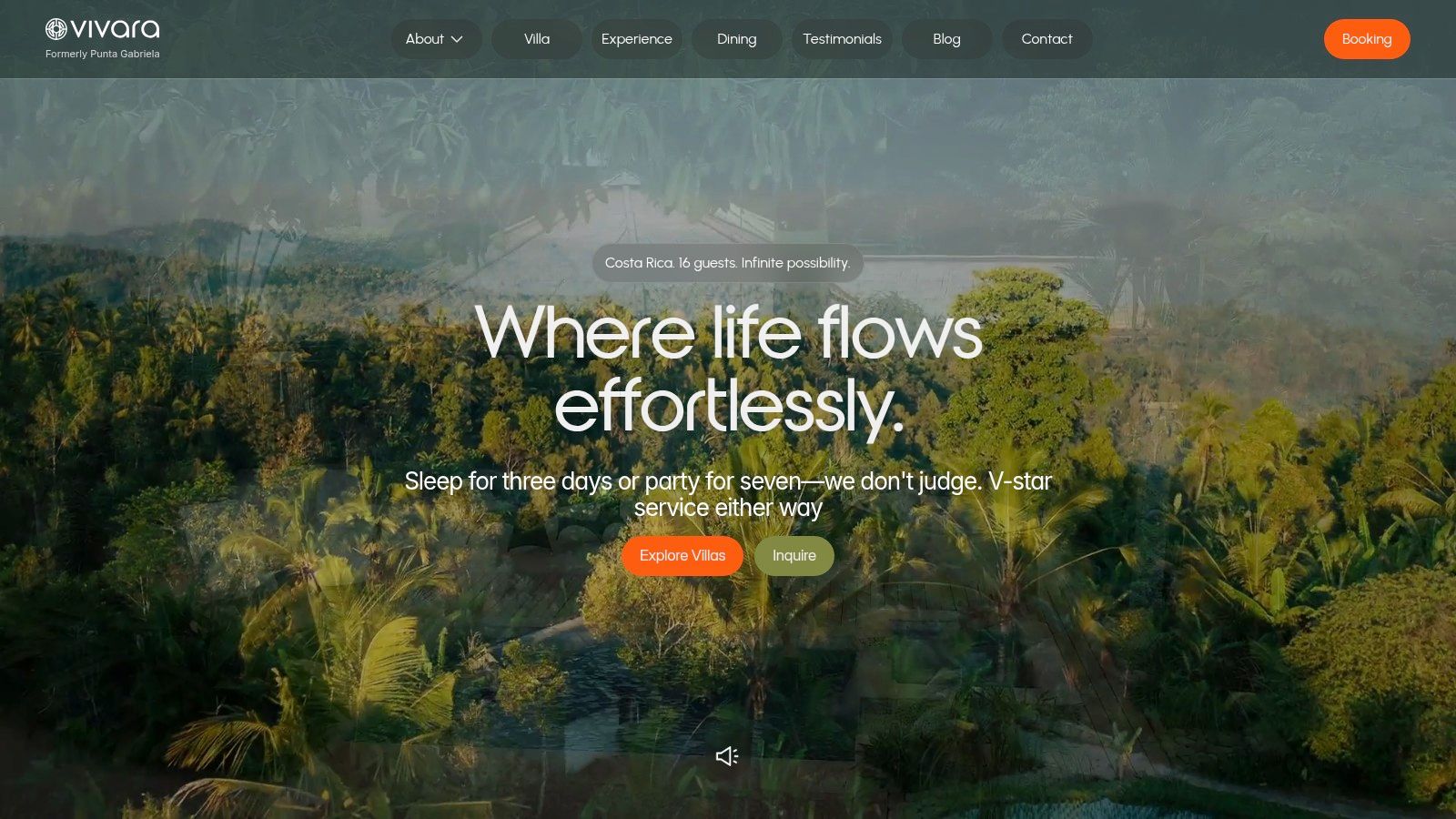
One example is an intimate retreat venue in Costa Rica designed for private stays and small gatherings. VIVARA in Dominical is a founder-led hospitality property built for couples, families, private groups, and hosted experiences. The difference is practical. Guests stay across distinct villas, meals are customized rather than pushed through a fixed menu, and the rhythm can stay quiet or become more active depending on the group.
This format tends to suit travelers who value:
Privacy: Space to rest without group expectations.
Flexibility: Wellness can sit alongside surfing, nature outings, or simple downtime.
Better fit for real relationships: Couples and families can stay connected instead of splitting into a public program.
Host control: Coaches, facilitators, and brand founders can shape the experience around their own community.
There are trade-offs. A private regenerative stay usually asks more of the guest or host upfront. Choices need to be made about pacing, activities, and group intent. Some people do better with the accountability of a published retreat schedule, especially if they are new to wellness travel or know they avoid structure. Others get better results when the environment supports change without over-directing it.
Why brands and community leaders pay attention
For practitioners, coaches, creators, and brands, this model offers something a standard retreat often cannot. It protects the feeling of intimacy. The setting holds the group, but the host keeps authorship over tone, timing, and content.
That matters in Costa Rica, where place does a lot of the work. In Dominical, the rainforest, ocean air, and slower rhythm already shift attention outward and down. A well-run private stay lets a host use that setting with intention instead of fitting their community into someone else's template.
The strongest outcome is not a busier itinerary. It is coherence. When the guest's why, the region, and the format match, the experience has a better chance of changing something after the flight home.
Your Next Step Toward Transformation
The right healing retreat in Costa Rica isn't the one with the most attractive website or the busiest itinerary. It's the one that matches your reason for going.
If you need a gentle entry point, mindful movement may be enough. If your body has been sedentary and your mind overstimulated, nature immersion often works better. If you care most about vitality, sleep, and sustainable routines, longevity-focused programming may be the better lens. And if you don't want a group retreat at all, a more private regenerative stay may fit your life far better.
The practical filters are simple. Know your why. Choose the region that supports that outcome. Be honest about whether you want community or privacy. Check what's included. Give the experience enough time to work. In Costa Rica, 5 to 7 nights is often the window where a retreat begins to move beyond pleasant and become meaningful, as noted earlier.
That's the promise of healing retreats in Costa Rica. Not escape for its own sake. Alignment. When the modality, setting, pace, and hospitality all fit, the trip stops being a break from life and starts becoming a better way back into it.
If you're comparing retreat formats and want a more private, design-led option in Costa Rica, VIVARA offers an intimate base in Dominical for couples, families, private groups, and community-led gatherings that want restoration, nature, and flexible experience design without a rigid group retreat structure.

