The Vivara Content Team
Intimate Wedding Venue: How to Plan a Meaningful Celebration
Intimate Wedding Venue: How to Plan a Meaningful Celebration

Most advice on an intimate wedding venue is backwards. Couples are told to trim the guest list, keep the menu elegant, and everything else will magically feel special. It won't. A true intimate celebration works because the venue is built around experience architecture, which means pacing, sightlines, acoustics, privacy, and service are designed for a small group from the start.
That's why the best small weddings don't feel like reduced versions of a big event. They feel more coherent, more social, and more emotionally complete. In Costa Rica especially, that matters, because the right property can turn a wedding into a few days of shared meals, nature, rest, and real connection instead of one long logistical sprint.
Why Intimate Weddings Are Not Just Smaller Weddings
A small guest list is only half the job. The true difference is whether the space feels intentionally made for 20 to 50 guests, or whether you've just inserted a tiny crowd into a ballroom that wants to be full. A 30-guest event in a room designed for 200 usually looks flat, sounds awkward, and forces the hosts to work harder to create energy that the venue should've provided naturally.
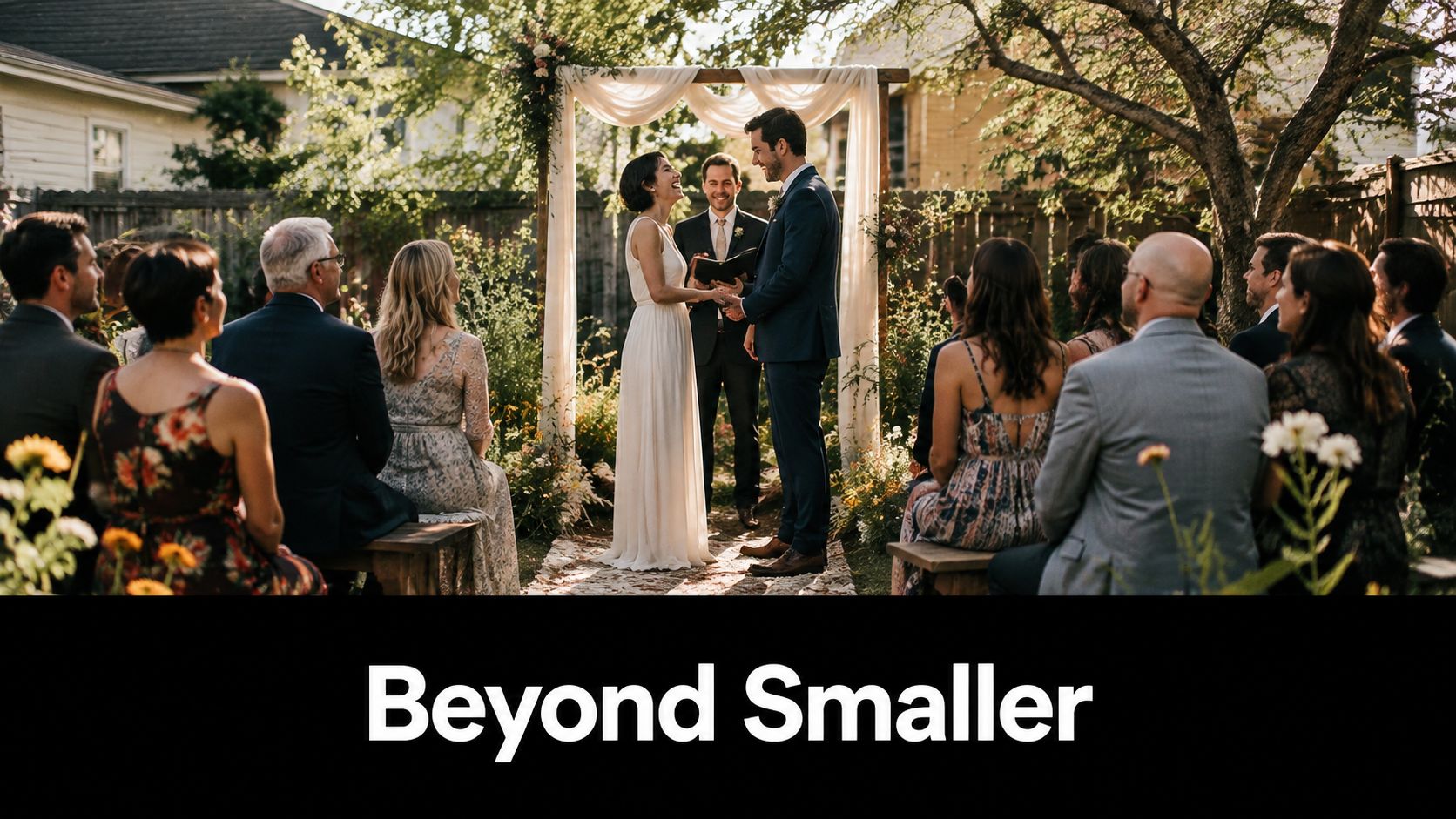
Intimacy Depends on pacing, not just headcount
For a real intimate wedding venue, the goal is conversational density. Guests should be close enough to hear one another, turn naturally into conversation, and stay visually connected without straining. That's why many planners treat 20 to 30 guests as the sweet spot for a true micro-wedding, while the broader planning range sits around 10 to 50 guests. The venue should feel sized for the event, not merely large enough to permit it.
The best small celebrations also spread the experience across time. A welcome dinner, a ceremony, a slow meal, and a farewell ritual create rhythm. They give guests space to arrive, settle in, and connect without the compressed feeling that comes from trying to force everything into a single evening.
A small wedding should feel complete, not abbreviated.
That's the standard I use. If the venue doesn't support that feeling through layout, pacing, and privacy, it's not an intimate wedding venue, it's just a venue with a smaller booking option.
Why generic venues fall short
Generic properties usually tolerate small weddings. Purpose-built intimate venues shape them. That difference shows up in how the guests move, where they gather, how easily the couple can greet everyone, and whether the celebration feels immersive or merely efficient. The more a venue assumes a large crowd, the more dead space it creates around a small one.
That dead space matters more than most couples expect. It weakens the atmosphere, complicates photography, and reduces the sense that everyone in the room belongs to one shared moment. If you want a celebration that feels warm and deliberate, choose a property that was designed with small-group flow in mind.
The Market Shift Toward Smaller Celebrations
The market has already moved. The Knot's 2026 Real Weddings Study found the average U.S. wedding size was 117 guests, based on a survey of 10,474 couples, and one industry summary cites a decline from 184 guests in 2006 to 117 in 2025 (The Knot). That points to a real change in how couples want to celebrate. Intimate wedding venues are responding by building capacity in this underserved range.
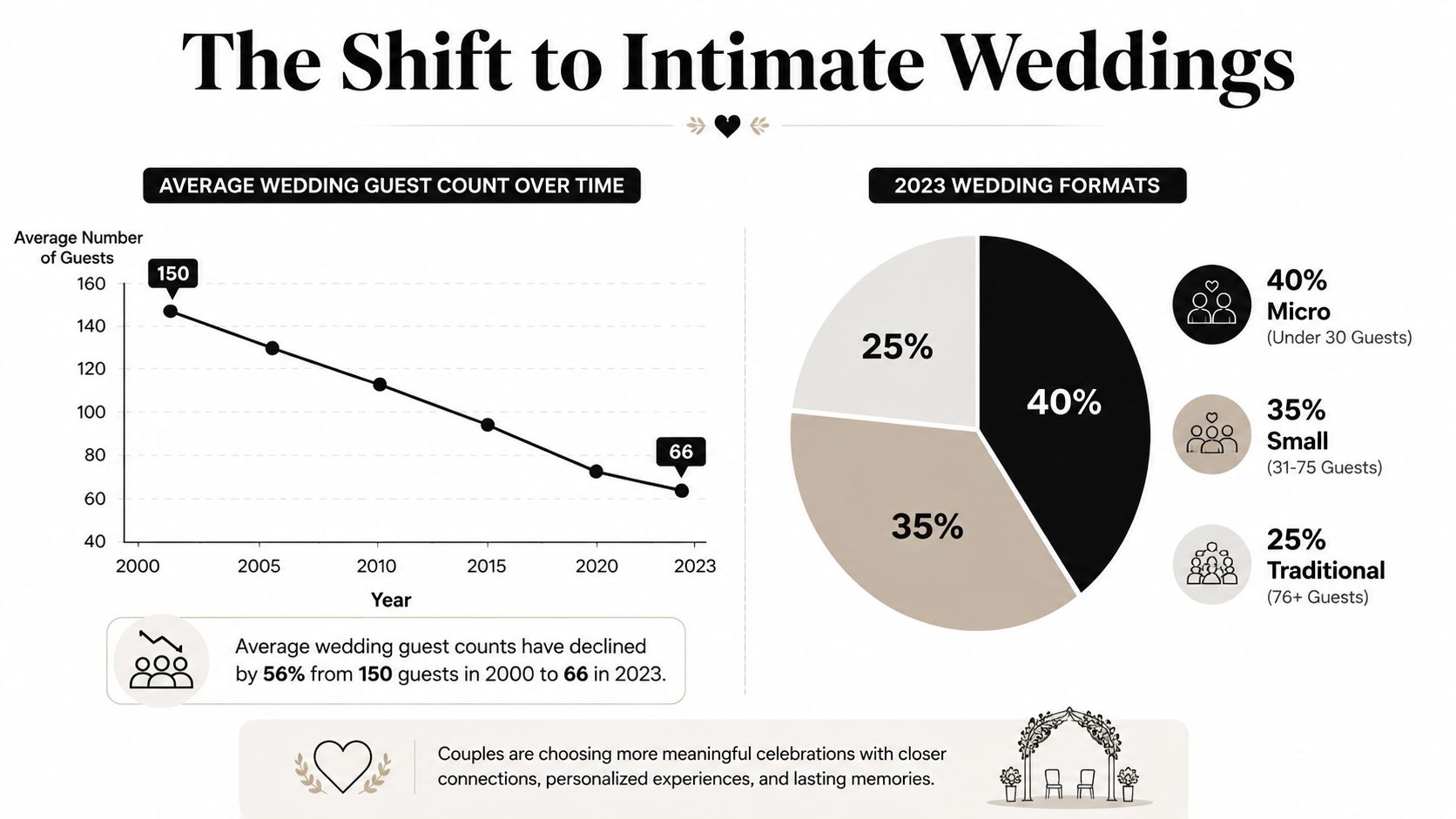
Demand is growing faster than venue supply
One industry analysis reported that weddings with 50 or fewer guests represented 18% of weddings in 2024, up from 10% in 2013 (MMCG Invest). The same source said 48% of couples consider micro-weddings, while only 6% planned sub-50 guest events in one 2025 dataset. That gap is the whole story. Interest is rising faster than execution.
Supply still lags. Many venues continue to require minimum guest counts averaging 100 to 150 guests, while 59% now offer micro-wedding packages and 78% require a minimum guest count to book. In practical terms, the 14 to 50 guest range is still underserved (MMCG Invest). Couples want privacy and design, but too many properties still think in banquet terms.
The smartest venues do more than accept smaller weddings. They know how to make them feel full.
That difference explains why intimate wedding venues are becoming a serious category instead of a style preference. The strongest properties know small events need tighter choreography, better acoustics, and more thoughtful hosting, not just fewer chairs.
What the data means for couples
If you are planning a small celebration, do not settle for a place that treats your guest count like a compromise. Look for venues that already work in the intimate range and can show you how they handle circulation, dining, photography, and private use. In a crowded market, that specificity is an advantage.
How to Evaluate an Intimate Wedding Venue
Start with the room itself. A venue can photograph beautifully and still fail at the basics if the layout fights the guest count. For speech-led ceremonies and dinner-first receptions, venue guidance recommends aisles around 900 to 1200 mm, chair-back clearance of at least 750 mm, and reverberation time around 0.6 to 0.9 seconds to protect vow intelligibility and conversation quality (Homestyler). Those aren't abstract design numbers. They're the difference between guests leaning in and guests straining to hear.
Check the space-to-guest relationship first
The venue should feel deliberately scaled for your event. If you're hosting 24 people, ask whether the room can still feel vibrant without relying on visual filler. Empty corners, oversized seating plans, and long service distances all sap energy from small events.
A strong intimate wedding venue usually makes the guest count look like an asset. It should create closeness without crowding, and openness without emptiness. If the team can't explain how they achieve that balance, move on.
Ask direct questions about flow and privacy
You need answers about circulation, sound, and exclusivity, not vague reassurance. Ask whether the ceremony aisle can be adjusted, whether the dining layout can change, and whether service paths stay out of guest sightlines. Privacy matters just as much. A venue that shares walls, walkways, or common areas with other events will dilute the experience fast.
Here's the practical checklist I'd use on a site visit.
Space-to-Guest Ratio: Can the room feel full and lively without being crowded?
Layout Flexibility: Can furniture and service paths adapt to a small group?
Acoustic Comfort: Can guests hear vows and dinner conversation without strain?
Privacy Guarantee: Is the event area exclusively yours?
Staff Presence: Are there enough people on the ground to deliver small-event service well?
If you want a resort-style comparison point, review an all-inclusive wedding option like Costa Rica wedding resorts all inclusive and compare its structure against a dedicated intimate property.
Don't overlook service choreography
Small weddings expose weak operations. In a large event, a little chaos disappears into the crowd. In a 20-person wedding, every delay is visible. Table timing, drink service, and the transition between ceremony and dinner all need to feel smooth, or the room loses momentum.
Real Intimate Wedding Formats That Work
I've seen three formats work consistently, and each one solves a different problem. The first is the single-day micro-wedding with around 20 guests. It's clean, efficient, and best for couples who care more about the ceremony and meal than about extended programming. The second is the family-only weekend, which gives people room to connect without the pressure of a full wedding production. The third is the retreat-style celebration, where the wedding becomes part of a longer shared stay.

The one-day micro-wedding
A one-day format works when the guest list is tight and the couple wants intensity without sprawl. Think ceremony, cocktail hour, dinner, and a short final toast. Nothing gets overprogrammed, and the energy stays focused because nobody is waiting for the next scheduled moment.
That format is strongest when the venue already has strong natural atmosphere. If the setting, architecture, and service are doing the heavy lifting, you don't need a long itinerary to make the day feel meaningful.
The weekend gathering
For family-heavy weddings, the weekend format is smarter. It softens the pressure on the wedding day itself and gives older relatives, children, and close friends time to settle in. A welcome dinner does more for emotional comfort than a lot of couples expect, especially when travel is involved.
A useful related planning reference is how to plan a vow renewal, because the pacing logic is similar. Small-group celebrations benefit from slower movement, clearer transitions, and fewer forced moments.
Don't cram intimacy into a timeline built for a 150-guest production.
That's the mistake that ruins a lot of otherwise beautiful weekends. If the group is small, let the format breathe.
The multi-day retreat style
This is the format that works best in Costa Rica. Recent trend coverage points to multi-day celebration weekends, private buyouts, chef's-table dining, editorial photography, and curated music as the dominant direction for micro weddings (Paperlust). That tracks with what feels good on the ground. Guests arrive, unwind, eat well, celebrate, and leave with a memory that feels layered rather than rushed.
For brands, founders, and community-led groups, this format also creates natural bonding. People talk more, stay longer, and share more of the experience instead of only showing up for a ceremony slot. That's a real advantage if the event is meant to build relationships, not just mark a date.
Why Costa Rica Works for Intimate Destination Weddings
Costa Rica gives you a rare mix of simplicity and richness. Foreigners can legally get married here without residency, and the process commonly requires only a valid passport, a sworn statement of marital status, and no residency waiting period. Some guides also note that blood tests and birth certificates are typically not required for civil ceremonies (Villa Punto de Vista). That makes the planning load lighter from the start.
The country also makes sense on the experience side. Wellness tourism reached about US$1 trillion in 2024 and is projected to reach about US$1.4 trillion by 2027 (Revista Summa). Costa Rica sits squarely inside that movement, which is why small weddings here often feel more restorative than transactional. You can pair the celebration with nature, recovery, and movement instead of treating the trip like a venue rental with palm trees.
Boutique retreat properties here are often intentionally small. One luxury retreat markets 6 rooms and a total occupancy of 12 to 14 guests, which shows how naturally the country supports private-group hospitality (Los Altos de Eros). That scale is ideal for couples who want a wedding weekend that feels private, not crowded.
Costa Rica versus other destination options
Compared with many European destinations, Costa Rica is easier to use for a small wedding because the legal setup is simpler and the travel experience is built around relaxation and activity, not just sightseeing. Compared with many Caribbean resorts, it usually offers a stronger blend of adventure, wellness, and terrain variety. You can move from ceremony to waterfall hike, surf session, or rainforest dinner without changing the entire tone of the trip.
For a property-level example, San Carlos, Costa Rica is a useful model of how the country's geography supports restorative travel. The point isn't just beauty. It's that the setting naturally supports a wedding weekend built around connection, good food, and time outdoors.
What matters most for practical travelers
If you want value, don't chase the lowest quote. Look for a venue that bundles privacy, service, and experience design into one coherent stay. In Costa Rica, that usually means a boutique property with strong food, flexible programming, and enough seclusion to make the group feel like it has the place to itself.
Your Intimate Wedding Planning Checklist
Start earlier than you think, especially for destination weddings. The legal side can create real lead time, since foreign couples should prepare passport identification, proof of single status, and sometimes apostilled or translated civil documents before the ceremony. One source notes a sworn declaration service fee of about US$55 for first marriages (ECIJA). If you're planning internationally, that document work needs to be handled before you fall in love with a specific date.
Intimate Wedding Planning Timeline | ||
|---|---|---|
Timeline | Task | Notes |
12 to 18 months out | Choose the venue and guest count | Prioritize privacy, acoustics, and buyout terms early |
9 to 12 months out | Confirm ceremony style and room layout | Ask how the space handles small-group flow |
6 to 9 months out | Secure legal documents and core vendors | Passport, marital status proof, and translations may take time |
3 to 6 months out | Finalize food, music, and pacing | Small weddings rise or fall on service choreography |
Final month | Review arrival timing and guest communication | Make travel, check-in, and event transitions easy |
Budget for experience, not excess
For intimate weddings, the smartest spending usually goes toward the venue, the food, and the service team. If you're buying out a private property, you're paying for control, calm, and uninterrupted use of the space. That's where the value lives. Shared venues can work, but only if the privacy and timing still feel locked in.
Ask the questions that expose fit
Do they allow exclusive use? Can the menu be customized? What happens if rain changes the plan? Can the event move fluidly from ceremony to dinner without resetting the whole room?
Those questions tell you more than any brochure. A venue that handles small weddings well will answer quickly and specifically. A venue that merely tolerates them will stay vague.
One option worth reviewing in this category is VIVARA, which offers intimate gatherings and full-estate private use for small groups in Costa Rica. If that model fits your plans, ask how the property handles meals, guest movement, and multi-day pacing before you sign anything.
The Deeper Value of Intimate Celebrations
An intimate wedding isn't a compromise on scale. It's a decision to prioritize presence over performance. When the guest list is smaller, the couple gets more actual time with each person, and the celebration stops feeling like a blur of greetings, logistics, and missed conversations.
That's why this format works so well for couples who want more than a party. It supports relationship building, burnout recovery, creativity, and shared reset. For brands or founder groups, it also creates a stronger bond with the community because people don't just attend, they participate. They eat together, talk longer, and remember the event as a shared experience instead of a staged appearance.
The best intimate wedding venue doesn't just fit fewer people. It gives those people a better rhythm, better food, and better space to connect. In Costa Rica, that often means nature, privacy, and boutique hospitality working together instead of competing for attention.
If you're comparing options, choose the property that makes the small format feel complete. For a retreat-forward wedding weekend with private hospitality, curated experiences, and space for real connection, explore VIVARA.

