The Vivara Content Team
Luxury Outdoor Spaces That Feel Like a Resort
Luxury Outdoor Spaces That Feel Like a Resort

You arrive at a Costa Rica retreat expecting beautiful views, but beauty alone doesn't determine whether the experience feels luxurious. The difference appears in the first few minutes, in how the team receives you, how naturally the outdoor environment guides you, and whether the outdoor spaces help you recover, connect, celebrate, or explore without friction.
For affluent travelers, couples, families, friends, and brands planning a retreat, luxury outdoor spaces are hospitality infrastructure. They shape the day's rhythm, support wellness and adventure, create memorable shared rituals, and give a property a physical expression of its values. Costa Rica is particularly suited to this approach, with rainforest, rivers, beaches, wildlife, local food traditions, and a strong sustainable-tourism culture.
Arriving at a Luxury Outdoor Space
The private drive curves beneath mature native plantings. You don't see a sign, a service cart, or a line of parked vehicles. Before anyone offers a formal welcome, a host appears with a cold towel and an electrolyte drink. Moving water replaces background music, and the first clear view is aimed toward a horizon-facing seating cluster rather than a reception desk.
That sequence matters. A polished retreat doesn't treat arrival as a handoff from transport to accommodation. It treats arrival as the first programmed experience, with the operational details kept out of sight.
The valet or cart drop should disappear behind planting or architecture. Paths need enough width for two people to walk together comfortably, without forcing one guest into the greenery. A change from timber to stone, or from smooth paving to textured gravel, can mark the transition from public to private more elegantly than a door or sign.
Practical rule: Guests should feel the property becoming more private before a staff member explains that it is.
The first sensory decisions
Premium quality is often recognized through subtraction. Mechanical noise is controlled. Decorative objects are limited to one architectural focal point. Shade and sun create a deliberate temperature contrast, while herbs or crushed stone release a subtle fragrance underfoot.
The seating cluster should frame the destination's strongest view, whether that's the Pacific horizon, a forested slope, or a garden that supports birds and pollinators. Furniture doesn't need to fill the arrival area. Empty space gives the view authority and allows guests to pause without feeling managed.
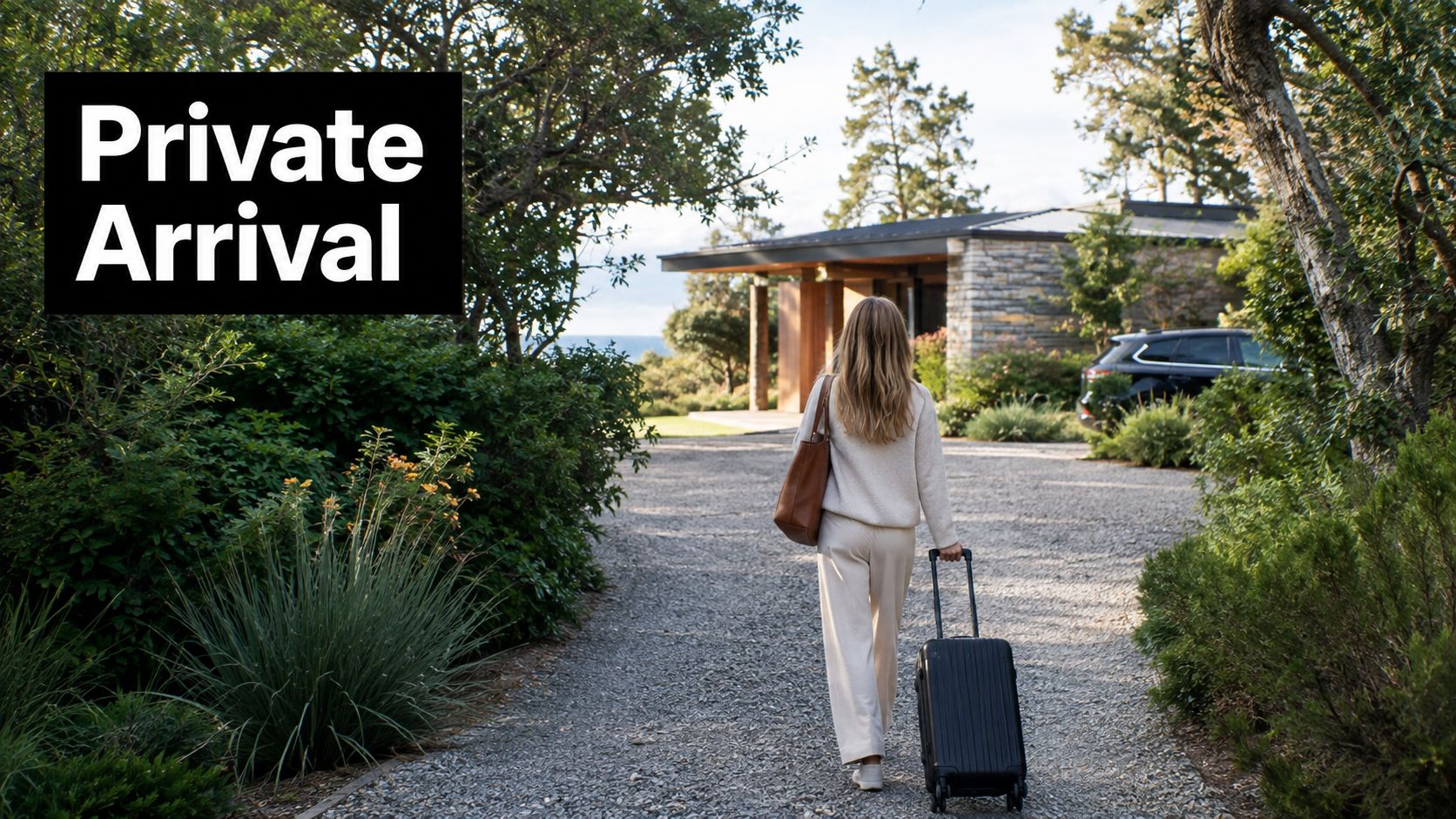
The test is simple. Could a guest understand the property's service standard without hearing a sales pitch? If the first outdoor threshold exposes carts, cleaning equipment, awkward circulation, or leftover furniture, the property has designed a patio. If it choreographs anticipation, orientation, comfort, and privacy, it has designed an experience product.
What Actually Makes an Outdoor Space Feel Luxurious
Luxury outdoor spaces aren't created by adding expensive furniture to a large terrace. They work as a stacked system of seven layers, and each layer has an operational job.
Seven layers that carry the experience
Spatial composition establishes proportion, movement, and privacy. Premium resort design often gives softscape more visual presence than hardscape, with a balance that sits closer to 40/60 between hard surface and planted areas. That ratio isn't a rule for every site, but it prevents the common mistake of building an outdoor room that feels like a paved parking area.
Materiality determines how the property feels underfoot, in the hand, and after years of exposure. Stone, wood, metal, and textiles should age with visible character rather than peel, crack, or look temporarily disguised.
Lighting needs separate ambient, task, accent, and path functions. Blue-rich fixtures create a clinical mood and can interfere with circadian comfort and wildlife, so warm, shielded sources are the better hospitality choice.
Ecology turn planting into living architecture. A layered canopy, mid-story, and understory create shade, privacy, habitat, and changing views instead of a flat decorative border.
Amenities must work in actual weather. Water, fire, shade structures, outdoor kitchens, rinse stations, and climate-control features should support use rather than serve as showroom props.
Service model answers who appears, when they appear, and how discreetly they move. A beautiful pool loses its authority when staff cross the guest's sightline with supplies.
Programming gives the space a reason to matter throughout the day. Coffee, yoga, dining, swimming, guided nature encounters, and evening fires turn visual appeal into memory.
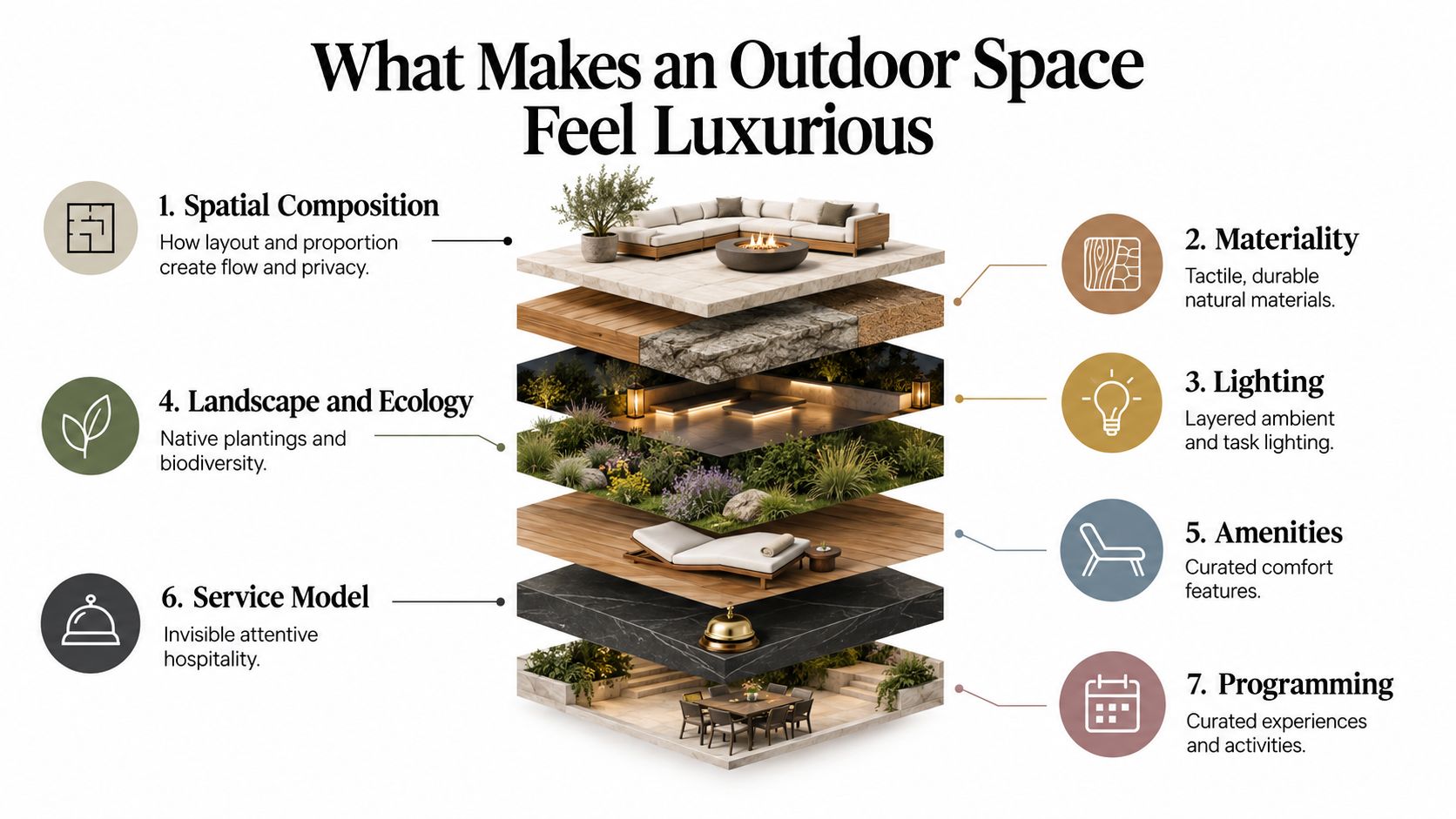
Remove one layer and the experience weakens. Excellent materials can't rescue poor circulation. Strong planting can't compensate for bad lighting. A well-staffed property can't overcome a pool terrace with no shade or a dining area exposed to service traffic.
The commercial case is substantial. The global outdoor living market was estimated at USD 28.5 billion in 2022 and projected to reach USD 45.2 billion by 2030, implying a 6.2% CAGR over that period, according to outdoor living market estimates. Outdoor living structures alone were forecast to grow from about USD 2.5 billion in 2025 to USD 4.0 billion by 2033, which reinforces the shift from decorative outdoor additions toward serious residential and hospitality infrastructure.
For a retreat operator, this stack also creates brand value. Guests remember how a property made them feel in motion, at rest, around a table, and inside a shared ritual. Brands can use that environment to build community through workshops, creator gatherings, team resets, and repeatable experiences that feel native to the place.
Materials and Lighting That Signal Premium Quality
A dressed-up patio photographs well on opening day. A luxury outdoor space still looks considered after years of sun, rain, salt, wet towels, food service, and repeated furniture movement.
Start with materials that have a credible aging story. Dense hardwoods such as teak and cumaru are better suited to demanding outdoor use than soft cedar. Large-format natural stone with calibrated joints reads quieter and more substantial than stamped concrete. Powder-coated aluminum or weathering steel generally offers a more controlled lifecycle than painted steel, which can chip and expose corrosion.
Marine-grade fabrics with solution-dyed acrylic resist the visual decline that quickly makes an outdoor lounge look tired. In wet zones, porcelain pavers rated R11 or higher provide a stronger slip-resistance specification than a surface selected only for color. These choices matter because guests notice texture and maintenance indirectly. A stained cushion, uneven joint, or rusting frame tells them the operation has lost control.
Lighting should be designed as a layered service system, not scattered decoration.
Layer | Recommended Specification | Why It Matters | Failure Mode to Avoid |
|---|---|---|---|
Ambient | 2700K concealed or indirect fixtures | Creates warmth without flattening the landscape | Bright overhead glare |
Task | 3000K fixtures at dining and preparation points | Supports reading menus, serving food, and movement | Underlit work surfaces |
Accent | 2400K narrow-beam sources | Adds depth to trees, walls, and architectural focal points | Over-lighting every object |
Path | Shielded fixtures under 100 lumens | Guides movement while protecting dark-sky comfort | Unshielded lights shining into rooms |
Use glare shields wherever guests sit or recline. Aim mature-tree uplighting at 30 to 45 degrees, rather than straight up, so the trunk and canopy read as a composition instead of a harsh spotlight. Keep fixtures discreet, serviceable, and accessible without damaging planting.
Contract-grade durability deserves equal attention. In the United States, ANSI/BIFMA X5.4 is the de facto benchmark for lounge and public seating, while Europe uses EN 581-1/2/3 for outdoor seating and tables. These standards assess stability, frame strength, cyclic loading, armrest and backrest loads, and tip resistance, simulating roughly 10 to 15 years of heavy commercial use according to outdoor furniture standards guidance.
If a material needs constant cleaning or a fixture fails within two seasons, it isn't premium. It's theatrical.
Designing Zones That Flex From Two to Fourteen Guests
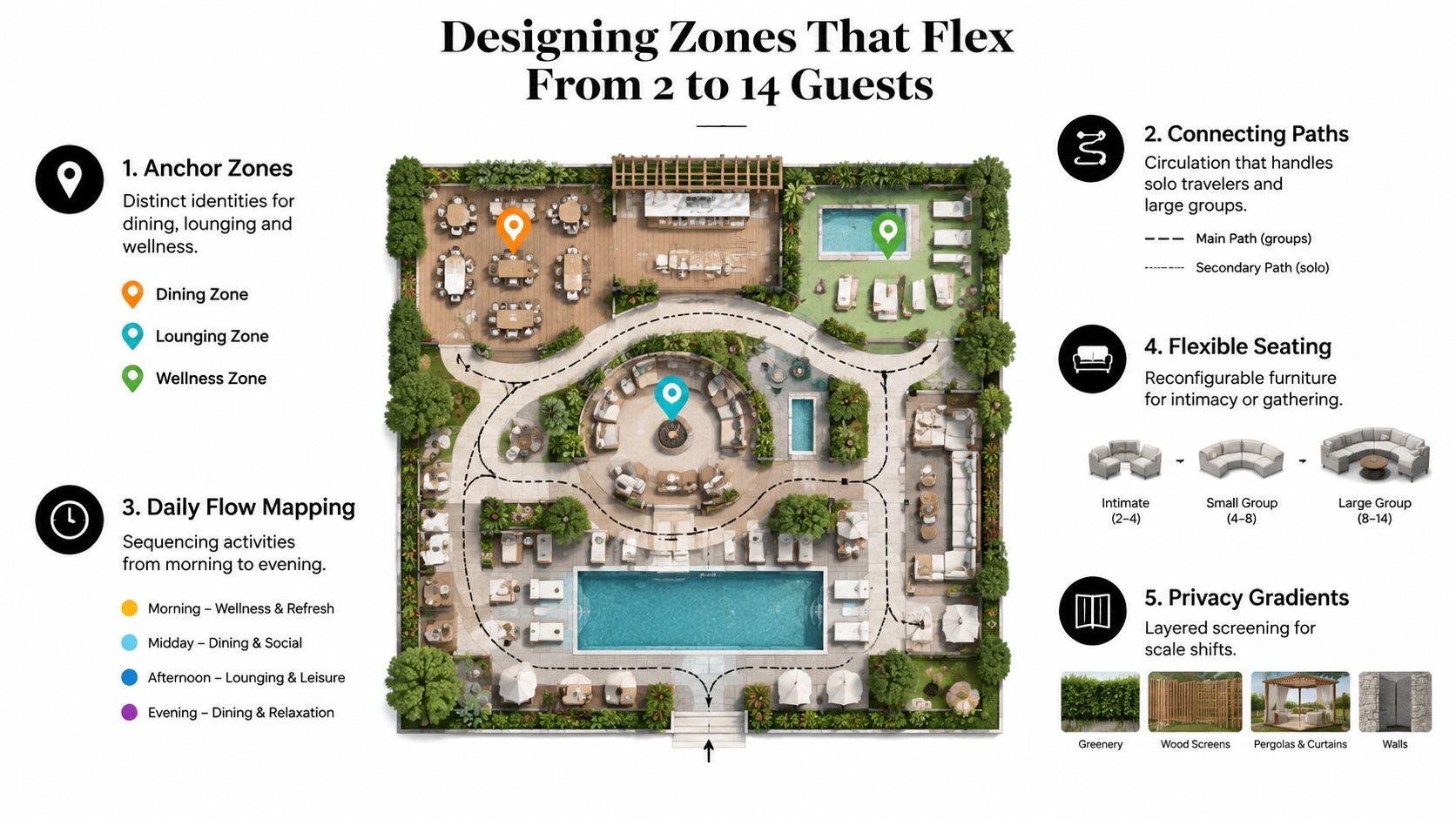
Design the outdoor floor plan like a small hotel. Guests should understand where to eat, rest, swim, work, and gather without needing a map, while staff should be able to serve every zone without cutting through someone else's private moment.
Begin with the day rather than the furniture catalogue. Assign a physical setting to sunrise coffee, a mid-morning swim, a shaded lunch, an afternoon treatment, sunset drinks, and a late-night fire. Each moment needs a distinct atmosphere, even when several settings share the same view.
Build the anchors first
A two-person breakfast deck can sit close to the kitchen, while a sunken lounge for six occupies the best conversational position. A banquet table for fourteen can take the broadest terrace, with planting or a low wall separating it from quieter seating.
Paths should connect those anchors without creating a runway through the middle of a gathering. A pergola threshold, a step-up platform, or a shift from stone to timber can mark the change from dining to wellness without signage. Privacy should increase gradually, from open social areas to screened reading corners and private terraces.
Design for change, not just capacity
Modular furniture allows a lounge to support a couple in the morning and a group gathering later. Retractable shade keeps the same zone usable as the sun moves. Movable lighting can shift the mood from a quiet dinner to a celebration without adding temporary equipment.
Service access needs its own plan. Tray routes, towel drops, waste removal, beverage replenishment, and bartender stations should remain invisible from guest seating. A property that can't restock discreetly will either interrupt the experience or under-serve the space.
Run a capacity stress test before approving finishes. Can fourteen guests move from pool to dinner in under five minutes without crossing another group's quiet moment? If they can't, redesign the circulation spine first. No stone, fabric, or lighting package will solve a bad sequence.
Climate, Sustainability, and Regenerative Outdoor Design
Decorative luxury ages badly when the climate pushes back. Imported turf, heat-absorbing surfaces, thirsty planting, and exposed furniture may look impressive at completion, but they place the operating burden on water, maintenance teams, and future guests.
The stronger alternative is a regenerative system that produces value after opening. That can mean food, habitat, shade, soil health, water capture, or lower energy demand. It also gives a retreat a more credible story to share with guests and brand partners.
Compare the tradeoffs honestly
An imported marble pool deck can signal status, but it may radiate heat, demand frequent cleaning, and rely on materials transported from far away. A locally sourced stone deck paired with a shaded dark-water mirror pool can deliver a similarly composed visual effect while supporting regional craft and improving comfort.
Ornamental lawn offers a familiar green surface, but it can consume substantial water and requires regular cutting, edging, and replacement. Weather-adjusted irrigation with drip lines, rainwater storage, native groundcovers, and edible pollinator gardens creates a more resilient setting with multiple guest-facing uses.
The regenerative menu can include:
Rainwater systems: Cisterns can feed irrigation where site conditions and local regulations allow.
Solar shade: Canopies can provide outdoor comfort while supporting on-site energy generation.
Native corridors: Trees and layered planting can cool microclimates, improve habitat, and create privacy.
Edible plantings: Herbs, fruit, and pollinator plants can connect the garden to the kitchen and guest programming.
Dark-sky lighting: Shielded, warm fixtures can preserve nighttime atmosphere and reduce unnecessary disturbance.
A property doesn't need to advertise every technical decision. Guests experience the result through cooler seating, better food, quieter nights, richer wildlife encounters, and fewer visible maintenance compromises. The design philosophy described in this guide to regenerative tourism is especially relevant to retreats that want environmental responsibility to operate as part of the guest experience rather than remain a marketing statement.
Luxury outdoor clients increasingly include high-net-worth individuals. One industry summary reports that 68% of luxury landscape clients in the United States are high-net-worth individuals, while 45% of luxury landscapes included biophilic design elements in 2023 and 38% prioritized sustainable hardscaping using recycled materials, as detailed in luxury landscape design market data. The same source estimates the global luxury landscape design market at $22.5 billion in 2023 and projects a 9.1% CAGR from 2024 to 2030.
The most valuable outdoor space won't cost more to install. It will generate more comfort, ecology, usable time, and meaningful programming once guests arrive.
Programming Experiences From Coffee Service to Canyoning
A beautiful outdoor room is a stage. Programming supplies the reason to stay for the second act.
Start with an arc that moves between restoration, discovery, nourishment, and celebration. Dawn coffee can arrive on a private terrace. Mid-morning might bring a guided river swim or farm visit, followed by a shaded lunch beneath a canopy. The afternoon can shift to a spa cabana or yoga deck, then move toward sunset cocktails beside a fire pit.
An adventure experience needs more than an itinerary listing. A canyoning departure point should have gear storage, a rinse station, towel access, and a shaded recovery area. A river excursion needs a comfortable return sequence, with dry clothing, hydration, and food ready before guests have to ask.
Give every activity a home
Use the property's outdoor spaces as operational bases:
Dining: A butler per six guests for outdoor dining keeps service attentive without making the table feel staffed.
Adventure: A guide per four guests supports safety, pacing, and personal attention during active excursions.
Wellness: One therapist per booking protects privacy and keeps the treatment experience focused.
These staffing ratios are specifications for a service model, not universal laws. They should change with terrain, activity risk, guest needs, and the operator's service promise.
The best programs also tie the property to place. Visiting chefs, conservation talks from resident biologists, local cultural performances, and farm or fishing relationships give guests a reason to value the destination beyond its scenery.
A Costa Rica itinerary can include whale watching, rainforest hikes, open-water swimming, horseback riding, paragliding, or a private sunset cruise. For guests comparing active retreats, this Costa Rica canyoning guide helps clarify the difference between a passive nature stay and an experience built around guided movement, recovery, and local terrain.
Set an operating standard: every outdoor area should host at least three programmed moments daily. Otherwise, the space is waiting for guests to invent its purpose. Premium hospitality does the harder work in advance, creating enough structure to make participation easy while leaving enough freedom for guests to change the rhythm.
Inside a Costa Rica Retreat Built Around Outdoor Living
VIVARA in Dominical provides a useful example of outdoor living treated as a complete hospitality product. The property is designed for up to 14 guests across architecturally distinct villas, allowing the surroundings to support both private restoration and shared experiences.
Arrival begins beneath a tropical canopy rather than at a conventional hotel lobby. Open-air pavilions use teak and local stone to establish a tactile palette, while infinity-edge pools visually connect with the Pacific horizon. Gardens operate as habitat as well as scenery, giving the outdoor environment a role in the property's ecological identity.
Where design meets the operating day
The programming follows the architecture. Guests can begin with dawn yoga on a timber deck, gather for chef-led dinners lit by fire bowls, and move into guided hikes through surrounding reserves. Conservation briefings hosted by resident naturalists add meaning to the area, turning a view into a place guests understand and remember.
The service model stays intimate. Small staff-to-guest ratios support personalized attention without creating visible congestion, while locally sourced food and beverage connect meals to Costa Rican producers and coastal and jungle ingredients. The property's relationship with land stewardship gives the outdoor experience a purpose beyond appearance.
This is the seven-layer system in operation. Spatial composition creates a sequence from villa to pavilion to pool and garden. Materiality gives the spaces warmth and durability. Lighting supports dinner and nighttime movement. The grounds provide shade, habitat, and privacy. Amenities support swimming, dining, and wellness. Staff move through the experience with discretion. Programming makes the spaces active from morning through evening.
For travelers evaluating fit, the practical question is not whether every activity appeals to you. It's whether the property can shape the experience around your reason for traveling, whether that's burnout recovery, relationship building, adventure, a family gathering, a creative reset, or a brand community event. What to expect at VIVARA is the right starting point for assessing the setting, service rhythm, and style of stay.
Costa Rica has the supply and infrastructure to support premium experience-led retreats at meaningful scale. A 2026 biodiversity and tourism report states that the country has 28,000 rooms across 1,671 hotels nationwide, according to Costa Rica tourism information from the Convention on Biological Diversity.pdf). A separate 2026 wellness-travel industry source reports that four boutique wellness hotels introduced since early 2023 increased local wellness accommodation capacity by roughly 65%.
The destination also supports trust through formal sustainability training. Costa Rica's Sustainable Tourism Certification ecosystem includes training in sustainable tourism, social responsibility, and innovation, as shown through CST training opportunities. That operational foundation matters to travelers and brands that want their retreat experience to align with community and environmental values.
Choosing or Designing Your Own Luxury Outdoor Space
Whether you're comparing a Costa Rica retreat, renovating a private estate, or presenting a hospitality concept, start with an audit rather than a mood board.
Walk the site at different times of day and record the view lines, shade, wind, privacy, noise, drainage, and utility capacity. Note where guests naturally stop and where staff would need to move. Then separate must-have amenities from programmed experiences. A pool may be essential for one group, while a shaded dining pavilion, treatment deck, or protected fire area may deliver more value for another.
Use a phased decision process
Quick wins: Improve lighting, planting, furniture layouts, soft furnishings, and arrival cues before committing to construction.
Operational upgrades: Add storage, rinse stations, hidden service routes, shade systems, and outdoor food-service capacity.
Structural investments: Consider pavilions, pools, outdoor kitchens, retaining walls, and major drainage only after circulation and programming are proven.
Professional support: Use an architect for site, ecology, and planting complexity. Add a hospitality consultant when service choreography, revenue strategy, or group programming matters.
Budget guardrails should protect experience rather than encourage overbuilding. Spend first on shade, drainage, durable surfaces, comfortable seating, useful lighting, and service access. Avoid expensive features that have no clear guest ritual, no maintenance plan, or no role in the property's positioning.
Vet operators, contractors, and suppliers by asking for material warranties, maintenance schedules, commercial references, replacement timelines, and examples of projects after several seasons of use. For retreat buyers, request a clear itinerary, inclusion list, group-size policy, staff availability, food approach, sustainability practices, and realistic expectations for weather and activity levels.
Quality survives through operating discipline. Require a nightly reset, scheduled maintenance cycles, guest feedback loops, and a quarterly review of how the outdoor spaces perform against revenue, repeat demand, guest satisfaction, and team workload. A beautiful setting becomes a durable hospitality asset only when someone owns those details.
For Costa Rica travelers, compare retreat types by group size, location style, duration, inclusions, activity intensity, privacy, food service, and purpose. Couples may want private terraces and unhurried wellness. Families need flexible zones and easy access to nature. Friends and brands need spaces that can move from intimate conversation to a shared event without losing coherence.
VIVARA offers an intimate, founder-led retreat in Dominical for couples, families, friends, teams, and brands seeking nature-rich connection, personalized service, chef-led dining, wellness, and guided Costa Rica adventures. Visit VIVARA to compare an experience-led stay with the outdoor living principles that make a retreat feel restorative, social, and memorable.

