The Vivara Content Team
What Is Regenerative Tourism and Why It Matters Now
What Is Regenerative Tourism and Why It Matters Now

“Leave no trace” sounds like the gold standard of responsible travel. It's a useful starting point, but it asks too little of tourism in places already carrying the effects of extraction, habitat loss, overcrowding, and uneven economic benefit. Regenerative tourism asks a more demanding question: after visitors leave, is the destination measurably stronger than before they arrived?
For travelers considering a wellness retreat, private villa, family escape, or nature-focused group experience in Costa Rica, that distinction matters. A low-impact stay may conserve water and reduce waste. A regenerative stay should also help restore ecosystems, strengthen local livelihoods, support cultural continuity, and give guests a meaningful role in that work. The promise is compelling, but the proof requires more than beautiful language.
Why Leaving No Trace Is No Longer Enough
The “leave no trace” ethic teaches travelers to minimize damage. Carry out your waste, respect wildlife, stay on marked trails, conserve water, and avoid treating a living destination like a theme park. Those habits remain essential, particularly in biodiverse places such as Costa Rica. Yet harm reduction alone doesn't demonstrate recovery.
A destination can preserve a forest fragment while nearby soils lose fertility, waterways face pressure, and local residents receive little of the value created by visitors. A hotel can reduce plastic consumption while importing most of its food, hiring decision-makers from elsewhere, and sending tourism revenue away from the community. These actions may be responsible, but they don't necessarily improve the wider system.
Academic literature increasingly defines regenerative tourism as a destination-scale approach that creates net-positive effects by increasing the regenerative capacity of human societies and ecosystems. That means assessing whether ecological and socioeconomic conditions improve against a baseline, using indicators such as biodiversity gain, carbon sequestration, soil health recovery, and water-system regeneration. Recent academic research on regenerative tourism describes this shift from reducing harm to building capacity.
Preservation versus active stewardship
Sustainable and conservation-focused travel often protects what remains. Regenerative travel adds active repair. The difference appears in the outputs a property or destination tracks:
A preserved area may limit disturbance and maintain existing habitat.
A regenerative project may document habitat restoration, species return, soil recovery, or watershed improvement.
A responsible guest may follow local guidelines.
A regenerative guest experience may also support community-led restoration or locally governed conservation.
Costa Rica offers a useful setting for this evolution. The country is widely associated with ecotourism and protected areas, yet its next challenge is not only attracting nature-conscious visitors. It's designing tourism so visitor spending, guest behavior, and hospitality operations help strengthen the places that make travel attractive in the first place.
Practical rule: “Low impact” describes what a stay avoids. “Regenerative” should explain what the stay improves, how the improvement is measured, and who remains accountable.
By the end of your evaluation, you should be able to define regenerative tourism clearly, distinguish it from sustainable and responsible travel, identify credible principles, and ask useful questions before booking a retreat.
Regenerative Tourism vs Sustainable and Responsible Travel
These terms overlap, which is why travelers often encounter confusing claims. The simplest way to separate them is to compare the goal, ownership, measurement, time horizon, and relationship to place.
Responsible travel begins with the individual. You behave respectfully, choose local businesses, follow environmental rules, and recognize that residents have a say in how tourism develops. Sustainable travel broadens the lens to the operation or destination. It aims to keep environmental, cultural, and economic impacts within limits over time. Regenerative tourism goes further by targeting restoration and local value circulation, with benefits that exceed the tourism load.
Criteria | Responsible Travel | Sustainable Travel | Regenerative Tourism |
|---|---|---|---|
Primary goal | Reduce careless or harmful behavior | Maintain a viable balance between tourism and destination systems | Create net-positive ecological, cultural, and social outcomes |
Ownership structure | The traveler makes ethical choices | The operator manages impacts responsibly | Local people have meaningful influence, ownership, or benefit-sharing |
Measurability | Conduct can be assessed through policies and behavior | Resource use, emissions, waste, and community effects can be monitored | Baseline-to-date ecological and socioeconomic improvement is tracked |
Time horizon | The current trip and its immediate effects | Ongoing operational performance | Long-term recovery that continues beyond one guest's stay |
Relationship to destination | The traveler respects the place | The business operates within its limits | Tourism actively contributes to the place's ability to regenerate |
The technical distinction is important. Research on regenerative tourism describes repeated ecological-footprint analysis alongside socioeconomic indicators, with a destination considered net-positive only when resource regeneration, ecosystem restoration, and local benefits surpass tourism pressure over time. This sustainability research also makes clear that regeneration isn't a replacement for basic sustainability. A retreat that wastes energy, strains water supplies, or treats employees unfairly can't claim a regenerative identity because it sponsors a tree planting.
Why the distinction matters in Costa Rica
Costa Rica's forests, coastlines, wildlife, and rural communities create genuine opportunities for restoration-based hospitality. They also make measurement more important. A retreat can be intimate, nature-rich, and beautifully designed without proving that its presence improves local conditions.
Recent reviews identify a continuing lack of standardized indicators, clear conceptual boundaries, and long-term evidence comparing regenerative and sustainable models. This review of the field's measurement gap supports a useful conclusion for travelers: regeneration is a performance claim, not merely a philosophy.
The Core Principles Behind Regenerative Travel
A credible regenerative retreat should make its principles visible in operations. Costa Rica's national policy environment provides useful context, including the country's National Decarbonization Plan and the Sustainable Tourism CST certification. These structures don't automatically make every property regenerative, but they help establish a culture of auditable environmental and social practice.
Costa Rica's tourism accord, promoted by the Center for Tourism Studies, also frames the country's direction through principles including sustainability and regeneration, community safety and well-being, territorial equity, social cohesion, business innovation, citizen participation, transparency, and technology. Costa Rica's Accord for Tourism is particularly relevant because it places community and territorial outcomes alongside environmental aims.
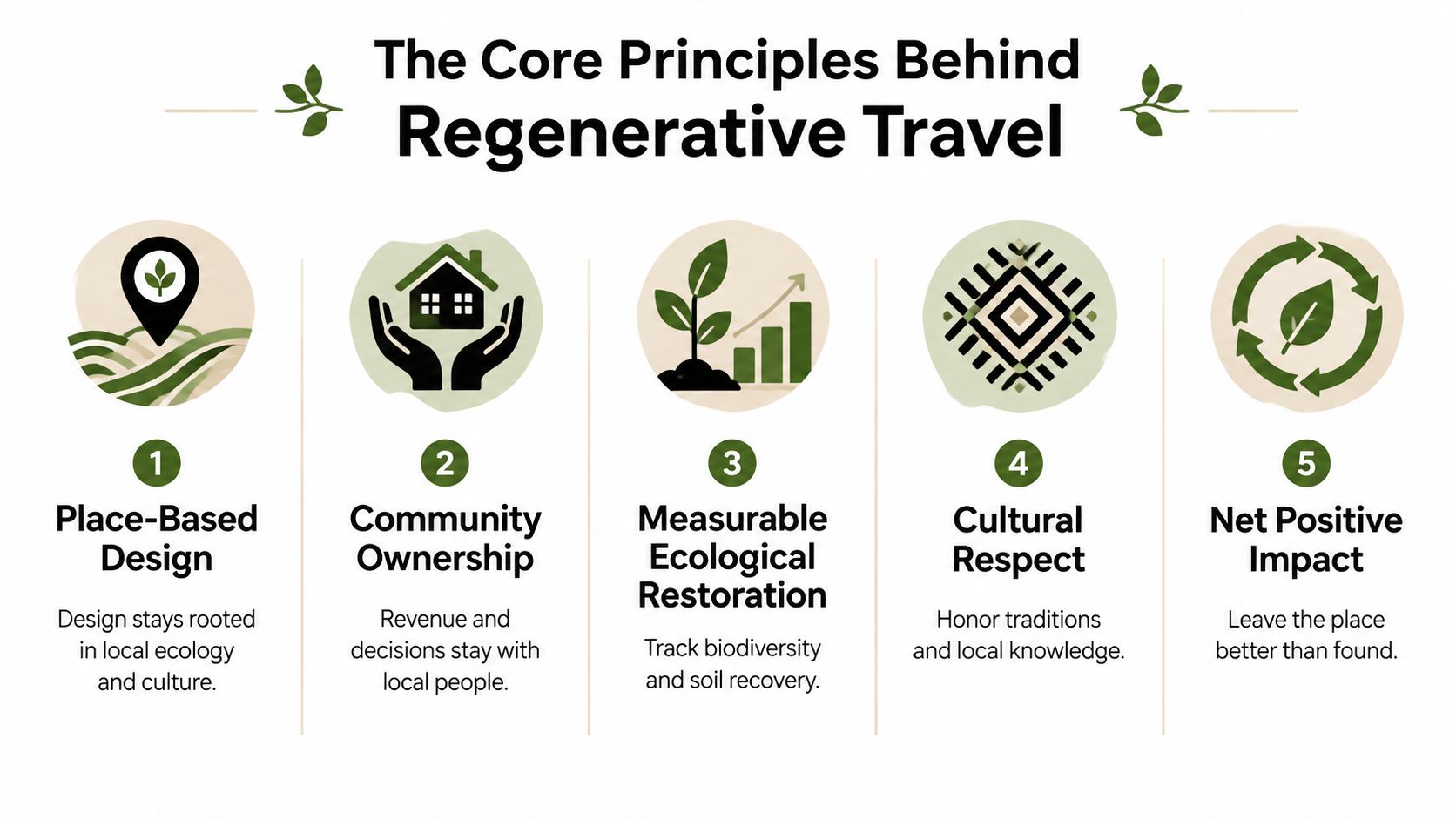
Five practices to verify
Place-based design
The retreat should respond to local ecology, climate, architecture, foodways, and cultural knowledge. Ask whether the experience could exist anywhere, or whether its programming depends on the surrounding territory.Community ownership and revenue retention
Local people should have more than a symbolic role. Look for community-led enterprises, local procurement, fair employment, shared decision-making, or clearly explained revenue flows. A property should be able to describe who benefits and how.Measurable ecological restoration
Claims should connect to outcomes such as reforestation, watershed recovery, soil regeneration, habitat protection, biodiversity monitoring, or wildlife rehabilitation. Request a baseline, the current status, and the method used to track change.Knowledge exchange
Guests shouldn't consume local culture as scenery. Strong programming creates respectful exchange between hosts and visitors, whether through food, conservation, craft, farming, ecology, or storytelling led by people with a genuine connection to the place.Long-horizon accountability
A single volunteer activity doesn't establish regeneration. Look for continuing projects, recurring reporting, named partners, and evidence that the work continues when occupancy changes.
Booking test: If a website lists values but can't identify the project, measurement method, local partner, or reporting process, treat the claim as unverified.
A property might share the area of land under restoration, the proportion of staff hired locally, guest-funded research contributions, or progress against a watershed plan. Those details matter more than broad promises because they let you judge whether the retreat is improving a place rather than just describing itself as conscious.
How a Regenerative Retreat Actually Works in Costa Rica
A regenerative stay changes the guest journey before arrival. Booking becomes a contribution decision, orientation explains local ecology and community expectations, and the itinerary connects pleasure with projects that support the destination. The experience still includes rest, excellent food, and adventure, but those elements sit inside a wider operating model.
VIVARA provides one example of how a small, founder-led retreat can connect hospitality with local impact. Its model links each villa to a rescued animal and states that guest presence supports lifeguard training, living wages, and turtle conservation along the coast. Travelers evaluating VIVARA's restoration retreat model should still ask for the same evidence they'd request from any operator, including contribution flows, partners, reporting, and project continuity.
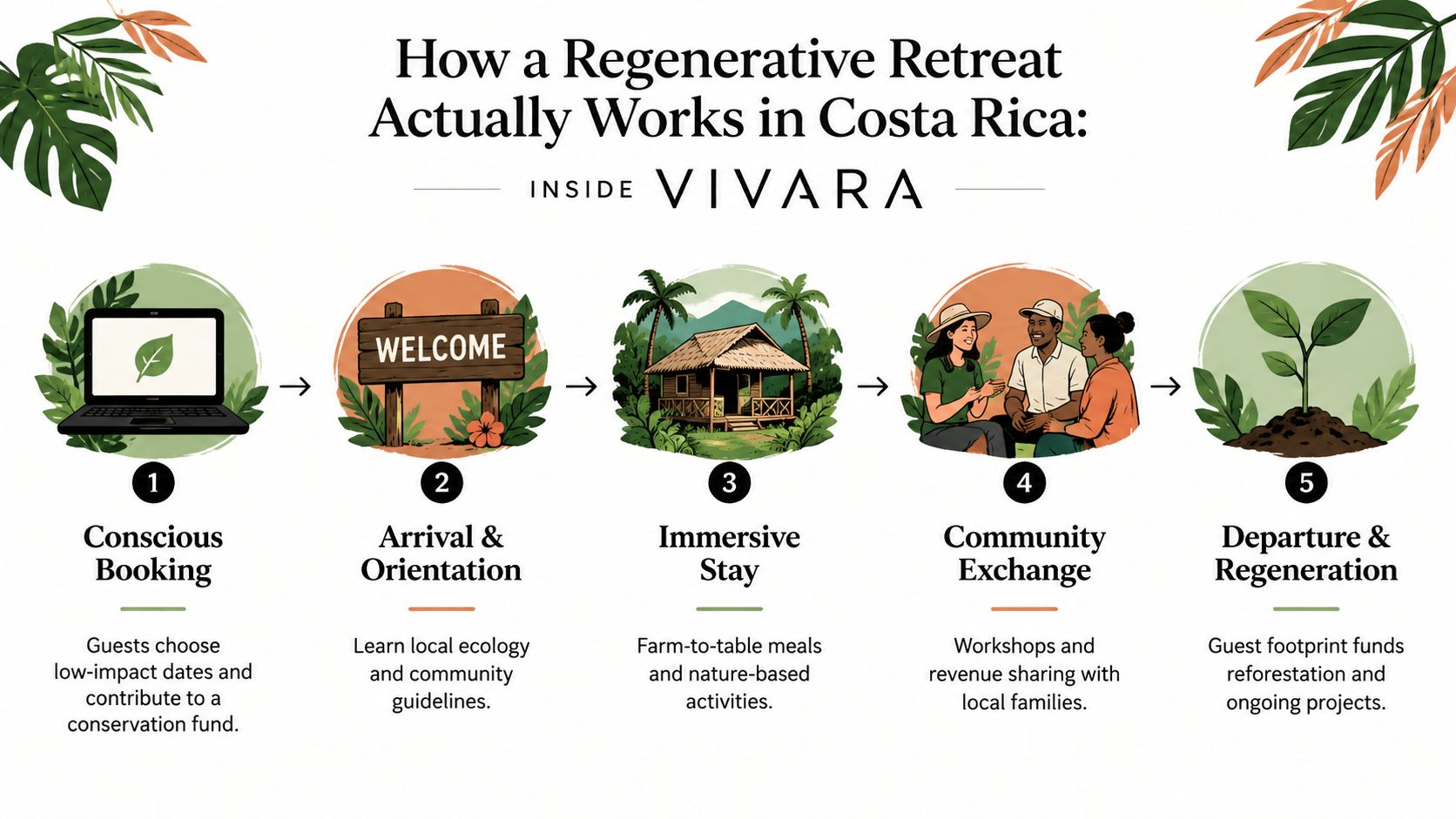
The guest journey
Conscious booking: Guests choose a stay whose pricing and operating model connect occupancy with conservation or community programs.
Arrival and orientation: Hosts explain local wildlife, water use, cultural expectations, safety, and the reason behind each guideline.
Immersive hospitality: Farm-fresh, ocean-caught, or locally sourced meals, nature-based activities, and carefully selected excursions keep the destination central to the experience.
Community exchange: Guests meet local partners through workshops, food, conservation, guiding, or cultural programming, with compensation and decision-making made visible.
Departure and continuity: The guest's contribution supports work that continues after checkout, rather than ending when the itinerary does.
A mature model may use percentage-based contributions, a public impact dashboard, locally hired staff, and programming designed with local partners rather than imported wholesale. It may also offer participatory service hours, although those should be optional, properly supervised, and useful to the project rather than staged for photographs.
The premium element isn't necessarily a larger room or a longer activity list. It's clarity, curation, privacy, and coherence. An intimate group can make it easier for hosts to tailor wellness, adventure, food, and community experiences without turning local relationships into mass-market entertainment.
What Regeneration Delivers to Communities and Travelers
Regenerative tourism should produce returns for more than the person holding the reservation. The clearest way to assess those returns is to separate the beneficiaries and connect each promise to an indicator.
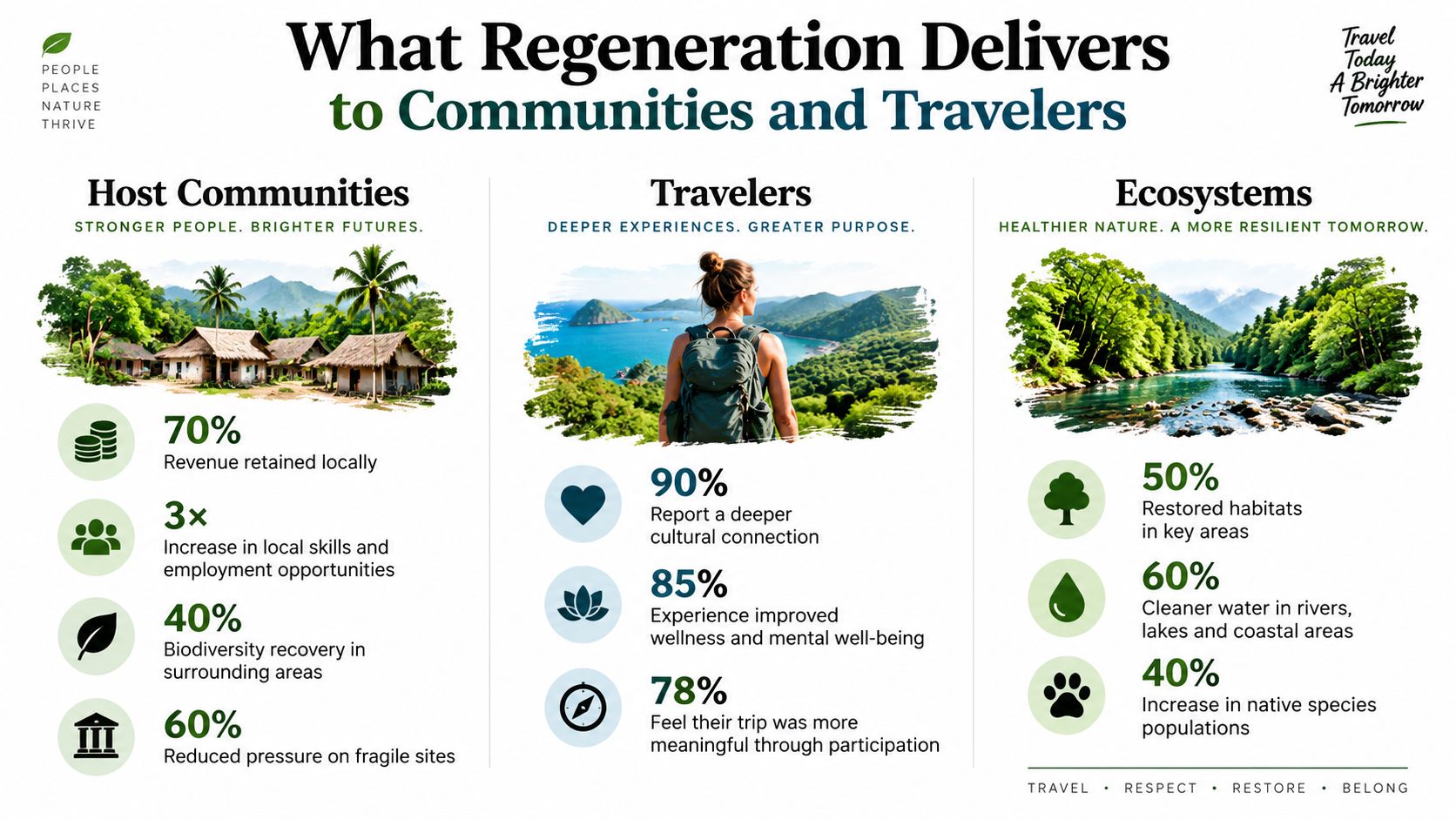
Host communities
Residents benefit when tourism revenue remains connected to the local economy rather than passing through distant ownership structures. Useful evidence includes local hiring, procurement from nearby farms and fisheries, paid training, cooperative participation, and community control over project priorities.
A regenerative property should also help reduce pressure on fragile sites. Well-designed itineraries can distribute visits, support trail maintenance, fund lifeguard training, or direct guests toward community-run activities instead of concentrating demand in already-stressed attractions.
Ecosystems
Ecological outcomes depend on land-use decisions, not slogans. A project might track restored habitat corridors, water quality, soil condition, native species, reforestation survival, or mangrove recovery. The right indicator depends on the ecosystem and the intervention, which is why context-sensitive measurement matters.
Costa Rica's protected-area management shows how visitor pressure can require concrete controls. Manuel Antonio National Park currently limits access to 3,000 tourists per day and closes one day per week, while an earlier carrying-capacity study set a maximum of 600 visitors on weekdays and 800 on weekends. Reporting on Manuel Antonio's visitation controls illustrates a central regenerative principle: tourism has to respect ecological limits before it can contribute to recovery.
Travelers
Guests receive more than an ethical label. They can develop deeper cultural understanding, learn from local ecological knowledge, and experience the satisfaction of contributing to a place rather than just consuming it. For wellness travelers, that reciprocity can add meaning to meditation, movement, food, time outdoors, and rest.
A regenerative retreat can also support different lifestyle goals. Couples may value shared purpose, families can learn through participation, teams can build trust through collaborative experiences, and founders or creators can use a quieter setting to reset attention. Costa Rica's forest recovery story offers a useful lens for travelers who want nature experiences connected to longer-term stewardship.
How to Tell Real Regenerative Claims from Greenwashing
The most attractive regenerative language is often the least useful. “Conscious,” “eco-friendly,” “carbon neutral,” and “giving back” can describe strong work, but they don't prove where money goes, who makes decisions, or whether conditions are improving.
Use four filters before you book: evidence, transparency, ownership, and long-term commitment.
Evidence
Ask what the operator measures and what the baseline was. A credible claim might identify a restoration area, monitoring method, project partner, species target, water outcome, or community indicator. “We support conservation” is a mission statement. “Our contribution supports a named program with a published monitoring process” is verifiable, though you should still examine the details.
Transparency
Find out how contributions are calculated and allocated. Does the operator publish an impact report, describe project expenses, identify recipients, and share setbacks as well as achievements? Transparency doesn't require perfect results. It requires enough information for a reasonable traveler to understand what happened.
Ownership
Consultation isn't the same as governance. Ask who owns the project, who hires the guides, who controls the funds, and whether local partners can change the program. A community appearance arranged for guests may be enjoyable, but it doesn't demonstrate community leadership.
Long-term commitment
Regeneration takes time. Look for continuing partnerships, recurring monitoring, maintenance responsibilities, and plans that extend beyond a promotional season. External offsets deserve particular scrutiny when they substitute for local operational change or allow a property to avoid addressing its own pressure on water, land, labor, and waste.
Use this short checklist in a sales call:
Follow the money: Where does each guest contribution go?
Ask for the baseline: What was measured before the project began?
Request current evidence: What has changed, and who verified it?
Examine ownership: Who leads the project and makes decisions?
Test the hard questions: What hasn't worked, and what changed afterward?
Check the time horizon: Does the work continue after the guest leaves?
A trustworthy operator won't resent scrutiny. Clear questions help distinguish a working model from decorative sustainability language.
Food offers another revealing test. A retreat can describe its cuisine as local while purchasing through opaque channels or using food as a branding device. Asking about producer relationships, compensation, seasonality, and waste gives you a practical view of whether the property's farm-to-table dining approach reflects local value circulation or premium positioning.
Choosing Your Next Regenerative Trip With Confidence
Start with your own reason for traveling. A retreat designed for burnout recovery may prioritize quiet, sleep, nourishing food, and unstructured time. A family trip may need accessible conservation activities and flexible dining. A team gathering may require private spaces, facilitated connection, and a clear balance between work and restoration.
Then choose the destination and property through three filters:
Personal wellbeing: Will the pace, setting, food, privacy, and activities support the reset you need?
Community relationship: Can you identify local partners, local staff, and a meaningful path for revenue to remain in the area?
Ecological contribution: Does the property show what it restores, how it measures progress, and how guests participate without overwhelming the project?
Costa Rica is especially relevant for wellness-led travel because the country has launched the Pura Vida Wellness Strategy, which aims to expand experiences connected to meditation, reflection, yoga, hot springs treatments, and organic products. Coverage of Costa Rica's national wellness strategy helps explain why a regenerative retreat can combine personal restoration with nature-based learning. Wellness also supports premium retreat positioning, with one industry summary reporting a global wellness tourism market of about US$1 trillion in 2024 and projecting 16.6% annual growth over the next five years. The wellness tourism market summary presents those figures as an industry projection, not a guarantee for any individual property.
Five questions to ask before booking
Does the operator reinvest a stated share of revenue locally? Ask for the calculation and recipient.
Can you see baseline-to-date ecological metrics? Look for evidence tied to a specific place.
Are staff paid above the regional living wage? Request the operator's definition and policy.
Do guests participate in activities that physically improve the site? Confirm that participation is useful, safe, and locally directed.
Is there third-party verification or destination-level accreditation? Treat certification as helpful context, not automatic proof of net-positive outcomes.
Budget should reflect the full experience, not only the nightly rate. Compare what's included, such as meals, transfers, guided activities, wellness programming, conservation contributions, staff support, and private-use options. A premium-but-attainable retreat can offer value through a small group, personalized service, local expertise, and fewer decisions for the guest, while a lower headline price may leave important experiences and transport outside the package.
For couples, friends, families, and brands building closer relationships with their communities, the strongest fit is a retreat where the itinerary has a clear identity. Look for a setting that supports conversation and recovery, activities matched to the group, food connected to the region, and hosts who can explain the destination's priorities without turning every interaction into a sales pitch.
VIVARA offers an intimate Costa Rica retreat experience for couples, families, private groups, teams, and brands, combining nature-connected villas, personalized adventure and wellness activities, farm-fresh cuisine, and guest-funded support for conservation and community initiatives. If you want to compare regenerative retreat options through the lens of measurable contribution, local connection, and personal restoration, visit VIVARA and explore whether its model fits your next stay.

