The Vivara Content Team
Luxury Villa Rental in Costa Rica: How to Choose Well
Luxury Villa Rental in Costa Rica: How to Choose Well

You're probably not choosing between villas. You're choosing between different versions of the same trip. A couple may want a quiet anniversary in the cloud forest, a multigenerational family may be debating Manuel Antonio against the Nicoya Peninsula, and a founder group may be deciding whether it needs a wellness retreat or a better offsite. The photographs matter, but they won't answer the question: what kind of experience should this group create together?
A luxury villa rental in Costa Rica works when the property, people, service model, and daily rhythm reinforce that purpose. It falls short when guests rent attractive square footage and then spend the week coordinating cooks, drivers, activities, groceries, and expectations. The right decision starts with group dynamics, not a pool photo.
The Decision Behind Booking a Luxury Villa
An anniversary couple may admire an infinity pool, but the booking decision rests on the experience they want to share. A secluded cloud-forest home supports silence, views, and long breakfasts. A staffed property near restaurants and guided experiences offers variety with less planning. Choose the setting that matches the couple's preferred rhythm, rather than paying for amenities they will barely use.
A multigenerational family needs a different setup. Grandparents may want slow mornings, teenagers may want surf or wildlife excursions, and parents may need a shared dining area without requiring everyone to follow one schedule. Location carries practical weight. A villa that looks perfect on a map becomes tiring when every activity requires a long transfer.
Founder groups must separate transformation from rest. A retreat needs space for conversation, wellness, creative work, and recovery. An offsite may require meeting infrastructure and privacy, without a programmed emotional arc. Treating those formats as interchangeable can produce a beautiful stay that misses the group's business purpose.
Start with the group, not the bedrooms
Bedroom count measures capacity. It does not design the experience. Ask who will share meals, who needs quiet, who wants adventure, and who expects service before making a request. A property for six couples has different requirements from a home shared by parents, children, grandparents, and a private guide.
Costa Rica supports distinct travel rhythms. The Nicoya Peninsula suits guests seeking beach time, wellness, and an unhurried social atmosphere. Manuel Antonio fits travelers who want nature, excursions, and easier access to established visitor infrastructure. Dominical and the southern Pacific coast appeal to groups seeking a more intimate setting with room for adventure and restoration.
The useful question: Don't ask which villa looks most luxurious. Ask which property will make the group's preferred way of spending time feel effortless.
Treat the villa as a container
A well-run villa gives guests a private setting to reconnect, celebrate, recover, or work without the friction of a conventional hotel. Architecture supports that purpose, while the operator brings it to life through arrival planning, dining, staffing, and local relationships. Those details determine whether the property feels considered or merely impressive.
Costa Rica's protected-land model includes about 25% of its territory, with more than 160 protected areas, according to this guide to Costa Rica ecotourism and conservation. That context gives nature-based retreats more substance than a generic wellness backdrop. Guests can pursue restoration while understanding how local conservation and community systems shape the destination. A thoughtful villa stay should return value to that setting through responsible operations and meaningful local engagement.
Villa Buyout vs Boutique Hotel vs Resort
The cleanest comparison uses four questions: How many people are traveling? How much control do they want? How much service do they need? And how should the cost be shared?
Private villas tend to suit groups of six or more, particularly multigenerational families and multi-household trips, while boutique hotels are often more efficient for couples, solo travelers, and groups of four or fewer, according to this comparison of private villas and boutique hotels in Costa Rica. Villas also become more attractive for larger groups because the estate is priced as a property rather than as a collection of rooms.
That advantage comes with a responsibility. Unless the operator supplies a manager or concierge, the lead guest becomes the logistics coordinator. Someone must approve menus, arrange transfers, schedule guides, handle grocery orders, and solve the small problems that hotels absorb through their operating systems.
Dimension | Villa Buyout | Boutique Hotel | Luxury Resort |
|---|---|---|---|
Group fit | Strong for families, friends, retreats, and full-estate gatherings | Strong for couples and smaller groups | Strong for travelers who want extensive facilities and programmed activity |
Privacy | Highest, especially with exclusive use | Moderate, with private rooms but shared spaces | Lower, because facilities and dining are shared |
Dining control | Flexible menus, private chefs, self-catering, or a combination | Restaurant-led, usually with less customization | Broad restaurant choice, often with fixed operating rhythms |
Service intensity | Can be highly personal, but depends on the manager and staffing model | Consistent and structured | Broad service infrastructure, often with standard programming |
Experience control | The group controls its schedule and social environment | Guests choose independently within a shared property | The resort shapes much of the available activity |
Main trade-off | Guests may inherit coordination work | Less privacy and less control over shared space | Less intimacy and a more commercial atmosphere |
For groups of eight to 20, a private villa usually wins when privacy, flexible dining, and one shared living environment matter more than a full activity calendar. A boutique property may win when guests want daily housekeeping, a restaurant downstairs, and the freedom to separate without negotiating the group schedule.
Resorts suit families who value kids clubs, multiple restaurants, pools, and scheduled activities. They're also practical when each traveler wants a separate booking and no one wants to manage a shared household.
The decision becomes clearer when you compare not only the room rate, but also the cost of privacy, control, and coordination. This guide to a private villa buyout for a family vacation is useful for evaluating that model before you compare properties.
Four Filters That Separate Good Villas from Great Ones
Luxury photographs reveal very little about how a villa operates. Before booking, test the property through four filters. The goal is not to collect amenities. It is to determine whether the villa can support your group's rhythm, privacy, and sense of place.
The people filter
Ask who runs the property each day. Look for a named local manager, one clear communication channel, and a defined response process. Confirm who greets the group, handles maintenance, and supports guests who need help.
Service structure matters just as much. Is housekeeping daily? Does a chef live nearby? Can the concierge arrange a guide, driver, wellness practitioner, or emergency appointment? A host who forwards restaurant links provides a different experience from a team that shapes the stay around your group.
The bones filter
Tropical architecture can be beautiful and demanding. Ask about sound separation between bedrooms, dependable air conditioning, water storage, backup power, pool care, and pest-control routines. These details rarely appear in marketing copy, yet they decide whether the property remains calm after the first night.
Request recent maintenance information, not a general assurance. Ask what happens if a cooling system fails, how quickly repairs are handled, and whether a local technician is available. A villa's beauty cannot compensate for poor sleep or slow problem-solving.
The experience filter
A villa should either curate experiences or state clearly that it does not. Ask whether the team books and manages surf guides, yoga teachers, naturalist hikes, canyoning, river activities, horseback riding, or boat trips. Confirm whether transportation is included in the quoted price.
Dining deserves the same scrutiny. Ask how the chef handles allergies, children's preferences, vegetarian meals, local sourcing, and changes during the stay. A flexible kitchen can make a family week feel generous. A rigid one turns every meal into a negotiation.
Review what guests can expect at VIVARA to understand how a clearly defined service model can shape the full stay.
The sustainability filter
Reject vague “eco-luxury” language. Ask how the property separates waste, hires locally, manages water, and supports conservation. Ask which vendors receive guest spending, and whether the operator can explain its community relationships with specific examples rather than marketing decoration.
Costa Rica's Payment for Environmental Services program provides useful local context. A responsible villa operator should explain how its own practices relate to that context, including water use, employment, purchasing, and conservation. Regenerative hospitality is visible in operating choices, not just in the property's materials or setting.
Pricing Transparency and What the Headline Rate Hides
The nightly rate is only the starting point. A proper quote should show the base accommodation price, required minimum stay, taxes, service charges, cleaning, food and beverage, transfers, activities, and any security deposit before you pay.
Luxury villa pricing commonly changes by season and stay length. Top-tier European villas can require seven-night minimums and range from roughly €18,000 to €68,000 per week, depending on season, with longer stays of 10 to 14 nights sometimes receiving modest rate adjustments, as explained in this luxury vacation-home rental pricing guide. Costa Rica operators use their own structures, but the same principle applies: minimum stays and inclusions shape the value.
Build the total before comparing formats
A six-bedroom villa booked by four guests still carries the estate's base rate. A boutique hotel may charge per room or per person, which can make a smaller group more efficient there. A full buyout can become compelling when a larger party shares the cost, especially if private dining and common space replace multiple restaurant reservations and separate hotel rooms.
Cost Category | Luxury Villa | Boutique Hotel | 5-Star Resort |
|---|---|---|---|
Accommodation | Estate rate, often shaped by season and minimum stay | Room or suite rate | Room or suite rate |
Dining | Chef, groceries, service, or meal package may be separate | Restaurant pricing | Restaurant, package, or per-person pricing |
Service fees | May include management, cleaning, and concierge components | Usually embedded or itemized | Often embedded, with additional service charges possible |
Transfers | Frequently arranged as an add-on | Usually arranged separately | May offer transport through the resort |
Activities | Private guides and experiences are usually extra | Booked independently or through concierge | Often available through resort programming |
Deposit and liability | Security deposit, damage terms, and possible waiver | Standard hotel deposit policies | Resort-specific holds and policies |
Group economics | Stronger as occupancy rises and privacy matters | More flexible for smaller groups | Strong when facilities and programming are the priority |
Separate reasonable charges from red flags
Food provisioning, private chef labor, bartender service, transfers, and specialist guides can reasonably cost extra because they require people and supplies. A transparent operator explains those costs before confirmation and identifies whether fees are fixed, per person, or based on consumption.
Be cautious when activity commissions appear only after booking, when damage waivers lack clear terms, or when the property adds unexplained “luxury” charges. Request a full quote with inclusions, exclusions, tax treatment, gratuities, deposit conditions, and cancellation consequences in one document.
A practical pricing exercise is to create two totals. The first is the stay total, covering accommodation and required fees. The second is the experience total, covering chef service, groceries, transfers, guides, wellness sessions, and the activities that make the trip worth taking. Compare both totals against a boutique hotel and resort, not just against another villa.
Contracts, Logistics, and How to Protect the Group
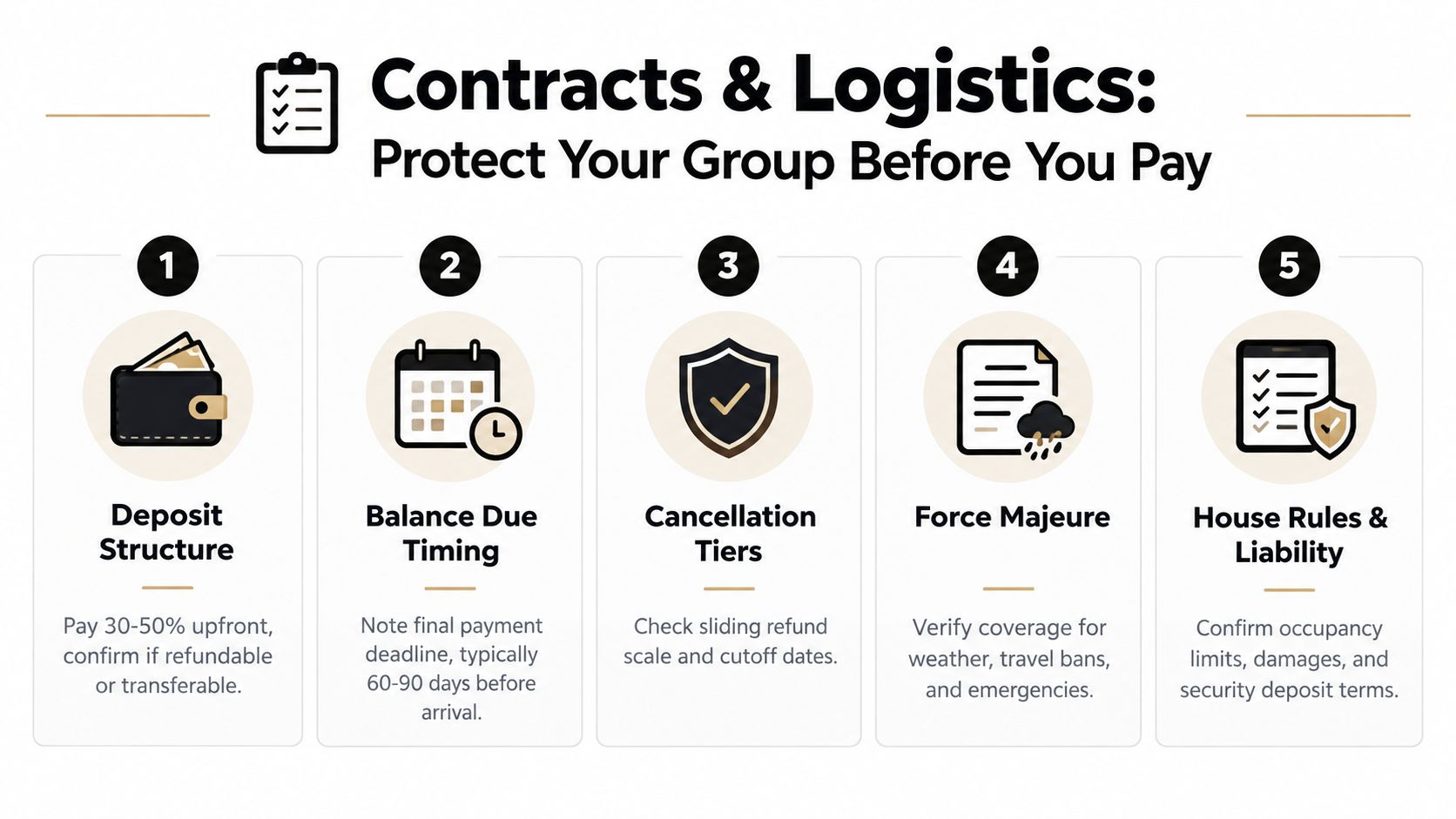
A luxury villa contract should be readable before it becomes urgent. Start with the payment schedule, deposit structure, refundability, balance deadline, cancellation tiers, and force majeure language. Wet-season planning makes the last point especially important because heavy rain, road conditions, flight disruption, and activity cancellations can affect the stay without making the property itself unusable.
Ask whether a canceled booking can be transferred to different dates, whether refunds change as arrival approaches, and what happens if the host cancels. Third-party booking platforms may offer familiar payment systems, while direct booking can provide more direct communication. Neither option removes the need to read the agreement.
Put privacy and staffing in writing
Ask who lives on the property, who enters during the stay, how housekeeping access is scheduled, and whether maintenance staff can arrive without notice. A staffed villa can feel wonderfully effortless when expectations are clear. It feels intrusive when guests discover unplanned access after arrival.
Retreat hosts should also clarify vendor access, music and noise rules, occupancy limits, filming permissions, and whether outside practitioners or caterers can work on the property. A family booking may need simple privacy protections. A founder, coach, or brand hosting a community gathering needs a more detailed operational agreement.
Make arrivals boring
Separate flights create unnecessary stress when no one owns the arrival plan. Give the manager each traveler's flight information, establish a meeting point, confirm transfer vehicles, and define the key handover process. Ask what happens if one guest is delayed and whether early arrivals can access the property.
Insurance should reflect the trip's purpose. A family may need coverage for medical events and cancellations. A retreat organizer should also consider participant liability, vendor requirements, and the consequences of postponing an event.
Before signing: Get written answers about damage liability, security deposits, vendor access, noise policies, staffing, cancellation tiers, force majeure, and host cancellation.
Designing the Stay Around Dining, Activities, and Host
A villa earns its place when the day has a clear rhythm and the group still feels free. The property supplies the setting. The host, chef, and concierge shape whether that setting supports connection, recovery, celebration, or focused work.
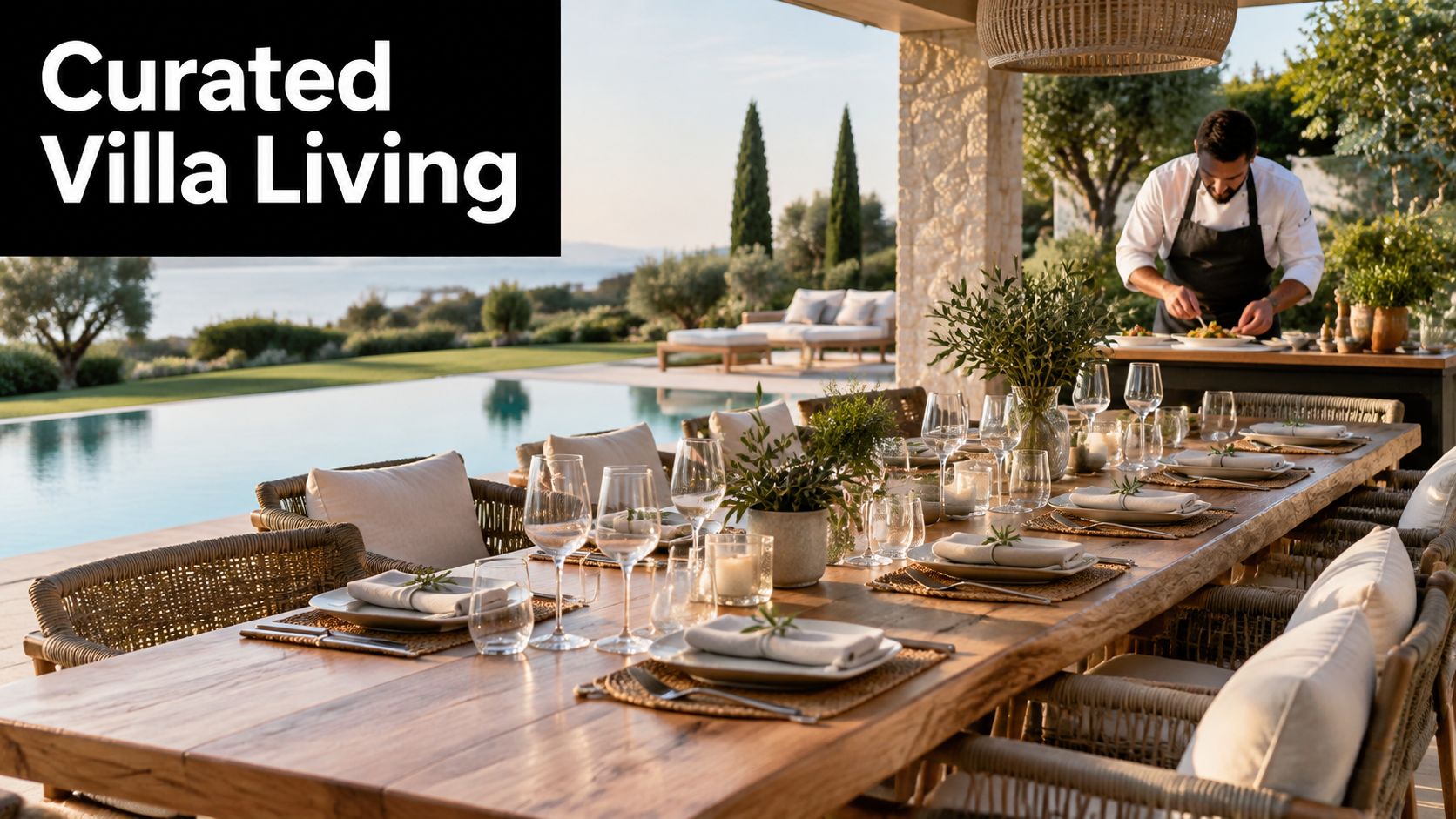
Dining sets the group's tempo. A chef-led format handles different arrival times, allergies, training schedules, and children's needs, while self-catering gives guests more independence. The trade-off is practical: someone must shop, store ingredients, cook, clean, and make decisions when everyone is tired. A hybrid usually serves groups best, with chef-prepared dinners, relaxed breakfasts, and simple lunches planned around excursions.
Ask where ingredients come from and how the menu changes with local availability. A farm-to-table dining approach should involve real relationships with farmers, fishers, and producers, not just a few local items on the menu. The chef should adapt the food to the group instead of turning every meal into a fixed performance.
Sequence intensity instead of collecting activities
Strong itineraries alternate effort and recovery. Pair a surf lesson or canyoning day with an unhurried evening. Follow a naturalist hike with a long lunch and open afternoon. Yoga, massage, swimming, and sunset time give guests room to recover, which keeps the stay from becoming an exhausting checklist.
In Costa Rica, a group might combine a guided forest walk, a beach morning, a restorative treatment, and a locally prepared dinner. Adventure-focused guests can add zip lining, horseback riding, river experiences, paragliding, or a sunset cruise. The host should group activities by geography, travel time, and physical demand. Accepting every request without considering those constraints creates a busy schedule, not a well-designed stay.
Leave some space unassigned. Weather, fatigue, and spontaneous decisions are part of the experience.
Regenerative hospitality needs operational proof
Regenerative hospitality connects the property, its workers, the land, and the local economy. Ask whether the operator hires locally, pays fairly, restores land, supports conservation, and chooses vendors that keep value in the community. Costa Rica's conservation model offers useful context for assessing how tourism can support ecological stewardship, as outlined in this Costa Rica ecotourism guide.
The host remains the practical differentiator. Before arrival, a good host learns the group's purpose, preferences, food requirements, and tolerance for structure. During the stay, that host introduces trusted guides, adjusts plans, and stays available without hovering. That difference turns a house rental into an experience designed around the people staying there.
Pre-Stay Checklist and Your Next Move
The booking becomes easier when you separate preparation into two operating moments, before arrival and during the stay. Your goal isn't to control every detail. It's to remove avoidable decisions so the group can spend its attention on one another and on the destination.
Before arrival
Send the villa manager a concise group profile. Include guest count, ages, mobility considerations, arrival patterns, preferred pace, and the reason for the trip. A family reunion, anniversary, wellness program, and founder retreat should never receive the same planning template.
Confirm dietary needs early. List allergies separately from preferences, identify children's requirements, and explain whether guests want chef-led meals, casual provisioning, restaurant bookings, or a mix. Ask how ingredients are sourced and when menus will be finalized.
Verify the documents before sending the final payment. Read the rental contract, cancellation policy, damage terms, occupancy rules, insurance requirements, and vendor-access provisions. Confirm the final balance date and ask for a receipt that identifies every charge.
Reserve the experiences that shape the stay. Private chefs, wellness practitioners, airport transfers, naturalist guides, and specialist activities may require advance coordination. Don't pre-book every hour. Protect open space for weather, fatigue, and spontaneous decisions.
During and after arrival
At check-in, confirm staffing, meal times, transfer windows, emergency contacts, Wi-Fi, water, air conditioning, and any house-specific instructions. Walk through the property with the manager when possible, and document existing damage so the departure inspection doesn't become a dispute.
Mid-stay, ask the group what needs adjusting. The best plan may require fewer activities, later meals, more privacy, or an additional guide. A responsive host treats the itinerary as a working document, not a contract carved in stone.
Before departure, confirm checkout time, luggage arrangements, outstanding charges, gratuities, and the security-deposit process. Leave the property in the condition required by the agreement, and ask when the final statement will arrive.
Your next move is practical: shortlist three villas, request full quotes including every fee, and book a 20-minute discovery call with each host. That conversation will reveal whether you're renting square footage or commissioning an experience designed around your group.
VIVARA offers exclusive-use stays in Dominical for groups of up to 14 guests, with architecturally distinct villas, chef-led dining, and on-demand experiences shaped around each group's rhythm. Visit VIVARA to compare a private Costa Rica retreat with the experience you're trying to create.

