The Vivara Content Team
Breathwork Retreat in Costa Rica: A Practical Guide
Breathwork Retreat in Costa Rica: A Practical Guide

You've typed “breathwork retreat” into a search bar because ordinary rest isn't working. The results offer jungle intensives, ceremonial experiences, yoga holidays, and programs that promise emotional release without explaining what happens between breakfast and bedtime. Choosing among them requires more than finding a beautiful location. You need to understand the breathing method, the safety standards, the daily rhythm, and whether the setting can support the kind of reset you're seeking.
Costa Rica makes a strong case for this type of travel. Its tourism infrastructure already accommodates wellness experiences that range from forest bathing and hot springs to spa treatments and gentle outdoor activities, while the country protects 26% of its land and shelters about 5% of the world's known biodiversity according to the Costa Rica tourism fact sheet. The right retreat can combine that natural richness with thoughtful facilitation, intimate hospitality, nourishing food, and enough quiet for the work to continue after each session.
What a Breathwork Retreat Is
You arrive expecting guided breathing and find a yoga holiday with one short class. Another listing offers a three-day intensive built around conscious breathing. A third combines breathwork with plant-medicine ceremonies, while a fourth uses the term for meditation, sound healing, and personal development.
These are different purchases. Read the itinerary before you book.
A breathwork retreat is a structured program where conscious breathing holds a central place. The schedule should include guided sessions, preparation, rest, reflection, and integration. Movement, meditation, bodywork, sound, nature, or coaching may support the program, but breathwork should shape the experience rather than appear as a decorative add-on.
A drop-in class gives you one guided session. A meditation retreat makes stillness and attention its central discipline. A therapy retreat may use breathing as one tool among several. A breathwork retreat builds its schedule around how breathing patterns can influence attention, arousal, emotion, and recovery.
The formats worth comparing
Compare the format before comparing the destination:
Residential retreats: You stay on-site, eat there, and follow the full schedule with the same group.
Day retreats: You sleep elsewhere and attend scheduled sessions. This suits local guests or travelers who want less immersion.
Small-group intensives: These allow closer observation and more room for individual support.
Larger cohorts: These can create stronger group energy, but they require clear boundaries and enough facilitators.
Programs commonly run from three to seven days. The quality of the container matters more than the number of nights. A short retreat can work when its schedule is focused and realistic. A longer stay gives you more time to observe patterns, recover between sessions, and turn insights into daily habits.
Breathwork retreats are generally facilitator-led rather than clinical, even when guests arrive with stress, anxiety, grief, or trauma-related concerns. Set expectations accordingly. A retreat can support reflection and nervous-system regulation, but it does not replace medical care or psychotherapy.
Before paying, ask what the itinerary includes, who leads each session, how facilitators screen participants, what support is available if someone becomes distressed, and whether the pace matches your current capacity. For a broader comparison of wellness formats, read the Costa Rica wellness retreat explainer. Treat the booking as a meaningful travel decision, not an interchangeable wellness package.
The Main Modalities You Will Encounter
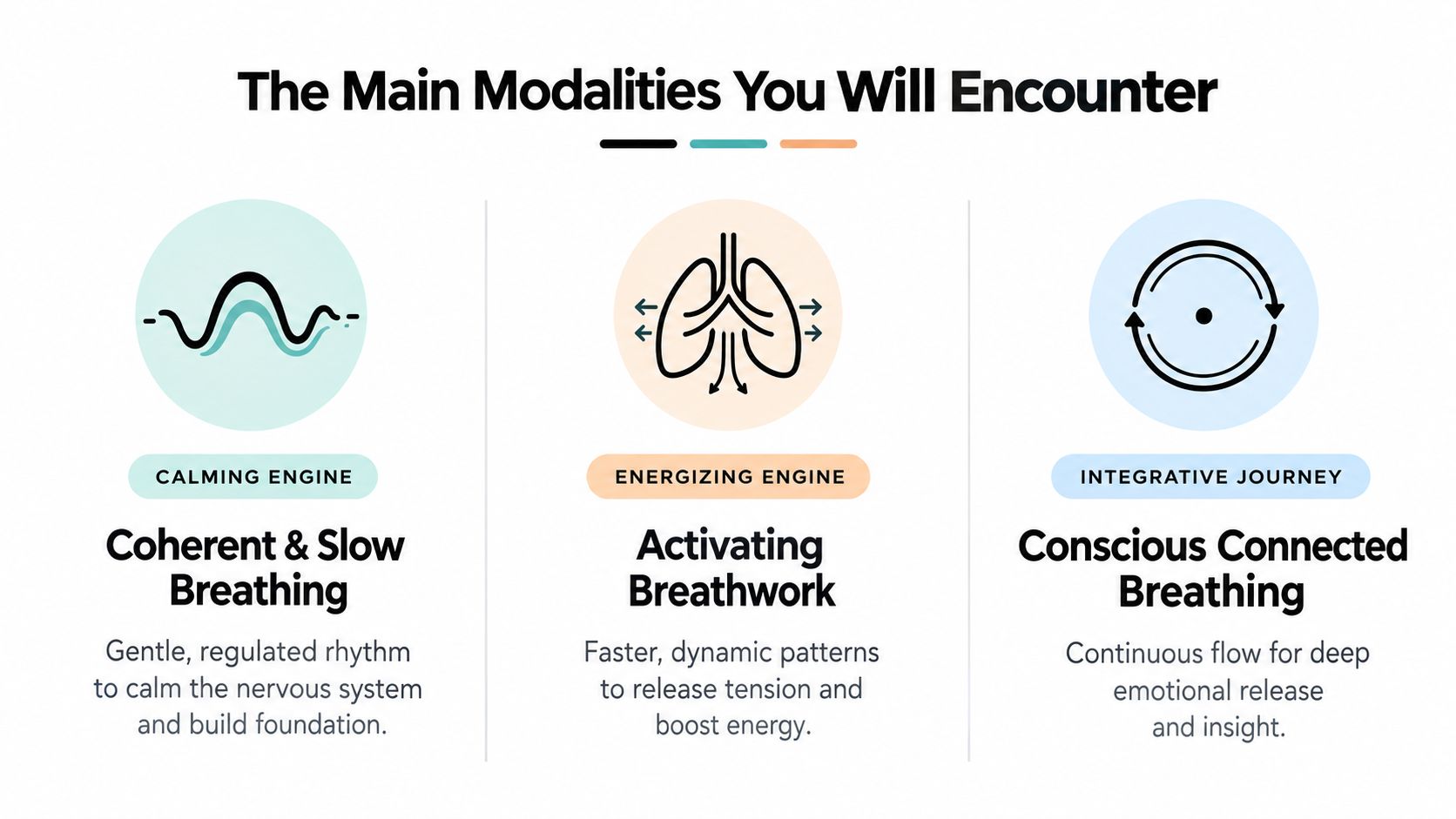
The simplest way to understand retreat breathwork is to think in gears.
Slow, regulated breathing is the calming engine. It includes coherent breathing, gentle diaphragmatic breathing, nasal breathing, and practices that lengthen the exhale. These sessions are designed to reduce activation and build control. They often feel quiet, steady, and accessible, which makes them a sensible foundation for mixed-ability groups.
Paced, conscious connected breathing is the middle gear. The inhale and exhale flow continuously, with less of a pause between them. Facilitators may use this style in emotional-release work or in approaches influenced by Rebirthing or Holotropic Breathwork. The experience can feel more absorbing than slow regulation without reaching the intensity of rapid hyperventilation.
High-ventilation breathwork is high gear. Rapid or deep breathing, including some intense Holotropic-style practices and Wim Hof-inspired formats, can produce strong physical sensations and emotional responses. These sessions need proper screening, close supervision, and a clear plan for participants who become distressed or physically unwell.
Match the method to the experience
Slow sessions may last around an hour or longer, depending on the program. Guests commonly notice a quieter mind, warmer hands, deeper exhalations, or a gradual sense of settling. The facilitator's posture should be observant and precise, with attention to rhythm, posture, comfort, and consent.
Connected breathing sessions often feel more inward. Tingling, shifts in emotion, memories, tears, or a sense of spaciousness can occur. A responsible facilitator offers clear instructions, avoids forcing an outcome, and provides time to rest afterward.
High-ventilation sessions can bring light-headedness, tingling, muscular tension, a racing heartbeat, or emotional catharsis. A controlled-breathing study found that increasing breathing rate significantly lowered end-tidal carbon dioxide while raising arterial blood pressure and heart rate, with autonomic coupling declining as rate increased in the published clinical study. That doesn't make the method wrong. It makes supervision and screening essential.
Practical rule: A well-designed retreat uses intensity deliberately. It shouldn't stack demanding sessions together simply because dramatic experiences photograph well.
Strong programs vary the gears across the stay. Guests might begin with slow regulation, explore connected breathing after they've established trust, and use gentler practices for recovery. The schedule should give the body time to process rather than treating exhaustion as proof of progress.
What Breathwork Does And What It Does Not
Breathwork works through specific protocols, not through the word itself. Slow, nasal, diaphragmatic breathing has the clearest practical case for retreat guests who want stress recovery, better self-regulation, or a calmer transition out of constant stimulation. Reviews associate these approaches with improved vagal tone, heart-rate variability, emotional regulation, and reductions in reported stress and anxiety, as summarized in this clinical review of slow breathing.
The mechanism matters. Slower breathing and longer exhalation can encourage autonomic downshifting, while regular practice gives guests a repeatable tool they can use after returning home. One dramatic session may feel meaningful, but consistent application is more likely to support lasting changes in sleep, stress response, and emotional steadiness.
High-ventilation work creates a different experience. It changes carbon dioxide levels and cardiovascular responses quickly, and participants often describe strong sensations, emotional release, or a cathartic sense of completion. Those experiences can be valuable for some people, but they're acute effects, not guarantees of psychological healing. Research continues to distinguish immediate physiological changes from durable outcomes.
Breathwork Retreat Effects by Modality
Modality | Primary Effects | Evidence Strength | Typical Frequency |
|---|---|---|---|
Slow, nasal, diaphragmatic breathing | Autonomic downshifting, improved regulation, support for stress recovery | Strongest among the commonly used retreat approaches | Repeated daily practice, with continued use after the retreat |
Paced, conscious connected breathing | Focused attention, emotional processing, altered bodily sensations | More variable, with outcomes depending on protocol and facilitation | Scheduled sessions with substantial integration time |
High-ventilation breathwork | Acute changes in arousal, sensation, and emotional intensity | Physiological effects are clear, while long-term therapeutic conclusions remain more limited | Occasional sessions, only with screening and close supervision |
A retreat isn't psychotherapy, medication management, or treatment for an acute psychiatric condition. It can't replace a clinician who manages depression, psychosis, seizure disorders, cardiovascular disease, or trauma symptoms that are destabilizing daily life.
The useful question is therefore not “Will breathwork transform me?” Ask instead, “Which protocol fits my current needs, and how will I integrate what happens?” Journaling, quiet time, a follow-up session, and a concrete plan for returning to work or relationships often matter as much as the breathing itself.
A Typical Day at a Breathwork Retreat
A retreat itinerary should show how the organizers protect the space between sessions. You're not paying only for guided breathing. You're paying for the rhythm of preparation, practice, food, rest, nature, conversation, and sleep.
The day often begins with a quiet check-in and intention setting. The first breathwork session may last 60 to 90 minutes, followed by a silent breakfast or mindful meal. That pause helps guests notice what the practice changed before conversation and stimulation return.
The rhythm behind the timetable
A representative day might look like this:
Morning grounding: A brief circle, body scan, or intention-setting exercise establishes a shared tone.
Primary breathwork: The facilitator guides the day's central practice while observing pace, comfort, and emotional response.
Nourishment and quiet: Breakfast or brunch gives the group time to recover without rushing into analysis.
Midday activity: Movement, sound work, a workshop, or a nature-based practice adds variety without competing with the core modality.
Afternoon integration: Free time, bodywork, journaling, and small-group conversations help guests put words around physical and emotional experiences.
Evening practice: The final session may be more inward or more intense, depending on the retreat's design, followed by rest and reduced stimulation.
Not every venue follows this exact sequence. Some put the demanding session in the morning, when participants are rested. Others reserve evening for a gentle reset. The important constant is a deliberate balance between practice and recovery.
A good host also makes the unstructured hours feel intentional. In Costa Rica, that might mean a forest walk, time by the ocean, a restorative treatment, or a well-prepared meal rather than another workshop added to fill the calendar. The restoration retreat guide offers a helpful reference for evaluating how rest, nature, and personal space can sit alongside structured wellness programming.
If every day contains multiple long sessions and little unscheduled time, ask why. Intensity can be part of the design, but fatigue shouldn't be the main product.
Who It Is For And Who Should Sit This One Out
Breathwork retreats suit people who want focused time away from habitual demands. Guests often come with chronic stress, mild anxiety, disrupted sleep, creative block, or a desire to explore patterns that are difficult to see during an ordinary workweek. Experienced practitioners may also choose a retreat because several consecutive days offer a depth that weekly classes rarely provide.
The phrase “sit this one out” should be taken seriously, especially for high-ventilation formats. Clinical and review literature identifies contraindications that can include cardiovascular or cerebrovascular disease, epilepsy, panic disorder, psychosis, pregnancy, and some medications. The clinical safety review also emphasizes that hyperventilation-style practices should take place away from water and hard ground because fainting and altered states create real physical risks.
A candid self-screen
Generally a Good Fit | Requires Clearance or Should Wait |
|---|---|
Adults seeking structured stress recovery | Uncontrolled cardiovascular or cerebrovascular conditions |
Travelers with mild stress or sleep disruption | Pregnancy, particularly during the second and third trimesters |
Experienced practitioners wanting deeper immersion | Seizure disorders or relevant neurological conditions |
Guests with enough stability for reflection and group work | Recent surgery or an active recovery process |
People willing to follow instructions and pause when needed | Severe PTSD without appropriate clinical support |
Beginners choosing a gentle, well-screened format | Active substance withdrawal, psychosis, or unstable psychiatric symptoms |
That table isn't a diagnosis. A prospective host should ask about health history, medications, pregnancy, panic symptoms, psychiatric care, and prior reactions to intense breathing. You should answer truthfully, even if you worry that disclosure could affect your booking.
A screening call isn't bureaucratic overhead. It's one of the clearest signals that a retreat team understands responsibility.
Sitting out a high-intensity retreat doesn't mean breathwork is unavailable to you. A slower class, private session, clinically supervised program, or later travel date may offer a better starting point. The right retreat respects a participant who chooses not to continue, rather than treating resistance as something to overcome.
How to Choose the Right Breathwork Retreat
Start with the itinerary, then question the people behind it. A polished website can show villas, meals, and ocean views. It can't tell you whether the facilitator can manage a participant who panics, faints, dissociates, or decides to stop.
Ask every host these questions before paying a deposit:
Which modalities are included, and in what proportion? A retreat with one slow session daily is a different purchase from one built around two long high-ventilation practices.
How many guests attend, and how many facilitators are present? Intimacy matters, but so does practical coverage during an intense session.
What screening happens before arrival? Look for a real conversation or health questionnaire, not a checkbox buried in the booking form.
What training and supervised experience do facilitators have? Ask for the name of the training pathway, relevant certifications, and documented supervised hours.
What's included in the rate? Clarify accommodation, meals, sessions, transfers, treatments, excursions, and any optional services.
What integration support continues after departure? A useful answer may include a follow-up call, practice guidance, or referrals, but the host should state exactly what it provides.
Questions that reveal the culture
Ask whether you can opt out of any session without penalty. Find out how the team responds to emotional release, physical discomfort, or a guest who needs to leave midway. Ask where participants rest, whether the practice space is ventilated and private, and how staff handle urgent situations.
The setting should support the method. Open-air jungle or ocean-adjacent space can be restorative, but beauty doesn't compensate for poor supervision. A small group can feel personal, but only if facilitators know how to maintain boundaries and avoid pressuring guests to disclose more than they want to share.
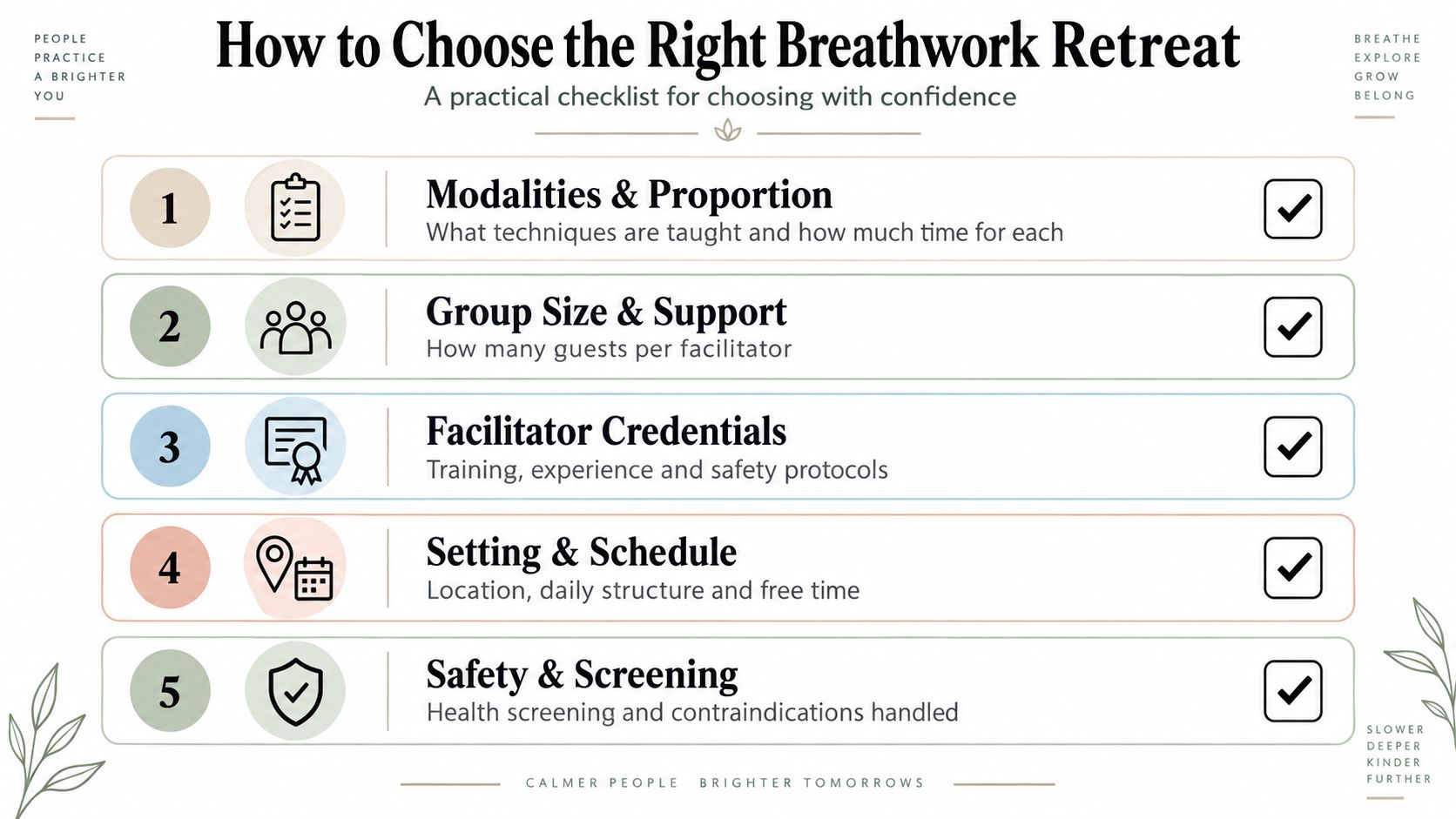
Two red flags override the rest. No screening call suggests the host hasn't taken participant safety seriously. Facilitators without documented training hours leave you guessing about their ability to manage intensity.
For brands, coaches, and teams, the same evaluation applies with an added layer. A retreat should fit the community you're building, reflect your values, and give participants a coherent experience rather than a collection of unrelated activities. Trust grows when the host can explain the program, boundaries, inclusions, and safety process before anyone arrives.
Why Costa Rica And Why VIVARA
Costa Rica works for breathwork because the environment gives guests somewhere to go after the session. Instead of moving from an intense practice straight into traffic, emails, and hotel noise, participants can walk through forest, sit near the ocean, eat fresh food, and let the nervous system settle in a setting that feels materially different from home.
The country's wellness offer already includes low-difficulty trekking, forest bathing, earthing, spa-and-lunch experiences, hot springs, and treatments using volcanic mud, coffee, tropical fruit, and chocolate, according to Costa Rica's wellness tourism coverage. That gives retreat designers a broad local palette. Breathwork doesn't need to stand alone when nature, food, movement, and culture can reinforce the experience.
Wellness travelers also represent a substantial commercial audience. Coverage citing Global Wellness Institute data reports that wellness tourism reached about $1 trillion in 2024, grew 36% from 2020 to 2024, and that travelers in this segment spend an average of $1,764 per trip, 41% more than the average tourist in the cited data from Costa Rica's wellness tourism boom. For hosts and brands, that creates an opportunity to build a community around credible, experience-rich programming rather than generic relaxation language.
A setting designed around the container
VIVARA is an intimate, founder-led hospitality retreat in Dominical, designed for up to 14 guests across architecturally distinct villas. Its open-air spaces, jungle setting, personalized hosting, and access to ocean and nature-based activities can support breathwork alongside movement, restoration, and carefully planned adventure.
The host model matters. A curated retreat team can coordinate certified instructors, align the program with group size and experience, and clarify screening and integration before arrival. Guests should still ask direct questions about the specific facilitator and protocol, but the coordination is different from renting a venue to an independent teacher.
The sensory details also shape the purchase. Ocean sounds, open-air practice, low-light evenings, nourishing food, and protected downtime can make the transition between sessions feel intentional. The VIVARA stay guide provides more context on the property, hospitality approach, and the kinds of experiences guests can combine with wellness programming.
For brands, private groups, and coaches, a retreat environment can do more than host an event. Shared meals, guided practices, nature excursions, and unhurried conversation give a community a reason to connect in person. That connection becomes credible when the experience has a clear niche, strong facilitation, and enough space for participants to feel seen rather than processed through a large schedule.
Deciding Whether a Breathwork Retreat Is Right for You
Use three paths.
Book now if you have previous breathwork experience, no active contraindications, a clear intention, and a facilitator or host you trust after asking detailed questions. Choose a program whose intensity matches your history, not the most dramatic description.
Start locally if you're new to breathwork, manage a chronic condition, or are navigating acute grief or psychiatric symptoms. A weekly class or one-on-one session lets you observe your response without adding international travel, unfamiliar food, and group dynamics to the experiment.
Wait if you can't protect the full retreat period from work, family demands, or recovery obligations. A retreat lasting three to seven days needs genuine downtime, and partial attendance can dilute the experience rather than make it more efficient.
Before booking, send the host five questions:
What screening process do you use before arrival?
What training and supervised hours do the facilitators have?
How many guests and facilitators will be present?
What emergency and mid-session exit protocols are in place?
What exactly is included in the rate?
The answers should be specific, prompt, and easy to understand. If they aren't, keep comparing options.
VIVARA offers an intimate Dominical setting for curated breathwork, movement, nature, dining, and shared experiences, with programming coordinated around the needs of your group. Visit VIVARA to explore a Costa Rica retreat designed for a personal reset, a meaningful gathering, or a community experience with room to breathe.

