The Vivara Content Team
What Is a Wellness Retreat: A Clear Guide for Travelers
What Is a Wellness Retreat: A Clear Guide for Travelers

You've booked beautiful hotels, slept late, booked the massage, and returned home feeling better for about a week. Now the tension is back, your phone is running your evenings, and you're wondering whether a wellness retreat is anything more than an upscale name for a spa vacation.
That hesitation is sensible. A retreat can be a carefully designed intervention, or it can be a scenic property with yoga added to the brochure. The difference matters, especially in Costa Rica, where the setting can be so compelling that it distracts from weak programming.
The Short Answer Most Guides Skip
Take a 42-year-old executive who's taken two spa vacations in the past 18 months. Both were comfortable, private, and restorative. Neither changed the routine that caused her exhaustion. She returned to the same calendar, the same work habits, and the same late-night scrolling. Her question is the right one: what is a wellness retreat, and how is it different from relaxing somewhere beautiful?
A wellness retreat is a deliberately structured, facilitated travel experience built around a defined wellbeing outcome. It takes place in a contained environment and combines accommodation, food, guided programming, and professional support into one coherent experience. The purpose isn't just to make you feel rested while you're away. It's to help you leave with a different relationship to stress, movement, sleep, recovery, connection, or another clearly stated goal.
The distinction rests on three markers:
Intentional outcome: The program has a stated purpose, such as stress reduction, habit change, grief processing, fitness recalibration, or deeper rest.
Trained facilitation: Practitioners lead the work. Hospitality staff can make a stay comfortable, but they aren't a substitute for qualified instructors, therapists, coaches, or medical professionals.
A contained container: The retreat limits competing demands through location, schedule, group agreements, phone boundaries, and a carefully sequenced daily rhythm.
The peer-reviewed overview of wellness retreats describes them as residential experiences extending beyond a weekend getaway, designed to support physical, psychological, spiritual, or social wellbeing through an immersive environment. That definition captures the central point: the product is not one massage or one class. It's the combination of time, place, people, and design.
Costa Rica is particularly suited to this format because nature, intimate hospitality, fresh food, and active experiences can coexist in one itinerary. But don't pay a deposit until you can identify the intended outcome, the people responsible for delivering it, and the structure that supports it.
What Separates a Wellness Retreat From a Nice Vacation
A nice vacation gives you freedom. A true retreat uses freedom selectively, creating enough structure to make the experience useful without turning every hour into an obligation.
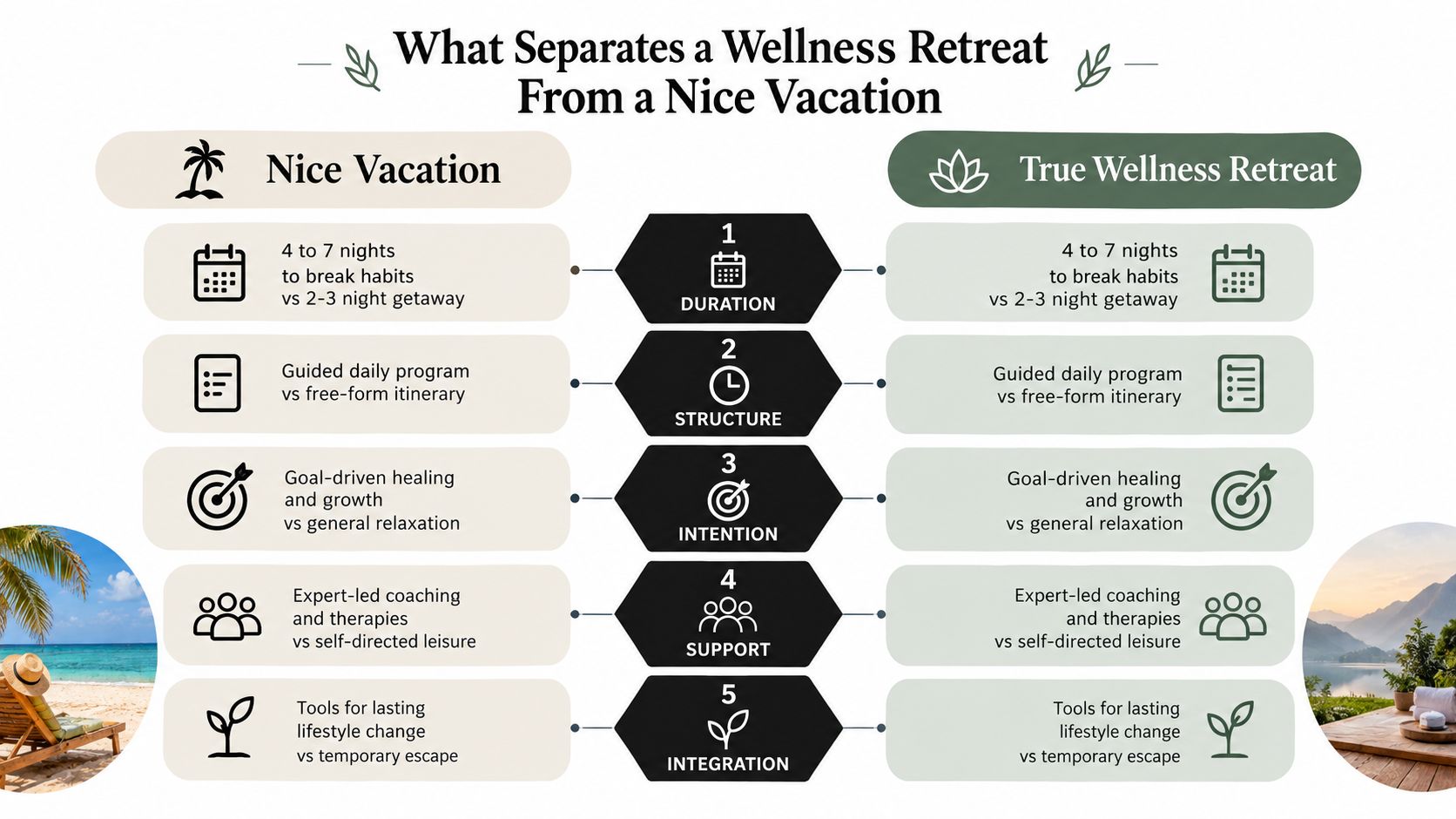
The five building blocks
Duration comes first. Retreats commonly run for four to seven nights, which gives guests time to move beyond the first-day decompression period. A two-night stay can be restorative, but it often functions more like a wellness weekend. In a Costa Rica villa program, the first day might focus on arrival, orientation, and sleep, the middle days on the core work, and the final day on integration and unhurried departure.
Environment shapes behavior. A purpose-built or carefully selected setting reduces the number of decisions competing for your attention. Open-air treatment spaces, jungle paths, ocean views, and limited external stimulation can make it easier to notice how you're feeling. The scenery isn't the intervention, but it can support one.
Programming gives the stay a spine. Expect guided movement, breathwork, meditation, bodywork, workshops, or facilitated group sessions. A serious program usually makes clear how much time is structured and how much is yours. A luxury Costa Rica villa retreat might combine morning practice, a nourishing meal, a private session, an excursion, and quiet time rather than handing you a list of optional activities.
Facilitation is the quality filter. Ask who leads the work, what training they have, and whether they're present throughout the stay. A beautiful property can't compensate for vague credentials or rotating practitioners who never understand your context.
Outcome completes the design. The program should name what it's helping you change and explain how you'll carry that change home. Integration might involve journaling, a closing conversation, a personal plan, or follow-up support.
Practical rule: If the operator can describe the room, meals, and view in detail but can't explain the intended outcome, you're probably booking hospitality with wellness language around it.
For a visual walkthrough, this Costa Rica holistic wellness retreat explainer offers useful context on how setting and programming can work together.
A short video can also help first-time travelers understand the atmosphere and rhythm of retreat-style travel:
The Main Retreat Formats and Who Each One Is For
There isn't one standard wellness retreat. The category includes gentle, contemplative stays, demanding physical programs, specialized health work, and active trips that happen to include mindfulness. Choose the goal first, then the destination.
Format | Best For | Typical Week Structure |
|---|---|---|
Yoga and meditation | Beginners through experienced practitioners seeking steadier attention and nervous-system regulation | Morning and evening practice, meditation, quiet windows, nourishing meals, and optional nature time |
Fitness and transformation | Athletes, active travelers, and guests pursuing a structured fitness or body-composition goal | Training blocks, recovery sessions, nutrition planning, assessments, and coached movement |
Detox and longevity | Executives and health-focused travelers interested in lifestyle optimization | Consultations, carefully supervised food protocols, restorative treatments, movement, and education |
Adventure and surf wellness | Travelers who want challenge, nature, and mindfulness in the same trip | Surf instruction, hiking, canyoning, breathwork, mobility work, and recovery time |
Women's health | Guests navigating fertility, perimenopause, postpartum recovery, or related life transitions | Specialist consultations, movement, pelvic-floor education, nutrition, and peer discussion |
Silent retreat | Spiritual seekers comfortable with reduced conversation and limited stimulation | Meditation, walking, simple meals, reflective practice, and extended non-speaking periods |
Yoga and meditation are the most approachable entry points, but don't assume they're passive. A well-run week can ask for consistent participation, early starts, and honest attention to habits that are usually easy to avoid.
Fitness retreats work best when the coaching is specific. If the itinerary promises transformation but offers no assessment, progression, recovery plan, or qualified oversight, treat the word “transformation” as marketing rather than a program description.
Detox and longevity formats require the most scrutiny. Fasting, supplements, IV therapy, and functional medicine consultations should be handled by properly qualified professionals, with clear screening and boundaries. These are not substitutes for medical care.
Costa Rica's Pacific coast is especially appealing for adventure formats. Nosara and Tamarindo suit travelers who want surf, movement, and social energy, while quieter properties near the southern Pacific coast can support a more private rhythm. Women's health and silent retreats demand a close match between guest expectations and facilitator expertise. A week of silence is not a relaxation package, and hormonal support shouldn't be reduced to a generic spa menu.
Who Actually Books Retreats and Why
Retreat guests rarely book because they want to “get away” in the vague sense. They book because something in ordinary life needs a different setting.
Burned-out executives and founders often want a reset with enough structure to prevent them from turning the trip into another work project. A private villa format in or near the Guanacaste region can suit someone who needs discretion, personalized meals, and space to think. The Nicoya Peninsula tends to attract guests who prefer a more social, nature-connected atmosphere, especially when surf, yoga, and community are part of the appeal.
Couples use retreats for a different reason. They may be marking an anniversary, recovering from an intense season, or choosing intentional time together instead of a conventional sightseeing itinerary. The value lies in shared experiences, not constant activity. A private session, a quiet meal, a guided walk, and an adventure can create better conditions for conversation than a packed resort schedule.
Women navigating perimenopause, fertility questions, or other hormonal transitions usually need program specificity. The right retreat should explain who provides the guidance, what the program includes, and where it stops. A spa treatment can feel pleasant, but it shouldn't be presented as specialist care.
Athletes and longevity-focused travelers typically pay for precision. They want recovery, mobility, nutrition, sleep support, or a clear training rhythm. The environment helps because it removes the friction that often prevents consistent recovery at home, but the program still needs competent assessment and sensible progression.
Small companies and leadership teams book retreats as offsites that combine work with culture building. A shared meal, guided reflection, movement, and a carefully facilitated conversation can help a team build trust without forcing every interaction into a conference-room format. This applies to brands, too. A thoughtfully designed retreat can give a company a real setting for meeting consumers, creators, or community members through shared experiences rather than a staged promotional event.
A retreat is most valuable when the property, people, and schedule all serve the same transition.
For groups, the key decision is whether privacy or community matters more. A private villa offers control over pace, meals, activities, and conversation. Group programming brings built-in social energy and the possibility of learning from people with similar goals. Neither is automatically superior. The right choice depends on whether you're protecting attention or seeking connection.
Seven Questions to Ask Before You Book
A polished website tells you how a retreat looks. These questions tell you how it works.
Is the program facilitator-led or self-guided?
Ask who is present, what they lead, and how often they interact with guests. Self-guided stays can be perfectly enjoyable, but they shouldn't carry the same price or promise as a facilitated retreat.
Red flag: The operator uses words such as “transformational” and “curated” without naming the lead practitioners.
How much time is structured?
Request a sample daily itinerary. You want to see the balance between guided sessions, meals, rest, private time, and excursions. A packed schedule can exhaust you, while an empty one may leave you recreating your usual routine.
Red flag: Every activity is described as optional, but the marketing promises a defined outcome.
What's the maximum group size?
Group size changes the experience. Ask whether sessions are intimate, whether private options exist, and how the operator handles guests with different abilities or goals.
Red flag: The property shows small groups in photographs but won't state the maximum number of participants.
What's included, and what's an upsell?
Clarify accommodation, meals, beverages, transfers, classes, treatments, excursions, and equipment. In Costa Rica, airport transfers and adventure activities can quickly change the total cost.
Red flag: The headline price includes accommodation and breakfast, while the core program appears only after you inquire.
Who leads the work?
Request bios, credentials, relevant experience, and the lead facilitator's tenure with the program. This matters more than an impressive treatment menu.
Red flag: The operator describes practitioners as “healers” or “experts” without explaining their training or role.
Can the retreat accommodate your needs?
Discuss age, mobility, injuries, dietary requirements, allergies, medication, sleep preferences, and cultural or spiritual boundaries before booking. Accessibility is part of program quality, not a favor added later.
Red flag: Staff respond to dietary or mobility questions with general reassurance instead of specific operational details.
What's the full landed cost?
Ask about gratuities, transfers, excursions, private sessions, taxes, equipment, and post-retreat support. Compare the total experience, not the nightly room rate.
Red flag: The operator avoids providing a written inclusions list or changes the quote after you've committed to dates.
A credible operator won't be offended by these questions. Clear answers indicate that the retreat has been designed operationally, not just photographed attractively.
What a Wellness Retreat Actually Costs in Costa Rica
Costa Rica pricing varies by location, accommodation, facilitator model, food program, and privacy. Independent guidance places wellness retreats in a broad range, from about USD 150 to USD 500 per night, with week-long packages estimated at roughly USD 1,050 to USD 3,500 or more, depending on inclusions. You can review the Costa Rica wellness retreat pricing breakdown for a useful market benchmark.
A separate destination guide notes that Costa Rica packages can start around USD 1,500 for five to six nights, with more luxurious beach-based options closer to USD 2,000, and identifies five to seven nights as a practical sweet spot for meaningful work without an excessive time commitment. See this Costa Rica destination retreat planning guide for additional planning context.
Tier | Nightly Rate (USD) | Accommodation | Meals & Beverage | Daily Programming | Facilitation |
|---|---|---|---|---|---|
Group and community | Around USD 150 to USD 250 | Shared rooms or simple private rooms | Healthy communal meals, some beverages | Group classes and rotating sessions | Shared facilitators, limited private work |
Boutique and mid-range | Around USD 250 to USD 350 | Private or shared villa occupancy | Curated meals, dietary adjustments, selected beverages | Guided daily schedule with group and selected private sessions | Consistent lead practitioner or small team |
Private and bespoke | Around USD 350 to USD 500 or more | Private villa or full-estate setting | Dedicated chef, tailored menus, premium beverages | Private itinerary, specialist sessions, curated excursions | Dedicated host and on-call practitioners |
The expensive line items are usually privacy, staffing, chef-led food, specialist access, transfers, and excursions. Operators cut corners by reducing practitioner time, outsourcing meals, using large groups, or presenting optional paid services as if they were central to the program.
Transparent pricing is a quality signal. Ask for a complete quote that separates accommodation from facilitation, food, transport, and activities. That makes it easier to decide whether you're paying for a meaningful program or just an attractive room in a high-cost destination.
How to Prepare, Pack, and Make the Benefits Last
Treat a retreat as a 30-day arc, not a week that ends at the airport. Preparation determines how quickly you settle in, and integration determines whether the experience becomes a memory or a new pattern.
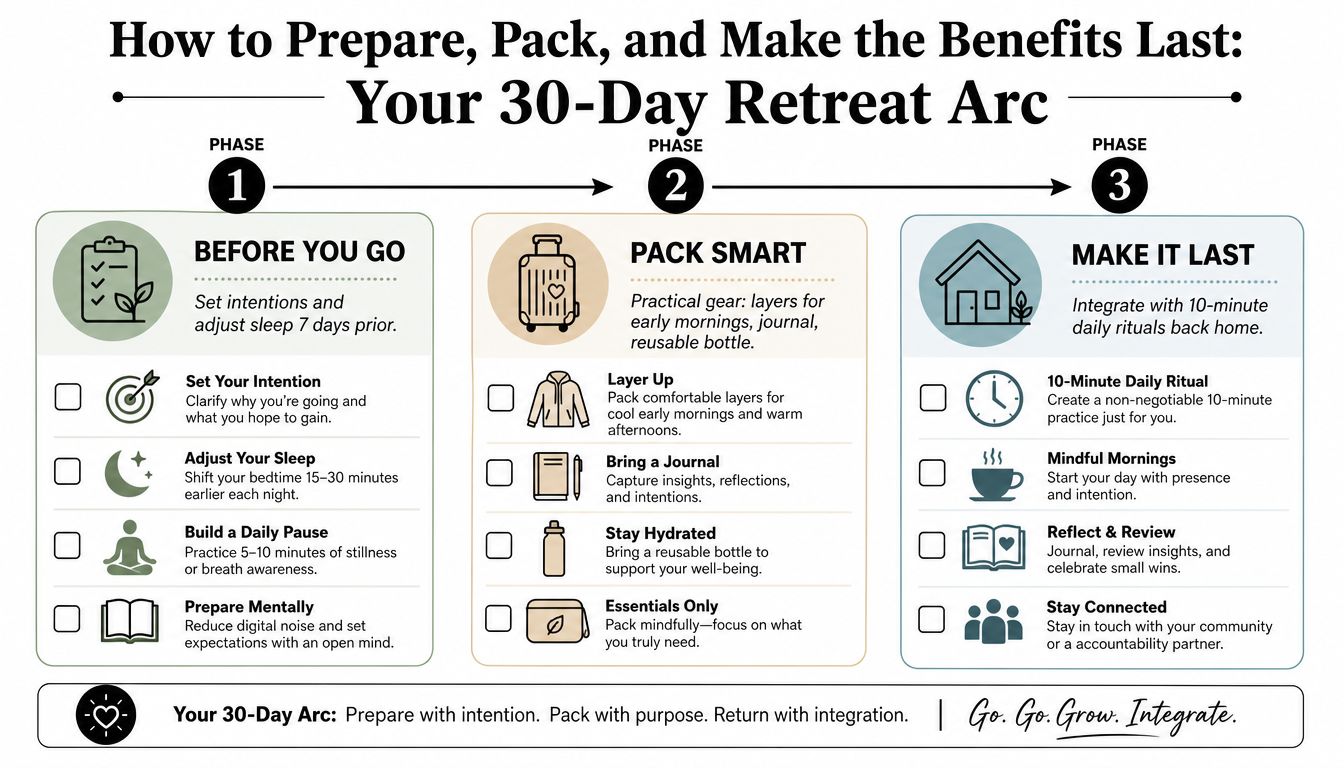
Before you go
Start by writing one intention in plain language. “Feel better” is too broad. “Create a sustainable evening routine,” “recover from a demanding work season,” or “make space for a difficult decision” gives the retreat a usable direction.
Use the weeks before departure to reduce unnecessary friction:
Review stimulants: Taper caffeine or other stimulants gradually if your retreat includes early mornings, meditation, or sleep work.
Protect movement: Keep gentle, consistent movement in your schedule instead of arriving after a period of complete inactivity.
Complete intake forms: Be honest about injuries, medications, supplements, dietary requirements, and mental health history.
Set phone expectations: Tell colleagues and family when you'll be reachable, then create an out-of-office message that supports the boundary.
Pack for the setting
Costa Rica's nature-forward programs can move between villa, beach, jungle, trail, and open-air practice spaces. Bring lightweight layers for early mornings, traction-friendly shoes for trails, a journal, a reusable bottle, swimwear, sun protection, and clothing you can move in comfortably.
Keep documents organized. Bring your booking information, identification, completed intake forms, supplement protocol, relevant medical information, and any vaccination records the operator has requested. Don't pack as though every day is a formal resort day. Pack for participation.
This restoration retreat guide is useful when you're comparing a restorative itinerary with a more demanding wellness program.
Make the return intentional
Capture your main insights within 48 hours of getting home, while the experience is still clear. Choose one behavior to track for 90 days, such as a consistent bedtime, daily breathwork, a weekly technology boundary, or scheduled movement. The point isn't to reproduce the entire retreat. It's to preserve one practical mechanism that supported your stated goal.
Schedule a weekly practice that resembles the retreat's rhythm. That could be one quiet meal, one guided class, a walk without your phone, or a standing conversation with someone who helped you reflect. If you return immediately to an overloaded calendar, the retreat becomes an isolated event rather than a supported change.
Choosing the Right Retreat and Taking the Next Step
A wellness retreat is worth considering when it represents a deliberate investment in a defined outcome, not when you need another attractive place to sleep. Costa Rica offers the raw ingredients, nature, food, movement, privacy, adventure, and community. The operator's job is to combine them with credible facilitation and a coherent schedule.
Start with three actions.
Shortlist two or three properties that match the goal you wrote before researching. A burnout reset, a surf-and-movement week, a couples' milestone, and a leadership offsite require different environments and different levels of privacy.
Request the working documents. Ask for a sample itinerary, a complete inclusions list, cancellation terms, accessibility details, and lead-facilitator biographies. Glossy imagery can confirm aesthetic fit, but it can't demonstrate program quality.
Choose the booking route carefully. A large booking platform may simplify comparison, while direct reservations can provide clearer communication with the property. A retreat specialist or travel advisor can add value by comparing inclusions, coordinating transfers, managing group needs, and protecting the investment when the itinerary involves several moving parts.
For travelers looking specifically at purpose-built recovery and personal work, these healing retreats in Costa Rica provide another useful comparison point.
The decision is straightforward once the variables are visible. If the program fits your goal, the property supports the way you want to travel, the practitioners are credible, and the total cost sits inside your budget, choose a date and arrive ready to participate. Don't book the view and hope the outcome appears later.
VIVARA offers an intimate, founder-led retreat setting in Dominical for up to 14 guests, with distinct villas, personalized service, chef-led cuisine, and wellness programming support such as yoga, breathwork, meditation, and facilitated group work. Visit VIVARA to compare a private Costa Rica retreat experience with your specific goal, group, and preferred balance of restoration and adventure.

