The Vivara Content Team
What Is Farm to Table Dining, Really
What Is Farm to Table Dining, Really

Farm-to-table dining is a direct, traceable sourcing model, not just a synonym for fresh or local, and the test is simple, does the kitchen name specific producers, and does the menu change with what's being harvested? In the U.S., the practical benchmark for “local or regional” food is ingredients sourced within 400 miles of origin or within the same state, so the label only matters when you can see how a property sources, not when it merely sounds wholesome (Congressional Research Service via Congress.gov).
That distinction matters even more in Costa Rica, where wellness retreats and boutique stays often use food to signal authenticity, connection, and care. The smartest travelers don't ask whether a place says farm-to-table, they ask whether the sourcing is operational, traceable, and tied to the rhythm of the land.
The Short Answer Most Articles Skip
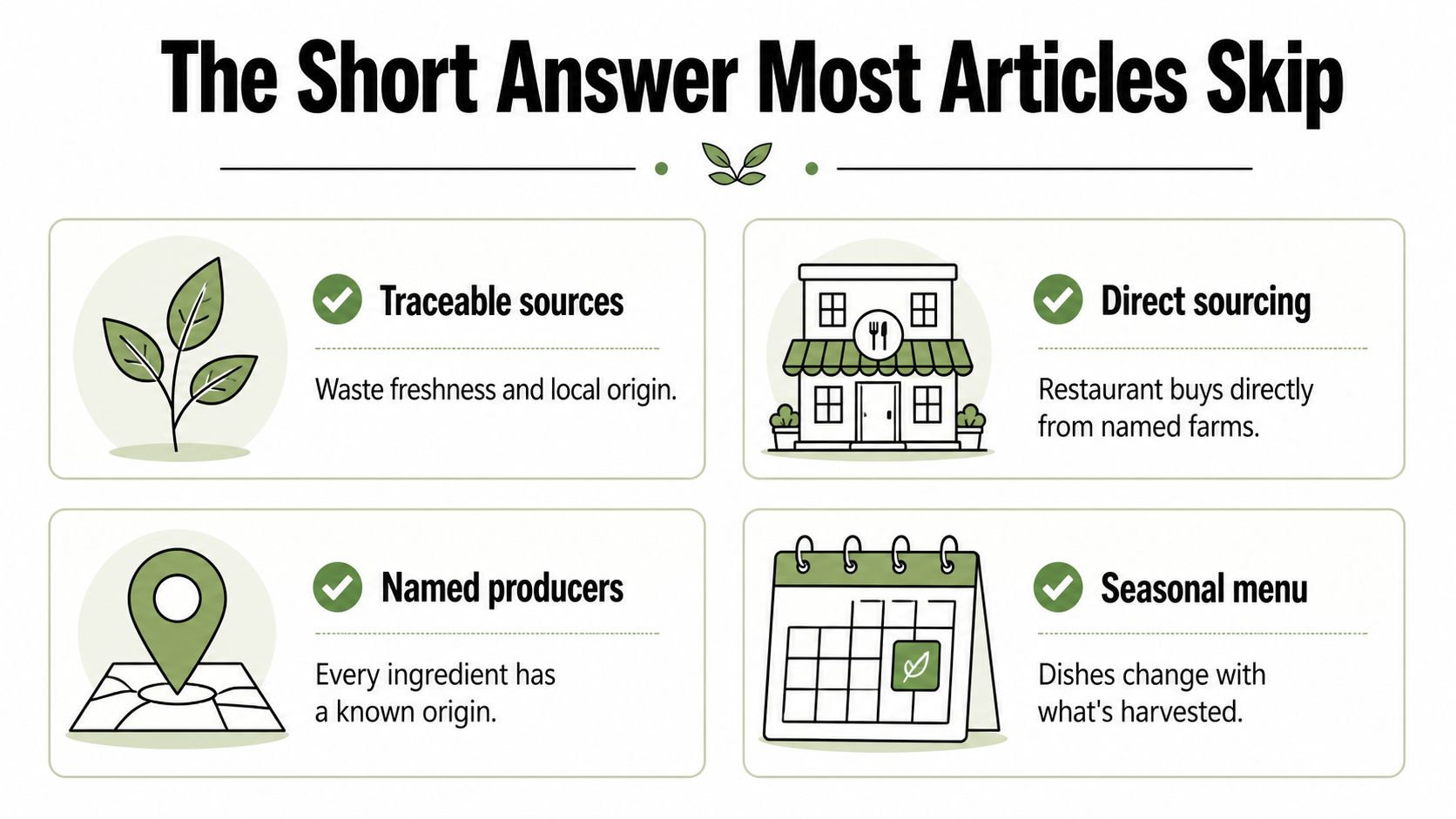
Farm-to-table dining means a restaurant or retreat buys ingredients through a short, transparent chain that leads back to named farms, ranches, fisheries, or other producers. It isn't a legal category, and it isn't automatically the same thing as “local” food, because “local” can be a broad regional label while farm-to-table is a sourcing relationship you can verify (Congressional Research Service via Congress.gov).
That's where most explanations fall apart. They stop at the warm idea, fresh vegetables, nearby farms, good intentions, and never tell travelers how to tell the difference between a working system and a decorative phrase on a menu.
A useful filter is built around two questions. Can the kitchen name the producers? And does the menu visibly shift with seasonal availability? If the answer to either one is fuzzy, the claim is probably softer than it sounds.
Practical rule: if the staff can't tell you where the tomatoes came from, the restaurant may be local-minded, but it's not giving you much to verify.
At boutique retreats, that gap gets bigger because the term often appears on websites without a producer list, a sourcing note, or any evidence that the kitchen works around harvest timing. Travelers who care about value should treat farm-to-table as an operating system, not a mood. That means looking for traceability, seasonal changes, and direct relationships, especially when a property is positioning food as part of the retreat experience.
A Longer History Than the Trend Suggests
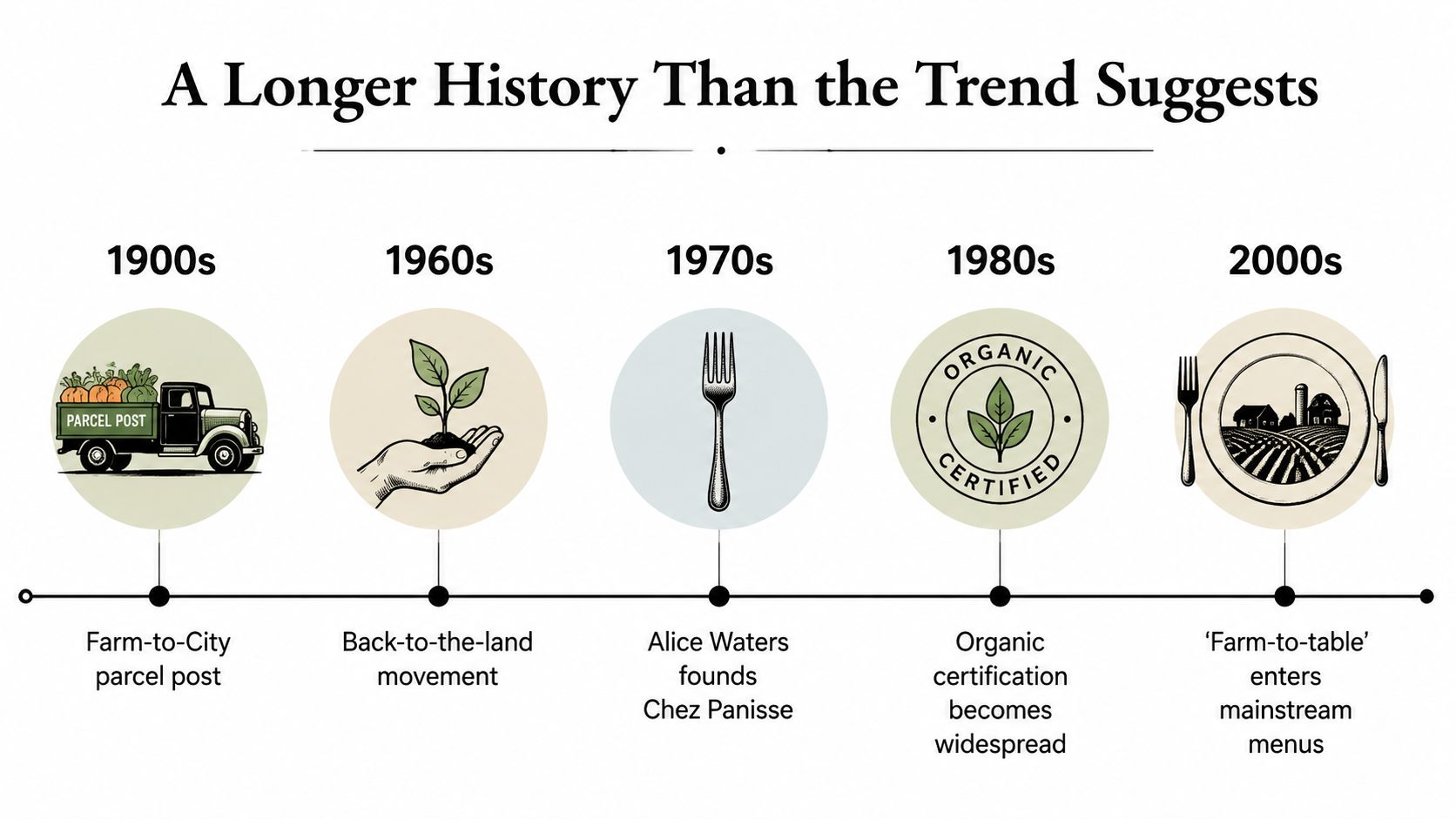
The modern phrase may feel recent, but the idea is old. USDA archival material describes an early 1900s U.S. Postal Service and USDA initiative called “Farm-to-Table” or “Farm-to-City,” which used parcel post to connect farmers and customers with fresh food (Congressional Research Service via Congress.gov). That matters because it shows farm-to-table began as logistics, not branding.
By the time industrial distribution took over much of American food retail, the counterreaction was already forming. Chefs and diners started pushing back toward identifiable producers, seasonal cooking, and shorter supply chains. The dining version of the idea became more visible in the chef-led restaurant world, but the core mechanic stayed the same, food moves fewer steps before it reaches the plate.
What survived the shift into restaurant culture
The original operational DNA is still recognizable. The producer has a name. The kitchen knows the source. The menu bends to the harvest instead of forcing the harvest to fit the menu.
That's why the concept still resonates with travelers today. A retreat in Costa Rica can borrow the language of farm-to-table without doing the work, but it can't fake the underlying relationship for long if guests start asking the right questions.
The history is useful for one more reason. It reminds you that the concept predates the trend cycle, so the strongest properties aren't selling novelty, they're practicing a supply chain philosophy that has been around for generations.
How Farm to Table Actually Works
Real farm-to-table programs are built on four mechanics, and each one is easy to miss if you only skim the menu.
Supply chain, seasonality, traceability, impact
Supply chain structure. The kitchen buys from a named producer, often with fewer intermediaries in between. That means less time sitting in warehouses and less dependence on commodity distribution.
Seasonality. The menu expands and contracts around what's available. If a property promises identical dishes year-round, it's probably smoothing over the harvest cycle rather than working with it.
Traceability. Staff can usually identify the farm, ranch, or fishery behind a dish. In stronger programs, the relationship is documented through purchase records, visits, or a standing partnership.
Impact. The best versions support nearby producers and reduce waste by aligning orders with ripeness and timing. A lower-transport model also tends to reduce shipping distance and refrigerated handling, which is one reason local sourcing is often framed as a lower-intensity system (Sage Journals).
Pillar | What It Means Mechanically | How a Diner Can Verify |
|---|---|---|
Supply chain | Ingredients move through a short route, often direct from producer to kitchen | Ask whether the kitchen buys directly or through a distributor |
Seasonality | Dishes change with harvest timing | Look for menu shifts, substitutions, or daily specials |
Traceability | Ingredients can be tied to named producers | Ask for farm names, fishery names, or supplier lists |
Impact | The program supports local producers and cuts unnecessary transport | Look for sourcing notes, farm visits, or transparent procurement language |
The most telling sign is not a slogan. It's whether the kitchen can explain where a dish came from without scrambling.
For travelers, the mechanics matter because they reveal whether “local” is a design choice or just a marketing adjective. If the restaurant can't describe the process, the claim is hard to trust.
Real Farm to Table vs Restaurant Marketing
A retreat can be farm-to-table and still be imperfect. It can also be stylish, expensive, and only loosely connected to local sourcing. The difference usually shows up in the day-to-day operations, not the website copy.
Dimension | Authentic Farm to Table | Marketing-Only Claim |
|---|---|---|
Traceability | Named producers are part of the conversation | “Local” stays vague |
Menu flexibility | Dishes change with harvests | Menu stays static for convenience |
Supplier relationships | Direct, ongoing partnerships | Spot buying from broadline channels |
Ingredient distance | Sourcing is intentionally short and regionally legible | Ingredients may pass through large distributors |
Surplus handling | The kitchen plans around weather and crop timing | Surplus gets hidden in specials or discarded quietly |
The difference shows up in language. A real farm-driven chef will usually talk about growers, weather, availability, and substitutions. A decorative version tends to talk about freshness in general terms and stops there.
How the spectrum looks in practice
You don't have to treat this as a binary. Some properties sit in the middle, with a few local ingredients and a few standard channels. That's still useful if the retreat is honest about what it can source well.
The problem starts when the label implies a deeper commitment than exists. A hotel plate labeled “locally sourced” once a week doesn't tell you much. A kitchen that says, “the beans changed because the farm had a smaller harvest,” tells you a lot more.
A Traveler Checklist for Authentic Dining
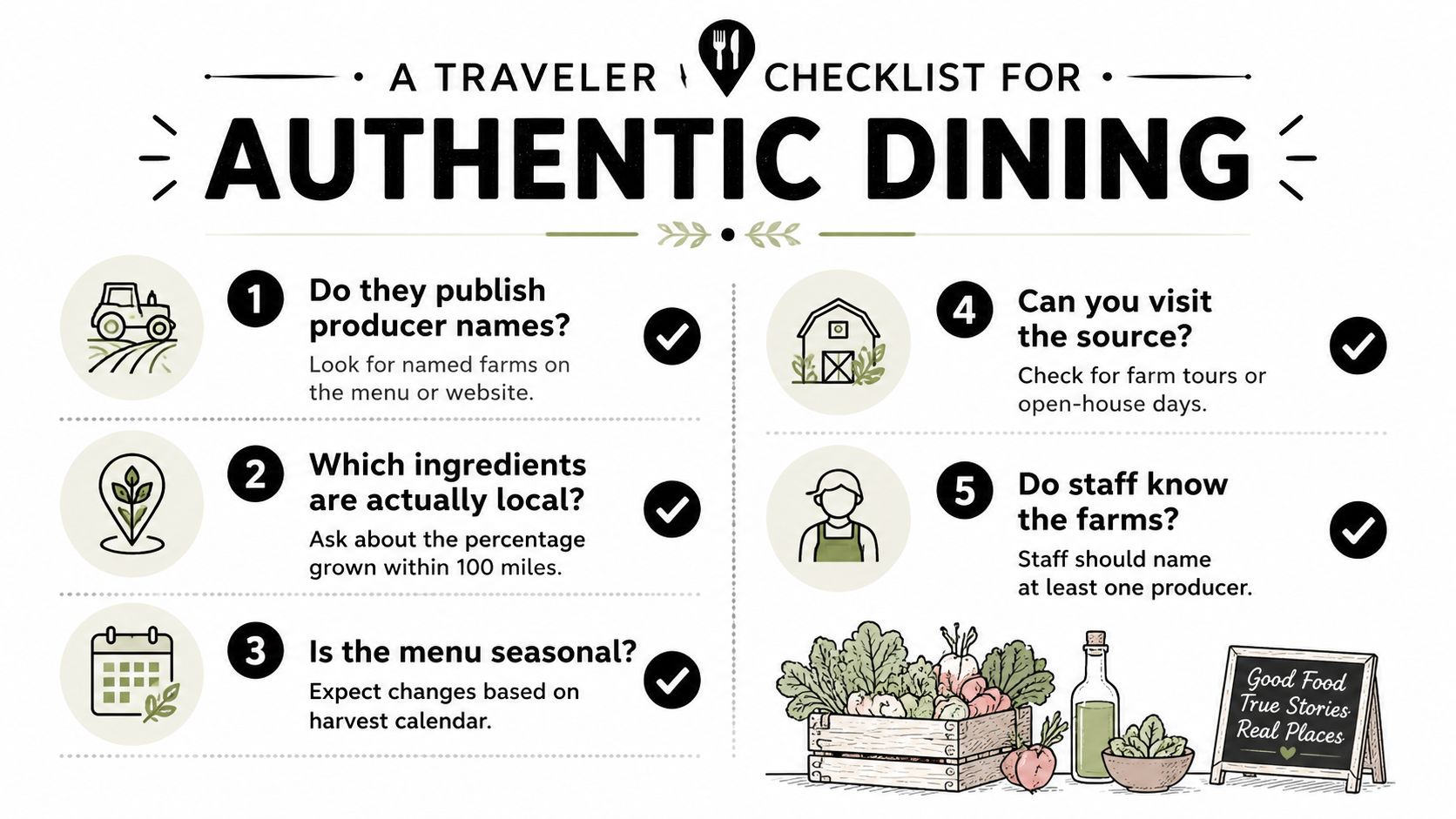
Before you book, ask the property for specific producer names and a sample of how often the menu changes. If the answer is vague, that's useful information. You're not interrogating the staff, you're checking whether the food program is built to be explained.
A few questions cut through the fog fast:
Do they publish producer names? Look for named farms, ranches, or fisheries on the menu or website.
What counts as local here? Ask whether ingredients are within a short regional range or bought in-country.
How seasonal is the menu? A real program usually changes with harvest timing.
Can you visit the source? Farm tours, open-house days, or visible producer relationships are strong signs.
Do staff know the farms? They should be able to name at least one producer without checking a binder.
If you want an example of a region where travelers often need to separate destination marketing from actual logistics, see this guide to San Carlos in Costa Rica. The same standard applies whether you're in a rainforest retreat, a beach villa, or a mountain lodge, the most credible places make the supply chain visible.
Save this rule: if the kitchen can tell you what changed because of the harvest, the program is probably real.
Tactile signs help too. Uneven heirloom tomatoes, a short specials list, or a server who can answer provenance questions without hesitation are all better signs than glossy language. The goal is informed evaluation, not a cross-examination.
How VIVARA Approaches Farm to Table

Some retreats use farm-to-table as a garnish. Others build the guest experience around it. The difference is obvious when the kitchen is making real-time decisions based on what arrived that morning.
At VIVARA in Dominical, the dining program is described as no fixed menus, with Michelin-trained culinary leadership shaping meals around farm-fresh, ocean-caught, and jungle-foraged ingredients. That kind of sourcing geometry matters because it lets a retreat pull from multiple local realities, not just one supply lane. Guests get a more grounded expression of place, but they also give up the predictability of standardized resort dining.
Here's the honest tradeoff. Flexibility and freshness work best for travelers with adventurous palates, couples who like shared discovery, and groups that see dining as part of the trip's rhythm. If someone in the group wants rigid menu certainty every night, a farm-driven kitchen can feel limiting.
The same transparency standard still applies. A retreat should be able to explain how its chefs communicate daily choices, what producers are involved, and how the kitchen adapts when a crop is missing. The strongest programs make that conversation easy because the food is part of the retreat's identity, not an afterthought.
Later, if you want a broader look at the property's style of stay, this what to expect at VIVARA overview helps frame the experience without reducing it to a dining label.
The most credible farm-to-table stays don't promise perfection. They promise responsiveness, and that's usually a better sign.
Honest Benefits and Fair Criticisms
The best farm-to-table programs deliver clear advantages. Ingredients tend to be fresher because they spend less time in transit. Supply chains are easier to explain. Small-scale producers get direct business. Seasonal menus push chefs to cook with what's good right now instead of repeating the same plate all year.
There's also a real environmental logic to shorter supply chains. Local sourcing can reduce shipping distance, refrigeration demand, packaging, and truck traffic, and one analysis of restaurant supply chains described locally sourced produce traveling about 50 miles versus 1,500+ miles in conventional chains, with transportation emissions cut by up to 75% (Sage Journals). That doesn't make every local dish low-impact, but it does show why transport distance matters.
The limitations are real too
The label is inconsistent across the industry. Premium pricing can put strong programs out of reach for some diners. Scaling direct sourcing across multiple locations is difficult. Weather and supplier reliability can disrupt even the most committed kitchen.
There's also a credibility problem. Some properties use the phrase while buying mostly through wholesale channels, which is why the verification framework matters more than the label itself. Diners are asking better questions now, including producer names and whether the producer benefits, and that skepticism is healthy (Sacramento Bee).
If the sourcing story can't survive basic questions, the story probably isn't the selling point.
The takeaway is straightforward. Farm-to-table is valuable when the operations back it up, and weak when it stays at the level of atmosphere. For travelers, that means the label is only the beginning of the evaluation.
Supporting Regenerative Food as a Guest
The easiest way to support better food systems is to spend money where the sourcing story is visible. Ask for producer names, request the garden or supplier list, and choose menus that change with the season instead of expecting imported ingredients to appear on command. A property that can explain where its food comes from is usually doing more than selling a vibe.
You can also make small choices that reinforce the model. Eat lower on the food chain when local options make that easy. Skip menu items that obviously undercut the kitchen's sourcing logic. Leave feedback about sourcing, not just ambiance, because operators notice what guests reward.
For retreat travelers, that's especially useful in Costa Rica, where the strongest experiences often combine nature, hospitality, and a sense of place. If you're comparing options for a restorative stay, this restoration retreat guide can help you think about food as part of the wider reset, not an isolated amenity.
The most informative way to judge a property is to experience a fully implemented program firsthand. That gives you a cleaner read on what's real, what's curated, and what's just decorative language.
If you want a retreat where dining, nature, and human-scale hospitality are all part of the same experience, VIVARA is built around that idea in Dominical, Costa Rica. Its chef-led, no-fixed-menu approach gives travelers a practical way to see what farm-to-table looks like when it's operational, not ornamental. Visit VIVARA to compare the experience for yourself and decide whether that level of transparency and flexibility fits the kind of Costa Rica stay you want.