The Vivara Content Team
Habitat Restoration Projects That Actually Work
Habitat Restoration Projects That Actually Work

You arrive on Costa Rica's Pacific coast expecting to see untouched nature. Instead, a guide points out a mangrove channel that looks wild because people repaired the conditions that let it function: water moves through the roots, native plants hold the soil, and wildlife can use the habitat again. The area isn't merely preserved. It's recovering.
That distinction matters for travelers choosing a wellness retreat, an eco-lodge, or a community experience. Habitat restoration projects can range from replanting a forest edge to reconnecting wetlands, but planting alone doesn't prove that an ecosystem works. The strongest projects restore the physical drivers, biological structure, and ecological functions that support recovery over time.
The global agenda has expanded sharply. In 2019, the United Nations General Assembly proclaimed 2021 to 2030 the United Nations Decade on Ecosystem Restoration, creating a policy framework for work across terrestrial and aquatic ecosystems. UN and Convention on Biological Diversity materials report that countries have pledged to restore more than 1 billion hectares by 2030, while the Bonn Challenge target is 350 million hectares of degraded land by 2030. UN reporting estimates that restoring 350 million hectares could generate about US$9 trillion in ecosystem services and remove 13 to 26 gigatons of greenhouse gases from the atmosphere, as described by UNESCO's ecosystem restoration overview.

For an eco-traveler in Dominical, this global effort becomes tangible. You can ask what a retreat protects, how it measures results, who benefits locally, and whether guests are observing restoration or participating in it responsibly. The answers reveal whether an experience supports genuine stewardship, personal reset, and community connection, or borrows the language of regeneration.
Introduction to Habitat Restoration Projects and Why They Matter Now
A restored area rarely announces itself. You may notice shade, birdsong, clearer water, or a trail through dense vegetation before anyone explains that the area once suffered from erosion, blocked drainage, invasive plants, or fragmented forest. Restoration succeeds when the ecosystem begins performing essential work again, not when a site merely looks green.
That's why the field has moved beyond isolated conservation projects. The United Nations Decade on Ecosystem Restoration gave governments, communities, scientists, and land managers a shared framework for repairing damaged ecosystems. The international targets are large, but the practical question remains local: what changed at this site, and can the project demonstrate that the change will last?
The IUCN's 2026 global assessment reported approximately 124.3 million hectares worldwide under restoration, rehabilitation, or improved management, with a lower-bound verified figure of 116.2 million hectares. The assessment also found that this achieved area represents only 10.4% of countries' restoration pledges under major international agreements, according to the IUCN Restoration Achievements Database 2026. The figures show progress, but they also expose an implementation gap between public commitments and durable ecological recovery.
A useful travel question: Don't ask only how many hectares a project covers. Ask what the land, water, plants, and wildlife can do now that they couldn't do before.
This guide connects the science to decisions you can make as a traveler, retreat guest, host, or brand partner. You'll learn how restoration differs from rehabilitation and rewilding, how projects are selected and permitted, which monitoring evidence matters, and how funding and volunteering can support long-term stewardship. Costa Rica offers a particularly clear setting for that learning because forest recovery, protected areas, community guides, coastal habitats, food systems, and tourism often meet in the same area.
For an intimate retreat in Dominical, the experience can be quiet and practical. A walk may reveal how a restored forest edge protects a stream. A conversation with a local guide may explain why wildlife habitat affects livelihoods. A hands-on activity may support a documented partner rather than create a one-off photo opportunity. Regenerative travel works best when the guest's presence strengthens a system already designed to recover.
What Habitat Restoration Projects Really Mean
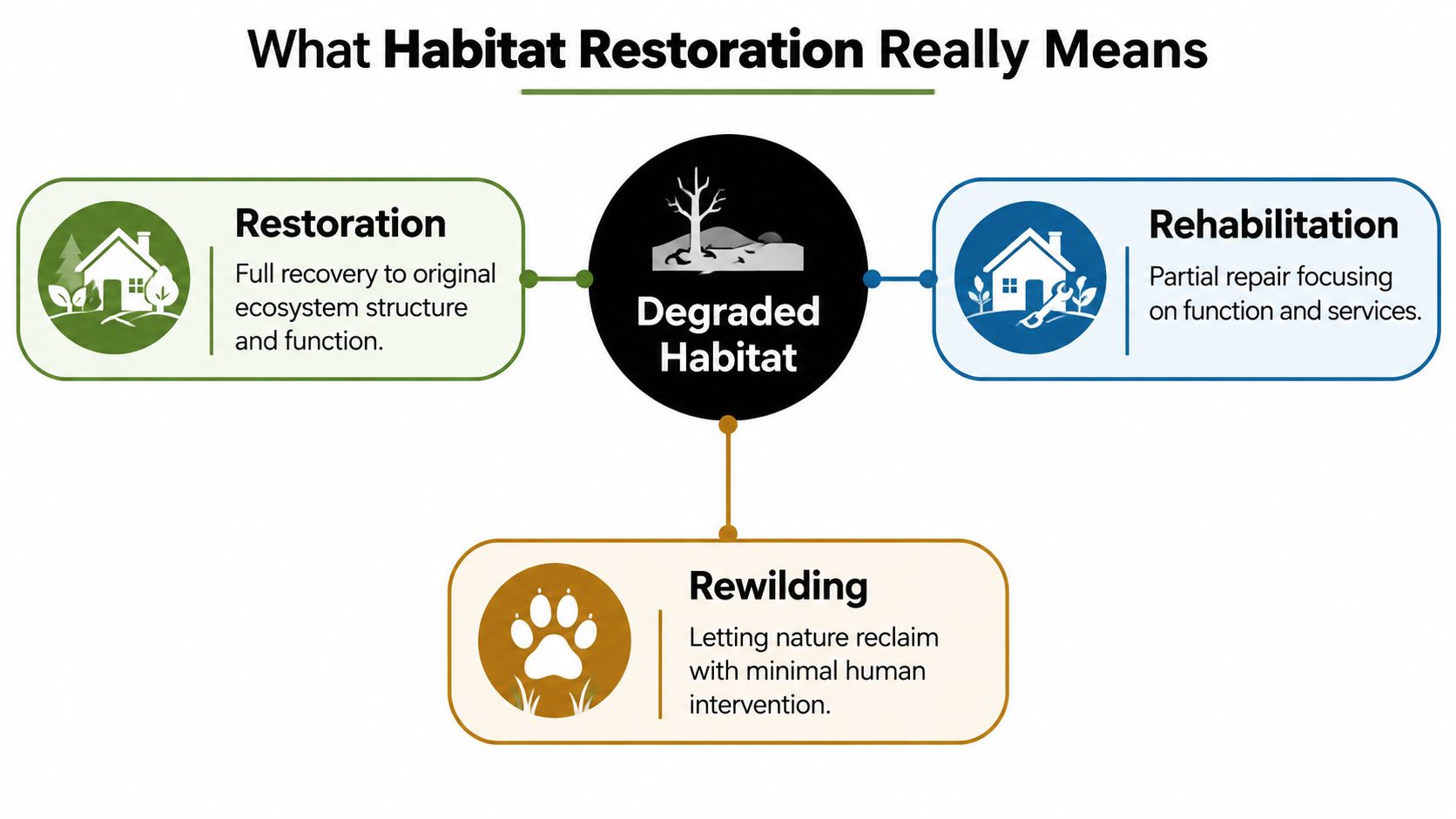
Start with a simple house analogy. A degraded habitat is like a house with a damaged roof, flooded foundations, broken windows, and missing rooms. Restoration aims to recover the original ecosystem's structure and function as closely as practical. Rehabilitation repairs selected functions or services without recreating the entire original system. Rewilding gives natural processes more room to return, often with limited intervention after initial barriers are removed.
These terms overlap in everyday conversation, so labels alone aren't enough. A project described as restoration might focus on native planting, while another might first repair water flow, remove barriers, rebuild soil conditions, and then allow vegetation to return naturally. The second approach may look less dramatic at the beginning, but it addresses the causes of decline rather than decorating the symptoms.
Appearance is only the first test
Healthy habitats have structure, such as vegetation layers, channels, pools, nesting spaces, and soil horizons. They also have function, including water filtration, infiltration, nutrient cycling, erosion control, pollination, carbon storage, and the ability to support wildlife through different life stages.
A planting day can help, but planted seedlings may fail if groundwater levels are wrong, soil compaction remains severe, herbivores remove new growth, or the selected species don't match the site. In a wetland, for example, restoring the connection between water and soil may matter more than adding visible plants. In a forest corridor, natural regeneration may outperform dense planting if nearby seed sources and appropriate soil conditions remain available.
The baseline determines the meaning of recovery
Project managers need a baseline before implementation. That record can include vegetation, soils, water levels, topography, wildlife use, invasive species, and evidence of past disturbance. They also need a reference ecosystem, meaning a healthier site or historical condition that provides a realistic comparison.
The reference isn't always a perfect snapshot of the past. Climate, land use, and surrounding communities may have changed. Good restoration therefore defines a credible target, explains what can and can't be recovered, and identifies which ecological drivers need attention first.
Practical rule: If a project can describe its planting activity but can't explain its baseline, target condition, or physical constraints, its success claim deserves careful scrutiny.
Major Types of Habitat Restoration Projects and How They Work
Different habitats fail in different ways, so restoration techniques shouldn't be selected from a generic menu. A compact forest edge may need native enrichment and invasive-species control. A wetland may need its water regime repaired. A coastal site may need sediment movement and dune-forming vegetation protected from disturbance.
Forest restoration and agroforestry
Reforestation adds native trees to land where forest cover has been lost. Natural regeneration can be equally important when seed sources, soil, rainfall, and protection from repeated disturbance remain. Agroforestry combines trees with crops or grazing in a managed system, which can reconnect habitat while supporting local livelihoods.
In Costa Rica, a forest project might restore a riparian corridor beside a farm or create shade-grown production that links isolated forest patches. The trade-off is patience. A planted line of trees can become visually impressive before it develops the layered structure, dead wood, canopy complexity, and wildlife value of a mature forest.
Wetlands and mangroves
Wetland rehabilitation focuses on water first. Managers may reopen blocked channels, remove barriers, reshape shallow basins, improve tidal exchange, or reduce sources of sediment and pollution. Native wetland plants then have a better chance to establish.
Mangroves are especially useful for teaching this principle. Their roots stabilize sediment and create habitat, but seedlings won't thrive if hydrology prevents regular inundation or if nearby land use continues to alter water flow. A successful project monitors the relationship between water movement, soil conditions, vegetation, and wildlife.
Dunes and coastal systems
Coastal restoration often protects natural movement rather than fixing the shoreline in place. Techniques can include native dune planting, boardwalks that concentrate foot traffic, removal of obstructions, and management of lighting or access during sensitive wildlife periods.
The visible result may be modest. A low dune, shifting sand, or a patch of pioneer vegetation can represent healthier coastal function than a rigidly managed shore. Visitors should expect restoration to look dynamic, especially where wind, waves, tides, and storms remain active.
Native species reintroduction
Reintroduction returns native animals or plants after the threats that caused their decline have been addressed. Those threats might include habitat loss, hunting, disease, invasive species, or disrupted food webs. Releasing animals without repairing those conditions can create a short-lived event rather than recovery.
Restoration Type | Core Techniques | Best For |
|---|---|---|
Forest restoration | Native planting, natural regeneration, corridor repair, invasive-species control | Fragmented forest edges, riparian zones, degraded farmland |
Agroforestry | Tree integration, shade systems, soil protection, habitat corridors | Working landscapes that need both production and ecological connectivity |
Wetland and mangrove rehabilitation | Channel repair, hydrology correction, native planting, sediment management | Floodplains, estuaries, mangrove margins, waterlogged sites |
Dune and coastal restoration | Native dune vegetation, access control, shoreline process protection | Eroding dunes, heavily visited beaches, nesting and coastal habitat |
Native species reintroduction | Threat reduction, habitat preparation, release planning, post-release monitoring | Sites where missing species can survive and contribute to ecosystem function |
The right match depends on the limiting factor. If water flow is wrong, planting more trees won't solve the problem. If habitat is connected but a key species is absent, reintroduction may help. If local livelihoods depend on the land, agroforestry or community stewardship may offer a more durable path than a project that excludes the people who manage the area.
How Habitat Restoration Projects Are Planned and Permitted
Good projects begin before a shovel reaches the ground. Planning gives managers a way to distinguish the visible problem from the underlying cause, while permitting ensures that restoration doesn't create new harm in a sensitive coastal, wetland, or forest setting.
Start with evidence
A baseline assessment should describe the site as it exists, including hydrology, soils, topography, vegetation, wildlife, land use, and nearby pressures. Managers then select a reference site or reference condition that represents the structure and function they want to recover.
The next step is alignment. Landowners, nearby residents, local guides, scientists, Indigenous communities where relevant, tourism operators, and regulators may have different priorities. A project that ignores access, livelihoods, customary knowledge, or maintenance responsibilities can lose local support even if its ecological design looks sound.
Design for the whole life of the project
A practical design identifies the intervention, expected response, risks, and maintenance plan. It should answer questions such as:
What is limiting recovery? Is the main issue water flow, soil condition, fragmentation, invasive species, disturbance, or missing native species?
What will change physically? Will the project alter channels, slopes, drainage, access, shade, or sediment movement?
Who will maintain it? Clarify responsibility for weeding, repairs, monitoring, visitor management, and future funding.
What approvals apply? Check protected-area rules, coastal restrictions, water rights, construction requirements, wildlife safeguards, and local environmental approvals.
How will the design adapt? Establish thresholds that trigger a change in technique if monitoring shows that conditions aren't improving.
In Costa Rica, requirements vary with location and intervention. A project near a protected area, river corridor, wetland, or coastline may involve different authorities and constraints than work on a private upland parcel. Community consent isn't a decorative addition to the permit process. It helps determine whether access, maintenance, cultural considerations, and local benefits are workable.
Here's a short educational video that illustrates the value of planning and implementation in habitat work:
Before supporting a project: Look for a site assessment, a defined reference condition, named implementation partners, a permitting pathway, and a stewardship plan that extends beyond the opening ceremony.
Measuring Success Through Monitoring and Long Term Stewardship
Restoration becomes credible when a project can show more than activity. Planting records, volunteer hours, and hectares treated describe effort. They don't necessarily demonstrate that water behaves differently, soils function better, vegetation develops complexity, or wildlife uses the site.
NOAA restoration-monitoring protocols recommend a tiered design that separates controlling factors, structural attributes, and functional outcomes. The approach combines measurements of hydrology, topography, vegetation, and fish communities with data loggers, on-site sampling, and remote sensing. In rapidly changing systems, the protocols note that monitoring should occur at least annually after restoration, as explained in NOAA's restoration-monitoring protocols.
Three layers of evidence
Tier one, controlling factors, asks whether the conditions that drive recovery have shifted. Monitoring might track water elevation, flow, water quality, soil moisture, sediment, or climate conditions.
Tier two, structural attributes, examines what the habitat physically looks like over time. Useful indicators include vegetation cover, native species richness, canopy or habitat complexity, topography, and soil carbon.
Tier three, functional outcomes, tests whether the ecosystem is doing its job. Wildlife return, fish use, breeding activity, infiltration, nutrient retention, flood storage, and other ecosystem services can provide that evidence.
A multi-method wetland study illustrates why below-ground measurements matter. Restored wetlands increased soil organic carbon by about 20%, native plant species richness by about 15 species, and saturated hydraulic conductivity by 27.3% plus or minus 11%, while reducing plant-available phosphorus by about 23%, according to the published wetland restoration study. The results connect restoration to soil permeability, water storage, nutrient retention, and plant-community recovery, not just surface appearance.
Ask for comparable records
Independent dialogue reports identify continuing gaps in habitat-condition data, baseline quality, reference areas, monitoring protocols, and central project databases, particularly for marine and freshwater systems. That means a large delivery figure can be difficult to compare across regions or interpret as ecological success, as discussed in the Biodiversa national restoration plans dialogue report.
For travelers, a credible host or partner should be able to explain what gets measured, who collects the information, how often surveys occur, and what happens when results disappoint. Guests can also explore related conservation context through VIVARA's turtle conservation guide, where habitat protection connects coastal stewardship with community responsibility.
Funding Models and Volunteer Pathways That Sustain Restoration
Restoration rarely fails because nobody cares. It often struggles because funding ends before maintenance, monitoring, and local stewardship become routine. The strongest model matches the project's timescale with a dependable source of support.
Four practical funding pathways
Philanthropy and conservation grants can support baseline studies, design, equipment, and early implementation. They're valuable for work with clear public benefits, but project leaders need a plan for what happens after the grant period.
Tourism-linked funding connects visitor spending with habitat care, guide training, wildlife protection, or local employment. It works best when the contribution is transparent and the project reports specific activities rather than using broad sustainability language.
Corporate partnerships can provide larger or more predictable support, particularly when a brand wants to connect its community with a credible place-based initiative. The relationship should protect scientific independence and avoid turning restoration into a branded backdrop.
Community volunteering contributes labor, knowledge, and social ownership. It's especially useful for native planting, trail maintenance, invasive-species control, wildlife observation, and public education, provided trained staff manage safety and ecological quality.
A small retreat group can offer something a large event often can't: time for orientation, direct conversation, and careful participation. Guests might learn why a particular task matters, meet local practitioners, and receive a follow-up summary showing what their contribution supported. That structure gives brands a more credible way to build community around shared values, because participants engage with a place and its caretakers rather than with a generic campaign.
Learn how regenerative tourism connects travel with local stewardship before deciding whether your priority is donation, volunteering, education, or a combination. A donation may suit a traveler with limited time. Hands-on work may suit a family, couples' group, or retreat team seeking a shared experience. Brands should define whether they want employee participation, customer engagement, storytelling rights, or long-term conservation support, then choose a partner that can document the relationship clearly.
The durable contribution is rarely the most photogenic one. It's the contribution that funds people, monitoring, maintenance, and decisions after guests have gone home.
Costa Rica Examples and How Retreat Guests Can Engage Responsibly
At a retreat near Dominical, a forest walk can reveal restoration in ordinary details: young native trees returning, shaded stream edges, and guides explaining why a protected corridor matters. Costa Rica's protected areas have long shaped its visitor economy. About 52% of tourists entering Costa Rica visit a national park or biological reserve, and park visits rose 13% between 2015 and 2016, generating 9.1 billion CRC in ticket sales, according to Tourism Review's Costa Rica ecotourism report. Independent research found that 58.1% of foreign tourists visited at least one protected area, while 72.3% described their trip as vacation, relaxation, recreation, or pleasure, as reported in research on Costa Rican tourism patterns.
This pattern developed through more than attractive scenery. A study cited by Cambridge recorded protected-forest visitation rising from 287,000 in 1987 to 866,000 in 1999, showing how conservation areas helped build a nature-centered travel economy, as discussed in Cambridge's history of Costa Rican ecotourism. Near Tortuguero National Park, a guide-training program responded to a 24-fold increase in park visitation over a decade by connecting tourism with environmental education, community training, and resource management, according to the Tortuguero guide-training document.
Guests can connect those larger patterns with responsible choices:
Choose a local guide: Ask who leads the experience and how local income supports conservation or community services.
Observe without pressure: Keep distance from wildlife, follow access rules, and avoid making sensitive habitat part of a performance.
Request measurable context: Ask whether a contribution supports monitoring, habitat work, guide training, or direct protection.
Prefer learning over extraction: A calm interpretation walk may build more understanding than unstructured volunteer activity.
For context on national forest recovery, read how Costa Rica regrew its forests. At an intimate retreat, that knowledge can make a stream, canopy, or restored clearing easier to read. Guests may come for rest, family connection, creative work, or team bonding, while seeing how tourism affects habitat. The meaningful test is whether local people retain agency, the project welcomes scrutiny, and the experience supports stewardship after the visit.
Choosing the Right Habitat Restoration Project for Your Goals
Start with habitat fit. A mangrove project should explain water movement and tidal conditions. A forest project should discuss regeneration, native species, connectivity, and protection from recurring disturbance. A wildlife project should identify the threats addressed before reintroduction or release.
Then check four filters:
Evidence: Is there a baseline and a realistic reference condition?
Monitoring: Does the project track drivers, structure, and ecological function?
Community value: Do local guides, land managers, residents, or conservation groups have defined roles and benefits?
Financial transparency: Can the organization explain where guest, donor, or brand support goes and how stewardship continues?
Costa Rica is compelling because restoration can be experienced through forests, rivers, wetlands, beaches, protected areas, food systems, and community-led interpretation. You don't need to choose between comfort and purpose, but you should choose an experience whose ecological claims match its evidence and whose scale matches your expectations.
For couples, families, friends, teams, and retreat leaders, the right project is the one that fits your available time, desired level of participation, and appetite for learning. Compare retreat-linked conservation experiences carefully, ask direct questions, and favor specific commitments over generic green language.
VIVARA offers an intimate, founder-led retreat setting in Dominical for up to 14 guests, with nature-based experiences, personalized activities, farm-fresh and ocean-caught dining, and guest stays that fund turtle conservation, lifeguard training, and living wages. Visit VIVARA to explore a Costa Rica stay where restoration, connection, adventure, and responsible local engagement can be part of the experience.

