The Vivara Content Team
Somatic Therapy Retreat: What It Is and How to Choose
Somatic Therapy Retreat: What It Is and How to Choose

You may arrive in Costa Rica with a beautiful itinerary, a quiet villa, and enough distance from work to notice what exhaustion has been hiding. Yet after years of pushing through, talking about the problem may no longer feel like progress. A slow breath, a grounded foot, or a facilitator's question about where tension sits in your body can open a different route into recovery.
That's the appeal of a somatic therapy retreat. It combines body-centered therapeutic practices with the spaciousness of an immersive stay, ideally in a small group and a natural setting. Costa Rica adds genuine practical value, not just scenery. About 1.6 million of the country's 2.7 million foreign visitors visited protected areas in 2023, showing how central parks and reserves are to the travel experience (Costa Rica protected-area tourism data).
The important question isn't whether a retreat looks serene online. It's whether the program's intensity, clinical support, group design, and setting match your actual nervous-system needs.
What a Somatic Therapy Retreat Is
A retreat begins with a practical question: what does your nervous system need from the experience? If you are depleted and easily overstimulated, a quiet, lightly scheduled program may suit you better than intensive emotional processing. If you already have therapeutic support and want structured practice, a retreat with individual sessions and carefully paced group work may be appropriate.
Somatic therapy uses physical sensation, breath, posture, movement, and autonomic responses as entry points into emotional healing. Instead of relying on narrative insight alone, you might track a tightening chest, notice an urge to withdraw, or try a movement that restores a sense of choice. The aim is to observe responses before attempting to change them.
Talk therapy works mainly through thoughts, memories, beliefs, and behavior. That approach can be valuable, yet some people understand their patterns intellectually while their bodies still react as if danger is present. A spa stay can relax muscles and reduce stimulation, but it generally does not teach deliberate regulation skills or examine trauma responses. A somatic retreat combines restoration with a therapeutic structure.
What the retreat format adds
Daily life rarely gives you enough uninterrupted time to notice a response, pause, and try something different. A retreat places meals, sessions, sleep, movement, and quiet within one container. That structure can make patterns easier to recognize, provided the schedule leaves room for recovery.
Look for four features:
Individual sessions: One-on-one work lets the practitioner adjust pace and attention to your history.
Facilitated group practice: A well-held group can support connection without demanding public disclosure.
Integration windows: Unstructured time allows your system to settle instead of turning every hour into an intervention.
Nature and sensory space: Outdoor settings offer practical anchors, including ocean sounds, walking paths, and changing light.
Small-group, design-forward properties in Costa Rica can strengthen this format. Thoughtful rooms, clear transitions, and usable outdoor spaces reduce logistical friction, so the setting supports the work rather than competing with it. Choose the property and schedule together. A beautiful location cannot compensate for excessive programming or weak clinical oversight.
Practical rule: Choose a program that makes rest part of the method, not a reward for completing an exhausting schedule.
For context on how body, mind, nature, and hospitality can work together, read this Costa Rica wellness retreat explainer. A somatic therapy retreat should be accessible to first-timers, while still asking for active participation. You are practicing regulated contact with difficult sensations, not just booking tropical relaxation.
The Lineage Behind Body-Based Healing
Body-based healing has a longer history than current wellness marketing suggests. Accounts of somatic therapy often trace its roots to the late nineteenth century, particularly to Pierre Janet, whose work connected trauma, memory, and bodily experience. The field's modern therapeutic identity is also commonly linked to Wilhelm Reich's 1933 book Character Analysis, which introduced the idea of “body armor,” chronic muscular tension associated with trauma and emotional suppression (historical overview of somatic therapy).
Reich's ideas remain controversial, but they helped establish a question that still matters in retreat work: how might emotional restriction show up in the body? Later practitioners developed more structured and less interpretively forceful approaches.
From muscular patterns to nervous-system regulation
In the 1970s, Thomas Hanna formalized the term Somatics, focusing on practical movement and the relearning of voluntary control over reflexive muscular patterns. Ron Kurtz developed Hakomi, a mindfulness-based approach that explores present experience through body awareness, emotion, and relationship.
Peter Levine developed Somatic Experiencing, founded in 1972, with a focus on autonomic nervous-system responses and manageable, gradual contact with activation. His landmark book Waking the Tiger: Healing Trauma, published in 1997, helped bring trauma-focused body work into wider public discussion.
The lineage continued to expand through modern frameworks, including Polyvagal Theory in the 1990s and 2011. These developments don't turn every retreat exercise into proven medicine, but they explain why today's programs may combine breath, movement, sensation tracking, relational safety, and trauma education.

A credible retreat doesn't need to reproduce every historical school. It should show thoughtful integration. Levine's gentle titration, Hanna's movement literacy, Janet's attention to trauma and memory, and Reich's early focus on muscular holding can inform modern practice without importing the excesses or certainty of older models.
That history matters to buyers because it separates a serious body-based program from a newly packaged trend. Somatic therapy has a lineage spanning roughly 130 or more years, while its retreat format remains a newer application of that evolving tradition.
What the Research Shows
The evidence supports interest, not inflated promises. A 2021 review of Somatic Experiencing summarized studies reporting measurable improvements in trauma-related and body-symptom outcomes, including Cohen's d = 0.46 for PTSD symptoms, Cohen's d = 0.68 for depression, and Cohen's d = 0.72 for somatic symptoms in separate findings (2021 review of Somatic Experiencing research). Another trial reported partial η² = 0.07 for kinesiophobia and partial η² = 0.19 for low-back-pain disability outcomes in its measured results.
Those figures describe early clinical signals, not a promise that a week in Costa Rica will produce the same outcome. The review characterized the strongest findings as preliminary. The wider literature also includes small samples, varied protocols, and limited research on retreats specifically. Studies usually examine somatic work in outpatient clinical settings rather than immersive residential programs, so buyers should treat retreat marketing as a question of fit, not proof.
Evidence snapshot for somatic therapy retreats
Modality | Evidence base | Typical effect size | Key limitation |
|---|---|---|---|
Somatic Experiencing | Initial clinical research in trauma and stress-related outcomes | Cohen's d values reported from 0.46 to 0.72 in selected studies | Findings remain preliminary and study methods vary |
Mindfulness retreat format | Controlled research on a 5-day residential retreat | Perceived stress, β = -8.85, and anxiety, β = -12.39, with p < 0.0001; awareness, β = 15.26, with p < 0.0001 (controlled mindfulness retreat study) | Results concern mindfulness retreat design, not every somatic therapy program |
Trauma-focused somatic work | Systematic review reports promising effects across PTSD-related, affective, somatic, and well-being outcomes | No single pooled figure applies across the reviewed studies (systematic review pre-proof) | Long-term and retreat-specific benchmarking remains limited |
Immersive retreat mechanism | Controlled retreat research includes subjective and biological stress pathways | Dose-dependent benefits were reported in the study | Design and facilitator quality determine how transferable findings are |
The practical conclusion is clear. Somatic therapy retreats occupy a promising middle ground, mechanistically plausible and supported by early clinical findings, but not backed by the mature consensus evidence of established medical interventions.
Match the retreat's intensity to your needs. If your nervous system is easily overloaded, choose a small-group Costa Rica property with spacious scheduling, skilled clinicians, and quiet recovery time. If you want structured exploration and can tolerate more activation, ask how facilitators pace exercises and adapt them when participants become overwhelmed.
Precise marketing is a quality signal. Choose programs that promise skills, reflection, regulation practice, and supported exploration. Be wary of claims guaranteeing trauma release, permanent nervous-system repair, or a predictable result after one stay.
Modalities and a Sample Retreat Day
The phrase “somatic therapy” can cover several practices, and they don't all carry the same intensity. A retreat may include slow or coherent breathing, more activating breathwork, Somatic Experiencing sessions, touch-optional bodywork, gentle yoga, somatic dance, and facilitated sharing.
Breathwork can help participants notice how breathing changes arousal and attention. Some styles are quiet and regulating. Others are intentionally intense, so the facilitator should explain the method, screen for medical and psychological concerns, and offer alternatives.
Somatic Experiencing sessions usually involve guided tracking of sensations, impulses, and shifts in activation. The practitioner's job isn't to force catharsis. It's to help you remain within a workable range while noticing what happens next.
Touch-based options, such as myofascial or craniosacral work, require explicit consent. You should be able to decline without explanation, change your mind during a session, and receive a clear account of where and how contact may occur. Movement practices can include restorative yoga, walking, stretching, or authentic movement. Group circles add social reflection, but participation should never require trauma disclosure.

A realistic day
A well-designed schedule has rhythm rather than constant programming:
Morning check-in: You orient to the group, your sleep, and your present capacity.
Opening breath practice: The facilitator offers a regulation-focused session with modifications.
Individual work: Private sessions allow deeper attention without performing for the group.
Shared lunch: Food becomes a social and sensory reset, not another workshop.
Afternoon movement or bodywork: You explore gentle physical integration, with touch remaining optional.
Evening integration: A short circle, journaling period, or quiet walk helps the day settle.
For travelers comparing formats, a Costa Rica breathwork retreat guide can help clarify how breath-centered programming differs from a broader somatic therapy retreat.
A useful sample itinerary should leave room for silence, naps, swimming, nature walks, and private conversation. If every hour is booked, the retreat may create stimulation rather than regulation.
Who Somatic Retreats Are Best For
The right retreat depends on your history, capacity, and goal. Budget matters, but it shouldn't be the deciding factor. A premium setting can improve comfort and privacy, yet it can't compensate for weak screening or a facilitator who doesn't understand trauma.
Matching retreat type to reader profile
Retreat focus | Best fit for | Pace | Clinical support level |
|---|---|---|---|
Regulation and resilience | High-performing professionals recovering from burnout | Gentle, skills-focused, with substantial rest | Wellness facilitator or clinician, depending on program |
Contained trauma processing | People carrying a defined traumatic event and already able to function day to day | Moderate, carefully titrated | Qualified trauma practitioner recommended |
Complex-trauma support | People with developmental trauma, dissociation, or unstable activation patterns | Slow, small-group, highly adaptable | Strong clinical oversight required |
Co-regulation and relationship work | Couples seeking shared grounding and better conflict recovery | Relational and experiential | Facilitators trained in couples or relational work |
Introductory somatic practice | Curious beginners with mild stress or a personal-reset goal | Low intensity, educational, flexible | Experienced facilitator with clear boundaries |
Burnout recovery usually benefits from a program that teaches repeatable tools without pushing participants into heavy trauma excavation. You should leave knowing how to recognize activation, pause, orient, breathe, and recover in ordinary life.
People with complex or developmental trauma need more than attractive programming. They need facilitators who understand dissociation, pacing, consent, and aftercare. A retreat may complement ongoing therapy, but it isn't interchangeable with weekly clinical care or a long-term treatment plan.
Couples and groups can gain something different. Shared meals, outdoor activities, and facilitated regulation practices create opportunities to practice connection outside a therapy room. Brands can use that same design principle for private team retreats, but the program should be framed around trust, creativity, communication, and recovery rather than treating employees as patients.
Safety, Screening, and When to Wait
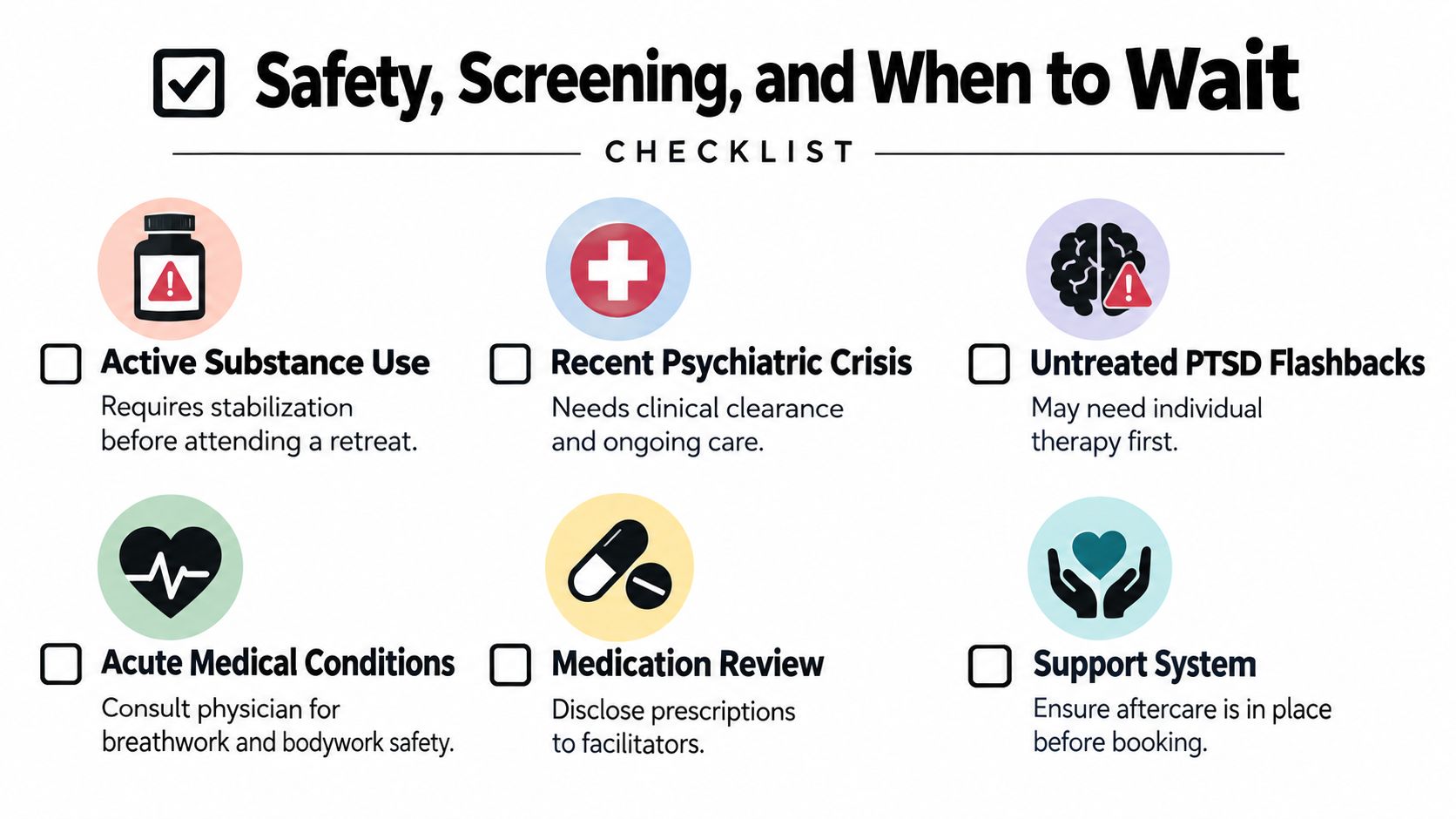
A tropical setting doesn't make intensive emotional work automatically safe. If you're experiencing active substance use, a recent psychiatric crisis, untreated PTSD flashbacks, or an acute medical condition, seek clinical stabilization before attending a retreat.
That doesn't mean somatic work is off limits forever. It means the first step may be individual therapy, psychiatric support, medical clearance, or a more contained treatment setting. People with chronic pain, dissociation, complex trauma, or significant medication needs should ask specific questions before booking, because the evidence and suitability vary across populations and formats (research on acceptability and suitability in trauma-sensitive somatic interventions).
What trauma-informed design looks like
Before you pay a deposit, ask whether the retreat includes:
A real screening call: A checkbox form can collect information, but it can't replace a conversation about stability, goals, medication, and support.
Informed consent: Facilitators explain intensity, touch, privacy, and your right to pause or leave an exercise.
Qualified support: Credentials should be verifiable and relevant to the work being offered.
Daily check-ins: Staff need a way to notice when someone is overwhelmed or withdrawing.
A clear escalation plan: Ask how the team responds to a medical or psychiatric emergency.
Aftercare guidance: You should know what support is available once you return home.
Warning signs include vague training claims, mandatory touch, pressure to disclose trauma publicly, promises of guaranteed release, and no meaningful intake process. A retreat that refuses to discuss emergency access or facilitator qualifications isn't offering the transparency this work requires.
How to Choose the Right Retreat
Use four filters before comparing villas, menus, or Instagram photographs. Group size, facilitator credentials, location, and screening tell you far more about likely fit than a polished brand story.
Start with the group
For intimate work, a group of 8 to 14 people can balance peer resonance with enough privacy for participants to remain known rather than exposed. Smaller isn't automatically better, and a larger group can work for educational wellness programming, but deeper processing requires clear boundaries and sufficient facilitator attention.
Ask for the facilitator-to-guest ratio. Also ask whether the retreat is a shared booking, a private group, or a full-property buyout. A private setting can be particularly useful for couples, families, founders, or brands building community around a shared purpose.
Verify the people, not just the method
Look for licensed mental-health clinicians, certified Somatic Experiencing Practitioners, or breathwork facilitators with a clear, verifiable training lineage. Ask which parts of the itinerary are therapeutic, which are educational, and which are hospitality or recreation.
A retreat should also explain who handles support outside formal sessions. One person may lead movement, another may conduct individual work, and a local host may manage food, transport, and logistics. That division can be a strength when responsibilities are explicit.
Compare the setting with your regulation needs
Dominical and Uvita offer a useful combination of jungle privacy, ocean access, and small-group capacity without the resort-scale distractions found in larger wellness destinations. Costa Rica also has a mature hospitality base. Tourism arrivals rose from 155,000 in 1970 to 435,000 in 1990 and 1.1 million in 2000, while tourism revenue rose from US$21 million to US$1.15 billion over the same period, according to research published by Cambridge (history of Costa Rica's tourism growth).
Factor | What to look for | Red flag |
|---|---|---|
Group design | Intimate cohort, clear privacy rules, adequate staff | Unclear capacity or overcrowded sessions |
Facilitator credentials | Verifiable licenses, certifications, and relevant experience | Titles without training details |
Program structure | Individual work, group practice, integration time, optional activities | A packed schedule with no recovery windows |
Location | Nature access, quiet rooms, reliable transport, reasonable emergency access | Remote setting with no emergency plan |
Screening | Live intake conversation and medical or mental-health questions | Instant booking with no suitability review |
Consent | Touch and intensity are opt-in and adjustable | Mandatory contact or pressure to continue |
For a wider comparison of program styles, review this guide to healing retreats in Costa Rica. A gently held week with daily movement and breathwork suits many beginners. Complex-trauma work usually calls for a smaller cohort, slower pacing, longer support, and stronger clinical oversight.
Preparing for the Experience and Next Steps
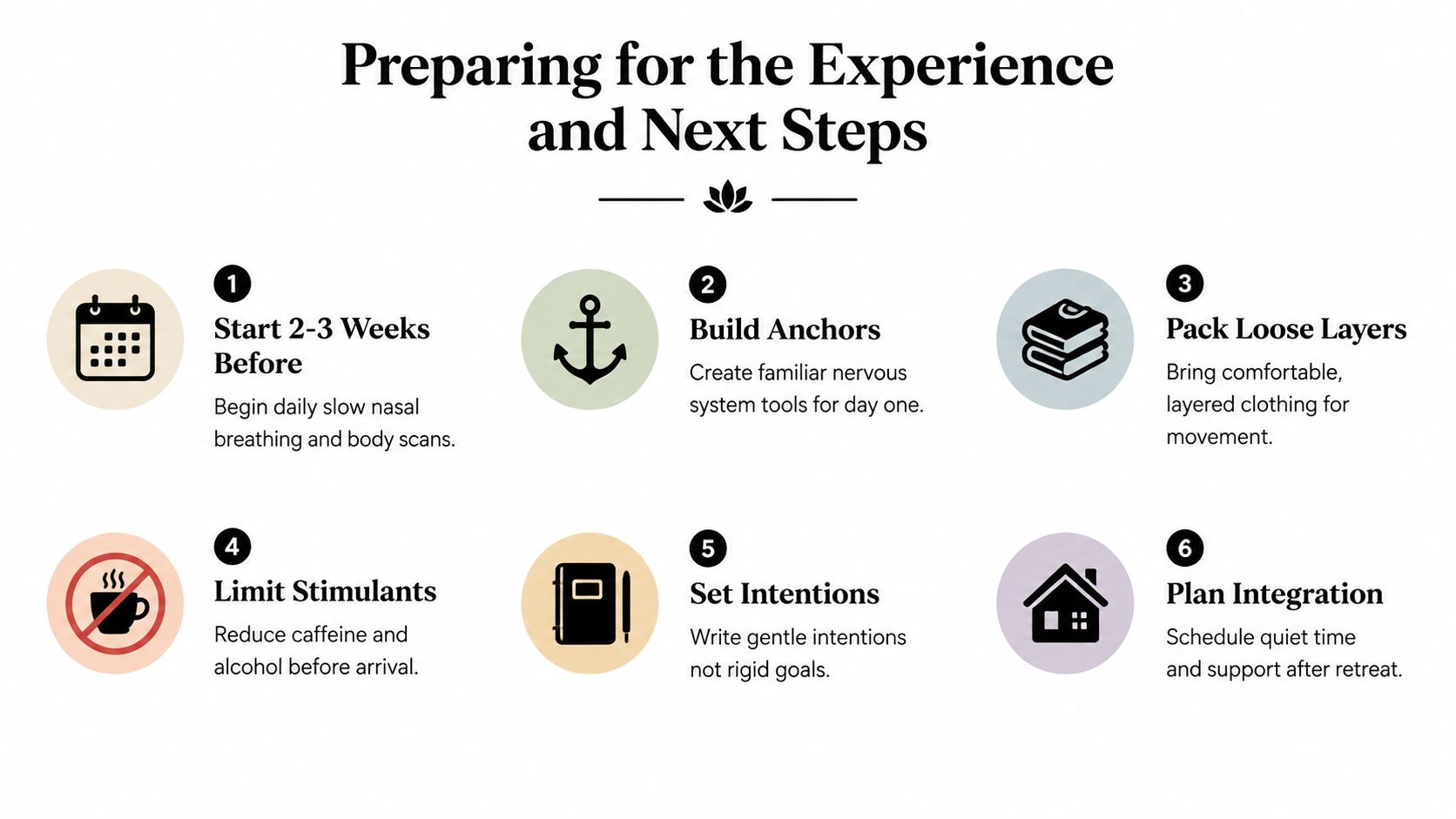
Preparation should begin two to three weeks before arrival. You don't need an elaborate routine. Practice slow nasal breathing and brief body scans daily, so you have familiar anchors when the retreat begins.
Pack loose, layered clothing for floor work and changing weather. A refillable water bottle, journal, eye mask, and a familiar comfort object can make rest easier. Reduce heavy alcohol intake before arrival, disclose medications and recent mental-health history during screening, and ask whether any planned breathwork requires medical clearance.
Set a direction, not a performance target
Write an intention such as “notice when I leave my body during conflict” or “practice resting without earning it.” Avoid demanding a breakthrough. That kind of pressure can turn a restorative experience into another achievement project.
On arrival, expect a soft landing, often with a welcome circle, intention setting, and a low-stakes opening practice. The early part of the stay should establish orientation, consent, and group rhythm before deeper work appears. Quiet rooms, outdoor practice space, and ocean exposure around Dominical can support the transition between structured sessions and ordinary sensory life.
Costa Rica's broader tourism infrastructure also makes a week-long format practical. A biodiversity and tourism report recorded 28,000 rooms across 1,671 hotels nationwide and an average tourist stay of 11.1 nights, useful context when planning a retreat that includes travel days and recovery time (Costa Rica biodiversity and tourism report.pdf)).
Plan the return home
The retreat doesn't finish at checkout. Block 30 minutes daily for two weeks for journaling and gentle movement, and arrange a follow-up call with your therapist if significant material surfaced. Keep your first days home relatively spacious if possible. Avoid turning every insight into an immediate life overhaul.
For brands, the same principle applies. A well-designed private retreat can help a community move from transactional contact to shared experience through food, nature, guided reflection, and unhurried conversation. The program still needs ethical facilitation, clear boundaries, and a genuine reason for participants to gather.
VIVARA offers a private, founder-led setting in Dominical for up to 14 guests, with villas, open-air spaces, customizable activities, chef-led dining, and support for wellness programming such as yoga, breathwork, meditation, and facilitated group work. It's a practical option to evaluate when you want a Costa Rica setting for a curated somatic program, a couples' reset, a private celebration, or a brand community retreat.
The best next step is to compare programs by clinical fit first, then hospitality. Ask who leads the work, how screening happens, what you can opt out of, how much integration time is built in, and what support follows you home. Costa Rica is compelling because its nature, hospitality, food, and outdoor culture can extend the work beyond the treatment room, but the program design still determines whether the experience is restorative or merely beautiful.
If you're looking for an intimate Costa Rica setting where breathwork, movement, nature, food, and facilitated connection can be shaped around your group, explore VIVARA. Contact the team with your goals, preferred pace, and group size, then ask for a retreat plan that matches the experience you want to create.

