The Vivara Content Team
Medical Tourism Costa Rica Costs Clinics and Recovery
Medical Tourism Costa Rica Costs Clinics and Recovery
You've found a Costa Rican clinic that appears reputable, received a polished estimate, and started imagining the part that comes afterward: a quiet villa, warm meals, jungle air, and enough time to recover without returning immediately to work. That vision can be appealing, but medical tourism in Costa Rica isn't just a procedure plus a holiday. The quality of the clinic, the recovery setting, the timing of your flights, and the follow-up plan all shape the value of the trip.
Costa Rica has become a significant regional destination for international healthcare, particularly for North American patients seeking elective treatment, dental care, cosmetic procedures, and recovery experiences. Estimates place the sector at about 70,000 patients a year, generating approximately $465 million and representing around 13.4% of international arrivals and 10.4% of the country's tourism economy (The Tico Times). Those figures describe a substantial travel ecosystem, not a guarantee that every provider or procedure is equally appropriate.
The practical question is not only, “How much does treatment cost?” It's also, “Who will care for me when I'm tired, uncomfortable, or back home?” This guide helps you evaluate the journey from consultation to return, compare procedure categories, assess clinic credentials, plan the travel details, and choose a recovery environment that supports your actual lifestyle goals.
Introduction to Medical Tourism in Costa Rica Today
A traveler may arrive with three goals that do not automatically align: dependable medical care, sensible costs, and a recovery setting quieter than a hospital corridor. Costa Rica can bring these pieces together, provided the treatment plan leads and the retreat experience is built around its demands.
Costa Rica's medical tourism industry expanded during the 2010s. One estimate recorded foreign treatment-seeking visitors rising from 9,774 in 2015 to 13,131 in 2016, a 34% increase, while earlier estimates placed medical tourists at 30,000 in 2009, 36,000 in 2010, and 46,474 in 2011 (News.co.cr). These figures describe more than demand for discounted surgery. Private hospitals, English-language coordination, established dental and cosmetic services, and Costa Rica's natural setting all contribute to the destination's appeal.
Nature can support recovery, but it cannot replace appropriate supervision. A dental traveler may combine appointments with gentle sightseeing. Someone recovering from orthopedic surgery may need rehabilitation and follow-up close to the treating hospital, rather than a remote beach villa. A traveler seeking wellness support without a medical procedure requires a different program. These journeys have different clinical and logistical requirements.
The central decision: Choose the clinical provider first, then build the travel and recovery experience around the procedure's demands.
Affluent travelers often want more than a low quote. They need to know what the fee includes, whether a concentration of providers makes comparison easier, how rain and road conditions may affect transfers, and who will handle complications after they return home. A private, nature-connected recovery can improve comfort and make the trip feel restorative, much like placing a carefully planned retreat around the treatment rather than treating a holiday as an afterthought. Hospitality still has limits. It can support rest, meals, transportation, and privacy, but it cannot substitute for clinical supervision or a clear follow-up plan.
How Medical Tourism in Costa Rica Works From Consultation to Return
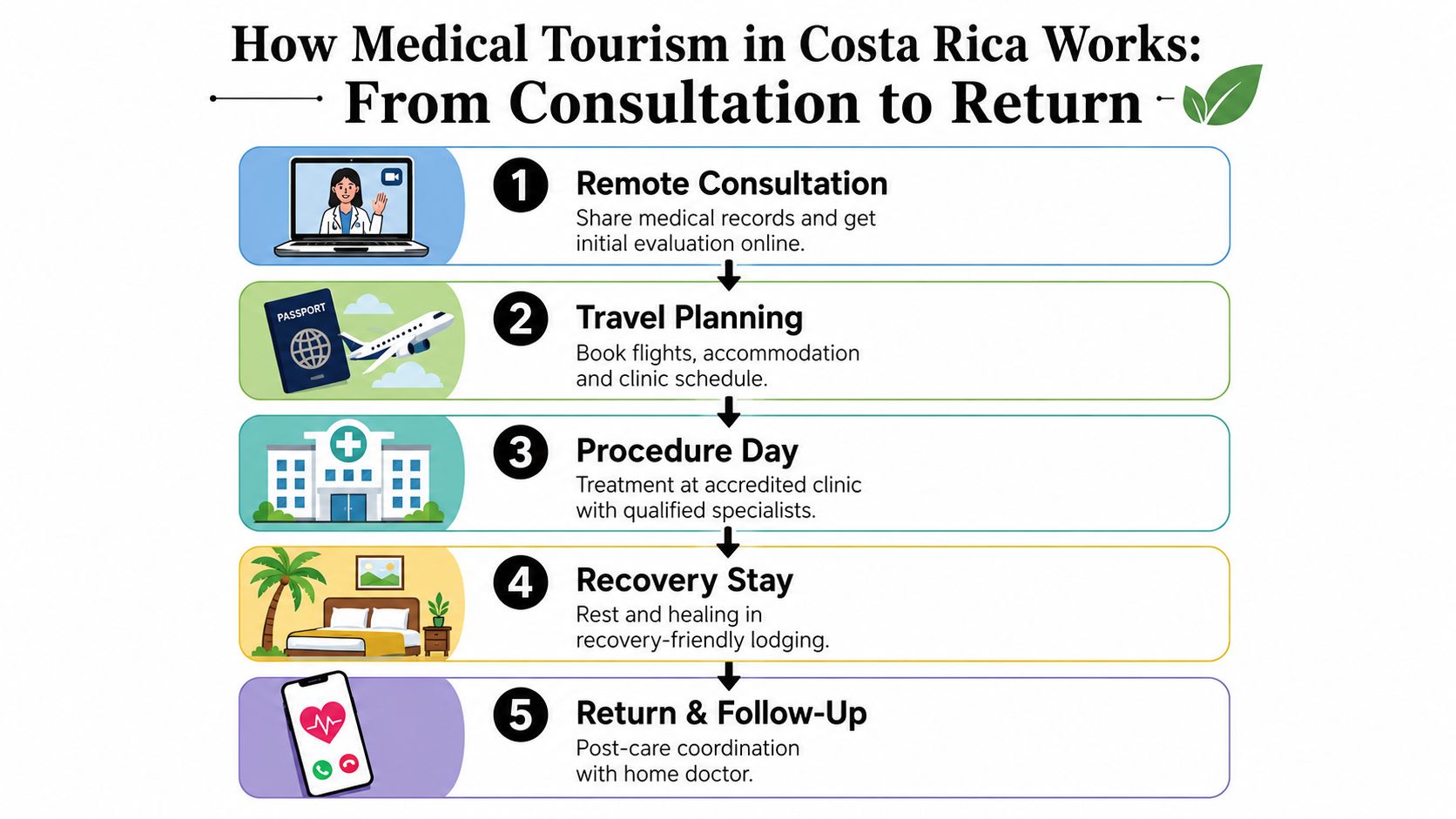
Medical tourism works best when you treat it like a carefully sequenced itinerary rather than a single booking. The clinic manages diagnosis and treatment, a facilitator may coordinate records and appointments, and a recovery host handles lodging and guest logistics. Those roles can overlap, but you should know who owns each responsibility before paying a deposit.
Start with records and candidacy
Remote consultation usually begins with medical records, imaging, medication details, allergies, and a description of your goals. The provider should explain what can be assessed remotely and what requires an in-person examination. A preliminary opinion isn't the same as final surgical clearance, so ask what could change the recommendation after arrival.
Travel planning comes next. Confirm appointment dates, required tests, lodging location, transport, companion needs, and the time you'll need to remain in Costa Rica after treatment. If the procedure requires rehabilitation or wound checks, staying close to the hospital may matter more than staying near the coast.
Separate procedure logistics from recovery hospitality
On procedure day, the medical team controls the clinical schedule, consent process, anesthesia, treatment, and discharge instructions. Your facilitator or companion may help with translation and transport, but they shouldn't make medical decisions on your behalf.
A recovery stay should match your mobility, pain level, medication routine, and need for assistance. A private villa can offer quiet and privacy, while a rehabilitation facility may be more suitable when you need frequent therapy or nursing support. Nature is restorative for many people, but steep paths, distant pharmacies, and rough roads can become burdens when you're not fully mobile.
The final step is return and follow-up. Before flying home, obtain records, imaging, prescriptions, instructions, emergency contacts, and a written plan for communication with your home physician. The medical journey isn't complete when you leave the country. It's complete when responsibility for your ongoing care is clear.
A short explainer can also help companions understand why a retreat-style stay differs from a standard vacation:
Common Procedures Costs and What Value Really Means
A medical quote is useful only when its boundaries are clear. Ask whether it includes the surgeon, facility, anesthesia, laboratory tests, medication, transportation, lodging, rehabilitation, and follow-up. Two estimates with similar totals can describe very different recovery journeys. One may cover a coordinated retreat near the treating team, while another leaves you arranging every transfer and appointment yourself.
Costa Rica's medical tourism economy spans dental treatment, cosmetic procedures, orthopedic care, diagnostics, and wellness-oriented stays. The market has grown, but broad revenue figures do not establish what your procedure should cost today. Request a current, itemized estimate from the provider, then compare each line with your expected recovery needs.
Compare the recovery burden, not just the procedure name
Procedure Category | Best For | Typical Stay and Recovery Focus |
|---|---|---|
Dental care | Travelers needing planned restorative work or staged treatment | Multiple appointments may require a longer stay, soft foods, medication planning, and reliable transport |
Cosmetic surgery | Patients seeking elective aesthetic treatment after appropriate medical evaluation | Rest, swelling management, wound care, compression garments where prescribed, and restricted activity |
Orthopedic procedures | Travelers pursuing joint or mobility treatment after local options and candidacy have been reviewed | Structured rehabilitation, fall prevention, mobility assistance, and clearance before a long flight |
Preventive diagnostics | People seeking organized screening or specialist evaluation | Efficient appointment coordination, record transfer, and a clear plan for interpreting results at home |
Wellness and recovery stays | Guests focused on rest, lifestyle reset, stress recovery, or companion support | Gentle movement, nourishing food, sleep, privacy, and activities adapted to energy levels |
Read the inclusion list as carefully as the total. For dental care, check the number of appointments, imaging, temporary work, laboratory charges, and treatment for complications. Cosmetic surgery estimates should identify garments, medication, wound reviews, and the length of required local supervision. Orthopedic quotes need particular attention to physical therapy, mobility equipment, hotel assistance, and transport that can accommodate limited movement.
Preventive diagnostics may have a lower recovery burden, yet coordination still affects value. Confirm which tests are included, who explains the results, how records are transferred, and whether your home physician will receive the report. A wellness stay is different again. Its value lies in suitable food, privacy, gentle activity, and support that fits your energy, not in adding excursions to a treatment schedule.
Dental care can pair relatively easily with local culture and light exploration, although complex restorative work still needs careful scheduling. Cosmetic treatment may appear straightforward, while restrictions on sun exposure, swimming, exercise, and social plans can shape the entire stay.
Orthopedic procedures usually call for the most cautious itinerary. Access to physical therapy and the treating team may matter more than a remote beach. A boutique retreat surrounded by nature can support recovery later, once the clinician approves the location, transport, and level of assistance.
Value is the full pathway: A transparent quote, qualified team, suitable lodging, local transport, recovery support, and home follow-up may be worth more than a lower headline price.
Build a separate budget for flights, companion costs, private transfers, tests, medication, accommodation, meals, rehabilitation, schedule changes, and contingency funds. Medical travel often requires more time and support than an ordinary holiday, and companions add their own lodging, food, and transportation costs. The right comparison is therefore the complete pathway from consultation through recovery, rather than the procedure price alone.
How to Evaluate Clinics Credentials and Quality Signals
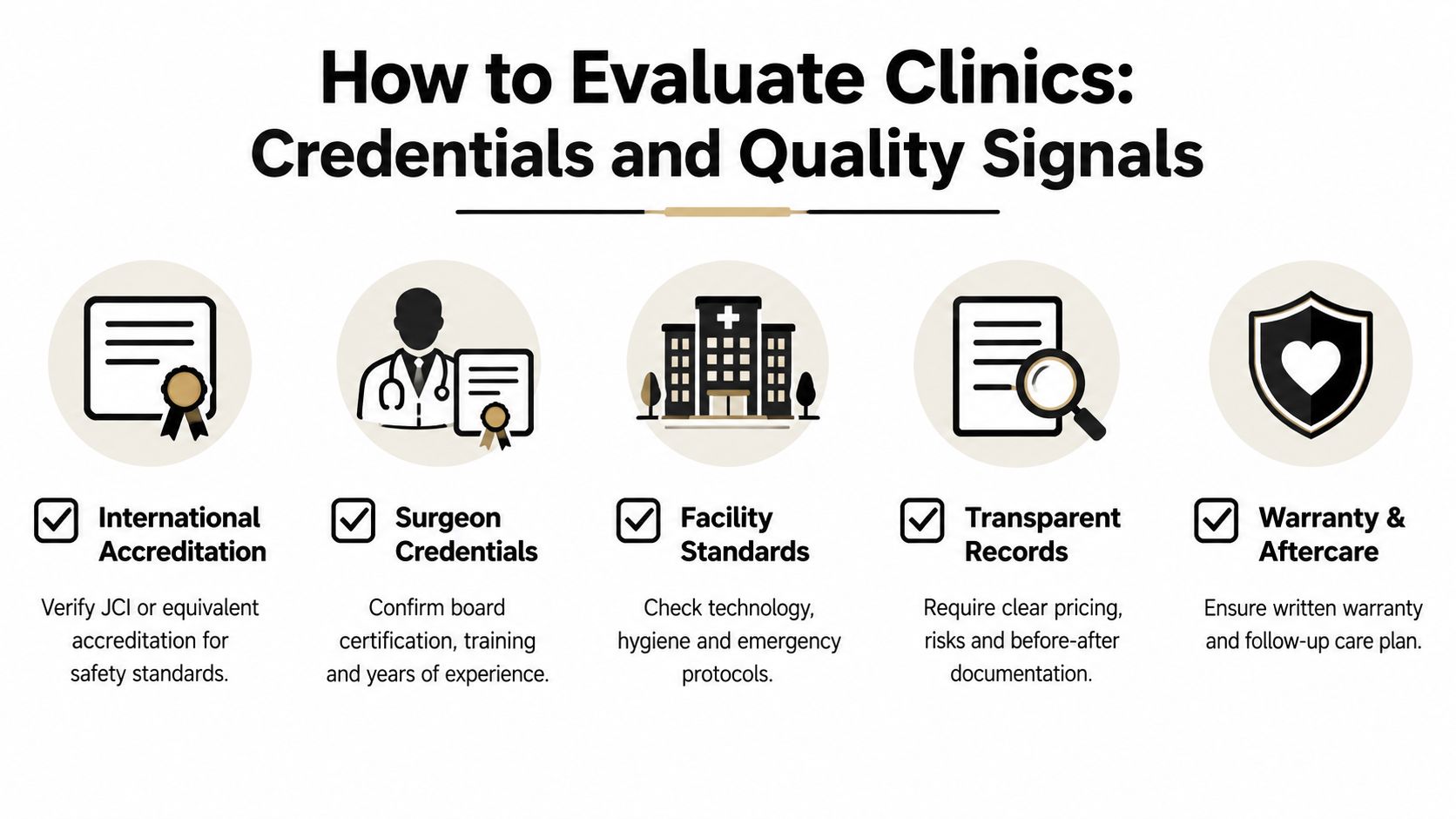
A clinic's website can look reassuring without answering the questions that matter in a clinical decision. Start with the facility, then examine the physician, procedure-specific experience, emergency capacity, records process, and aftercare obligations. Accreditation is useful, but it's one signal within a broader review.
Costa Rica's quality infrastructure is relatively concentrated. Industry sources report two JCI-accredited private hospitals, both in San José, alongside ambulatory facilities with AAAASF or AAAHC status (Surgery Planet). Another source identifies at least two hospitals with Joint Commission International accreditation, additional internationally accredited dental and ambulatory facilities, and a national quality seal called PROMED for providers meeting national and international requirements (Medical Tourism Magazine).
Use accreditation as a starting filter
JCI accreditation can help you identify hospital-grade organizations with formal quality systems. It doesn't mean every physician, department, or procedure is the right fit for you. Ask the facility to confirm the accreditation's current status and whether your treatment will occur inside the accredited hospital or in a separate ambulatory location.
Surgeon credentials deserve the same attention. Verify medical licensing, board certification or equivalent specialty recognition, training history, procedure-specific experience, and who will perform each part of the treatment. Ask how the team handles unexpected findings, revisions, transfers, and specialist referrals.
Ask for evidence you can review
A trustworthy provider should answer direct questions without rushing you toward a deposit.
Facility location: Confirm the exact hospital, operating room, recovery unit, and emergency resources.
Clinical responsibility: Ask who provides anesthesia, postoperative checks, rehabilitation, and complication management.
Written pricing: Request inclusions, exclusions, cancellation terms, revision terms, and costs that could arise from changed findings.
Records access: Confirm that you'll receive complete English-language records, imaging, prescriptions, and discharge instructions.
Communication: Establish who responds after hours and how your home physician can contact the Costa Rican team.
If you're combining treatment with a restorative stay, read VIVARA's guide to what a wellness retreat involves so you can distinguish hospitality, lifestyle programming, and medical care. A retreat host may support meals, transport coordination, privacy, and companion experience, but it shouldn't be presented as a substitute for a hospital or licensed rehabilitation service.
Travel Logistics Visas Seasonality and Getting Around
Medical travel rewards conservative planning. A normal vacation can absorb a delayed transfer or a long day of sightseeing. A post-procedure itinerary often can't. Build the trip around your appointments, expected mobility, clinician clearance, and access to appropriate care.
US and Canadian travelers should verify current entry requirements with official authorities and their airline before booking. The specific documents and permitted stay can depend on nationality, passport validity, return plans, and current rules. Your clinic or facilitator may help with logistics, but entry compliance remains your responsibility.
Choose location according to treatment needs
San José and the surrounding Central Valley usually make the most sense for hospital-based care because consultations, testing, surgery, and early follow-up can be coordinated in one region. Coastal destinations such as Dominical may offer a more immersive nature setting, but the transfer can be demanding after treatment. Don't select a recovery location until the treating clinician confirms that the distance, road conditions, and available support are appropriate.
Book ground transport with medical comfort in mind. Ask whether the vehicle allows easy entry, whether a companion can sit beside you, and how long the transfer normally takes under local conditions. Carry essential medication, records, comfortable clothing, and basic personal items in your hand luggage rather than checked baggage.
Treat seasonality as part of the care plan
One retreat listing identifies August through October as low season with the highest rainfall, while May through July and November can also bring increasing rain; rural roads may deteriorate enough to become impassable (BookRetreats). Rain doesn't make the country unsuitable, but it can affect transfers, outdoor activities, delivery times, and access to remote lodging.
Read practical guidance about the green season in Costa Rica before choosing a coastal recovery stay. Plan flexible arrival and departure buffers, particularly when the procedure requires a specific follow-up appointment or a medical clearance before flying.
Safety Legal Considerations Insurance and Continuity of Care
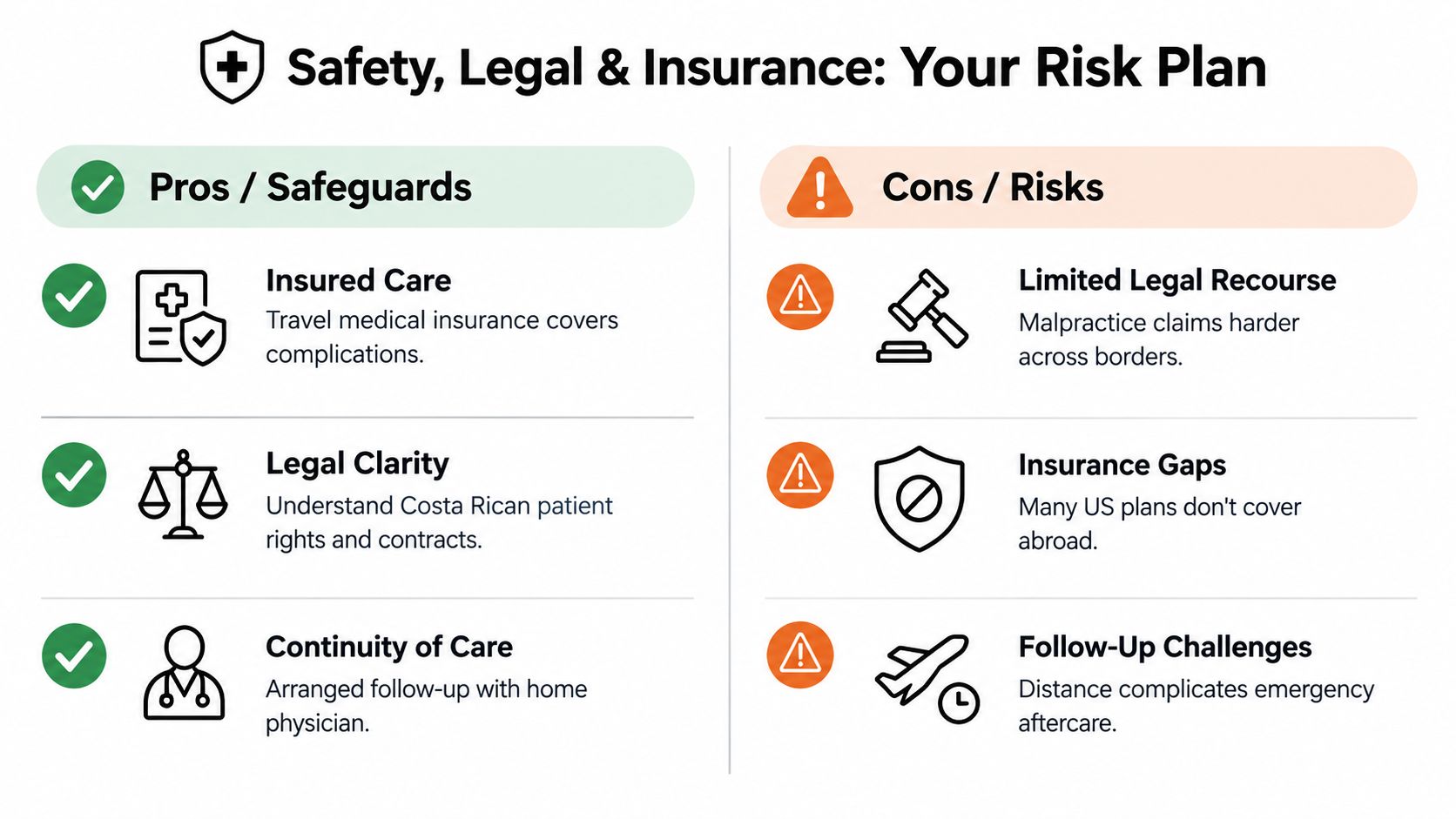
A successful procedure abroad still needs a safe handoff at home. Before you cross the border, know who will review your wound, adjust medication, interpret a new scan, or respond if pain and swelling change. The clinic, your home physician, and your insurer should have clearly defined roles.
Destination guidance recommends requesting complete English-language records, imaging, warranties, and a clear protocol for emergency pain or infection after return (PlacidWay). Public information about cross-border follow-up, revision rates, and continuity outcomes is less developed than information about procedures themselves. Treat that gap as a reason to ask sharper questions, not as automatic proof that care is unsafe.
Build a written continuity plan
Request a document before booking that identifies the person or team responsible for each stage of care. A recovery journey works like a relay. The next provider needs the records, instructions, and authority to act before the previous provider steps away.
Before departure: Confirm testing, medication instructions, allergies, consent documents, and required records.
During recovery: Identify who handles urgent symptoms, after-hours questions, transport to care, and treatment changes.
After returning home: Arrange a home physician or specialist, define how records will be transferred, and confirm whether virtual communication is available.
If a revision is needed: Read the written warranty carefully. Check what it covers, where treatment would occur, and who pays for travel, accommodation, testing, and local care.
Travel insurance and a procedure warranty serve different purposes. Travel coverage may address medical emergencies, evacuation, trip interruption, or baggage, while planned treatment and related complications may be excluded. Ask the insurer to explain international medical coverage in writing. Do not assume a standard policy covers the procedure itself.
Legal protections differ across borders. Review the contract, consent forms, dispute process, governing law, and limits on liability before signing. Keep copies of every quote, message, image, invoice, prescription, and clinical report.
A lower price only has value when responsibility for problems is visible.
Choosing Your Recovery Experience and Next Steps in Costa Rica
Recovery is where Costa Rica can offer something distinct, provided the setting fits the medical plan. A private, nature-connected environment can give couples, families, or companions room to rest, eat well, sleep soundly, and spend time together without turning the trip into a rigid schedule. It can also support broader goals such as burnout recovery, creativity, relationship building, or a personal reset.
The setting should be selected with the same care as the clinic. Look for accessible rooms, dependable transport, quiet spaces, adaptable meals, privacy, and staff who understand that a recovering guest may need a slower pace. Curated activities can include gentle nature time, cultural experiences, or companion-focused excursions, while more demanding adventures should wait for medical clearance.
Match the retreat style to the traveler
An intimate group setting can suit guests who want connection without the atmosphere of a large resort. A private buyout may work better for a couple, multigenerational family, brand community, or team where one guest needs discretion and the rest of the group still wants meaningful shared time.
For recovery-oriented planning, healing retreats in Costa Rica offer a useful comparison point, especially when you're deciding whether the priority is privacy, community, structured wellness, or nature immersion. Farm-fresh food, flexible dining, and on-demand experiences can make the stay feel personal, but they should remain secondary to the clinician's instructions.
VIVARA is one example of a private jungle property in Dominical designed for up to 14 guests, with architecturally distinct villas, personalized experiences, and culinary programming led by Michelin-trained leaders. It can be considered for a recovery-oriented private stay or companion experience when the treating team approves the location and the property's logistics match the guest's needs.
The clearest next step is to create two shortlists. First, compare clinics by accreditation, physician credentials, facility, price inclusions, emergency arrangements, and continuity plan. Then compare recovery options by distance, accessibility, privacy, food, companion support, weather, and transfer requirements. Costa Rica becomes compelling when those two decisions work together, creating a journey that is clinically responsible and restorative.
If you're evaluating medical tourism in Costa Rica, start by confirming your clinical plan and then design the recovery experience around it. VIVARA offers an intimate, nature-connected setting in Dominical for private stays, companion recovery, and carefully curated shared experiences. Visit VIVARA to discuss whether its villas, hospitality, dining, and local logistics fit the recovery journey you're planning.

