The Vivara Content Team
Private Pool Villa in Costa Rica: A Complete Guide
Private Pool Villa in Costa Rica: A Complete Guide

You've spent months planning a Costa Rica escape that should help everyone slow down, reconnect, or celebrate properly. Yet the options still blur together: a hotel suite with a plunge pool, a beautiful rental with limited support, and a secluded estate that promises a completely different rhythm. The right private pool villa isn't just a larger room. It's a carefully designed way to inhabit Costa Rica, with privacy, service, food, nature, and purpose working as one experience.
That distinction matters in a destination where the setting carries real depth. Visit Costa Rica says the country contains about 5% of Earth's biodiversity and officially protects 26% of its national territory through its conservation system. Costa Rica's sustainable tourism information gives context to what a well-chosen retreat can offer: not scenery alone, but meaningful access to wildlife, rainforest, beaches, and restorative outdoor experiences.
Arriving at a Private Estate in Costa Rica
The transfer has taken you from the airport through warm lowlands, then onto a winding road climbing into the hills. By the time the vehicle reaches the estate, you've had enough of luggage handling, directions, and hotel lobbies. A member of the team opens the door with a cool towel and a glass of tamarind agua fresca, and the wet rainforest air immediately feels different from the sealed atmosphere of a conventional resort.
The first view does the actual work. Beyond the trees, an infinity pool appears to merge with the Pacific. The kitchen sends out a trace of woodsmoke and toasted spices. At dusk, howler monkeys call from the canopy, a sound that makes the surroundings feel inhabited rather than staged.
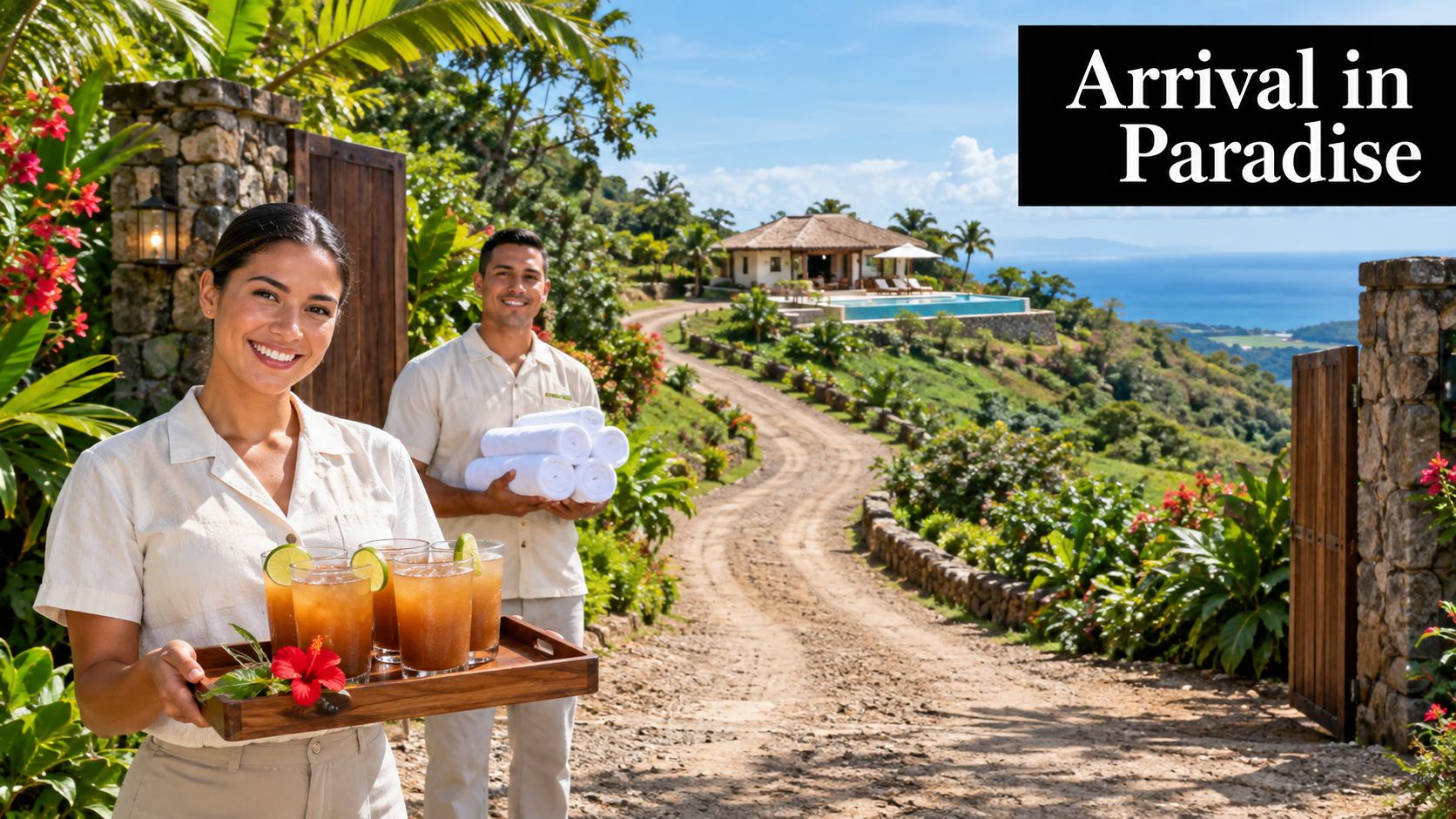
The best arrivals don't feel like check-in. They feel like the moment your group takes possession of a temporary home. Bedrooms are ready according to how people travel, chilled drinks are where they'll be used, the chef knows whether dinner should be immediate or unhurried, and nobody needs to explain the same preference to three different departments.
That's why I don't treat a private pool villa as a property tier. A villa can have an impressive view and still deliver a forgettable stay if the service is outsourced, the layout exposes guests to neighbors, or the itinerary is left to generic recommendations. A private estate changes the relationship between traveler and place only when the host has designed every touchpoint around one group.
The pool is memorable. The way the estate lets people live together, privately and naturally, is what stays with them.
The following standards separate a private pool villa from a polished rental. They also explain why VIVARA's private villa accommodation belongs in a different conversation from a standard resort booking.
What a Private Pool Villa Actually Is
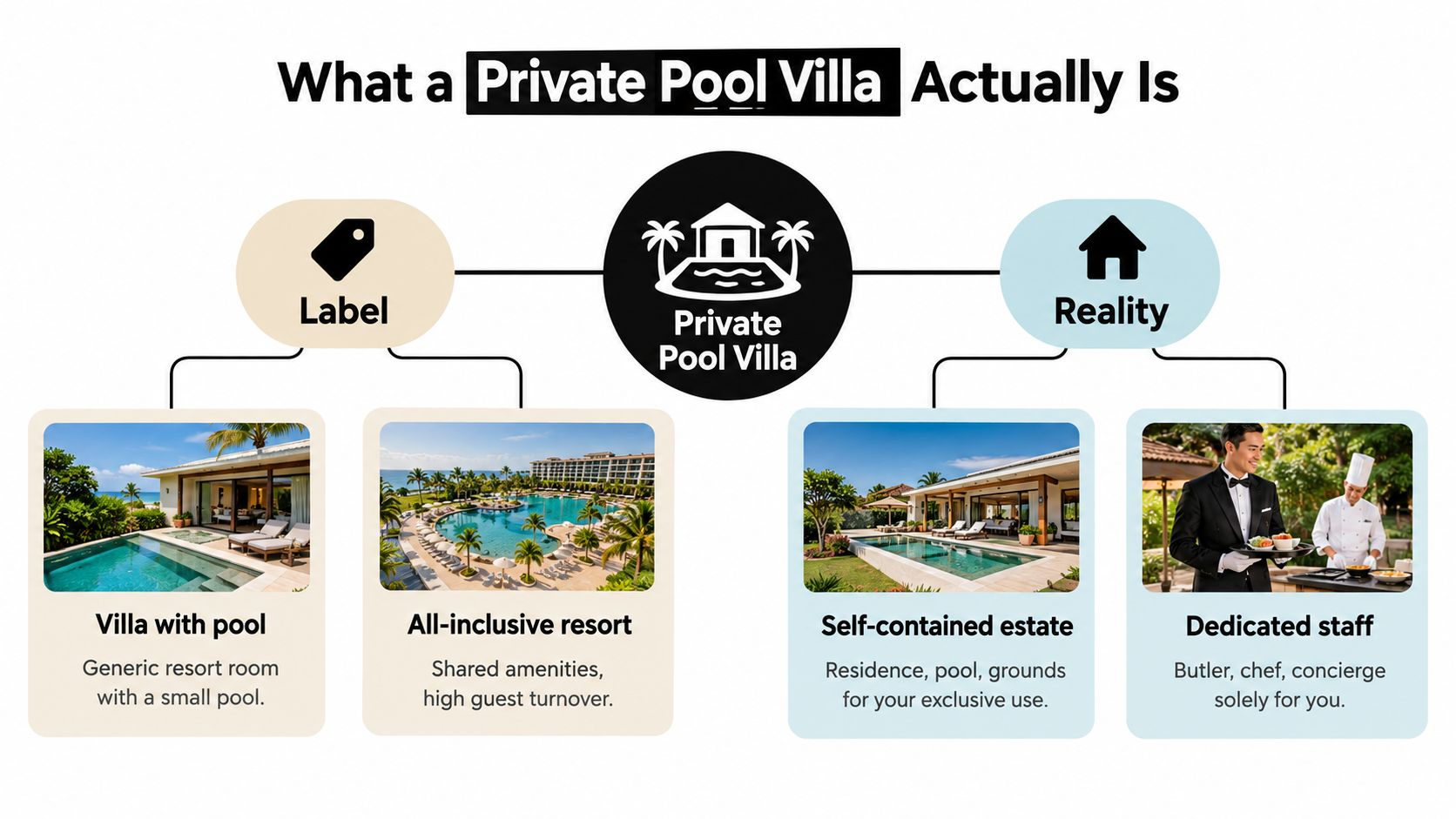
The label has become too loose. Many properties call a room with a small plunge pool a villa, but that doesn't make it a private estate. A proper definition starts with exclusive use, then tests whether the design and service support that promise.
A private pool villa is not a room with a pool attached; it is an estate that resets the relationship between guest and place.
Privacy that works in practice
Genuine privacy means more than a hedge in a listing photograph. There shouldn't be shared walls, a public corridor outside the bedroom, or neighboring guests within earshot of the pool. You should be able to have breakfast outdoors, swim before sunrise, or talk late into the evening without negotiating the habits of another party.
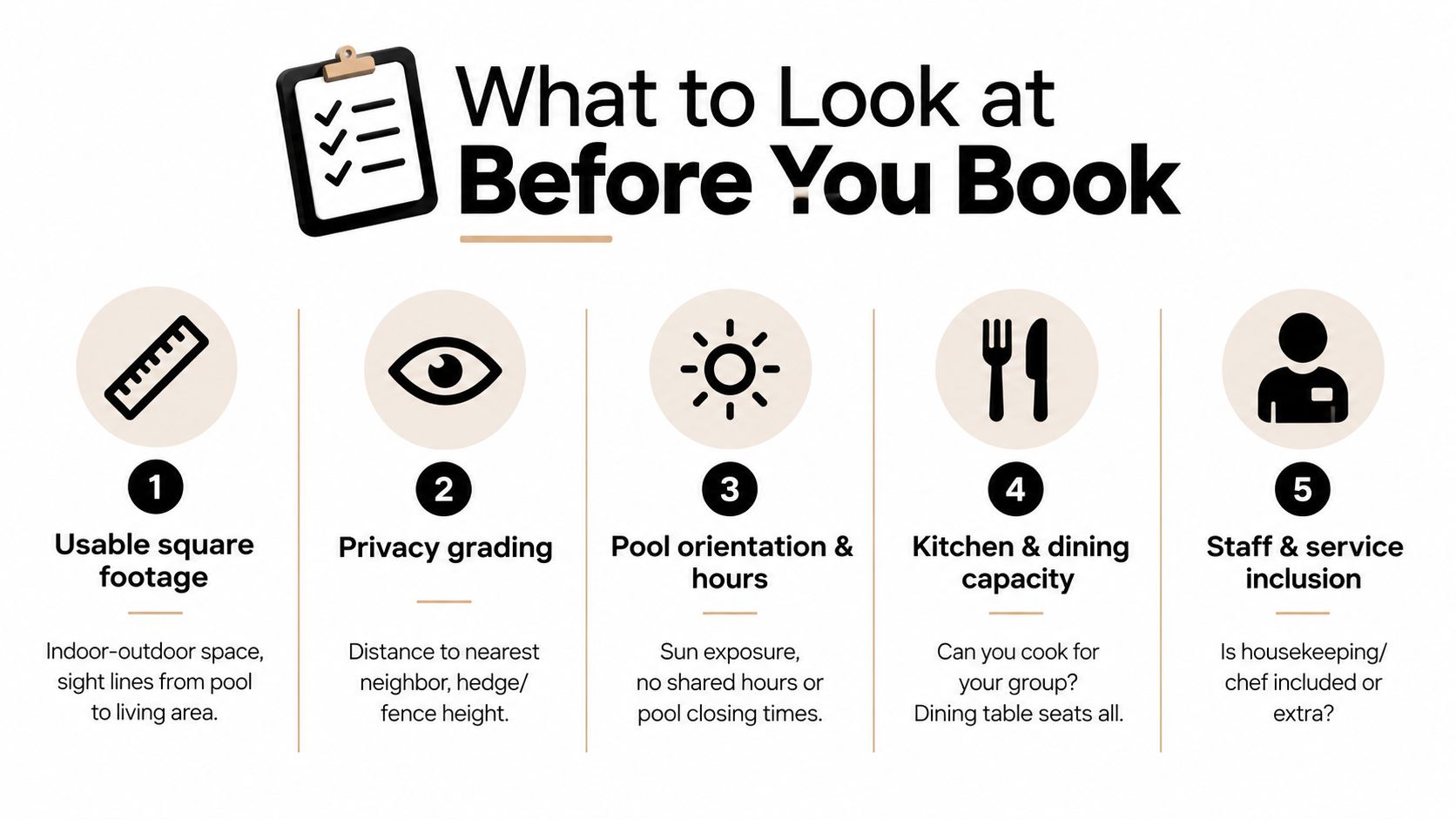
Check sightlines from raised terraces, roads, public paths, and nearby villas. Guidance on choosing a villa rental also highlights the importance of checking exact positioning and nighttime lighting, because a property that feels secluded in daylight can become visible after exterior lights come on.
Architecture with a reason
Architectural distinctiveness isn't a collection of expensive finishes. The structure should respond to the terrain, rainfall, prevailing breezes, vegetation, and view orientation. Outdoor rooms need shade and shelter. Bedrooms should offer privacy without isolating the group. The pool should feel connected to the surrounding site, not placed beside the building as an afterthought.
A service layer, not a phone number
A true estate has people who understand the house and the guests. That may include a house manager, private chef, concierge, housekeeping team, and activity specialists. The key question is whether those people can act on context, rather than merely answer requests through an on-call hotline.
A private pool villa isn't a hotel suite with a plunge pool, a timeshare, or a rental supported by a stock photo and a remote management company. It's a self-contained residence, pool, and outdoor area prepared for one guest party at a time.
The Four Benefits That Change a Stay
A higher nightly rate matters only when it changes how the estate works around your group. The value of a private pool villa comes from four connected benefits: privacy, attentive service, safety, and experiences shaped by the people staying there.
Privacy gives the group its own rhythm
At a well-run estate, the group sets the pace. Nobody needs to dress for a dining room, follow a resort's quiet-hour policy, or compete for a lounger. A couple can eat barefoot at midnight. A family can move between the pool and kitchen without gathering everyone for a formal meal. From a pre-dawn swim to a late-night soak, the pool belongs to one party.
That privacy changes the social dynamic. Guests can spend time together, split into smaller groups, or retreat without leaving the property or explaining their choices to strangers.
Service that removes friction
The strongest staff notice patterns and act on them. A chef may recognize that one guest has skipped the cheese course repeatedly and adjust the menu without making that person explain themselves. A concierge may reroute a planned hike after river levels rise, replacing a risky excursion with a safer route that still suits the group's energy.
Continuity makes that attention possible. A rotating roster or remote call center can process requests, but it rarely understands the difference between a guest who wants a full day of adventure and one who needs quiet time after a difficult season at work. Dedicated staff build useful knowledge of the group, then apply it before small inconveniences become interruptions.
Safety supports wellbeing
Wellness includes more than a massage or yoga deck. It also means that staff know about a severe allergy, have been properly vetted, and provide one trusted contact when plans change. A controlled private environment lets guests enjoy social time without the public-facing compromises of a large resort.
Pool operations deserve the same seriousness. Hospitality guidance commonly maintains free chlorine at 0.5–3.0 mg/L, pH at 7.2–7.6, alkalinity at 80–150 mg/L as CaCO3, calcium hardness at 200–400 mg/L, and turnover times at 4–8 hours. Hotel and resort water-treatment guidance explains why these controls matter, particularly when guest use changes from day to day.
Curated experiences make the setting personal
A generic excursion list is not curation. A private dawn walk across a hanging bridge, an in-villa mezcal tasting with a visiting distiller, or a cacao ceremony on the terrace becomes meaningful when it fits the group's interests and the estate's location. Weather, energy, timing, and local knowledge should shape the plan.
Benefit | Generic Villa Rental | Private Estate Stay |
|---|---|---|
Privacy | Private room or pool, with possible nearby guests and visible shared areas | Residence, pool, grounds, and daily rhythm reserved for one party |
Dedicated on-site service | Requests handled remotely or through external vendors | Staff who learn preferences and act on context |
Safety and wellbeing | Guests coordinate allergies, transport, and activity details themselves | One informed contact coordinates health, comfort, and logistics |
Curated experiences | Standard tour menu selected by the guest | Activities shaped around the group, weather, energy, and local knowledge |
The difference is operational. A private pool villa delivers these advantages because someone has built a hospitality system around the group, not because a booking page uses the word “luxury.”
What to Look at Before You Book
Treat every listing as a claim that needs testing. A bedroom count and infinity-pool photograph tell you very little about how the estate will function once your group arrives.
Start with usable space
Size means more than the number of bedrooms. Look for indoor-outdoor space that allows people to gather, separate, and reconnect without crowding. Ask where the pool can be seen from the living area, whether bedrooms have direct access to outdoor space, and whether the dining table seats everyone comfortably.
A villa can feel expansive in photographs but awkward in use if the kitchen is far from the dining area, the only shaded lounge is small, or the bedrooms force every guest through a central social zone.
Judge location by access
A beautiful map pin isn't enough. Ask what the location lets you do within a practical drive. Beach access creates one type of stay. Immediate rainforest entry creates another. Proximity to a private airstrip may reduce transfer friction for a group arriving together.
Costa Rica's protected nature is central to its travel appeal. A 2024 analysis reported that 1.6 million of 2.7 million foreign visitors in 2023, about three in five, visited protected areas. The wider responsible-tourism context supports a practical conclusion: choose a villa that makes nature access realistic, not one that leaves you admiring it from a terrace.
Test amenities as operating systems
Ask whether the saltwater pool has a functioning chiller, whether filtered water is available throughout the property, and whether Wi-Fi can support the entire group at once. If someone is combining retreat time with remote work, a beautiful desk is irrelevant if the connection fails under load.
Verify who delivers the service
A rental becomes a hospitality product when a dedicated concierge, in-house chef, and on-property manager are clearly identified. Confirm what's included, what costs extra, and who remains responsible when weather disrupts an excursion or a dietary requirement changes.
Read sustainability in the details
Look for solar arrays, greywater reuse, local employment, and on-site regeneration projects. Don't accept broad claims without asking what guests can review. A guide to luxury villa rental decisions should help you compare the operating model, not just the décor.
Make pricing and events explicit
For a group, transparent weekly pricing is usually more useful than a nightly rate followed by layered fees. Ask whether the published figure covers the whole estate, staffing, meals, transfers, and activities. Event planners should also confirm vendor access, noise rules, maximum guest capacity, ceremony locations, reception backup in bad weather, and kitchen capability for dietary accommodations.
Matching the Villa to Your Group
The right villa depends on what your group needs to do together, and what it needs permission to do separately. Couples rarely need a large social complex. They need visual seclusion, a canopy-facing plunge pool, in-villa dining for two, and access to a spa therapist without turning the stay into a production.
Families and multi-generational groups need operational ease. A single-level footprint or elevator access can matter more than an additional bedroom. Connected suites with separate entrances give teenagers independence, while childproofed pool edges and activities suitable for different ages prevent one adult from becoming the permanent supervisor.
Friend groups usually value social architecture. Large outdoor dining, a fire-pit lounge, late-night pool access, and staff who facilitate without hovering create the conditions for a celebration that still feels private. Event planners are assessing something else entirely, including full-estate exclusivity, vendor flexibility, weather backup, dietary-capable kitchens, and clear noise policies.
Group | Priority Features | Service Need | Layout Preference |
|---|---|---|---|
Couples | Seclusion, private pool, intimate dining, wellness access | Discreet planning and responsive personal service | One-bedroom or separated bedroom suite with strong view privacy |
Families and multi-generational groups | Safe pool design, varied activities, accessible movement | Chef coordination, childcare referrals, flexible itinerary support | Single-level circulation, connected suites, shared gathering areas |
Friends | Outdoor dining, fire-pit lounge, late pool access | Social hosting, transport, celebration planning | Large communal spaces with bedrooms offering individual retreat |
Event planners | Buyout terms, vendor access, weather backup, dietary capacity | Dedicated production contact and on-site manager | Ceremony, dining, and reception areas with clear guest flow |
Practical rule: Choose the estate around the moments you want to repeat every day, not the amenities you might use once.
For a burnout-recovery stay, that might mean an easy path from bedroom to pool, quiet breakfast, and one guided nature activity. For a team retreat, it may mean a reliable work area, restorative meals, and enough separation for focused conversations. For a family celebration, the dining table and staff coordination may matter more than the view.
Why VIVARA Sets the Standard
A private estate should be judged by how coherently its promises work together. VIVARA operates as an intimate estate for up to 14 guests, not as a large resort trying to simulate personal attention. That scale supports a different relationship between the group, the property, and the people delivering the stay.
Its V-star team is trained around intuitive hospitality rather than scripted turn-downs. On-property management means small problems can be handled before they become interruptions, whether that involves adapting the day's timing, coordinating transport, or reshaping a meal around a guest's preferences.
The culinary model is equally important. Michelin-trained culinary leaders build menus around the Osa Peninsula's farms and fisheries instead of importing a generic luxury menu. There are no fixed menus in the publisher's description, which leaves room for food that responds to the group, the local supply, and the restorative purpose of the stay.
Transparent value for private groups
Published pricing for full-week stays makes the decision easier to evaluate. The full-estate buyout option is spelled out, rather than hidden behind per-person stacking or surprise service fees. For affluent but practical travelers, that transparency matters because value comes from the complete experience, not from a headline nightly rate.
Impact that belongs in the booking decision
The operating model connects every stay with reforestation, watershed protection, and community programmes, with outcomes guests can review before booking. That gives the retreat a clearer relationship with its surroundings than a property that treats sustainability as a decorative message.
The VIVARA guest experience is therefore best understood as an experience architecture. Scale, trained service, local food, transparent buyout terms, and regenerative impact reinforce one another. Remove any one of those elements and the stay becomes easier to imitate, but less distinctive in practice.
Brands can apply the same logic when building a community or consumer experience. A private estate gives a brand room to create shared rituals, thoughtful content, local partnerships, and memorable participation without the noise of a mass event. The value lies in designing an environment where people connect naturally, not in placing a logo beside a pool.
The Case for Choosing With Intention
A private pool doesn't qualify a property as a luxury Costa Rica experience. An infinity edge overlooking jungle can still be a generic backdrop if the service is outsourced, the food comes from a distant catering kitchen, and the estate produces no positive impact for its surroundings.
The strongest retreats combine three layers. Location depth means a real bioregion, a distinct microclimate, and practical access to nature. Intentional service means staff who know the estate and the guests, rather than a rotating roster. Measurable regeneration means evidence of reforestation, watershed protection, or community partnership.
Use the booking criteria already established as a final filter:
Usable space: Can the group gather and retreat without friction?
Privacy: Are sightlines and nighttime visibility controlled?
Pool experience: Is the pool comfortable, well maintained, and available on the group's terms?
Food capacity: Can the kitchen and culinary team respond to allergies, preferences, and local supply?
Service depth: Who is on-site, and who makes decisions when plans change?
Impact: Can the property show specific environmental or community outcomes?
Commercial clarity: Is exclusive use, pricing, and event capacity explained in writing?
A five-bedroom villa with a heated pool can still feel hollow without those foundations. Costa Rica's conservation history gives travelers a strong reason to expect more than attractive scenery. The country began building modern ecotourism with Cabo Blanco National Reserve in 1963 and its first national parks in 1971. Its conservation system now includes 70 entities protecting over 3,221,000 acres, while another account describes more than 30% of national territory as marked for conservation and a payment-for-environmental-services programme covering about 1.3 million hectares. Costa Rica's ecotourism history and conservation model show why regenerative practice should be part of the evaluation, not an optional extra.

Before booking, request the property's impact report, ask exactly who will be on-site during your dates, and confirm whether the estate can be booked exclusively. Intentional travel isn't a marketing phrase. It's the difference between renting a house and inhabiting a place.
VIVARA offers an intimate Costa Rica estate for up to 14 guests, with private buyout options, personalized V-star service, locally grounded cuisine, curated nature experiences, and regenerative programs connected to every stay. Visit VIVARA to compare the estate with your group's needs and begin planning a private pool villa experience built around connection, restoration, and purpose.
