The Vivara Content Team
Costa Rica Villa Rentals: How to Choose the Right One
Costa Rica Villa Rentals: How to Choose the Right One

You've found the villa with the perfect drone shot, but you still don't know whether it suits the people coming, the pace you want, or the practical details that make a high-end stay feel effortless. That uncertainty matters. In Costa Rica, a couples' reset, a family reunion, and a founder retreat can all require completely different properties, even when they're looking at the same coastline.
The right Costa Rica villa rental isn't the prettiest house. It's the property whose location, layout, host, staff, and surrounding experiences support the trip you're trying to have. Choose by purpose first, then compare regions, service levels, contracts, and sustainability claims with a clear eye.
Why Your Villa Choice Shapes the Whole Trip
You arrive after a long travel day and join a transfer headed toward a familiar resort complex. There's a queue at reception, a buffet serving food designed for everyone, and background music drifting across a shared pool. Nothing is wrong, but the trip already has a rhythm you didn't choose.
A private villa changes that rhythm immediately. Your first drink might arrive in a shaded courtyard, breakfast can follow the tide rather than a restaurant schedule, and the group can spread across terraces, bedrooms, pools, and outdoor lounges without negotiating public space. The architecture becomes part of the holiday.
The same country, different daily life
A couple trying to recover from burnout needs quiet bedrooms, a generous view, and staff who understand when to be present and when to disappear. A teenager may value a reliable pool and Wi-Fi more than another guided excursion. A founder group needs a long table, consistent connectivity, separate sleeping areas, and enough acoustic distance for late calls.
Families need a different kind of luxury. A kitchen that supports group meals, several comfortable living zones, shaded outdoor space, and manageable access to the beach often matter more than a dramatic but isolated hillside setting. A beautiful villa becomes frustrating when everyone must use one small sitting room or wait for one bathroom.
Practical rule: Choose the villa's layout for the hardest daily moment, not the best photograph.
Costa Rica rewards place-based travel. The country's official tourism messaging emphasizes its biodiversity, adventure, and varied natural scenery, from wildlife and surfing to hiking and nature immersion through Visit Costa Rica's adventure guide. Your property determines whether those experiences feel like natural extensions of the stay or exhausting logistical projects.
That's why boutique villas often outperform large resorts for intimate groups. They let the host adapt meals, excursions, arrival support, and downtime around your group instead of fitting everyone into a standardized operating model. The property isn't a backdrop. It sets the tempo for every decision that follows.
Matching Regions to the Trip You Actually Want
Costa Rica's villa regions aren't interchangeable. A dry Guanacaste estate, a wildlife-focused Central Pacific house, and a remote southern jungle retreat can all be luxurious, but they create very different holidays.
Region | Best for | Signature experience | Trade-offs |
|---|---|---|---|
Papagayo and Tamarindo | First-time visitors, families, service-focused groups | Dry heat, sunsets, surf, and resort-grade support | More developed, less secluded in popular areas |
Manuel Antonio and the Central Pacific | Wildlife-first families and active couples | National park outings, beaches, and rainforest encounters | More variable weather and busier access points |
Nosara and the Nicoya Peninsula | Surfers, yoga groups, wellness retreats | Slow mornings, design-led spaces, and a strong wellness culture | Dirt roads, fewer dining choices, and a need for planning |
Osa and the southern Pacific | Nature-first couples and small adventure groups | Jungle immersion, remote beaches, and whale-watching | Longer transfers and less dependable convenience |
La Fortuna and Arenal | Multigenerational groups and adventure seekers | Volcano views, hot springs, and zip-line days | Inland setting, so it doesn't suit a beach-led itinerary |
Choose the primary motive
For an easy first visit, Papagayo and Tamarindo remain the most forgiving choices. Liberia access, established services, beach infrastructure, and reliable sunset conditions make the corridor practical for families who want a polished experience without constant coordination.
Manuel Antonio is stronger when wildlife matters more than resort polish. A family that wants a national park outing, guided animal viewing, and beach time may accept a busier environment in exchange for that proximity.
Nosara suits travelers who want a wellness rhythm rather than a conventional beach holiday. The Nicoya Peninsula is officially recognized as a Blue Zone on Visit Costa Rica's destination site, which connects the region with active living, balanced food, social connection, and integrated health practices. Don't choose it if you expect smooth roads and a broad restaurant circuit. Choose it if yoga, surfing, local food, and slower days are the point.
The southern Pacific asks for more commitment and gives more immersion in return. Dominical, Uvita, and nearby areas suit couples or small groups who prefer jungle, wildlife, and outdoor activity over convenience. La Fortuna works especially well for groups with mixed energy levels, because adventurous guests can fill the day while others retreat to comfortable indoor spaces and hot springs.
What Villas Really Cost and When to Book
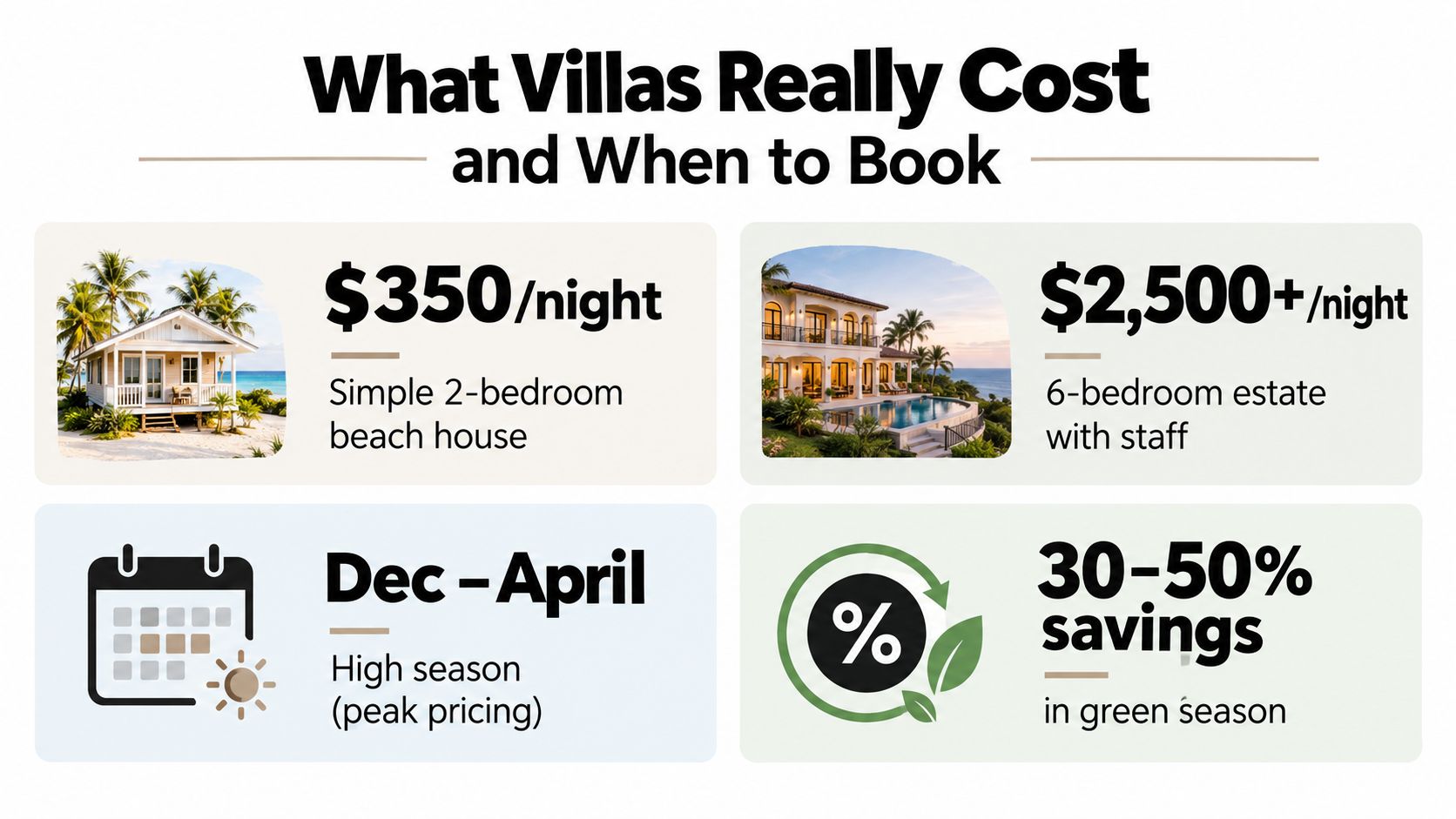
A villa's rate reflects more than bedroom count. It reflects staff coverage, access, maintenance, privacy, outdoor living, and the amount of coordination the host absorbs for you.
The required pricing infographic below offers a quick visual reference, but treat its seasonal savings figure as a planning illustration rather than a universal promise. Actual rates vary by property, location, dates, and inclusions.
Read the rate as a service signal
At the simpler end, you may be paying for a well-kept house and a responsive property manager. A mid-tier property may add a private pool, housekeeping, and access to a cook on request. Larger estates can include full staff, chef service, excursion planning, and outdoor areas designed for group meals or retreats.
Don't assume a published nightly rate is your final bill. Costa Rica's non-traditional lodging framework subjects accommodation to 13% IVA, and operators must register with the ICT and Hacienda, as explained in this Costa Rica vacation rental development guide. Ask for a line-item quote that separates rent, tax, cleaning, transport, staff, and any levy or service charge.
The country's short-term rental market reached 48,985 active listings by June 2026, spread across 243 markets, with estimated annual revenue of $813.5 million, an average daily rate of $204, and average occupancy of 43.7%, according to reporting by La Nación. That scale gives travelers more choice, but it also makes careful comparison essential.
Seasonality changes the value equation
High season generally brings stronger demand and firmer pricing, while the green season offers lusher scenery and quieter beaches with more variable Pacific weather. Use the green season guide for Costa Rica to assess whether afternoon rain fits your plans.
For premium properties and larger groups, start the search early. The best dates disappear first because guests aren't only booking accommodation. They're also coordinating flights, transfers, chefs, guides, and celebrations around a shared calendar.
Amenities and Property Signals That Matter Most
Luxury language is easy to print on a listing. Reliable design, maintenance, and service are harder to fake once guests arrive.
Start outside. An ocean-view terrace should have a useful orientation, shade, comfortable seating, and enough depth for meals, not just a narrow balcony with a camera-friendly angle. An infinity pool with a sun shelf, an outdoor kitchen, and a shaded rancho can change the way a group spends the entire day.
Inside, inspect the details that protect sleep and work. Consistent air conditioning, blackout bedrooms, dependable hot water, a stocked pantry, and mesh Wi-Fi matter more than decorative furniture. A kitchen is only a benefit if it has usable storage, working appliances, sharp knives, adequate cookware, and a layout that supports the number of guests.
Marketing term versus usable proof
Marketing Term | What It Usually Means | What to Ask the Host |
|---|---|---|
Ocean view | Some sightline toward the sea | Is it oceanfront, and which rooms have the view? |
Private chef | Chef access may be limited or outsourced | Is the chef live-in, on-call, or available only on selected days? |
Infinity pool | An edge visually blends with the horizon | Is there heating, shade, a shallow area, and pool maintenance during the stay? |
Full concierge | Someone can arrange selected services | What are the concierge hours, response times, and planning fees? |
Fully equipped kitchen | Basic cooking equipment is present | Can you provide a current inventory and confirm pantry provisions? |
Build a shortlist that survives scrutiny
Filter first by ocean orientation, ensuite bedroom count, and outdoor living footprint. Then compare recent reviews from travelers with a similar group size and purpose. A review from a honeymoon couple won't tell you much about how a villa handles a multigenerational reunion or a working retreat.
Ask for a floor plan when the group is large. Missing floor plans, vague staff descriptions, inconsistent lighting between photographs, and heavily edited views all deserve follow-up. Request recent, unedited room images and clarify which amenities belong to the villa rather than a neighboring resort.
The strongest host signals are specific answers. A good operator can explain arrival procedures, backup systems, staffing, noise expectations, and nearby logistics without hiding behind broad words such as “exclusive” or “bespoke.”
Booking Logistics, Contracts, and Local Rules
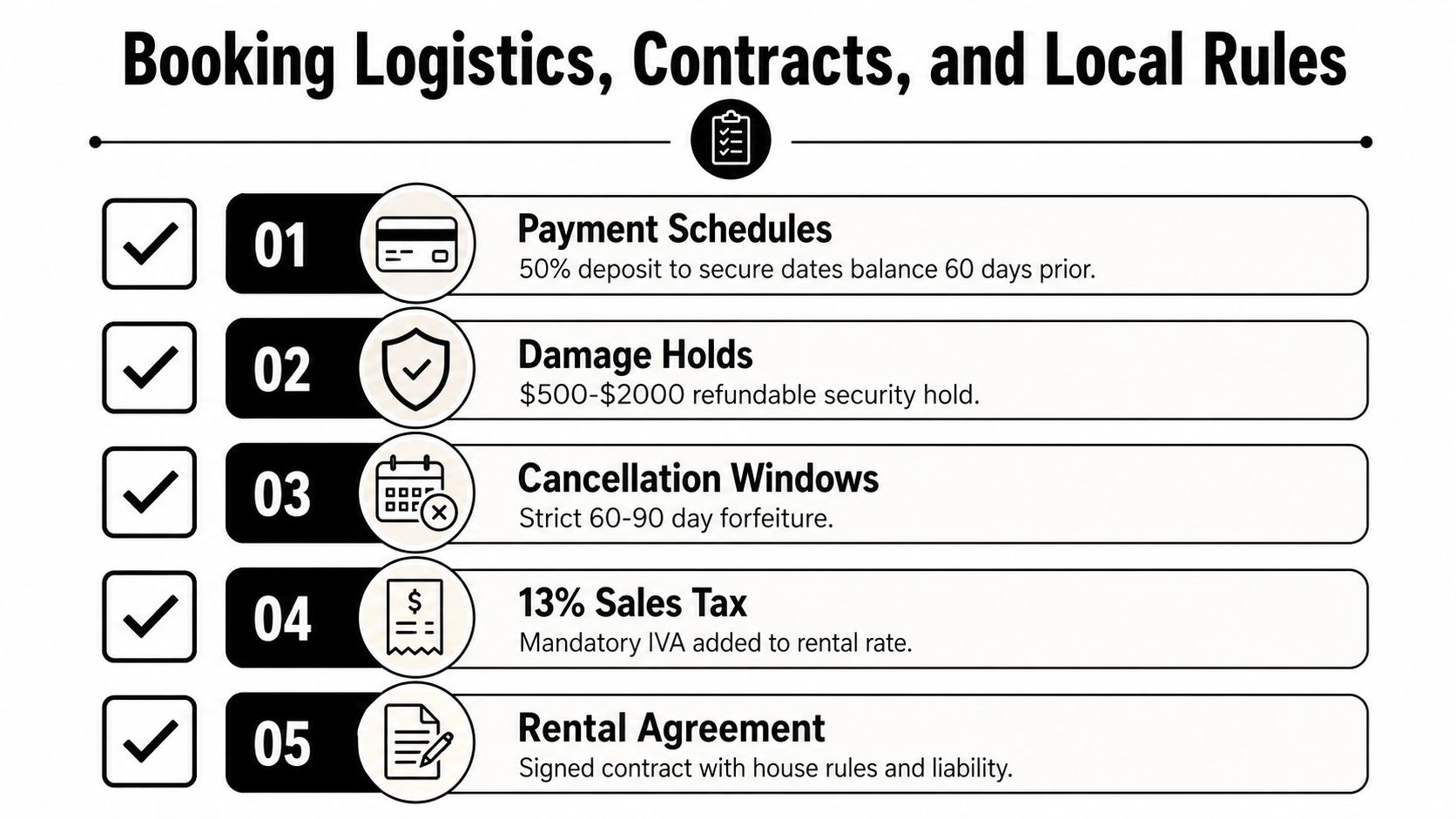
A villa becomes a dependable booking only when the commercial details are as clear as the photographs. Platforms sometimes display taxes and fees inside the checkout total, while direct operators may quote them separately. Never compare two rates until you know they describe the same package.
Read the payment schedule, deposit requirement, damage hold, and cancellation window together. A lower headline rate may become less attractive if it requires an inflexible payment structure or excludes essential staff and arrival services.
Review the agreement before paying
Check whether the contract states:
Taxes and levies: Confirm the 13% IVA line item and ask whether any tourism levy or service charge is separate.
Damage protection: Identify the refundable hold, release timing, and permitted deductions.
Cancellation: Look for the exact forfeiture dates rather than a general “strict policy” label.
Guest count: Confirm fees for additional guests, visitors, children, and unregistered arrivals.
Events and retreats: Ask whether dinners, celebrations, filming, or team sessions trigger extra charges.
House rules: Review noise curfews, pet restrictions, pool requirements, parking, and community rules.
Payment method: Compare card fees, bank-transfer costs, currency conversion, and the legal entity receiving funds.
A valid CFIA building permit is a baseline compliance document for non-traditional lodging, alongside ICT and Hacienda registration, according to the regulatory guidance cited above. That matters to guests because legal operability can affect safety procedures, insurance, and the operator's ability to manage the property professionally.
Copy this pre-booking checklist
Before sending a deposit, request written confirmation of the all-in total, refundable damage hold, included staff hours, check-in window, emergency contact, backup power, water arrangements, and property registration status. Ask who handles urgent maintenance after normal concierge hours.
Don't rely on a phone conversation for material promises. Put every inclusion, exclusion, and contingency in the agreement or an attached schedule.
Sustainability and Regenerative Impact at Villa Scale
A reusable water bottle doesn't prove that a villa operates responsibly. Neither does a linen-reuse card placed beside the sink.
Genuine regenerative hospitality shows up in infrastructure and relationships. Look for rainwater harvesting, greywater treatment, solar generation, passive cooling, composting, reduced single-use plastic, habitat restoration, and purchasing that keeps money moving through nearby communities.
Test the claim, don't admire the label
Small, owner-operated villas can sometimes create more visible local impact than large resorts because decisions happen closer to the property. That advantage only counts when the operator shares specifics.
Ask these questions before booking:
Energy: What supplies the property, and does solar power support daily operations or only selected systems?
Water: Does the villa harvest rainwater, recycle greywater, or monitor consumption?
Employment: Are staff hired locally, paid consistently, and retained over time?
Food: Does the kitchen source from local farms, fishers, or producers?
Waste: How are compostables, recycling, sewage, and hazardous materials handled?
Conservation: Does the property fund or participate in habitat, wildlife, or community projects?
Costa Rica's biodiversity supports a nature-rooted retreat model. The official tourism site says the country contains 6% of the world's biodiversity, a fact highlighted in Visit Costa Rica's adventure-seeker resources. That setting can support wellness, creativity, and outdoor restoration, but only if the property protects the environment it sells.
Read VIVARA's explanation of regenerative tourism in practice as a useful framework for distinguishing a meaningful operating model from a decorative sustainability message.
Ask for evidence you can understand. A credible host should explain what the property does, who benefits, and how the team measures progress.
Sample Itineraries for Couples, Families, and Groups
The easiest way to choose among Costa Rica villa rentals is to imagine the day you want to repeat. A property that works beautifully for two people may feel chaotic for a reunion, while a meeting-ready estate can make a romantic stay feel overbuilt.
Trip Type | Best Villa Style | Recommended Region | Group Size | Season Sweet Spot | Signature Add-Ons |
|---|---|---|---|---|---|
Couples reset | Quiet jungle villa with a view and private pool | Dominical or Uvita | Two guests | Drier Pacific months or a flexible green-season stay | Private yoga, tide-pool hike, chef dinner |
Family reunion | Estate with pool, casita, kitchen, and beach access | Manuel Antonio or Tamarindo | Extended family group | School-holiday periods booked well ahead | Surf lesson, national park guide, sunset barbecue |
Founder retreat | Property with meeting room, strong Wi-Fi, and breakout terraces | Nosara or Arenal | Small working group | Shoulder or green season for a calmer working rhythm | Farm-to-table visit, facilitator, guided adventure |
The couples reset
In Dominical or Uvita, the right villa lets the day begin slowly. Espresso on the terrace becomes a private yoga session, followed by a tide-pool hike and a chef-prepared dinner. A quiet night swim works because the property gives you privacy rather than a schedule of shared entertainment.
Budget for experiences that deepen the reset rather than filling every hour. A local guide, wellness practitioner, or carefully planned coastal outing can be more valuable than adding another formal amenity.
The family reunion
Choose a Manuel Antonio or Tamarindo estate with enough separation for different ages. Teens can take a surf lesson, younger children can join a manageable national park outing, and grandparents can remain near the pool without missing the group's main meal.
The best family villas make food social but practical. A shaded pool lunch and a concierge-arranged sunset barbecue create shared memories without forcing one person to manage every meal.
For larger family groups, a private villa buyout in Costa Rica can simplify privacy, scheduling, and shared costs, provided the property has enough bathrooms, living zones, and staff support.
The founder retreat
A five-night Nosara or Arenal stay needs more than attractive bedrooms. Look for a real meeting room, dependable fiber internet, breakout terraces, and sleeping arrangements that allow people to work intensely without living on top of one another.
Build the schedule around focus and decompression. A guided farm-to-table experience can open conversation, while team dinners can continue strategic work without making every meal feel like another meeting. Add one adventure day, then leave enough unscheduled space for ideas to surface.
Choosing the Right Villa and Taking the Next Step
The best villa isn't the one with the most dramatic aerial photograph. It's the one that makes your intended trip easier, more connected, and less dependent on improvisation.
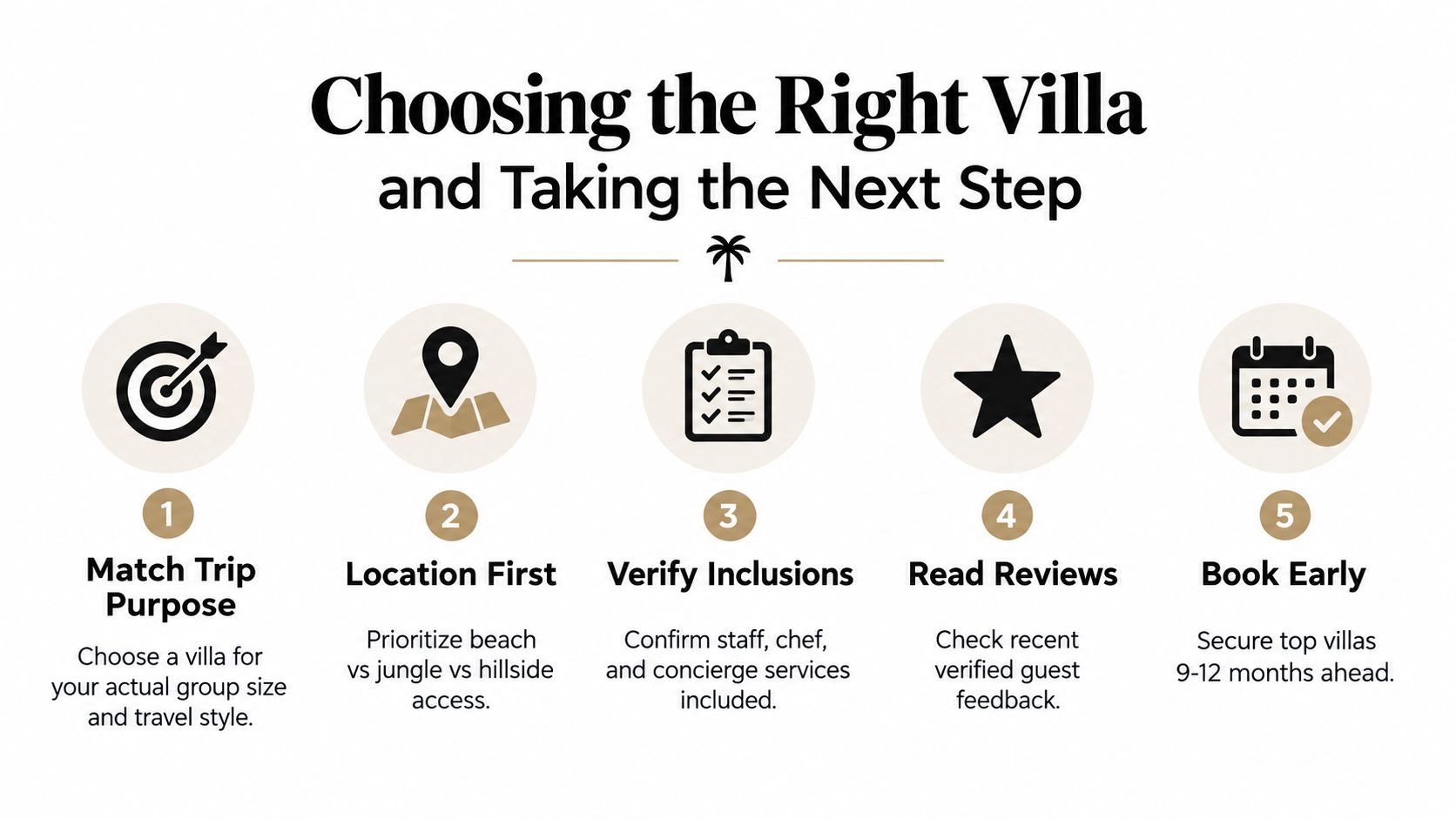
Start with the purpose. Couples should prioritize silence and privacy. Families should prioritize circulation, kitchens, bathrooms, and beach access. Work groups should verify connectivity, acoustic separation, meeting space, and staff capacity before they care about the view.
Use a short, unforgiving shortlist
Compare only two or three properties that match your chosen trip type. For each one:
Confirm the region fit. Check transfer practicality, nearby food, beach or jungle access, and the activities that define the stay.
Verify every inclusion. Ask whether housekeeping, chef service, concierge support, transport, and activities are included or priced separately.
Request current evidence. Recent unedited photographs, a floor plan, and guest videos can reveal details a polished listing hides.
Test host responsiveness. Ask the same contract questions in writing and compare the quality and speed of the answers.
Read reviews for resilience. Look for comments about refunds, weather contingencies, maintenance, water, power, and post-storm communication.
Ask directly about minimum-stay rules during shoulder periods, chef and transport availability on arrival days, backup power, water storage, and legal registration under Costa Rica's tourism framework. A host who avoids these questions before payment won't become more transparent afterward.
Request detailed quotes from your shortlist within the same 48-hour window so the comparison stays fair. Then book the property whose host answers the contract and operating questions most thoroughly, not the one that wins the beauty contest.
VIVARA offers intimate villa stays and full-estate buyouts in Dominical for couples, families, celebrations, and founder-led groups, with custom experiences and chef-led dining. Visit VIVARA to compare a nature-rich retreat format with conventional Costa Rica villa rentals and start planning a stay built around the way your group wants to travel.
