The Vivara Content Team
Micro Wedding Planning: The Intimate Costa Rica Guide
Micro Wedding Planning: The Intimate Costa Rica Guide

You've chosen the guest list, opened a dozen tabs for Costa Rican villas, and started wondering whether your wedding should be a single beautiful afternoon or a private retreat shared with the people you love most. That decision sits at the heart of modern micro wedding planning. A smaller celebration gives you room to replace formal production with thoughtful hospitality, from an unhurried welcome dinner to a jungle excursion, chef-led meal, or quiet morning by the ocean.
Costa Rica suits this format because the destination already supplies a strong sense of place. Boutique hospitality, dramatic coastlines, rainforest, local food, and nature-based adventure can become part of the celebration rather than background scenery. The challenge is sequencing those elements so the experience feels effortless, personal, and worth the investment.
The Rise of Intimate Celebrations in Costa Rica
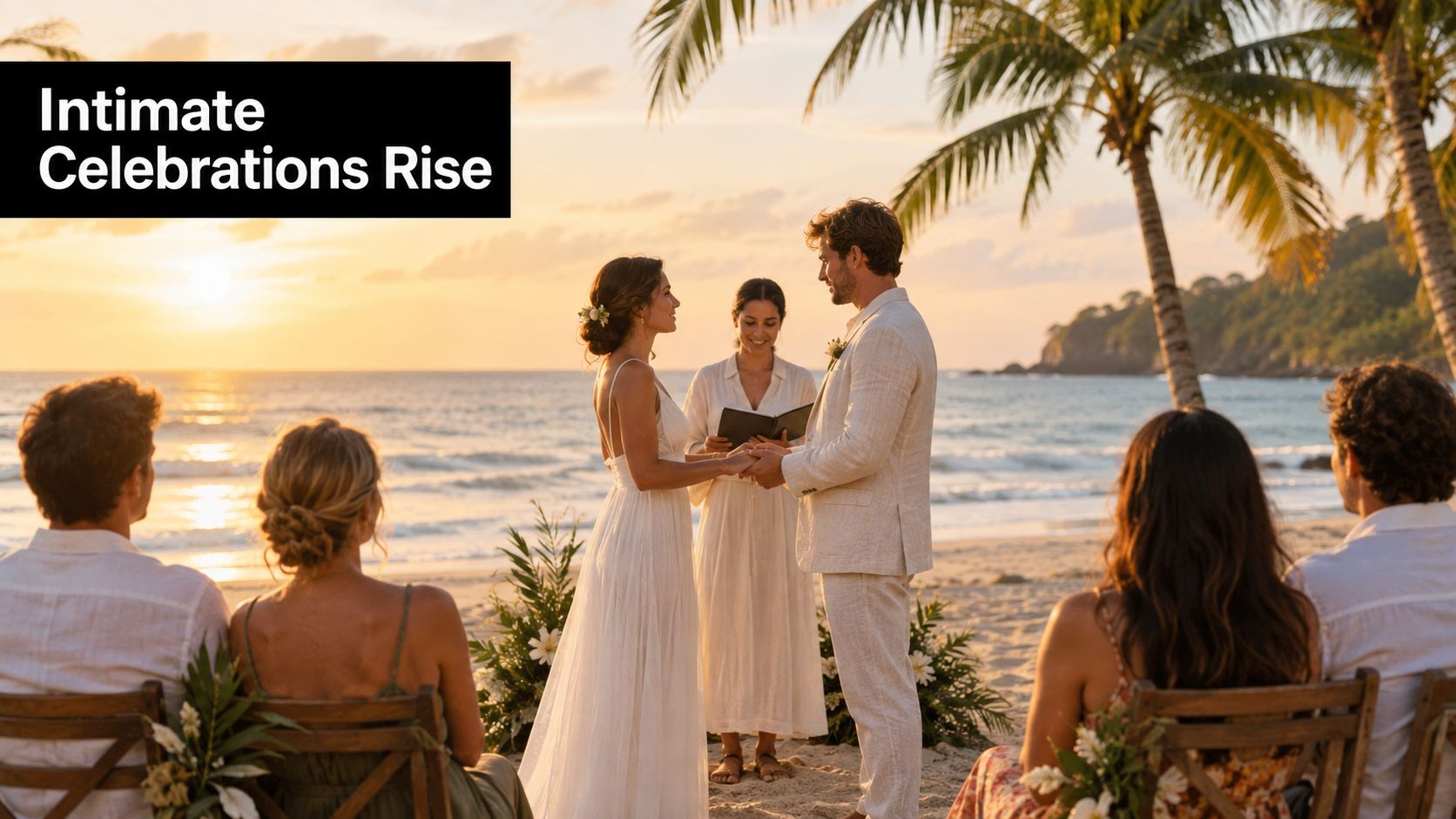
A couple arrives in Dominical with their closest friends and family. They share a relaxed meal, wake to jungle sounds, exchange vows in a private setting, then spend the next day exploring together. The ceremony remains the emotional center, while the surrounding meals, rest, and excursions give guests more time to connect.
That model reflects a broader shift in wedding design. Weddings with 50 guests or fewer represented 18% of U.S. ceremonies in 2024, compared with 10% in 2013, while the average guest count declined from 131 in 2019 to 116 in 2024, according to market reporting based on The Wedding Report data. The most common wedding size remains 100 to 150 guests, so intimate celebrations have not replaced larger weddings. They have become a distinct format, particularly for couples who want a hosted experience rather than a single scheduled event.
Why Costa Rica fits the format
The Knot's 2024 data says 13% of couples chose a microwedding with 50 or fewer guests, while 48% had considered one, as reported in coverage of the 2024 wedding market. For destination couples, that interest has practical implications. A smaller guest list makes international travel more manageable and leaves room to prioritize lodging, food, photography, and shared activities instead of spreading resources across a large production.
Costa Rica gives guests natural ways to spend time together. A sunset cruise, waterfall visit, guided wildlife outing, surf lesson, or restorative morning can build connection without turning every interaction into a formal reception. The trade-off is that a retreat-style wedding requires more deliberate hosting. Transport, pacing, weather, and guest energy all matter.
Handled well, the result feels less like a ceremony with optional extras and more like a private retreat shaped around the couple's relationships, wellness, and the country's nature.
The useful question isn't only how many people you'll invite. It's what you want those people to feel from arrival through departure.
Locking Your Three Essential Constraints
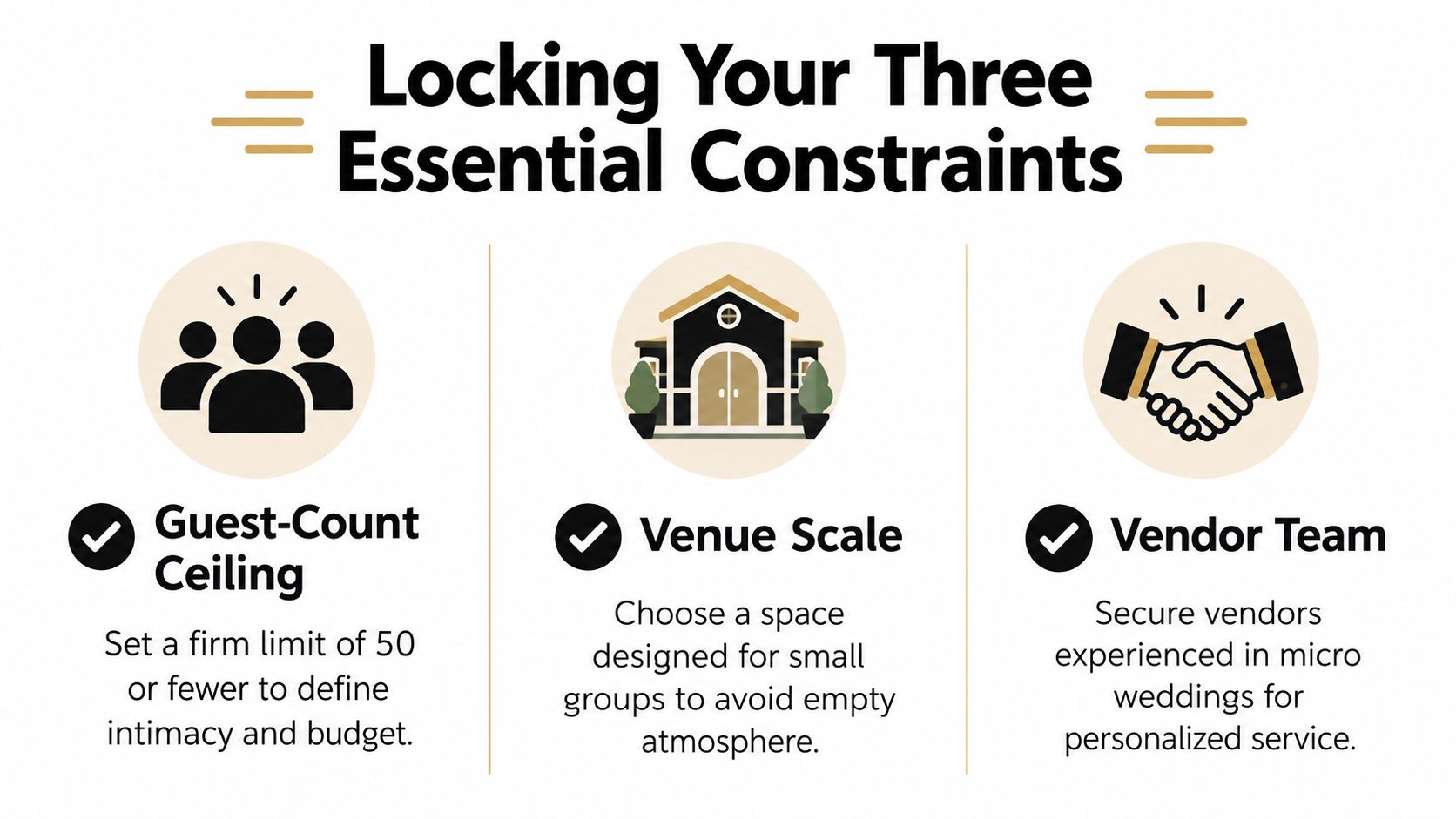
Successful micro wedding planning starts before flowers, menus, or attire. Set three boundaries first: your guest-count ceiling, the scale of the venue, and vendor minimums. These decisions shape almost every later choice, and postponing them creates avoidable pressure.
Set the guest-count ceiling privately
A celebration with 50 or fewer guests qualifies as a micro wedding, but the number that feels right for your property and relationship may be much smaller. Write down the maximum before you speak with extended family, then agree on the rules together. Decide whether you're inviting immediate family, wedding-party members, lifelong friends, or guests who are already part of the couple's shared life.
Family communication needs to happen early. Tell relatives that the limit is a design decision, not a judgment about who matters. Private confirmation also helps you avoid the awkward situation where one partner assumes the guest list is closed while the other continues adding names.
Match the property to the group
A large resort ballroom can technically host a small wedding, but an empty room often makes the gathering feel less intimate. Look for spaces where the architecture, dining layout, and outdoor areas support conversation. A villa, small hotel, or private estate can make arrival, meals, and downtime feel connected.
The trade-off is operational. A private property may offer privacy and character, but you'll need clear answers about catering access, rentals, music, transportation, weather plans, and event restrictions. A boutique hotel may simplify logistics while offering less control over the guest journey.
Ask vendors about minimums
Photography, planning, officiant services, entertainment, rentals, and catering may not scale down in proportion to guest count. Ask each vendor for their minimum booking, what's included, and what changes when the event spans several days. Secure a coordinator who can manage the full run of show, not only the ceremony.
Planning guidance cited by Kande Photo Booths warns that a guest count entering the 60 to 75 range can lose its intimate character while costs rise in nonlinear ways. Protecting the ceiling keeps the event aligned with its purpose.
Understanding the Real Cost of Micro Wedding Planning
A small wedding usually has a lower total spend, but it isn't automatically a low-cost wedding. Fixed-fee services still require professional time, equipment, travel, and preparation. Photography, officiating, coordination, florals, music, and transport can remain substantial even when the guest list is short.
The Knot's 2024 Real Weddings Study reports that weddings with 50 guests or fewer averaged $15,000, compared with $42,000 for weddings with more than 100 guests, a difference of $27,000. The same 2024 wedding data places the average U.S. wedding cost at $33,000. Couples also spent about six hours per week reviewing and finalizing wedding details, with 90% of planning conducted digitally.
Read the budget by experience, not by table
Costa Rica adds destination-specific costs, including lodging, transfers, imported items, local staffing, and activities. A 2026 Costa Rica wedding cost guide places intimate celebrations for 2 to 15 guests at about $7,500 to $21,000 or more, while celebrations for 20 to 50 guests are estimated at about $25,000 to $45,000, according to Costa Rica wedding cost guidance.
Industry planning guidance also cites common benchmarks around $250 or more per guest, with luxury micro weddings reaching $400 to $500 per guest. One guide estimates a 30-guest wedding at about $8,760 before venue minimums and fixed vendor fees are added, as outlined by Our Vows. Treat those figures as planning references, not guaranteed quotes.
Budget priority | What it can change |
|---|---|
Food and hospitality | Turns a meal into a shared cultural and sensory experience |
Photography | Preserves the relationships and setting that define a small wedding |
Lodging and privacy | Keeps the group together and reduces fragmented logistics |
Activities | Gives guests meaningful connection beyond the ceremony |
Design | Makes a small setting feel intentional without filling it with décor |
Spend where guests actually feel the difference
Premium food can matter more than elaborate ceremony production when everyone is seated together. A private chef's table, locally sourced menu, or carefully designed welcome meal creates conversation and gives the destination a tangible role.
Photography deserves similar thought. With fewer guests, the photographer can capture more individual relationships and the unplanned moments between formal events. Design should support the setting rather than compete with it. A smaller event rarely needs more décor. It needs better placement, lighting, materials, and flow.
Building Your Planning Timeline from Twelve Months Out
Destination planning rewards early decisions. A Costa Rica guide recommends locking in the region, date, and venue 12 to 15 months ahead, then finalizing the guest count and room blocks 3 to 6 months before the wedding, according to Costa Rica destination-wedding planning guidance.
Twelve to fifteen months out
Choose the region before you choose the aesthetic. The Pacific coast, Central Valley, and other areas offer different combinations of climate, access, scenery, and activity options. Once the region is clear, secure the date and venue, then confirm whether the property permits ceremonies, receptions, amplified music, outside vendors, and multi-day programming.
At this stage, also decide whether the legal marriage will take place in Costa Rica or at home. That choice affects paperwork, officiant coordination, and the shape of the ceremony.
Nine to twelve months out
Send save-the-dates with realistic travel information. Guests need to understand the destination, expected stay, lodging approach, and whether the wedding is part of a broader retreat weekend. Build a simple digital planning hub with arrival guidance, packing notes, activity preferences, and emergency contacts.
Couples also planning a vow renewal can use this vow-renewal planning guide for ideas on ceremony structure and guest logistics.
Six to nine months out
Book the vendor team, catering, photography, transportation, and any specialist activities. Confirm dietary needs and activity accessibility before creating the itinerary. This is also the right moment to shape the visual language, including attire guidance, ceremony materials, tablescape direction, and welcome gifts.
Three to six months out
Finalize the guest count and room blocks. Confirm airport transfers, arrival windows, room assignments, and activity reservations. Give vendors a single working document with contact details, locations, timing, and contingency plans.
Final month and final week
Reconfirm the ceremony order, seating, weather alternatives, meal service, speeches, and transportation. In the final week, keep the couple out of operational conversations wherever possible. A coordinator or host should own arrivals, vendor questions, timing changes, and guest needs so the couple can be present.
Choosing the Right Venue for Your Intimate Celebration
Venue choice determines whether your wedding feels like a private escape or a small event placed inside a larger machine. Costa Rica gives you several distinct formats, and each solves a different problem.
Compare the main property types
Beachfront resorts can simplify catering, rooms, staffing, and guest services. They work well for couples who want recognizable hospitality and minimal vendor coordination, but privacy may be limited and the setting can feel less personal during busy periods.
Boutique hotels often balance local character with professional service. They're suitable for couples who want a shared base, a curated atmosphere, and easier accommodation planning without taking responsibility for an entire estate.
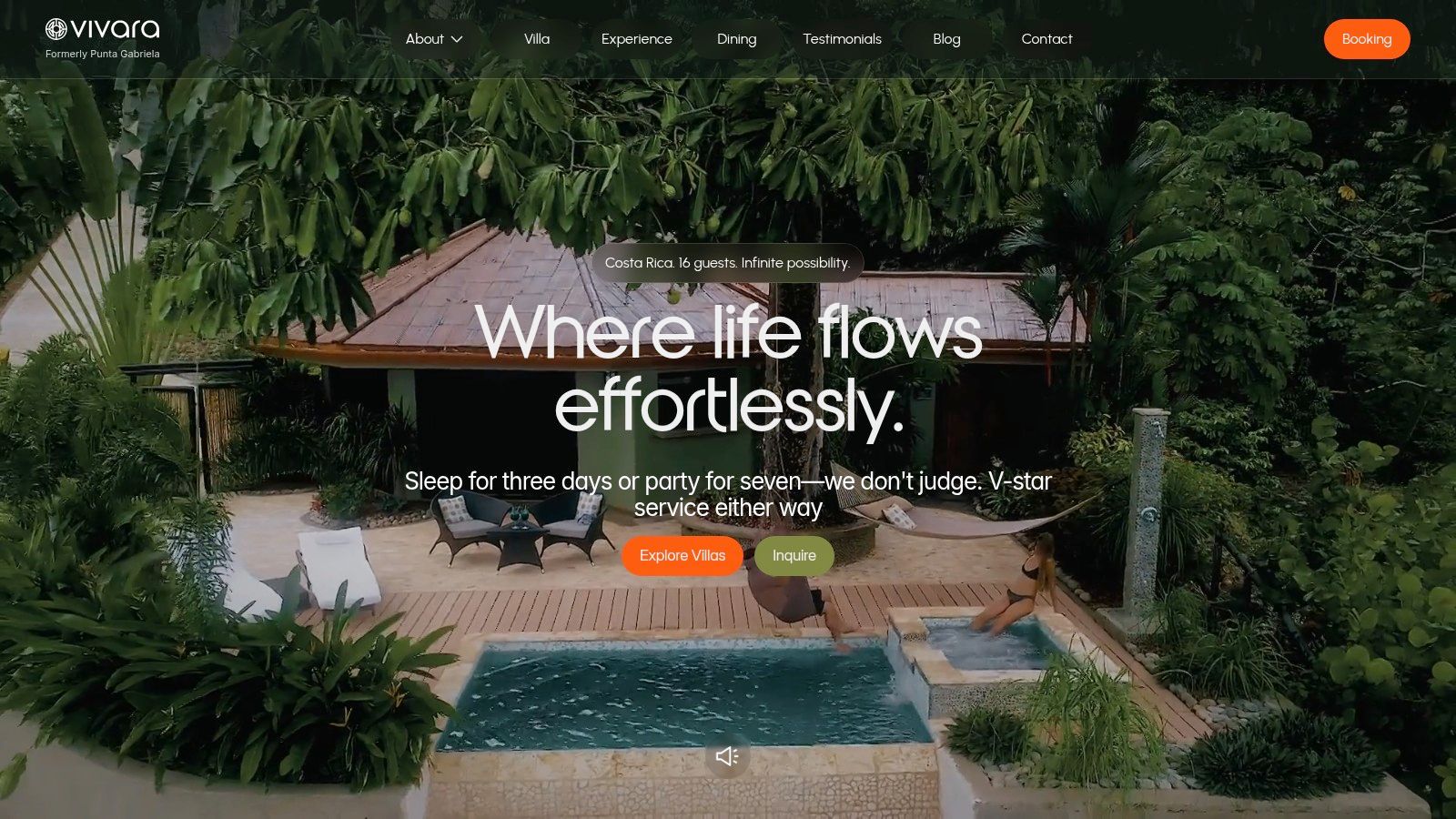
Private villas provide the strongest sense of ownership over the guest journey. You can coordinate a welcome dinner, ceremony, poolside gathering, and post-wedding activity around the same property. The drawback is that the villa may require outside coordination for catering, rentals, staffing, transport, sound, and weather contingencies.
Independent venue guidance says private villa event fees in Costa Rica may begin around $1,000 to $4,000, while luxury estate stays can reach tens of thousands of dollars before event design, catering, rentals, and transport are added, as explained in this Costa Rica villa venue guide.
Evaluate the setting as a guest experience
Ask how guests move through the property. Can older relatives reach the ceremony comfortably? Is there enough shade? Where does breakfast happen? Can the group gather without constant driving? Does the venue offer a quiet place for someone who needs time alone?
A beautiful venue that creates daily transportation problems isn't an intimate retreat. It's a logistics project with attractive views.
The right property gives you a natural rhythm. Guests can wake, eat, gather, separate, and reconnect without needing a new production plan for every transition. For a closer look at decision criteria, compare this guide to intimate wedding venue planning.
The visual setting should also support your ceremony style. A beach may offer openness and sunset light, while a jungle terrace can create privacy and a stronger connection to the natural environment. Your choice should account for wind, rain, heat, sound, footwear, accessibility, and the comfort of guests who won't experience the location as an aesthetic image.
A short venue video can help couples assess how the space flows between indoor and outdoor areas:
Navigating Legal Requirements and Vendor Coordination
A symbolic ceremony and a legal marriage create different planning paths. Foreigners seeking a legal wedding in Costa Rica commonly need a valid passport, apostilled birth certificate, apostilled proof of single status issued within one month of the wedding, and two adult witnesses with identification. Documents that aren't in Spanish must be officially translated, according to Costa Rica marriage requirements for foreigners.
Start by confirming the process with the officiant or legal professional handling your ceremony. Requirements can depend on nationality, document format, timing, and the authority involved, so don't rely on a venue's general checklist as your final legal advice. Build document deadlines into your planning calendar and keep digital and physical copies organized.
Create one coordination system
Planning across borders becomes easier when every vendor works from the same source of truth. Use a shared document with:
Vendor contacts: Include names, roles, phone numbers, email addresses, and arrival responsibilities.
Master schedule: List guest movement, setup, ceremony, meals, activities, and breakdown.
Payment record: Track deposits, balances, currencies, inclusions, and cancellation terms.
Guest profile: Note dietary needs, accessibility concerns, room assignments, and activity preferences.
Contingency plan: Identify indoor locations, weather triggers, transport alternatives, and decision authority.
Choose vendors who can explain their process clearly from a distance. Ask who will be present on the day, how they handle weather changes, whether they work with the venue, and how they communicate when the couple is offline. Response quality during planning often reveals more than a polished portfolio.
For a multi-day event, the coordinator should manage more than ceremony timing. They need to understand arrivals, meals, excursions, staff handoffs, guest energy, and the moments when the couple should be protected from interruptions. A small wedding still benefits from full coordination because every visible gap feels more noticeable when the group is small.
Designing a Multi-Day Experience Beyond the Ceremony
A ceremony can be beautiful and still leave guests with little shared memory beyond the photographs. A multi-day format solves that by giving relationships time to unfold. Guests arrive as travelers, become a group through shared meals and activities, and leave with a stronger connection to the couple and to one another.
Recent trend coverage points toward private restaurant buyouts, chef's-table dining, pop-up bars, live music, and multi-day celebration weekends rather than treating the ceremony as the only event. That approach makes sense in Costa Rica, where the natural beauty and local culture offer inherent ways to build a guest journey without adding unnecessary production.
Give each day a clear emotional purpose
Arrival should reduce friction. Arrange airport transfers, a simple welcome, and an easy first meal. Don't schedule the most demanding activity immediately after a long journey. A good arrival experience tells guests that the weekend will be cared for.
The first full day can create familiarity. Offer an optional wellness morning, a beach walk, a local food experience, or a guided nature activity. Keep the schedule spacious. Guests should have permission to rest, swim, read, or talk privately rather than feeling obligated to attend everything.
The ceremony day should have room around it. A long sequence of formal events can make a small gathering feel surprisingly corporate. Consider a slow breakfast, private preparation time, a short ceremony, a meal designed for conversation, and one memorable evening element such as live music or a sunset toast.
Departure should feel complete. A final breakfast, handwritten note, shared coffee, or locally sourced gift can close the experience with intention. Guests often remember how they left as clearly as how they arrived.
Design connection without overprogramming
The strongest itineraries alternate between collective and individual time. A group excursion may be followed by an unscheduled afternoon. A chef-led dinner can sit beside a quiet morning. A wellness session can serve guests who want restoration, while a waterfall visit or zip-line outing gives adventure seekers a different way to participate.
For a private estate format, review the planning considerations in this private villa rental guide. The property should support both togetherness and retreat, with gathering areas that feel natural and private spaces where guests can recharge.
Premium hospitality isn't a packed itinerary. It's knowing what the group needs next and making that transition feel simple.
A practical decision checklist
Before booking, write a one-page experience brief that answers:
Who is this for? Couples, close friends, immediate family, multigenerational guests, or a blended group may need different pacing and activity options.
What should guests remember? Choose a few emotional priorities, such as reconnection, adventure, rest, local culture, or celebration.
What deserves premium spend? Compare food, photography, lodging, transport, wellness, activities, and design based on what guests will use.
What stays optional? Mark excursions, wellness sessions, and social events as either essential or flexible.
Who owns the details? Name the person or team responsible for guest questions, vendors, timing, weather changes, and transport.
How will excluded people be included? Consider a later party, livestream, dinner at home, personal letters, or a post-wedding gathering for friends and relatives outside the core group.
This last question matters because a small guest list can create social tension even when the decision is financially practical. Explain the format early, frame it around the kind of experience you're creating, and offer meaningful inclusion rather than vague apologies.
Costa Rica also creates an opportunity for brands, founders, and retreat hosts. A carefully designed intimate wedding can demonstrate how hospitality builds community through food, place, storytelling, and shared activity. The same principles apply to a brand gathering, mastermind, wellness program, or customer experience. People connect more when the schedule leaves room for genuine interaction and the setting reflects a clear point of view.
Couples should begin with three decisions: the guest ceiling, the destination region, and the experience priorities. Then compare venues by privacy, flow, hospitality capability, and total coordination needs. Request proposals that separate accommodation, venue fees, catering, staffing, rentals, transport, photography, activities, and taxes or service charges, so you can see what you're buying.
The right Costa Rica micro wedding won't feel like a reduced version of a large wedding. It will feel deliberately composed, with enough structure to protect the experience and enough openness for real moments to happen.
VIVARA offers an intimate, founder-led retreat setting in Dominical for gatherings of up to 14 guests, with distinct villas, personalized service, chef-led dining, and curated nature and adventure experiences. Visit VIVARA to explore whether its private hospitality model fits the intimate Costa Rica wedding weekend you're planning.
