The Vivara Content Team
Special Event Coordination in Costa Rica: A Complete Guide
Special Event Coordination in Costa Rica: A Complete Guide

You've chosen the setting, the guest list, and the feeling you want people to carry home. Then the practical questions arrive: Which vendors can work in a coastal jungle environment? Who owns transportation, dietary details, weather changes, emergency access, and the timing of every experience? In Costa Rica, a beautiful location can make those questions more important, not less.
Special event coordination is the discipline that turns a compelling idea into a controlled, memorable guest journey. For a retreat, wedding, milestone celebration, brand gathering, or leadership offsite, the coordinator connects the vision with venue operations, local suppliers, guest care, safety, food, transport, and the emotional rhythm of the event.
Costa Rica is particularly well suited to experience-rich gatherings. Guests may move from ocean views to rainforest trails, from farm-led dining to a sunset cruise, often within the same itinerary. That variety creates possibility, but it also demands precise planning. The right approach feels effortless to guests because someone has already managed the complexity behind the scenes.
The Art of Special Event Coordination in Costa Rica
A host may begin with a clear ambition: an intimate celebration in the jungle, a restorative team retreat, or a private wellness gathering that feels personal rather than packaged. The venue looks right, the guest experience sounds exceptional, and then the operational reality appears. Guests need arrivals coordinated, meals adapted, activities timed, vendors briefed, and backup plans ready for tropical weather.
That's where professional coordination earns its place. It doesn't just keep a schedule. It translates an emotional concept into decisions about space, pacing, staffing, service, transport, communication, and contingency planning.
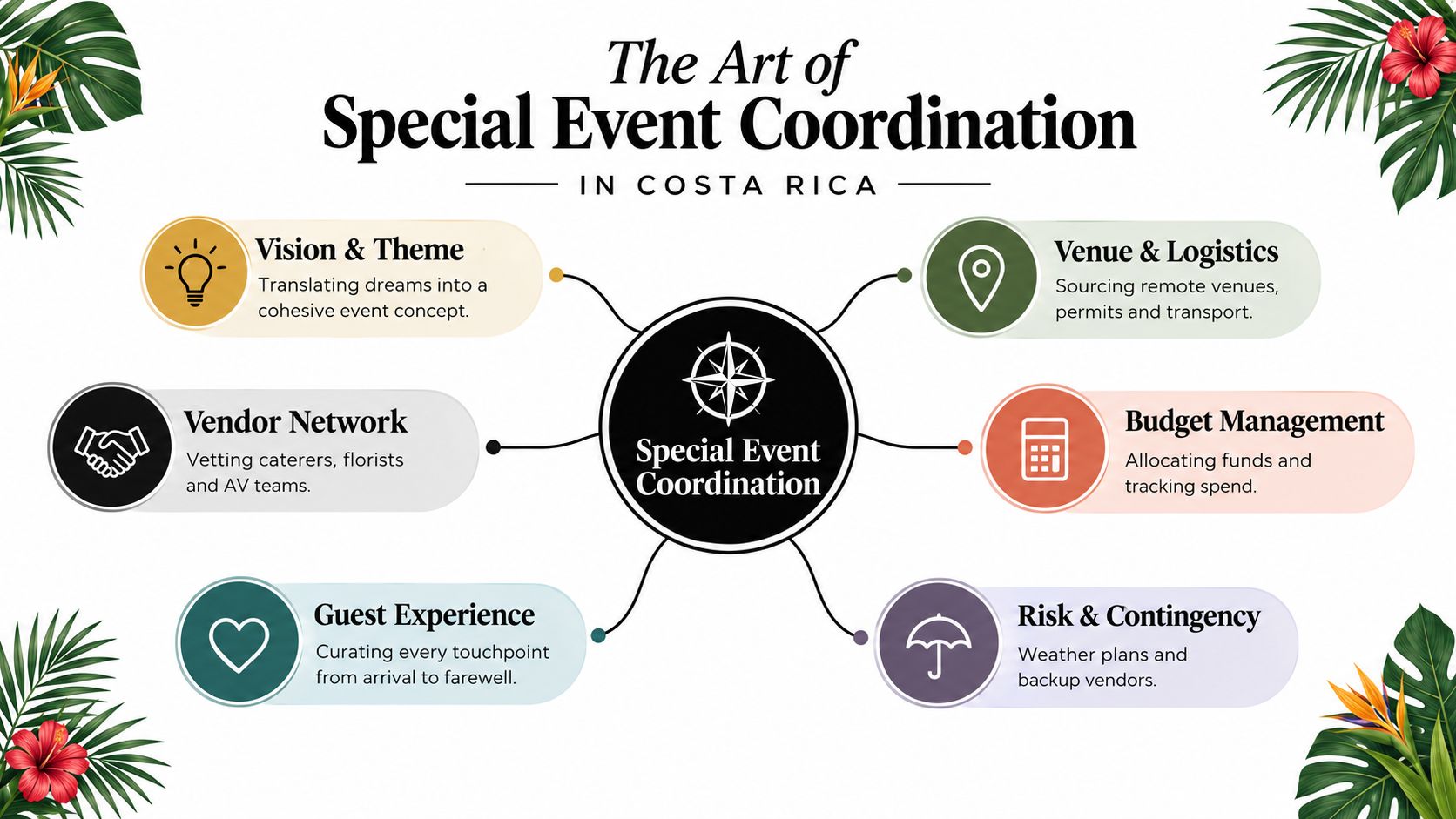
Coordination is more than day-of support
For luxury wellness and lifestyle events, the coordinator should protect two things at once:
Operational control: Vendors, permits, deliveries, transfers, setup, guest information, and emergency procedures must connect through one accountable system.
Experiential intention: The event should have a deliberate rhythm, with enough space for rest, conversation, discovery, and unplanned moments.
The wider events economy illustrates why this work has become a professional function. The global events economy was estimated at about USD 1.16 trillion in 2024 and projected to reach USD 2.09 trillion by 2033, with a 6.7% CAGR from 2025 to 2033, according to Grand View Research's event management market analysis. The same source places event-related travel in the United States at USD 126 billion in 2024, supporting nearly 620,000 jobs.
Those figures describe a broad market, not a promise for any individual event. They do show that coordination sits at the center of a substantial professional ecosystem involving venues, catering, audiovisual production, transportation, attendee care, and risk planning.
Practical rule: If the guest should never have to ask who is responsible, assign that responsibility before the event begins.
At a place such as Dominical, the strongest coordinator doesn't flatten Costa Rica into a generic backdrop. They use local food, nature, culture, and movement as part of the design while ensuring every transition feels calm. That balance is the art.
Roles and Deliverables, Your Coordination Team
A polished event needs more than a host and a collection of enthusiastic suppliers. It needs clear ownership, written deliverables, and a decision path that works when the program changes.
The lead event coordinator owns the master picture. This person confirms the event concept, manages the budget framework, approves major choices, and resolves conflicts between guest experience and operational limits. They should be able to answer, at any moment, what happens next, who owns it, and what happens if the original plan fails.
Assign responsibilities before booking suppliers
Use a simple team structure:
Lead coordinator: Creates the event brief, master budget, decision log, and final run-of-show.
Logistics manager: Manages venue access, permits, transport, setup, power, weather contingencies, and teardown.
Vendor liaison: Maintains contracts, arrival windows, technical requirements, payment status, and on-site communication.
Guest services lead: Owns RSVPs, rooming, dietary needs, accessibility, transfers, seating, and personal requests.
On-site crew: Executes setup, signage, furniture movement, technical checks, reset, and strike.
The roles can be combined for a smaller gathering, but the responsibilities can't disappear. One person may wear several hats, yet the host should still know who owns each category.
The best coordination plan makes responsibility visible before anyone needs to exercise it.
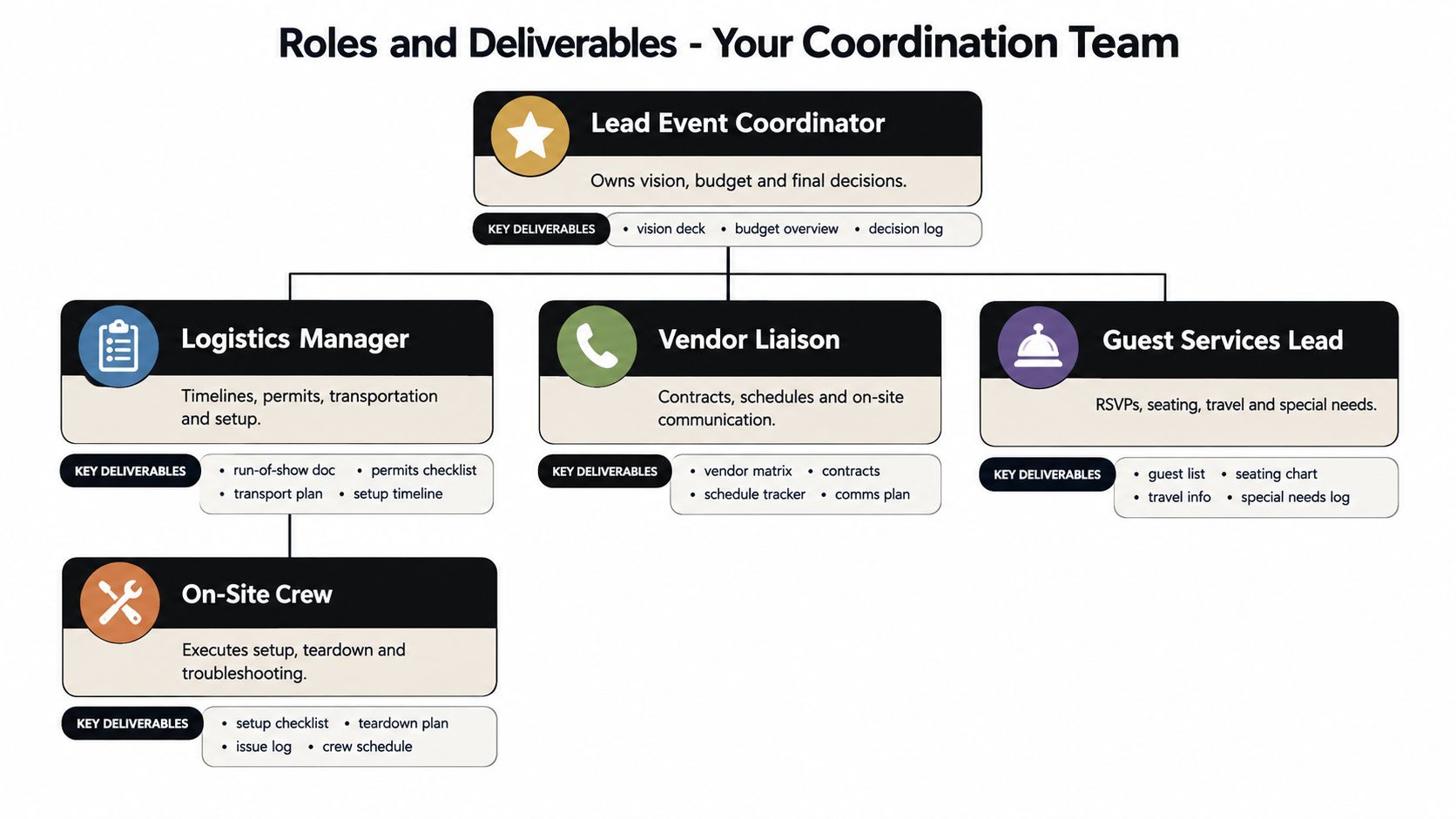
Deliverables that protect the experience
Require a written vendor matrix with contact details, scope, arrival time, equipment, payment status, and backup contact. Build a guest profile document that captures preferences without turning hospitality into a data exercise. The coordinator should also produce a venue map, transport manifest, dietary summary, emergency contact sheet, and teardown checklist.
This structure reflects a broader shift toward integrated event operations. In 2026, 79% of organizers reportedly had their event platform integrated with CRM or marketing automation tools, according to G2's event industry statistics. For brands, that integration matters because an event can support community building and consumer relationships before, during, and after the gathering. The data should improve relevance, not interrupt the experience.
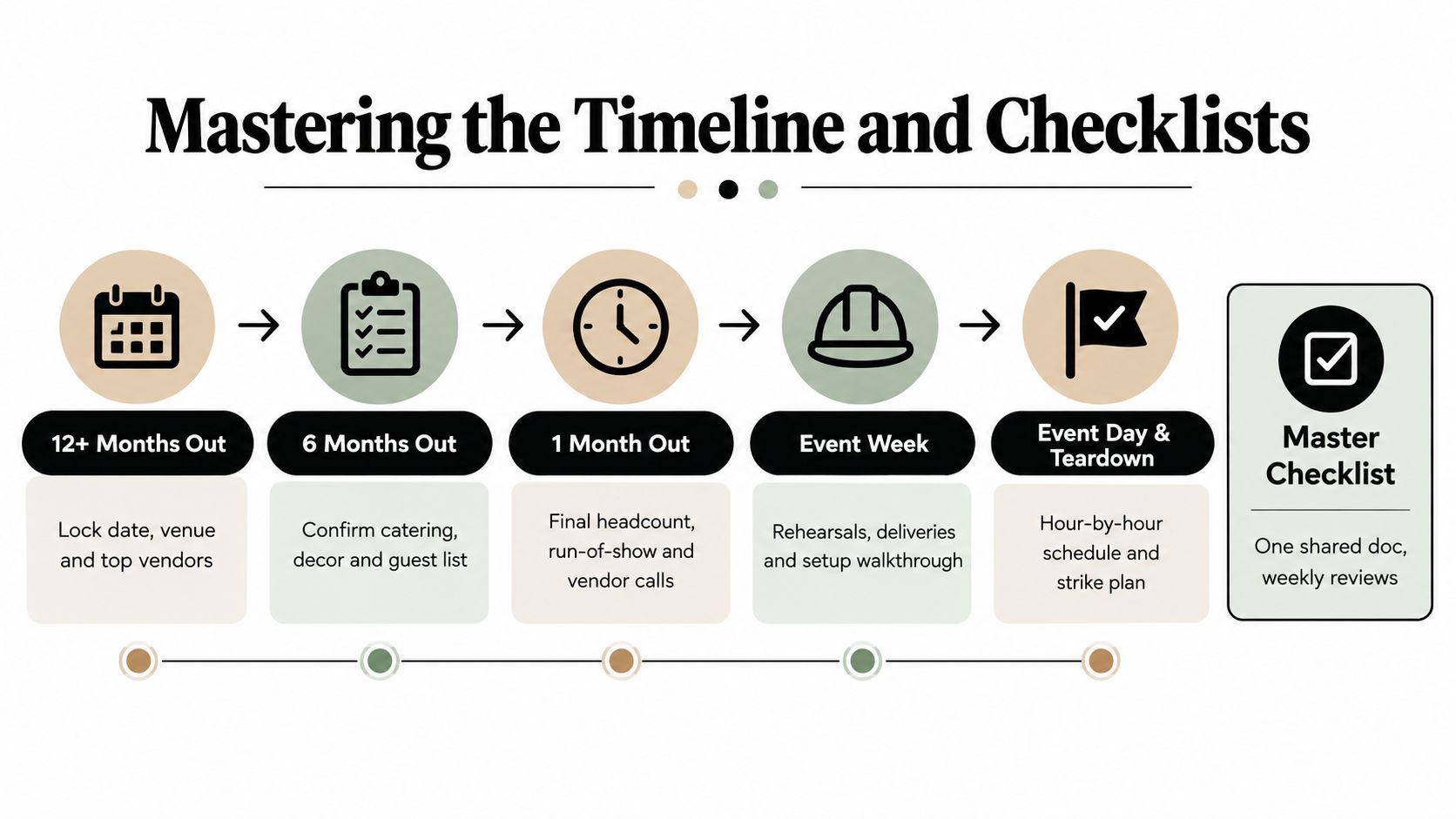
Mastering the Timeline and Checklists
A timeline should do more than list dates. It should show dependencies. The caterer can't finalize service without the guest profile, the transport provider needs confirmed arrival information, and the production team needs the floor plan before technical setup.
Start with the event outcome, then work backward. Decide what guests should feel at arrival, during the central experience, and at departure. Build the operational sequence around that emotional arc.
A practical planning sequence
Twelve months or more out: Lock the event purpose, preferred date, venue style, guest profile, and priority suppliers.
Six months out: Confirm catering direction, accommodation requirements, activity partners, design elements, and the working guest list.
One month out: Close the headcount, verify dietary and accessibility details, circulate the run-of-show, and hold vendor calls.
Event week: Walk the venue, rehearse key transitions, confirm deliveries, test audio, review weather plans, and brief every team lead.
Event day and teardown: Use an hour-by-hour schedule, assign decision authority, protect meal and rest windows, and document the strike.
The most useful checklist is one shared document, reviewed consistently by the people who execute the event. Include permit status, vendor contracts, guest arrivals, room assignments, transport, medical access, food safety, weather decisions, payment approvals, and post-event follow-up.
For a wedding or milestone gathering, the micro-wedding planning guide can help frame the relationship between intimacy, guest flow, and venue decisions. The same logic applies to private retreats and brand communities.
A run-of-show should include both the visible program and the hidden work behind it. Note who opens the venue, who receives deliveries, who checks guest transfers, who approves a weather change, and who communicates the decision to every affected supplier.
The safety plan belongs in the same operating system. FEMA guidance identifies a multidisciplinary planning group that can include emergency management, law enforcement, fire and rescue, public works or utilities, and public health. For an intimate event, that doesn't mean creating unnecessary bureaucracy. It means identifying the people responsible for access, transport, food, shelter, medical response, weather, and community impact before guests arrive. Review the FEMA special events planning guidance when the event involves complex movement, remote settings, or public-facing activities.
Budgeting for Luxury in a Premium Destination
Luxury event budgeting works best when you fund the moments guests actually remember. Don't spread money evenly across every line item. Prioritize the venue, food, service, transport, and signature experiences that define the event, then protect a contingency reserve for changes that arise in a destination environment.
Because no universal allocation fits every Costa Rican event, use categories rather than rigid percentages. Build the budget around scope, then request comparable quotes that clearly state inclusions, exclusions, taxes, transport, staffing, equipment, setup, and teardown.
Category | Suggested Allocation % |
|---|---|
Venue and accommodation | To be determined by scope |
Catering and beverages | To be determined by menu and service style |
Experiences and activities | To be determined by itinerary |
Production, décor, and rentals | To be determined by design |
Transportation and transfers | To be determined by guest movement |
Coordination and staffing | To be determined by operational complexity |
Sustainability and community impact | To be determined by chosen commitments |
Contingency | Reserve before approving the final program |
Where premium spending creates value
Invest first in coordination quality and guest movement. A beautiful dinner loses impact if guests wait for transport, miss the experience window, or receive conflicting instructions. Food deserves similar attention. A flexible, locally grounded menu can feel more luxurious than a fixed selection designed without regard to dietary needs or the setting.
Ask every supplier whether the quote includes travel time, equipment transport, overtime, weather protection, setup labor, and cancellation terms. Remote or nature-integrated venues may also require additional planning for power, lighting, access, communications, and surface protection.
Affluent travelers don't necessarily need maximal production. They want decisions to feel intentional. A smaller event with a coherent menu, thoughtful rooming, well-timed excursions, and responsive hosts can deliver stronger value than a larger program filled with disconnected extras.
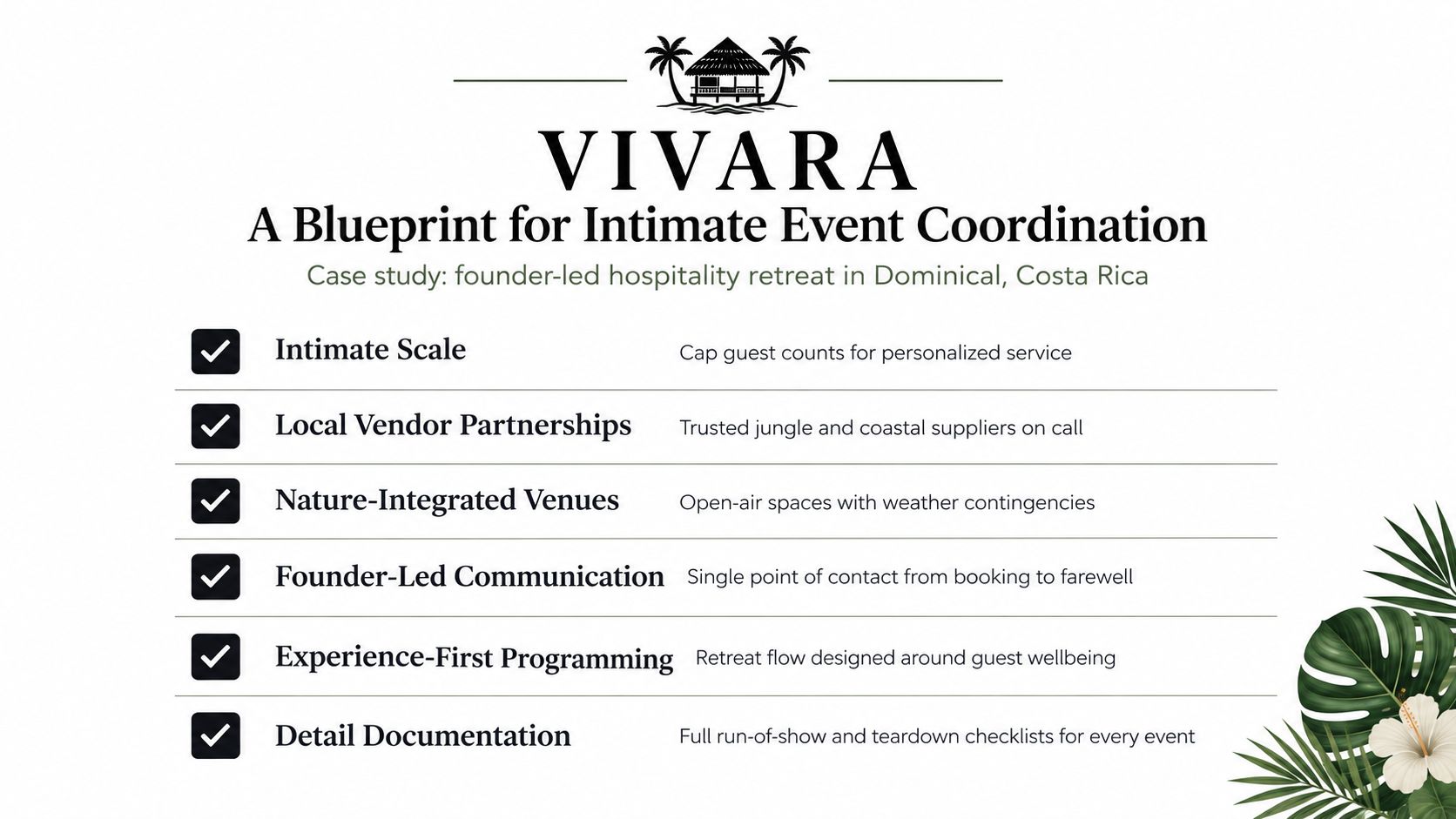
VIVARA, A Blueprint for Intimate Event Coordination
An intimate event changes the coordination equation. Fewer guests don't eliminate complexity. They raise expectations because each person notices the timing, the welcome, the food, and the personal details.
VIVARA, a founder-led hospitality retreat in Dominical, offers a useful planning model for this kind of gathering. The property is designed for up to 14 guests across architecturally distinct villas, with personalized V-star service and an on-demand menu of experiences. Its format suits couples, families, friends, founders, wellness leaders, and brands that want community connection without the distance of a conventional large venue.
Design the event around the group's natural rhythm
A VIVARA-style itinerary might begin with an unhurried arrival, a private meal shaped by farm-fresh, ocean-caught, and jungle-foraged ingredients, and a sunset experience that gives guests time to connect. Another day could combine whale watching, canyoning, horseback riding, zip lining, or paragliding with quieter recovery time. The point isn't to fill every hour. It's to choose experiences that match the group's energy and purpose.
For a founder-led team, the morning may support focused conversation, followed by an outdoor adventure and a shared dinner. For a family milestone, the coordinator might prioritize flexible dining, wildlife encounters, and a celebration that accommodates different ages and abilities. For a brand, the gathering should create authentic opportunities for people to meet, participate, and associate the brand with a meaningful experience rather than a staged promotion.
The intimate event space at VIVARA demonstrates why venue selection and coordination should be treated as one decision. Open-air settings, private villas, local cuisine, and nature-based activities only work when the schedule, service team, transport, and weather alternatives are designed together.
A full-estate gathering also lets hosts control the guest journey from arrival to farewell. That control supports privacy, personal service, and a consistent atmosphere, while still leaving room for local culture and spontaneous discovery.
Navigating Vendors and Local Logistics
The strongest vendor strategy in Costa Rica is relational, documented, and selective. A supplier who understands the location, climate, access conditions, and service expectations may be more valuable than a cheaper provider with a polished portfolio but little local fit.
Compare vendors on four dimensions:
Approach | Strength | Risk | Best use |
|---|---|---|---|
Local specialist | Strong destination knowledge and relationships | Capacity may be limited | Nature activities, food, transport |
National provider | Broader systems and formal processes | May feel less personal | Production, larger logistics |
Venue-recommended partner | Faster coordination and known access | Less independent comparison | Intimate events with tight timelines |
Independent premium supplier | Distinctive creative direction | More coordination required | Signature décor, culinary, or artistic work |
Use one vendor liaison to prevent conflicting instructions. Confirm arrival windows, loading access, equipment needs, power requirements, cancellation terms, payment milestones, and the person authorized to make on-site changes.
Costa Rica's terrain and weather make timing practical, not cosmetic. Build buffers between transfers and experiences, avoid sending every guest through one arrival bottleneck, and make sure the backup plan preserves the event's emotional purpose. If an outdoor dinner moves indoors, the replacement should still feel considered, not like an emergency surrender.
For brands, local suppliers also help create credible community touchpoints. A chef, guide, conservation partner, or craft producer can contribute to a richer gathering when the relationship is transparent and the guest experience respects local expertise.
Integrating Sustainability and Regenerative Impact
Sustainability should influence the event brief from the first conversation, not appear as a final line in the welcome message. In Costa Rica, guests often choose the destination because they want nature, restoration, and connection. The event should protect those values through its purchasing, staffing, transport, food, and community relationships.
Regenerative event coordination goes beyond reducing harm. It asks what the gathering can strengthen. That may include local employment, fair compensation, conservation support, rescued-animal sponsorship, lower-waste dining, and respectful access to natural places.
VIVARA's model connects each villa with a rescued animal sponsorship and links guest presence to lifeguard training, living wages, and turtle conservation. Those commitments give hosts a concrete way to connect hospitality with impact rather than relying on vague sustainability language. Learn more about regenerative tourism at VIVARA before building the impact layer of an event.
Make the impact visible without making it performative
Tell guests where food comes from, who provides the activity, and what their stay supports. Don't turn community partners into decorative content. Give them fair commercial terms, respect their expertise, and avoid promising outcomes the event can't verify.
For a brand, this matters beyond reputation. A thoughtfully designed retreat can help a company build community around shared values, create meaningful consumer participation, and develop stories that come from real relationships rather than staged messaging.
Choose fewer, stronger commitments. A locally sourced menu, responsible wildlife experience, and transparent conservation contribution will usually mean more than a long list of symbolic gestures that staff can't explain.
Your Next Steps in Costa Rican Event Planning
Begin with the outcome, not the décor. Decide whether the gathering is meant to support recovery from burnout, strengthen relationships, celebrate a milestone, generate creative work, deepen a brand community, or give guests a personal reset. That decision should shape the venue, pace, activities, service style, and budget.
Then use this sequence:
The edited paragraph is provided below.
Write a one-page event brief. Include the purpose, guest profile, preferred setting, desired feeling, must-have experiences, dietary needs, and core values.
Choose the right scale. An intimate buyout suits groups that value privacy, flexibility, and personal service. A larger venue may suit public programming, broad networking, or extensive production.
Appoint one accountable coordinator. Give that person authority over the run-of-show, vendor communication, guest information, and contingency decisions.
Build the vendor matrix early. Compare local fit, service scope, transport, equipment, weather capacity, payment terms, and backup options.
Protect the guest journey. Plan arrivals, meals, activity transitions, rest, communication, and farewell with the same care you give the main celebration.
Document safety and weather decisions. Map access, egress, medical response, shelter, communications, and who can change the program.
Set the budget by experience priority. Fund the elements guests will feel most strongly, then reserve room for destination logistics and operational changes.
Define the impact promise. Choose community and conservation commitments that the host team can explain clearly and support consistently.
Costa Rica's entry requirements are straightforward for many travelers. U.S., Canadian, and most European visitors can stay up to 90 days with a valid passport and onward ticket, and the country currently doesn't require COVID-19 vaccination or testing for entry, according to Costa Rica wellness travel guidance. Travelers arriving from countries with yellow fever risk may need proof of vaccination, while those flying directly from North America, Europe, Asia, or Australia generally don't need it for Costa Rica entry, as outlined in Costa Rica's vaccination guidance.
Costa Rica also appeals to travelers who actively spend on wellbeing. Wellness tourism reached an estimated 819.4 million domestic and international trips in 2022, with average spending of about $1,764 per trip, or 41% more than the average tourist, according to reporting on Costa Rica's wellness tourism market. Independent reporting also notes nearly 2.7 million international air arrivals in 2025 and a strong opening quarter in 2026, signaling sustained interest in nature and wellness travel, as described by The Costa Rica News.
The right retreat isn't just the one with the most activities or the most polished setting. It's the one whose scale, service model, location, values, and coordination process match the people you're bringing together. Compare full buyouts with partial venue use, fixed programs with flexible itineraries, and generic luxury with a clearly defined guest experience.
VIVARA offers intimate stays and custom gatherings in Dominical for couples, families, friends, teams, brands, and retreat leaders who want nature, personalized hospitality, curated experiences, and regenerative impact in one setting. Visit VIVARA to explore the property and begin shaping a Costa Rican event around your group's purpose.

