The Vivara Content Team
Intimate Event Space: What It Is and How to Choose One
Intimate Event Space: What It Is and How to Choose One

You've found the right guest list, the right setting, and perhaps even the right country. Then you arrive and discover that the “intimate” venue is either a crowded house with nowhere to retreat or an oversized event hall that makes every conversation feel exposed. In Costa Rica, where a gathering may combine ocean time, shared meals, wellness, adventure, and several nights under one roof, the venue isn't background scenery. It's the operating system for the entire experience.
A well-chosen intimate event space should make connection feel natural, recovery feel possible, and logistics nearly invisible. It should work for a private celebration, a founder retreat, a wellness program, or a brand gathering designed to build a real community around shared values. The key question isn't just whether the property looks beautiful. It's whether the property can carry the emotional and operational weight of your event.
The Moment You Realize the Venue Was the Wrong Choice
The first warning usually appears before the ceremony, workshop, or welcome dinner.
A 12-person retreat arrives at a property designed for 40. The dining table looks impressive, but the lounge has too many empty seats and the sound system feels oversized for the room. Guests split into awkward clusters because the space doesn't tell them where to gather. The host keeps moving people around, trying to create intimacy that the architecture never planned to provide.
The opposite failure is just as common. A 30-person micro-wedding occupies a ballroom built for a much larger reception. Candlelight softens the room, but it can't fix the distance between tables. Sightlines disappear after the third row. Hard surfaces throw conversation across the floor, while the couple spends the evening checking whether elderly relatives can hear the speeches.
Small details then become major constraints:
Sound: Reverberation makes a toast tiring to follow and a group discussion harder to lead.
Bathrooms: One shared bathroom can bottleneck hair, makeup, morning routines, and accessibility.
Neighbor relations: A late discovery about noise limits forces the host to apologize for restrictions nobody discussed.
Sleeping arrangements: Guests may technically fit, but open-plan rooms and distant villas eliminate privacy.
Movement: Parking, kitchens, ceremony areas, and bedrooms sit far enough apart to create constant transfers.
Practical rule: If the host has to explain why the group can't use the property naturally, the venue is probably solving the wrong problem.
The right arrival feels different. The guest count matches the rooms, the kitchen sits close to the dining area, and the communal space has enough structure for conversation without forcing everyone into one formation. Sleeping quarters feel connected to the gathering hub, but not exposed to it. Covered outdoor areas remain useful when rain changes the plan.
That difference is structural, not decorative. Fresh flowers and careful lighting can improve a room, but they can't repair bad circulation, weak acoustics, insufficient bathrooms, or a fragmented property plan.
What an Intimate Event Space Actually Is
An intimate event space isn't just a small venue. It's a property designed to keep people connected while giving them enough room to rest, move, and change pace.
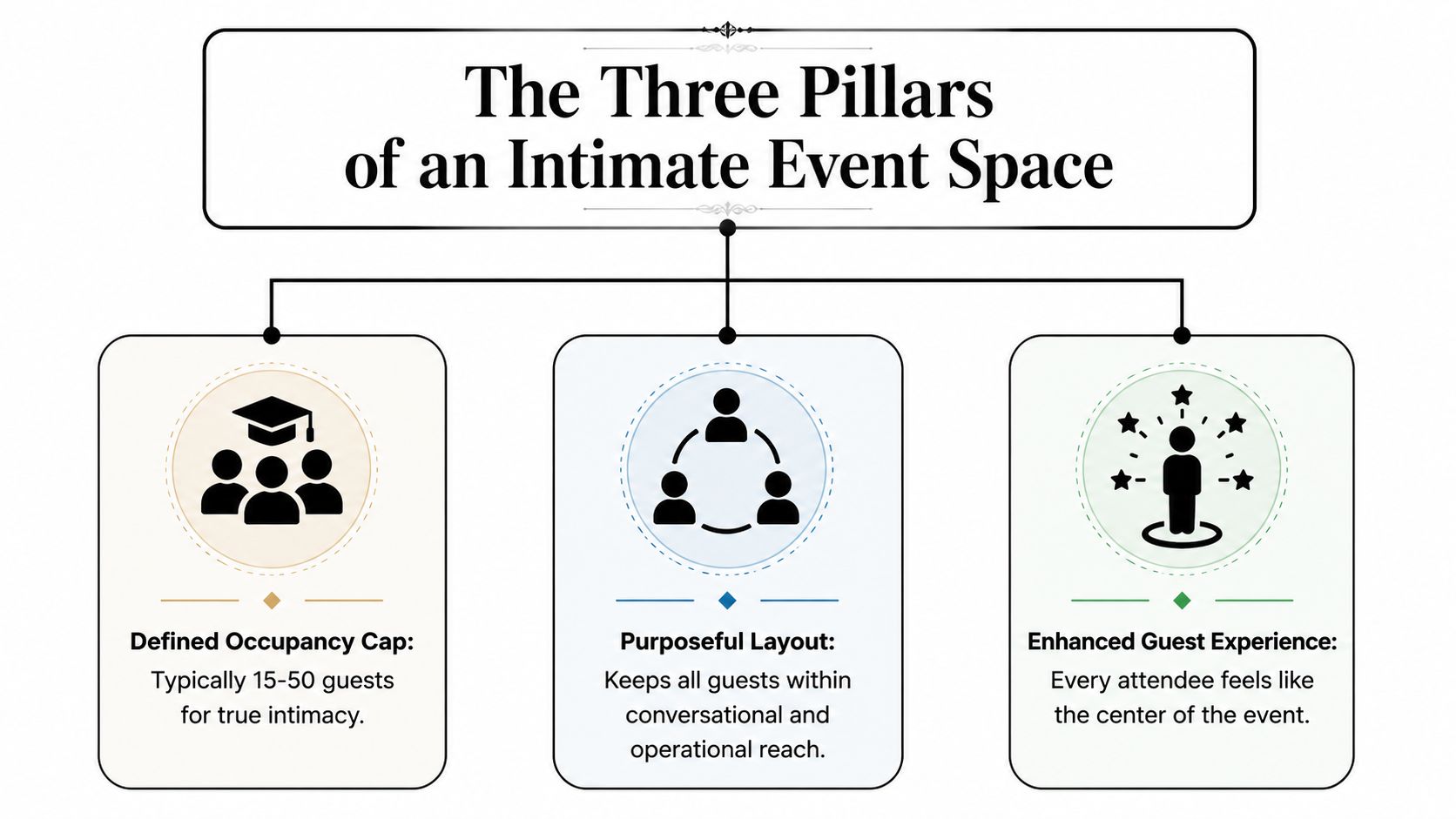
I use three tests:
A defined occupancy cap. The venue knows the maximum group it can serve well, not just the maximum number it can physically squeeze inside.
A purposeful layout. Guests stay within conversational and operational reach of the host, staff, and one another.
An enhanced guest experience. The property supports privacy, personalization, and meaningful interaction rather than treating a small group as a reduced version of a large event.
Capacity tiers that help with the first decision
Capacity is useful when it reflects how the venue operates:
Micro: Under 15 guests, usually suited to private celebrations, couples' gatherings, or focused leadership retreats.
Boutique: 15 to 30 guests, enough for multiple social combinations without losing a shared center.
Small-resort: 30 to 50 guests, workable for larger retreats or milestone events if the property has strong zoning.
Industry benchmarks place the average small event venue at about 2,500 square feet and typically support 100 to 200 guests, but that category includes venues that may host short events rather than overnight, multi-day experiences. The same summary reports that 75% of venues under 3,000 square feet are independently owned, while 30% of U.S. venues offer outdoor spaces. Those figures help explain why small venues vary so widely in staffing, service, and adaptability. See the wedding venue market analysis.
For a standing or mingling format, plan around 15 to 20 square feet per guest. Seated dining or activity-based gatherings generally need 20 to 30 square feet per guest, and groups of 10 to 30 may work in a semi-private area of about 500 to 800 square feet. These are planning benchmarks, not permission to ignore the floor plan. Use this capacity planning guide.
What separates intimacy from downsizing
A generic hotel meeting room provides a function. An intimate venue provides a setting for an entire social rhythm. Look for private buyout availability, dedicated event staff, full-property dining, on-site lodging, and indoor-outdoor flow that can adapt to weather.
A residential rental may sleep a group, but it often lacks commercial kitchen capacity, event staffing, sound control, and a clear decision-maker. A wedding venue reduced to fewer guests may still feel like a large production with unused zones and rigid vendor rules.
The most useful test is simple. Can the property host arrival, meals, conversation, activities, quiet time, and sleep without sending guests away from the experience every few hours? If not, it's a small venue, but it isn't necessarily an intimate one.
Capacity, Layout, and the Features That Matter
A beautiful property can still fail under live conditions. Capacity planning starts with usable space, not the headline square footage. Subtract stages, bars, buffets, equipment, fixed furniture, and circulation paths before applying a per-person standard. Then use the lower of the layout-based capacity and the local occupancy limit. Review this venue capacity calculation method.
For a multi-day retreat, I also want roughly 60 to 80 square feet of shared indoor space per guest. That isn't a comfort formula for every event. It's a practical target for a property that needs to support meals, informal meetings, weather changes, quiet work, and downtime without making guests compete for the same chair.
Layout patterns that hold up
The strongest plans usually cluster sleeping villas around a central gathering hub. Guests can join breakfast, a workshop, or an evening conversation without navigating a hotel corridor or arranging a shuttle. Separate breakout zones give people somewhere to work privately, take a call, or decompress.
A covered outdoor area is essential in Costa Rica. It should be a usable room, not a decorative roof over a terrace. If rain arrives, the group should still be able to eat, talk, practice, or wait comfortably.
Guest Count | Sleeping Rooms | Communal Sq Ft (indoor) | Communal Sq Ft (covered outdoor) | Bathroom Ratio | Staffing |
|---|---|---|---|---|---|
Under 15 | Private rooms or villas for the full group | Prioritize conversation and flexible dining | A weatherproof gathering zone | Avoid a single shared bottleneck | One empowered property lead plus event support |
15 to 30 | Clustered rooms with clear privacy | Add breakout space for parallel activities | Dining, movement, and rain backup | Confirm morning and event-flow capacity | Dedicated coordinator and service team |
30 to 50 | Multiple lodging clusters with an obvious hub | Separate dining, work, and recovery zones | Covered programming and meal space | Review occupancy and accessibility carefully | Department-level coverage with one decision-maker |
Questions to ask before signing
Ask who has authority when the weather changes, a vendor is late, or a guest needs support. Confirm backup power and water, acoustic separation between lodging and event zones, ADA-aware pathways, and commercial kitchen capacity for the full guest count.
A venue with one property manager who can make decisions is usually easier to operate than one that requires approval from several disconnected owners. You also want a clear service plan for meals, activities, housekeeping, transportation, and emergency coordination.
The red flags are familiar because they keep causing the same failures: one shared bathroom, open-plan sleeping, distant parking, no covered outdoor room, and event sound directly beside bedrooms. A property should feel compact, not compressed.
Planning Checklist and Timeline for an Intimate Gathering
Private-buyout events need an earlier start than casual travelers expect. For a carefully produced gathering, begin venue research 12 to 9 months before arrival, especially if you need exclusive use, specific villas, specialist food service, or a multi-day program.

The working timeline
At the first stage, shortlist venues against the guest experience, not the photo gallery. Schedule site visits or live video walkthroughs. Confirm the usable layout, sleeping plan, kitchen, bathrooms, outdoor backup, connectivity, and access from a regional hub.
During the middle months, review the contract closely. Ask about attrition, cancellation, force majeure, payment timing, outside vendors, alcohol, noise, weather contingencies, and the responsibilities of each party. Send guest communications early enough to explain travel requirements, climate, activity intensity, and the social rhythm of the stay.
The final phase should include dietary intake, transportation manifests, AV checks, connectivity tests, activity confirmations, and a 14-day run-of-show. Intimate events have fewer moving parts, but every guest sees every mistake, so the final review matters.
A printable operating checklist
Confirm the guest count: Separate confirmed guests, likely guests, children, accessibility needs, and room preferences.
Send save-the-dates: Include destination logistics, expected trip length, and the type of participation required.
Lock activity partners: Verify insurance, transport, weather alternatives, equipment, and cancellation terms.
Confirm staffing ratios: Identify who handles meals, housekeeping, activities, transportation, and guest issues.
Test technology: Check Wi-Fi, microphones, screens, charging access, and backup communication.
Build the room plan: Protect privacy, quiet hours, accessibility, and natural social groupings.
Approve the final schedule: Give every host, vendor, and property lead the same version.
Pricing should be compared as a unit-economics decision. A flat event fee may suit a single-day celebration with outside lodging. Per-guest pricing can simplify a retreat with meals included, but you need to test what happens when attendance changes. A nightly buyout makes more sense when privacy, shared meals, and on-site programming are central. A week-long estate rental suits a group that wants a temporary social world rather than a sequence of disconnected bookings.
For a vow-renewal format, use this Costa Rica vow-renewal planning guide as a practical reference, then adapt the schedule to your property's actual staffing and travel conditions.
Pricing Models and How to Budget Honestly
Per-guest pricing is common because it looks simple. It's also the easiest model to manipulate if the quote leaves out staffing, service charges, transport, activity coordination, or exclusive-use fees.
Read every proposal in three layers. First, identify what's bundled, such as linens, basic staffing, meals, sound, housekeeping, or use of communal spaces. Next, mark every à la carte item, including bar service, excursions, transfers, upgraded menus, and ceremony production. Finally, ask where the property adds margin through minimum spends, vendor commissions, premium dates, overtime, and room upgrades.
Three scenarios, three different answers
A micro-wedding may justify a flat event fee if the couple needs a ceremony setup, welcome dinner, sound, photography access, and a dedicated coordinator for one primary day. A wellness retreat usually needs more attention to meal cadence, movement space, dietary preparation, quiet hours, and activity support, so a per-guest package can be useful if those services are clearly itemized.
A founder mastermind may favor a nightly buyout. Private rooms, reliable connectivity, whiteboards, working meals, and confidentiality can matter more than a wedding-style production package. If the group stays several nights, the buyout may compare favorably with separate lodging, restaurant meals, meeting rentals, and transfers.
A week-long estate rental only makes sense when the group will use the property across the full program. Otherwise, unused nights and self-managed services can erase the apparent value.
Pricing Model | Best For | Hidden Costs to Watch |
|---|---|---|
Flat event fee | A defined celebration or single production day | Lodging, overtime, furniture, sound, and outside vendor charges |
Per-guest package | Retreats with meals and core services | Minimum guest counts, service fees, upgraded menus, and activity exclusions |
Nightly buyout | Private multi-day gatherings | Minimum nights, staffing, food service, transport, and cleaning |
Week-long estate rental | Extended programs with a stable group | Self-managed coordination, supplies, insurance, and unused capacity |
Costa Rica has historically favored small-scale lodging. A UN Convention on Biological Diversity tourism paper reports 1,671 hotels with 28,000 rooms nationwide, and only 27 hotels, or 1.6%, had more than 50 rooms. That context makes boutique, property-wide hospitality a natural format, but it also means you must evaluate operational depth rather than assume a small property can run a complex event. Read the Costa Rica tourism profile.pdf).
Ask for a fully itemized proposal before signing. A headline number tells you almost nothing about the actual cost of an intimate event space.
Use Cases That Show How the Format Flexes
An intimate event space earns its keep by supporting an entire stay, not by serving as a smaller wedding hall. The property must shift between lodging, dining, activities, focused work, and shared downtime without making guests feel they are moving through separate venues.
A 14-person micro-wedding might run from a Friday welcome dinner through a Sunday farewell brunch. The welcome evening needs relaxed dining and easy introductions. The ceremony needs clear sightlines, a quiet preparation area, weather backup, and a practical route into dinner. The host should settle sound boundaries, photography access, meal timing, and responsibility for resetting each area before arrival.
A five-night wellness retreat needs a different rhythm. Quiet practice can lead into nourishing meals, nature-based activities, and time for reflection. The communal room must support group energy and recovery. The chef should receive dietary preferences before arrival, and staff should protect privacy by limiting unnecessary room entries.
A four-day founder mastermind requires work areas, whiteboards, dependable connectivity, and discreet meeting zones. Private rooms give participants focused time, while shared meals build connection without forcing constant interaction. Confirm that staff understand confidential discussions and that event sound will not carry into sleeping areas.
The program changes more than the architecture.
The same footprint, different social design
An 8,000-square-foot private estate can support a wedding, retreat, or working session without rebuilding the property. Dining may become a celebration, a nutrition session, or a working meal. A lounge may serve as a ceremony transition area, reflection room, or strategy space.
That flexibility reduces production work and gives the host more control over the guest experience. A venue designed for one format creates constraints as soon as the program changes. A property that can support restoration, celebration, adventure, and community remains useful across different groups and seasons.
Evaluate the setting as a hospitality ecosystem. Can guests sleep comfortably, eat well, gather privately, and reach activities without constant transfers or operational handoffs? If those functions compete for the same space, the venue may look intimate while working poorly.
For planners comparing formats, this intimate wedding venue guide offers a useful standard: judge the property as a complete setting, not only as a ceremony backdrop. Apply the same test to retreats, brand gatherings, and founder programs.
How VIVARA Fits the Intimate Event Space Model
VIVARA in Dominical is a useful case study because its operating model aligns with the core requirements of a multi-day intimate event space. The property is designed for up to 14 guests, offers a full private buyout, and distributes lodging across architecturally distinct villas connected to shared gathering areas.
One footprint, fewer handoffs
The property can combine lodging, dining, ceremony, breakout time, and downtime without sending the group through a chain of unrelated vendors. An on-demand chef and customized programming allow the host to shape the pace around the group rather than force every event into a fixed banquet schedule.
That matters for a six-person founder retreat as much as it does for a 14-guest micro-wedding week. A small group can move from a private conversation to a shared meal, then to an ocean-view pause or an activity, without losing the sense that everyone is part of one experience.
Costa Rica also makes nature part of the operating environment. SINAC says a quarter of the national territory is under some category of protection, organized across 11 conservation areas that include national parks, wildlife refuges, national monuments, biological stations, wetlands, and biological corridors. Explore Costa Rica's protected-area system. VIVARA's regenerative land management, rescued-animal sponsorship model, and support for lifeguard training, living wages, and turtle conservation connect the stay to that broader conservation context.
The decision filters
Criterion | What It Requires | How VIVARA Delivers |
|---|---|---|
Capacity | A clear cap matched to rooms and service | Designed for up to 14 guests |
Privacy | Exclusive use for one group | Full private-property buyout |
Lodging | Connected rooms with personal space | Multiple villas across one estate |
Dining | Flexible service for the full group | On-demand culinary programming |
Activities | Options shaped to the group's energy | Bespoke nature, adventure, and restorative experiences |
Weather resilience | Indoor-outdoor spaces that can shift function | Flexible shared areas and an ocean-view pavilion |
Purpose | A credible relationship with place | Regenerative land and community-support practices |
Operations | One accountable team | Founder-led hospitality with on-site production support |
VIVARA isn't the right fit for a large conference, a group that wants a conventional hotel system, or an event built around maximum attendance. It suits couples, families, friends, wellness leaders, founders, and brands that value privacy, flexible programming, and a shared residential experience. Before booking, review the VIVARA guest experience, then ask for a proposal that separates accommodation, dining, activities, staffing, and event production.
VIVARA offers a private Dominical setting for up to 14 guests, with multi-villa lodging, flexible dining, curated experiences, and spaces that support both celebration and recovery. Visit VIVARA to compare your guest count, trip length, and event goals with a Costa Rica retreat designed as a complete hospitality ecosystem.

