The Vivara Content Team
Weight Loss Retreat Costa Rica: What to Expect
Weight Loss Retreat Costa Rica: What to Expect

You've spent the year meeting other people's deadlines, eating between calls, and postponing the health decisions you keep promising to make. Now you're considering a weight loss retreat in Costa Rica, attracted by the idea of a reset but wary of returning home with good intentions and the same old routines.
That caution is sensible. A retreat can create the conditions for change, but it can't outsource your life after checkout. The right program gives you structure, skilled guidance, community, and practical habits to carry home. The wrong one gives you a beautiful setting, a punishing schedule, and a result that depends on staying inside the retreat bubble.
Why a Weight Loss Retreat Feels Different in Costa Rica
You arrive after a demanding year with a backpack, a suitcase, and a body that feels permanently switched on. The first morning may involve guided movement outdoors, a carefully prepared breakfast, and a conversation about your goals rather than a rushed coffee before opening your laptop. Nothing magical has happened, but the usual friction has been removed.
At home, changing your routine means negotiating work, family, grocery shopping, social plans, and fatigue all at once. At a purpose-built retreat, meals, movement, recovery, and coaching sit inside one environment. That concentration gives you space to notice what affects your appetite, energy, sleep, and motivation.
Setting matters, but setting isn't the treatment
Costa Rica adds a useful layer because nature can make healthy behavior feel less like a correction and more like an experience. A walk through tropical scenery, a swim, a quiet hour beneath the trees, or a locally prepared meal can support a broader reset around stress and attention. The country's official tourism site states that 26% of its national territory is preserved and that Costa Rica contains 6% of the world's biodiversity, making nature immersion a credible part of the destination story, not just decorative language (Visit Costa Rica's official destination information).
Still, a rainforest view won't compensate for unsafe coaching or a weak transition plan. A standard resort spa may offer treatments, healthy dishes, and occasional classes. A weight loss retreat should go further by coordinating nutrition, movement, behavior change, and accountability around a defined objective.
The experience should transfer home
The best retreats use the setting to help guests practice ordinary skills in an unusually supportive place. That might mean learning how to build a balanced plate from local ingredients, adjusting exercise to your actual fitness level, identifying emotional eating triggers, or planning for restaurant meals after departure.
A boutique group can make that learning more personal. Intimate numbers allow staff to notice when a guest needs a lower-impact option, more rest, or a direct conversation about unrealistic expectations. Shared meals and guided activities also create community, which matters for couples, friends, private groups, and brands designing a meaningful experience for their own consumers or team members.
Practical rule: Judge a retreat by what you can repeat at home, not by how impressive the arrival experience looks.
For a deeper look at how scenery and recovery can work together, explore this guide to nature and wellness in Costa Rica. The useful question isn't whether Costa Rica can transform you. It's whether the program uses Costa Rica to help you build a routine that survives the flight home.
What a Weight Loss Retreat Is
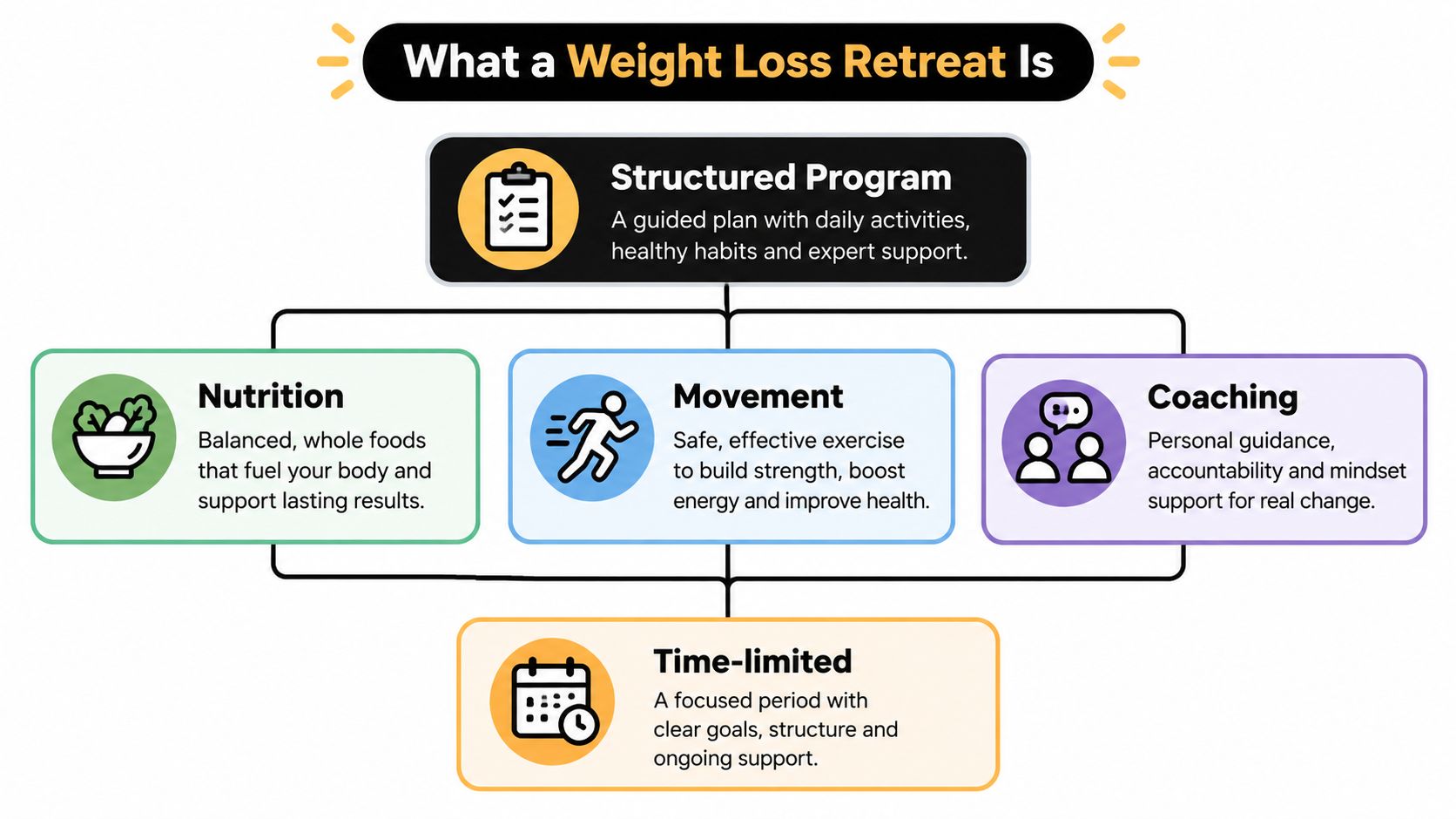
A weight loss retreat is a time-limited residential program that brings structured nutrition, progressive movement, behavioral coaching, and, where appropriate, medical oversight into one setting. Guests temporarily step away from work, family demands, and familiar food cues so they can concentrate on health decisions with support close at hand. A hotel with a gym, spa treatments, and a few healthy dishes does not provide the same level of coordination.
The category has moved beyond the old “fat camp” image. Commercial weight-loss camps in the United States date back to the 1940s and 1950s, when supervised exercise, controlled meals, and group accountability were combined in dedicated settings. Contemporary retreats may deliver a similar core structure through stronger hospitality, lifestyle coaching, better-designed facilities, and medically informed care. This historical overview of the retreat economy describes the broader shift from narrowly defined slimming programs toward transformation-focused stays.
What the evidence supports
Wellness retreats now form a large hospitality category, although market estimates cover far more than weight-loss programs. A Worldmetrics estimate places the global wellness retreat market at US$199.4 billion in 2024, projecting US$288.8 billion by 2030 at a 6.4% CAGR. The same publisher estimates the U.S. market at US$54.3 billion in 2024 and projects yoga retreats to reach US$126.8 billion by the end of its forecast period (market estimates for wellness retreats). Treat those figures as secondary market estimates, not as evidence that a particular retreat produces weight loss.
Research on residential programs offers a more useful lens. A systematic review found that the strongest randomized studies reported improvements in metabolic and neurological pathways, weight, blood pressure, abdominal girth, and subjective wellbeing. Some gains continued from immediately after the retreat to five years later, but results differed by program and follow-up period (systematic review of residential retreats). The finding supports residential care as a possible starting point, not a guarantee of permanent change.
A separate study of an adolescent residential camp reported a mean 6.0 kg weight loss, a 2.4-unit BMI reduction, and a 0.28 decrease in BMI SD score over a mean 29-day stay. Fat mass fell significantly while fat-free mass did not change, indicating that program design and body composition matter alongside scale weight (the residential weight-loss camp study). Because the participants were children, the results should not be used as a direct forecast for affluent adult travelers.
What a retreat can and cannot do
A retreat can remove daily friction long enough for guests to test new routines. It cannot control meals after departure, erase every trigger, or guarantee that weight will not return. The outcome depends on whether the stay produces practical skills, an achievable routine, suitable clinical guidance, and follow-up.
Program labels also hide meaningful differences. A clinical model may prioritize assessment and risk management. A boot-camp model may emphasize schedule, exertion, and group accountability. A restorative model may focus on recovery, stress, and a gentler return to movement. The right choice depends on health status, goals, and what you can continue at home. In Costa Rica, ask about licensed staff, emergency arrangements, medication handling, and the plan for care if symptoms develop during travel.
This guide to what a wellness retreat is explains the wider category. A wellness retreat can support general wellbeing without offering a weight-management program, so confirm the clinical scope, daily schedule, and follow-up before booking.
Which Weight Loss Retreat Model Fits Your Goals
Three program models dominate the market, although many properties combine elements of each. The deciding issue is not whether a retreat offers luxury villas, clinical language, or demanding classes. It is whether the method suits your health profile, goals, preferences, and ability to continue the routine at home.
Clinical or medically supervised programs
A clinical retreat fits guests who need health assessment, medication coordination, or closer oversight of medical risks. The team may include physicians, nurses, registered dietitians, psychologists, and exercise professionals. This model can suit people with complex medical histories, significant weight-related concerns, or questions about combining medication with lifestyle changes.
The trade-off is a more scheduled experience. Expect health screening, documented consent, clear escalation procedures, and communication with your own clinician when needed. A medical label does not prove that care is sound. Ask which practitioners are licensed, who makes treatment decisions, how records are handled, and what support remains after you leave Costa Rica.
Entry logistics matter as well. Before booking a remote property, confirm its cancellation terms, transfer arrangements, access to medical care, and requirements for bringing prescription medication into Costa Rica. A retreat should explain what happens if illness, injury, or a medication issue interrupts the stay.
Boot-camp-style programs
Boot-camp retreats appeal to guests who want firm accountability, visible structure, and a demanding physical challenge. They can suit active travelers who enjoy group energy and respond well to a full schedule. The weakness appears when intensity replaces individual planning.
A program that treats exhaustion as proof of progress can exclude beginners, people with joint or back concerns, and guests with a history of restrictive dieting. High effort also fails to teach portion awareness, emotional regulation, sleep habits, or how to exercise during a normal work week. If the scale is the only meaningful measure, the retreat may be buying short-term disruption rather than durable change.
Ask how the staff adjusts sessions for heat, humidity, altitude, previous injuries, and changing energy levels. Costa Rica's environment can make a demanding itinerary feel harder than it appears in a brochure. Qualified staff should offer lower-impact options and explain when a guest should stop.
Restorative lifestyle retreats
A restorative model combines movement, nutrition, stress reduction, sleep support, and time to recover. It may include guided hikes, strength or mobility sessions, breathwork, cooking, coaching, local excursions, and unstructured time. This approach often suits people recovering from burnout, couples seeking a shared reset, or guests who abandon plans after harsh restriction.
The risk is vague programming. A wellness label should still come with measurable goals, qualified practitioners, appropriate movement progressions, and a clear plan for life at home. Ask how meals are designed, how progress is reviewed, and whether the schedule gives you skills to repeat rather than just an enjoyable week. For a wider view of restorative options in the region, see our guide to healing retreats in Costa Rica.
Recent wellness-travel commentary points toward programs that address sleep, stress, muscle health, nutrition, and support after the stay, rather than relying only on rapid results (wellness travel trend commentary). Use that lens when comparing restrictive boot camps, clinic-led programs, and restorative stays. Sustained outcomes depend more on adherence, suitable training, and follow-up than on how intense or photogenic the retreat feels.
Decision matrix
Model | Best for | Intensity | Sustainability focus |
|---|---|---|---|
Clinical or medically supervised | Guests needing assessment, medication coordination, or closer oversight | Moderate to high, based on clinical suitability | Strong when follow-up and continuity of care are built in |
Boot-camp style | Active guests who enjoy group challenge and firm external structure | High, with modifications essential | Variable, depending on nutrition education and aftercare |
Restorative lifestyle | Burnout recovery, gentle reset, couples, private groups, and experience-led travelers | Low to moderate, with progressive options | Strong when habits are practiced rather than merely discussed |
Special considerations for GLP-1 users
GLP-1 medication changes the questions a retreat should answer. Guests should ask how the program handles reduced appetite, protein intake, resistance training, lean-mass preservation, side effects, and any eventual medication transition. A current guide to weight loss retreats and GLP-1 support identifies this as an underserved area.
Before booking, confirm whether the retreat coordinates with your prescriber, adapts meals to lower appetite, monitors tolerance, and measures progress beyond scale weight. Do not stop or alter medication without qualified medical guidance.
A history of yo-yo dieting may favor a restorative or clinical model over an aggressive boot camp. Guests booking a private group should also ask whether the operator can adjust the balance of adventure, recovery, and structured health work instead of placing everyone on the same itinerary.
What a Strong Program Includes Day by Day
A credible itinerary has rhythm. It doesn't fill every hour with punishment, and it doesn't leave guests to improvise the parts that determine results.
Morning creates a useful baseline
The day should begin with movement suited to the group. That might include mobility, strength training, a guided walk, a hike, or water-based activity. A strong team offers progressions and lower-impact alternatives, then observes how guests respond instead of assuming that everyone arrives with the same fitness level.
Breakfast should support the day's demands without turning food into a moral test. In Costa Rica, locally sourced produce, seafood, beans, fruit, herbs, and other regional ingredients can create varied meals that feel like real food rather than a temporary diet. The important feature is personalization, including allergies, preferences, medical needs, appetite changes, and the guest's plan for eating at home.
Midday turns experience into learning
The most useful retreats make education practical. A cooking session should help you assemble meals you can reproduce in your own kitchen. A coaching conversation should identify the moment a habit breaks down, whether that's travel, stress, social pressure, poor sleep, or an overpacked calendar.
Nature-based activity can strengthen the experience when it has a purpose. A guided trail walk may support low-impact conditioning and conversation. A surf lesson, horseback ride, canyoning excursion, or coastal outing may give adventure seekers an enjoyable reason to move. The activity should complement the health program, not distract from it.
Afternoon allows recovery and reflection
Recovery isn't an indulgence added after the “real” work. Sleep support, quiet time, massage, breathwork, and stress coaching can help guests understand how fatigue affects food choices and willingness to exercise. A premium retreat should offer enough flexibility for guests to participate fully without turning every treatment into an upsell.
Community also deserves deliberate design. Shared meals, small-group coaching, and optional excursions help guests connect without making disclosure compulsory. For brands, a retreat can become more than an incentive trip when it is thoughtfully structured. A thoughtfully designed gathering gives consumers, founders, or teams a shared language around wellbeing while creating genuine experiences rather than staged engagement.
Evening checks the plan against real life
A final conversation or journal prompt can ask what worked, what felt difficult, and what needs modification. Staff should track more than weight where appropriate. Useful measures may include energy, mood, sleep quality, movement confidence, functional fitness, waist or abdominal changes, and body composition.
The last day should include a written transition plan. It might cover home meals, weekly movement, travel contingencies, professional follow-up, and the warning signs that call for clinical advice. If the retreat only measures departure weight and doesn't discuss the following weeks, its design is incomplete.
A strong retreat doesn't make ordinary life unnecessary. It makes ordinary life easier to navigate.
How to Vet a Retreat Before You Book
Start with the people, not the villa. A striking property can hide weak screening, generic coaching, and no meaningful plan for a guest who becomes unwell or needs a modified session.
Ask who is responsible for your care
Request the names and credentials of the professionals involved. Find out whether the team includes licensed medical staff, registered dietitians, qualified trainers, mental health professionals, or coaches whose scope is clearly defined. Ask who reviews health information before arrival and who makes decisions if medication, injury, disordered eating, or an acute illness becomes relevant.
A responsible operator should explain its screening process without defensiveness. It should also tell you what it cannot treat and when it will refer you elsewhere.
Examine the program's operating details
Use the pre-booking call to ask precise questions:
Safety procedures: Who handles emergencies, injuries, allergic reactions, and changes in medication?
Movement modifications: Can sessions be adapted for beginners, joint limitations, surgery recovery, or low fitness confidence?
Nutrition philosophy: Are meals designed by qualified professionals, and can the team explain how it protects adequate nourishment and lean mass?
Health monitoring: What is assessed on arrival, what is optional, and how is personal information handled?
Aftercare: Do you leave with a meal framework, movement plan, coaching contact, or clinician follow-up?
Group design: How many guests attend, and can the program preserve personal attention?
Inclusions: Are transfers, meals, activities, consultations, treatments, and excursions included or priced separately?
Testimonials can help you understand the atmosphere, but they shouldn't replace evidence of competence. Look for reviews that describe staff communication, modifications, food, schedule, privacy, and what happened after guests returned home. A polished before-and-after image tells you very little about the quality of care.
Recognize the red flags
Be cautious when a retreat promises rapid, universal results, uses extreme restriction without explaining monitoring, or refuses to discuss medical screening. Vague claims about “detoxing” shouldn't substitute for a clear explanation of what guests eat, how hard they train, and who supervises the process.
Budget for value, not the lowest headline rate. A retreat that includes skilled staff, private accommodation, meals, curated activities, and aftercare may cost more than a loosely organized stay, but the comparison should be based on what you receive. Ask for a complete proposal before booking so you can compare like with like.
What to Pack and How to Prepare for Costa Rica
Arrive ready to participate, not to shop for missing essentials. Pack durable shoes for uneven or wet terrain, lightweight moisture-wicking layers, swimwear, a hat, sun protection, a reusable water bottle, and clothing suitable for both active sessions and relaxed dinners. Bring prescribed medication in its original packaging, and discuss supplements, appetite changes, or medication adjustments with your clinician before travel.
Costa Rica-specific planning deserves attention. The Costa Rican Tourism Board advises travelers to be up to date on basic vaccines including hepatitis A and B, rabies, and tetanus, particularly relevant when a stay includes remote settings, outdoor activity, or longer travel (official Costa Rica health and travel tips). Your clinician can advise what applies to your personal history and itinerary.
Many visitors from North America, the European Union, Australia, and several South American countries can enter visa-free for up to 90 days, according to independent travel guidance. Travelers should have a passport valid for at least one day beyond the stay and proof of onward travel. Immigration officials may also ask for evidence of approximately US$100 per month in funds, so verify current requirements before departure through the relevant authorities and your airline (Costa Rica entry guidance for travelers).
Clear your calendar before you leave. Tell the retreat about injuries, dietary requirements, accessibility needs, medication, and your preferred balance of challenge and downtime. If the program offers an intake form, complete it carefully. A personalized stay starts with accurate information.
Planning Your Next Step After the Retreat
Treat the final day as the start of the home plan, not the end of the program. Before booking, confirm how nutrition, movement, coaching, and medical follow-up will continue after departure. Choose a clinical, boot-camp, or restorative model according to your actual goals and risk factors, then verify credentials, inclusions, safety procedures, and support.
Costa Rica is compelling because it can combine nature, hospitality, food, community, and adventure in one focused setting. The retreat is worth considering when it helps you practice a life you can sustain, not when it just gives you a dramatic week away.
VIVARA offers an intimate Costa Rica setting where couples, families, friends, teams, and brands can build a restorative experience around nature, purposeful food, shared adventure, and genuine connection. Compare your retreat goals with the flexible, experience-rich stays at VIVARA, and start planning a visit designed around how you want to feel and live after you return home.
