The Vivara Content Team
Beachfront Villa Costa Rica: The Complete Booking Guide
Beachfront Villa Costa Rica: The Complete Booking Guide

The most popular advice about booking a beachfront villa in Costa Rica is also the least useful: find the house closest to the sand and pay for the view. That approach ignores ownership rights, erosion, water, access, staffing, and the quality of the experience once the photographs stop doing the work.
A coastal stay should support the reason you're traveling. Couples may want privacy and unstructured time, families need safe shared activities and recovery space, and brands need an environment that builds trust rather than just providing a scenic meeting room. The right property combines legal clarity, regional fit, thoughtful hospitality, nature, food, and a credible relationship with its community.
For affluent travelers, the question isn't whether a villa looks luxurious online. It's whether the property delivers a secure, restorative, experience-rich stay without asking guests to overlook practical risks.
The Reality of Beachfront Property in Costa Rica
A listing described as “beachfront” doesn't necessarily mean you'll own a private strip of Costa Rican shore. Under the country's maritime zone rules, the first 50 meters from the high-tide line is public domain, while the next 150 meters often falls under concession-only use. Titled property generally begins beyond 200 meters, according to Costa Rica property guidance on maritime-zone ownership.
That distinction matters even if you're only booking a retreat rather than purchasing land. A concession can involve different rights, restrictions, renewal questions, and development conditions than titled property. A villa may be steps from the water, yet the land beneath it may not offer the ownership security that the marketing language suggests.
Practical rule: Ask what right the owner holds over the land, not simply how many steps separate the terrace from the beach.
What to verify before you book or buy
Request clear answers about:
Legal status: Is the parcel titled, concession-based, or part of another arrangement?
Usable privacy: Is the beach public, and can other visitors pass directly in front of the property?
Setbacks and structures: Are pools, decks, access paths, and buildings permitted where they stand?
Water and infrastructure: Does the property have dependable legal water access, wastewater systems, power, and all-weather access?
Shoreline exposure: What has the owner done about drainage, erosion, elevation, and storm conditions?
Environmental risk deserves equal attention. At Limón on the Caribbean coast, corrected measurements indicate sea-level rise of 4.28 millimeters per year, a rate with direct implications for foundation elevation, drainage, freeboard, and long-term shoreline stability, as documented in research on sea-level change along Costa Rica's Caribbean coast. Coastal erosion also reflects dam construction, mangrove degradation, land-use change, and breakwaters, not sea-level rise alone. A commonly used planning rule for open-ocean Pacific beaches suggests that one centimeter of sea-level rise can correspond to roughly one meter of shoreline retreat under average beach-slope conditions, according to coastal geomorphology research on Costa Rica.
The sensible response isn't to reject the coast. It's to prioritize setbacks, dune preservation, design, drainage, and transparent documentation. In many cases, an ocean-view or near-beach property offers a stronger risk-adjusted choice than a low-set structure inside the most exposed coastal zone.
Choosing Your Coastal Region and Vibe
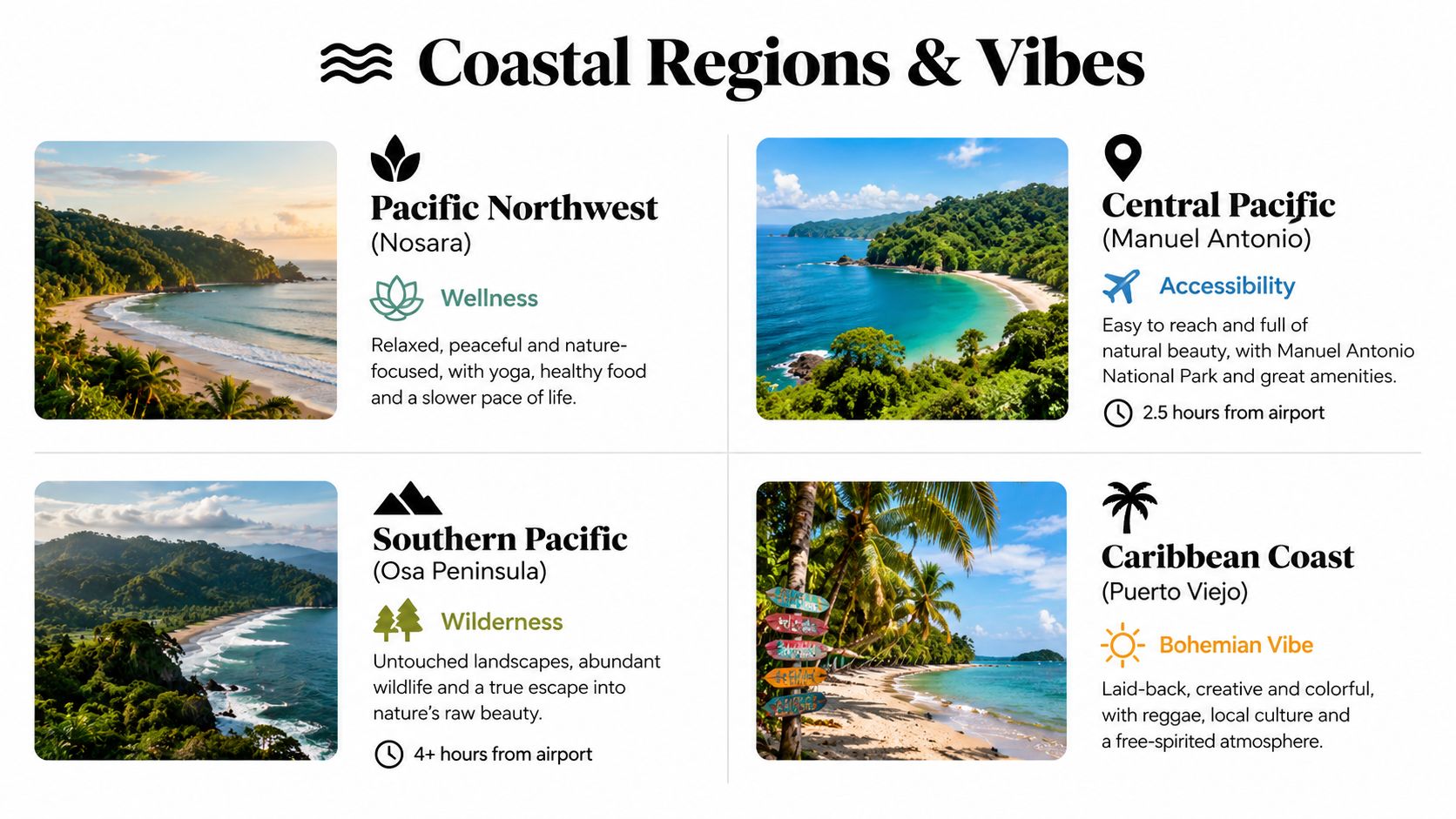
Costa Rica's coasts offer very different trips. The best beachfront villa Costa Rica experience depends less on a national label and more on your airport corridor, road tolerance, climate preference, medical access needs, and desired level of local service.
Pacific Northwest for polished wellness
Guanacaste is the easiest choice for travelers who want dry tropical scenery, established luxury hospitality, and straightforward airport access. Guanacaste Airport handled about 0.90 million air arrivals in 2025, while Juan Santamaría handled about 1.78 million, creating two major arrival corridors for leisure travel, as reported in Costa Rica tourism market data.
This region suits private-air transfers, refined dining, golf, sailing, and wellness programs that need reliable premium suppliers. The trade-off is development. Popular areas can feel more curated and busier, and the most desirable coastal inventory commands serious pricing.
Central and Southern Pacific for nature-led immersion
The Central Pacific offers a practical compromise between accessibility and biodiversity. Manuel Antonio and nearby coastal areas suit families, couples, and small groups who want wildlife, guided nature, restaurants, and a manageable transfer rather than complete isolation.
Further south, Dominical brings a more elemental rhythm. Surf culture, rainforest, dramatic coastline, and a strong independent hospitality scene create better conditions for a founder-led retreat than for a conventional resort itinerary. Dominical travel guidance is useful for travelers comparing this region's character with more developed coastal corridors.
The Osa Peninsula is the choice for wilderness first. Expect greater travel friction, fewer premium vendors, and a retreat experience built around remoteness rather than convenience. That can be powerful for creative recovery, conservation-focused travel, and deep digital disconnection, but it demands realistic planning.
Caribbean coast for texture and informality
Puerto Viejo and the Caribbean coast offer a looser, more bohemian atmosphere, with Afro-Caribbean culture, music, food, cycling, and lush surroundings. It's a stronger fit for travelers who value character over polish and want their stay to feel culturally layered rather than conventionally luxurious.
Before committing, ask whether the local ecosystem can support your format. A retreat requiring specialist chefs, reliable transport, private guides, clinical support, and polished event production may work better in a developed corridor than in a remote enclave.
Navigating Pricing, Seasons, and Booking Logistics
International demand supports Costa Rica's coastal villa market. The country recorded 2,943,991 international arrivals in 2025, including 2,689,278 air arrivals, or about 91.3% of all visitors. North Americans represented 72% of air arrivals, according to reported Costa Rica tourism market figures.
Airport access therefore deserves attention before you choose a property. Guanacaste and the Central Valley corridor serve different coastal markets, and transfer time shapes the first and last day. For a premium stay, arrange private transport, luggage handling, provisioning, and arrival support in advance. These services prevent avoidable friction.
Build the true total cost, not just the nightly rate
A credible quote should clarify:
Accommodation: The villa, residence, or estate fee, plus cancellation conditions.
Service: Housekeeping, concierge support, chefs, guides, drivers, and security.
Movement: Airport transfers, boats, private air arrangements, and local transport.
Food and drink: Groceries, chef fees, special diets, wine, cocktails, and provisioning.
Experiences: Surf instruction, canyoning, wildlife tours, spa work, sailing, or wellness practitioners.
Taxes and deposits: What is included, what is refundable, and which services are billed separately.
Costa Rica also suits longer stays. Air travelers remain an average of 13.5 nights and spend $1,591 per person, according to ICT data cited by CINDE's tourism infrastructure overview. The figures do not set a villa budget, but they support planning beyond a rushed stopover. A longer stay gives couples time to recover, families room to settle, and brands space to combine strategy with unstructured connection.
Seasonality changes value. High season generally brings more predictable beach conditions and stronger demand. Green season can provide fuller vegetation, quieter surroundings, and more flexible planning, depending on the region. Use this guide to Costa Rica's green season to compare weather expectations, access, and atmosphere.
Book the property and key suppliers together. A beautiful villa with weak transfers, unreliable water, or no serious dining plan is an expensive backdrop, not a premium stay.
Standard Luxury Villas Versus Boutique Regenerative Retreats
A large luxury rental can give you space, a pool, staff, and an impressive setting. That's enough for some groups. It's less effective when the purpose of the trip is relationship repair, creative renewal, team cohesion, or a meaningful celebration.
The standard mega-villa model often separates luxury from context. Guests receive polished surfaces and a familiar amenity package, but the experience may remain transactional. Staff can rotate, meals can feel interchangeable, and the property may have little relationship with the nearby community or natural surroundings.
A boutique regenerative retreat starts with a different premise. The property becomes a social and ecological environment, not merely a container for bedrooms. A practical explanation of regenerative tourism helps distinguish genuine community and conservation work from sustainability language used as decoration.
Compare the experience, not the square footage
Decision factor | Standard luxury villa | Boutique regenerative retreat |
|---|---|---|
Atmosphere | Private and amenity-led | Designed around connection and place |
Group format | Often optimized for larger occupancy | More intimate, with deliberate social space |
Service | Defined by a standard package | Adapted to guest rhythms and purpose |
Community link | May be limited or unclear | Should be explained through specific local relationships |
Environmental role | Often focused on property maintenance | Can include conservation, fair employment, and community investment |
Best fit | Privacy, entertaining, and convenience | Retreats, milestone gatherings, wellness, and meaningful collaboration |
VIVARA, an intimate founder-led property in Dominical, accommodates up to 14 guests across architecturally distinct villas. Its model combines personalized service, locally connected dining, activities, and stated support for lifeguard training, living wages, rescued animals, and turtle conservation.
The point isn't that every traveler needs a regenerative retreat. It's that affluent guests should decide what they're buying. If the trip is primarily about sleeping near the ocean, a conventional rental may be sufficient. If it's about changing pace, strengthening a relationship, building a community, or helping a team think differently, experience design matters more than excess space.
Costa Rica's tourism sector accounts for 8.2% of GDP and 21.3% of the workforce, including direct and indirect jobs, according to reporting on tourism and conservation in Costa Rica. Hospitality choices therefore affect local livelihoods as well as guest comfort.
Curating the Experience, Wellness, Dining, and Adventure
A villa doesn't create restoration by itself. Guests need a rhythm that alternates stimulation with recovery, and that rhythm should reflect the group rather than a preloaded activity list.
Costa Rica's national tourism guidance gives retreat planners a practical wellness menu. It includes low-difficulty trekking, forest bathing, earthing, healthy local food, spa-plus-lunch experiences, volcanic-mud body wraps, hydrotherapy, and hot springs, as outlined by the Costa Rica Tourism Board's wellness guide.
Build days with contrast
A strong day might begin, with movement, breathwork, or time outside before breakfast. The middle can hold a demanding activity such as canyoning, surfing, zip lining, horseback riding, or a wildlife excursion. Late afternoon should become less scheduled, with massage, a swim, a nap, or a walk before dinner.
Couples often need less programming than they think. Two carefully chosen excursions, private dining, and long intervals without an appointment can produce more connection than a packed itinerary. Families benefit from alternating shared adventures with contained downtime, especially when children and older relatives have different energy levels.
Dining should follow the same logic. Standard catering fills a table, but a thoughtful culinary team asks about allergies, preferences, training load, sleep, alcohol, timing, and appetite. Farm-fresh ingredients, ocean-caught seafood, and locally sourced produce can support a sense of place while allowing meals to fit the day's physical demands.
For brands, food is part of community design. A shared breakfast can create informal conversation, while a long dinner can help participants move from professional roles into more honest relationships. The culinary experience should feel local and personal, not like a resort menu transported to a villa.
The most restorative itinerary usually leaves enough room for the unexpected.
Private air charters, sunset cruises, spa treatments, and specialist guides can enrich a stay, but only when they serve a clear purpose. Don't add adventure to signal luxury. Add it because the group wants challenge, discovery, play, or a memorable shared story.
Designing Your Itinerary for Specific Group Dynamics
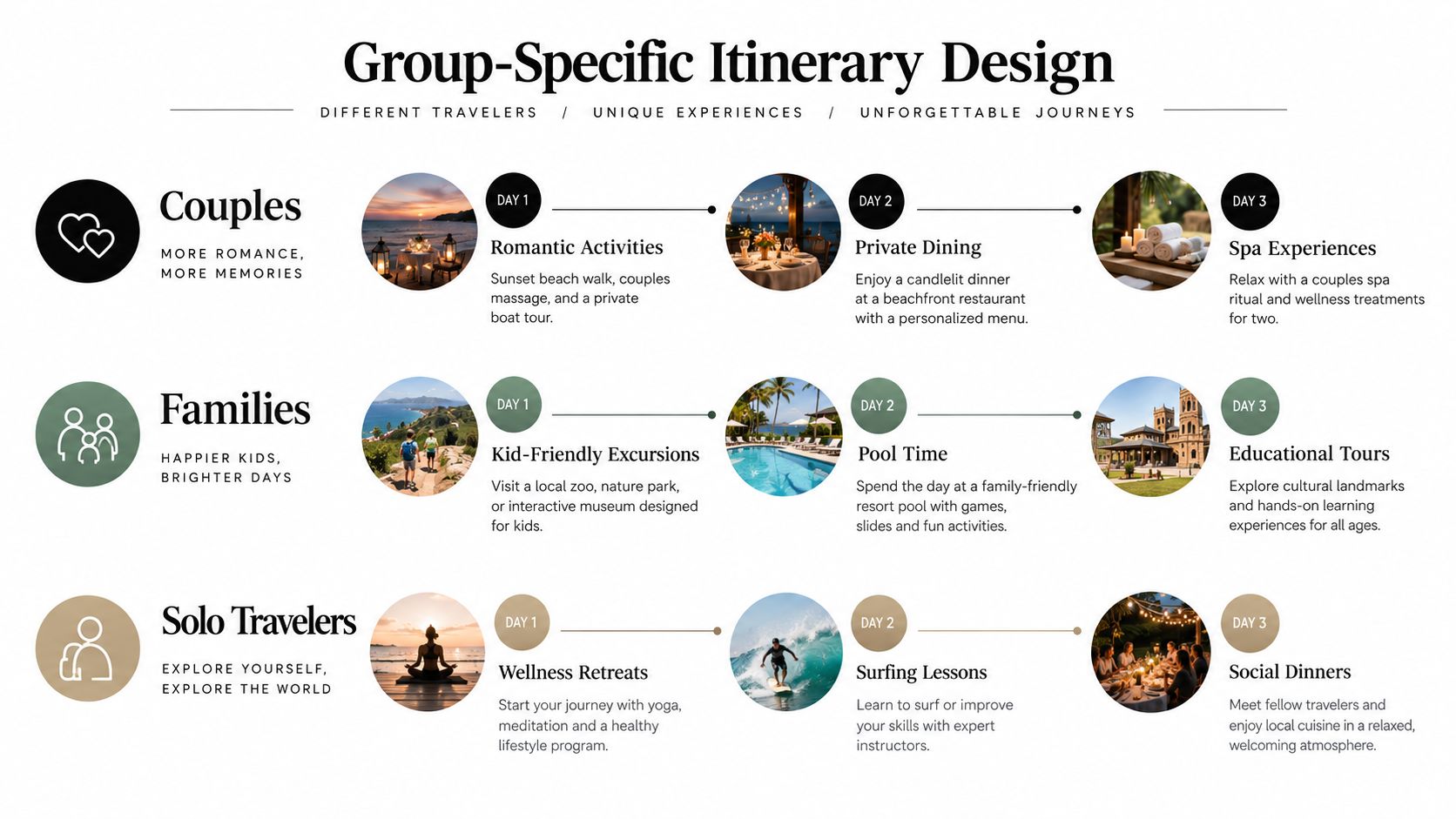
The same coastal property can produce completely different results depending on who occupies it. A couple needs privacy and ease. A multi-generational family needs varied energy levels and dependable logistics. A brand needs a setting that turns proximity into trust and participation.
Couples seeking a relational reset
Use a gentle three-part structure:
Arrival day: Keep transfers private, settle in without a formal agenda, and arrange an easy dinner at the property.
Connection day: Choose one shared experience, such as a private boat outing, horseback ride, or guided nature walk, then protect the evening from additional commitments.
Integration day: Start with wellness or quiet time, enjoy a slow meal, and leave the afternoon open for conversation, reading, or the beach.
The mistake is overprogramming. Couples usually value frictionless transitions, private dining, and enough unscripted time to feel present again.
Families across generations
Design around shared milestones rather than constant togetherness:
Morning: A safe, age-appropriate nature activity or cultural visit.
Midday: Pool time, lunch, and separate rest options.
Afternoon: A shorter shared activity, such as a beach walk, easy wildlife outing, or cooking experience.
Evening: Early dinner for younger travelers, followed by flexible adult time.
Confirm medical access, vehicle suitability, shade, swimming conditions, food requirements, and sleeping arrangements before paying a deposit. A luxury family villa should reduce coordination work, not transfer it to the eldest traveler.
Brands, entrepreneurs, and community builders
A brand retreat needs a deliberate arc:
Arrival: Establish shared context without forcing immediate performance.
Working sessions: Use the property's common spaces for focused collaboration, with outdoor breaks to prevent meeting fatigue.
Community experiences: Create moments where founders, customers, creators, or team members interact without a sales script.
Integration: End with commitments, content capture where appropriate, and a clear path for continuing the relationship at home.
A physical retreat can become a community epicenter when the host designs participation rather than just renting rooms. That matters for brands building loyalty, launching a membership community, or bringing customers into a more human relationship with the company.
The strongest group itineraries share one principle: schedule the experiences that create the intended outcome, then leave space for people to respond naturally.
Final Evaluation and Securing Your Stay
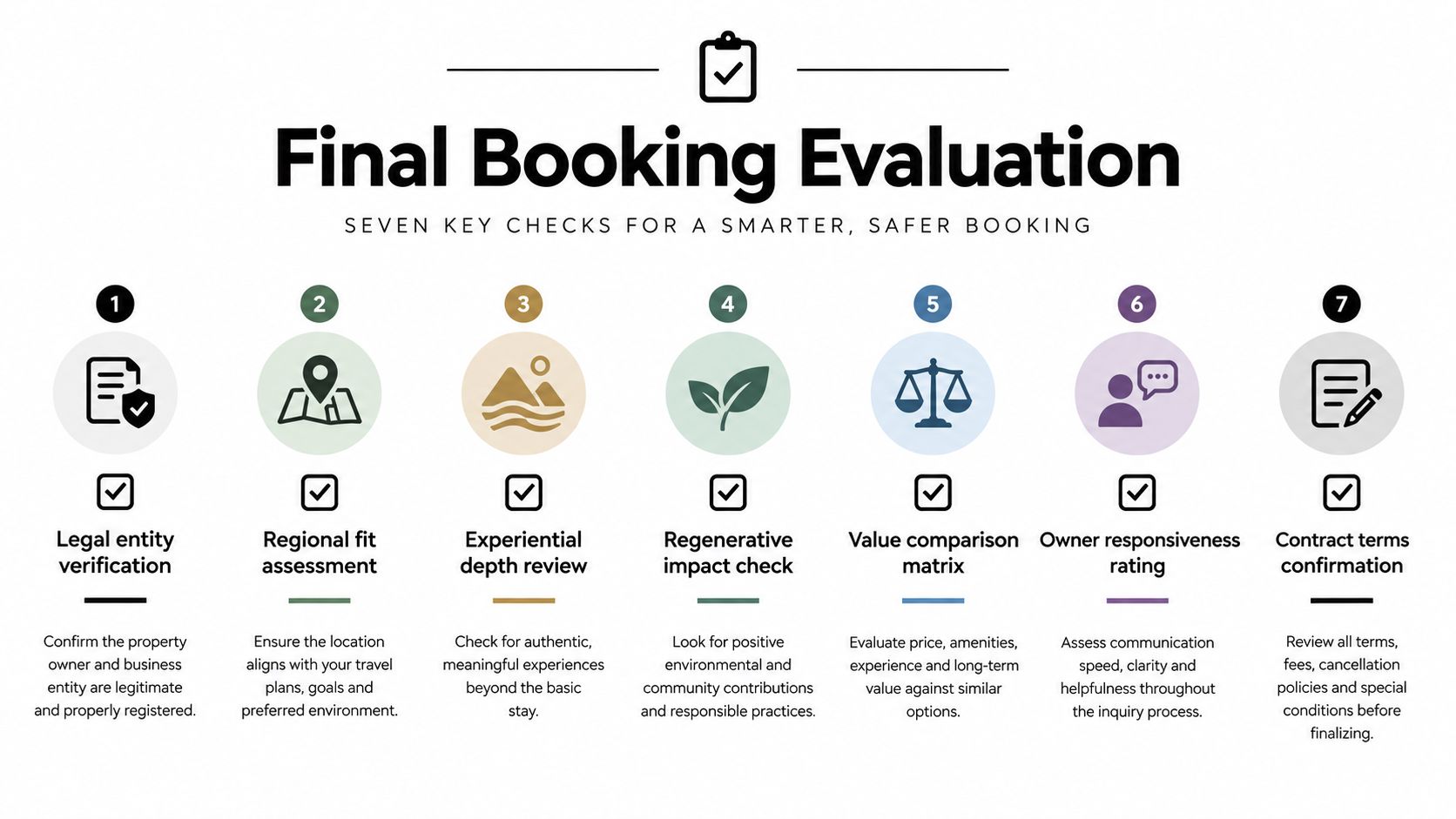
Before booking, score each property against four priorities: legal security, regional fit, experiential depth, and regenerative impact. A photogenic terrace should never compensate for unclear access, fragile infrastructure, poor communication, or a vague community story.
Use this final evaluation:
Legal entity verification: Confirm who operates the property and who signs the contract.
Regional fit assessment: Match the airport, transfer, climate, medical access, and local services to your group.
Experiential depth review: Ask who designs the meals, guides, wellness sessions, transport, and downtime.
Regenerative impact check: Request specific information about conservation, local hiring, wages, and community relationships.
Value comparison matrix: Compare the complete stay, not only the accommodation rate.
Owner responsiveness rating: Notice how quickly and precisely the team answers difficult questions.
Contract terms confirmation: Review deposits, cancellations, inclusions, liability, damage terms, and service changes.
Ask about water security, drainage, backup systems, staff retention, beach access, and the property's response to changing coastal conditions. These questions aren't a mood-killer. They're how you protect the mood you came to experience.
The best coastal stay may not be the villa that claims absolute beachfront ownership or offers the largest footprint. It's the property with transparent rights, a resilient setting, thoughtful hosts, local depth, and a clear ability to help your group rest, connect, celebrate, or create.
VIVARA offers an intimate, founder-led coastal retreat in Dominical for couples, families, private gatherings, and brand communities, with architecturally distinct villas, experiences, and dining shaped around each group's rhythm. Visit VIVARA to compare a purpose-designed retreat experience with a generic beachfront rental and begin planning a stay with genuine human and environmental connection.

