The Vivara Content Team
Family Reunion Resort Planning Guide for a Costa Rica
Family Reunion Resort Planning Guide for a Costa Rica

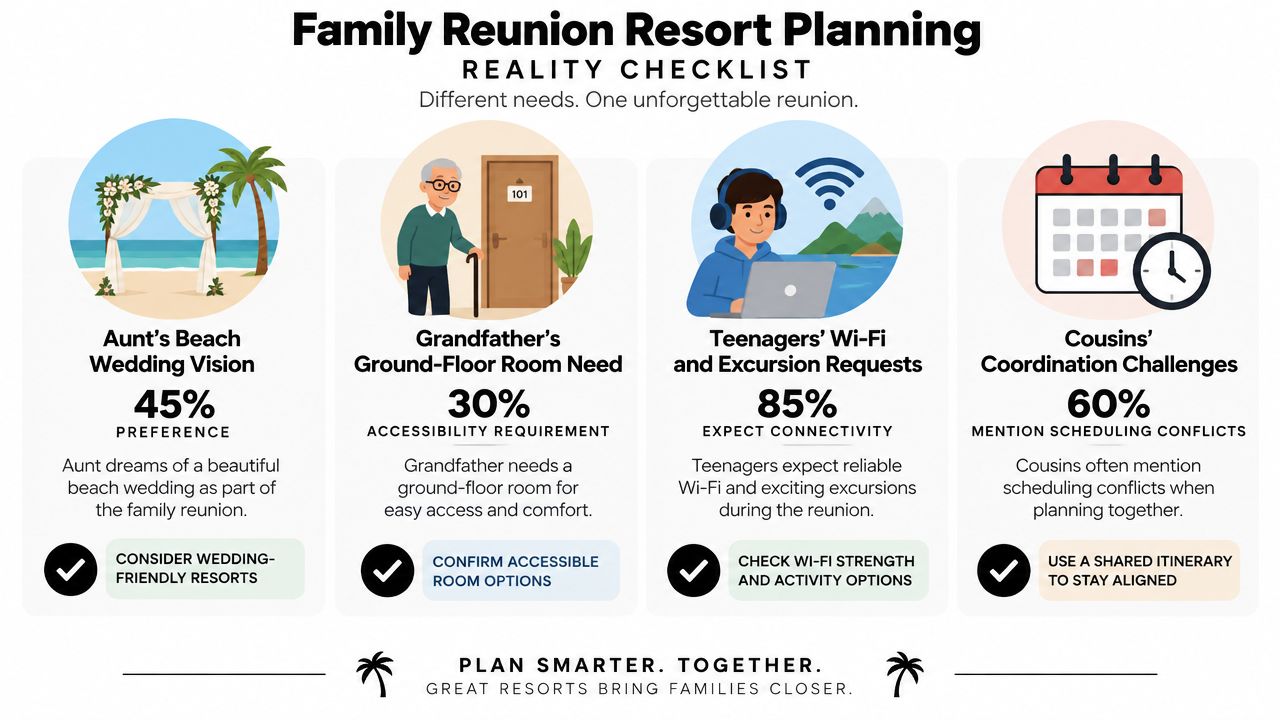
You're probably trying to solve three incompatible requests at once. One relative wants a relaxed beach celebration, a grandparent needs easy access to every shared space, teenagers want reliable Wi-Fi and real excursions, and the planning group wants everyone to stop asking who's booking what. A family reunion resort can remove much of that friction, but only if the format matches the family.
Costa Rica adds a useful dimension. A well-designed stay can combine private gathering space, chef-led meals, rainforest and ocean experiences, wellness, and local culture without forcing every generation into the same schedule. The decision isn't which property looks beautiful. It's whether you should book a resort block, rent a large home, or control the entire estate.
When a Family Reunion Resort Is the Right Format
A family reunion resort makes sense when coordination has become harder than the travel itself. You're managing room types, meal preferences, mobility needs, children's routines, transportation, and a growing list of activities. Keeping everyone on one property can turn those moving parts into one operating plan, but it won't fix a poor fit or an inflexible venue.
Three signals point toward a resort-style format:
The group is larger than 20. A resort block can absorb different arrival dates, room preferences, and household budgets without forcing every family branch into one shared floor plan.
Mobility needs vary. Ground-floor rooms, walk-in showers, short routes to dining, and staff support matter more than a photogenic infinity pool.
You want structured activities without hosting every meal. A resort or staffed estate can handle food service, scheduling, and equipment while the family focuses on being together.
A smaller rental or destination home is often better when the group is compact, comfortable sharing common areas, and happy to cook or hire support independently. It also suits families who want a private house rather than organized programming, especially when everyone has similar mobility needs and the itinerary is intentionally loose.
The commercial case for this format is substantial. One industry summary reports more than 300,000 family reunions annually in the United States, with about 50% of families gathering every year and roughly 66% of reunion groups containing 31 to 100 people. The same summary says 64% plan to use hotel, resort, or similar accommodations for their next reunion, making resort lodging a mainstream choice for family gatherings, not a niche solution. Industry reunion planning data
My advice is simple: choose the format first, then the property, then the programming. Starting with a venue photograph is how families end up trying to force three generations into a plan that was never designed for them.
Resort vs Villa vs Full-Estate Buyout Compared
The three options solve different problems. A resort block maximizes infrastructure, a large vacation rental maximizes domestic privacy and kitchen access, and a full-estate buyout maximizes control. None wins every category.
Criterion | Resort Block | Large Vacation Rental | Full-Estate Buyout |
|---|---|---|---|
Privacy | Moderate, with shared public areas | High within the rented home | Very high, with one group on the property |
Cost sharing | Straightforward by room or household | Shared costs can be efficient, but uneven usage creates tension | One invoice simplifies group accounting |
Accessibility | Usually strongest for elevators, medical access, and room variety | Must be inspected carefully | Can be excellent if confirmed before booking |
Activity flexibility | Built-in programs, kids' clubs, and equipment | Family organizes everything | Staff can curate a private mix |
Dining logistics | Restaurants and banquet service are convenient | Kitchen costs can be shared, but cooking becomes someone's job | One kitchen and operations team centralize meals |
Staff support | Broad operational infrastructure | Often limited or outsourced | Dedicated support can be arranged around the group |
Social atmosphere | More public and less intimate | Private, but the group must generate its own energy | Private and naturally communal |
Hotels win when children need built-in programming, older guests need easy access to medical services, or households want independent accommodation. They also make sense when the invitation list is fluid and not everyone will arrive or depart together.
Large villas win when the group values a shared kitchen, flexible meal timing, and a domestic rhythm. The trade-off is invisible labor. Someone still has to arrange groceries, coordinate chefs, manage dishes, and decide what happens when half the family wants an excursion and the rest wants lunch.
A full-estate buyout is my preferred format for a smaller but complex multigenerational group. You avoid lobby traffic, keep the family's social life in one setting, and can design meals and activities around actual energy levels. The model is particularly strong for wellness retreats, milestone celebrations, and families that want privacy without giving up hospitality. A practical example of this private format appears in this guide to private villa buyouts in Costa Rica.
My decision rule: If the family needs different rooms but one shared rhythm, book a resort block. If it needs one private rhythm and dedicated support, buy out the estate.
Use a hybrid when the core group needs privacy but the wider invitation list is too large or unpredictable. A private estate can host the central family program, while a nearby hotel block gives overflow guests their own rooms and keeps the main property from becoming overcrowded. That arrangement often beats compromising the entire experience for relatives who may only attend part of the week.
Building Your 9 to 12 Month Planning Timeline
Late booking causes predictable damage. Popular venues sell out, save-the-dates reach people after vacation calendars are fixed, and the person who volunteered to organize dinner suddenly owns transportation, dietary requests, and everyone's payment questions.
For a reunion with lodging, start 9 to 12 months ahead. The planning model below keeps decisions visible and distributes responsibility instead of leaving one capable relative to become an unpaid event manager.
Window one from 12 to 9 months
Form a committee of 3 to 5 people, ideally with one representative from each family branch. Give every person a defined role:
Lead planner: Owns the master calendar and venue communication.
Treasurer: Builds the budget, tracks deposits, and records household balances.
Accessibility lead: Collects mobility, medical, and room requirements.
Activities lead: Designs optional excursions and age-appropriate programming.
Communications lead: Manages invitations, RSVPs, and updates.
Research the destination, identify the preferred travel season, and create a short list of properties. Don't ask the committee to make every decision together. Assign research, set a decision date, and require written recommendations.
Window two from 9 to 6 months
Build the budget from lodging, meals, venue fees, activities, and supplies, then divide shared costs by household and discount children where appropriate. This method exposes the price before the family commits to a package that looks attractive but excludes the experiences everyone expects.
Send the save-the-date once the destination and approximate dates are credible. The planning guidance for family reunions recommends this early runway and a per-person budget structure because they reduce both underspending at the start and uneven expectations later. Family reunion planning guidance
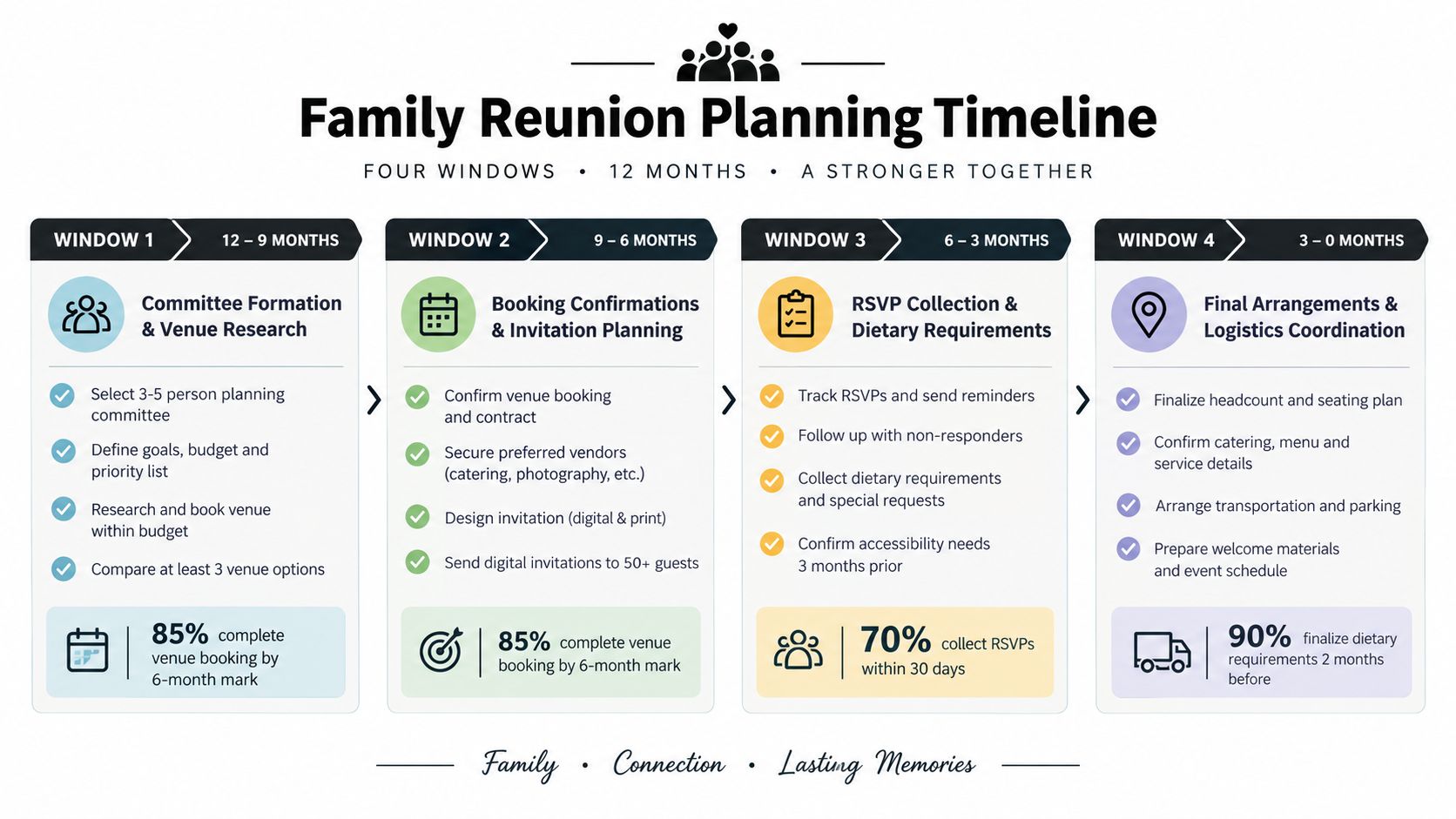
Window three from 6 to 3 months
Lock the venue, collect deposits, and circulate a survey covering dietary restrictions, mobility, room preferences, children's ages, and preferred activity intensity. Book high-demand excursions only after you have a credible attendance range.
Forecasting attendance requires discipline. One event guide recommends assuming 50% to 70% of invitees will express interest, then expecting 60% to 80% of those interested to attend, creating a likely final range of 30% to 56% of the full invite list. Attendance forecasting guidance
For destination planning, document responsibilities in writing and use a specialized special event coordination resource when the gathering includes formal meals, ceremonies, or complex vendor requirements.
Window four from 3 months to arrival
Finalize rooming lists, transfers, staffing, printed or shared digital itineraries, dietary confirmations, and the weather backup plan. Share the final headcount with the property before its deadline, then keep a contingency fund for changes that no spreadsheet can predict.
The two common failures are committee burnout around the middle of the process and budget overruns caused by unbundled activities. Clear roles prevent the first. A complete per-person budget, with every optional excursion labeled before deposits are due, prevents the second.
Accessibility and Guest Logistics for Three Generations
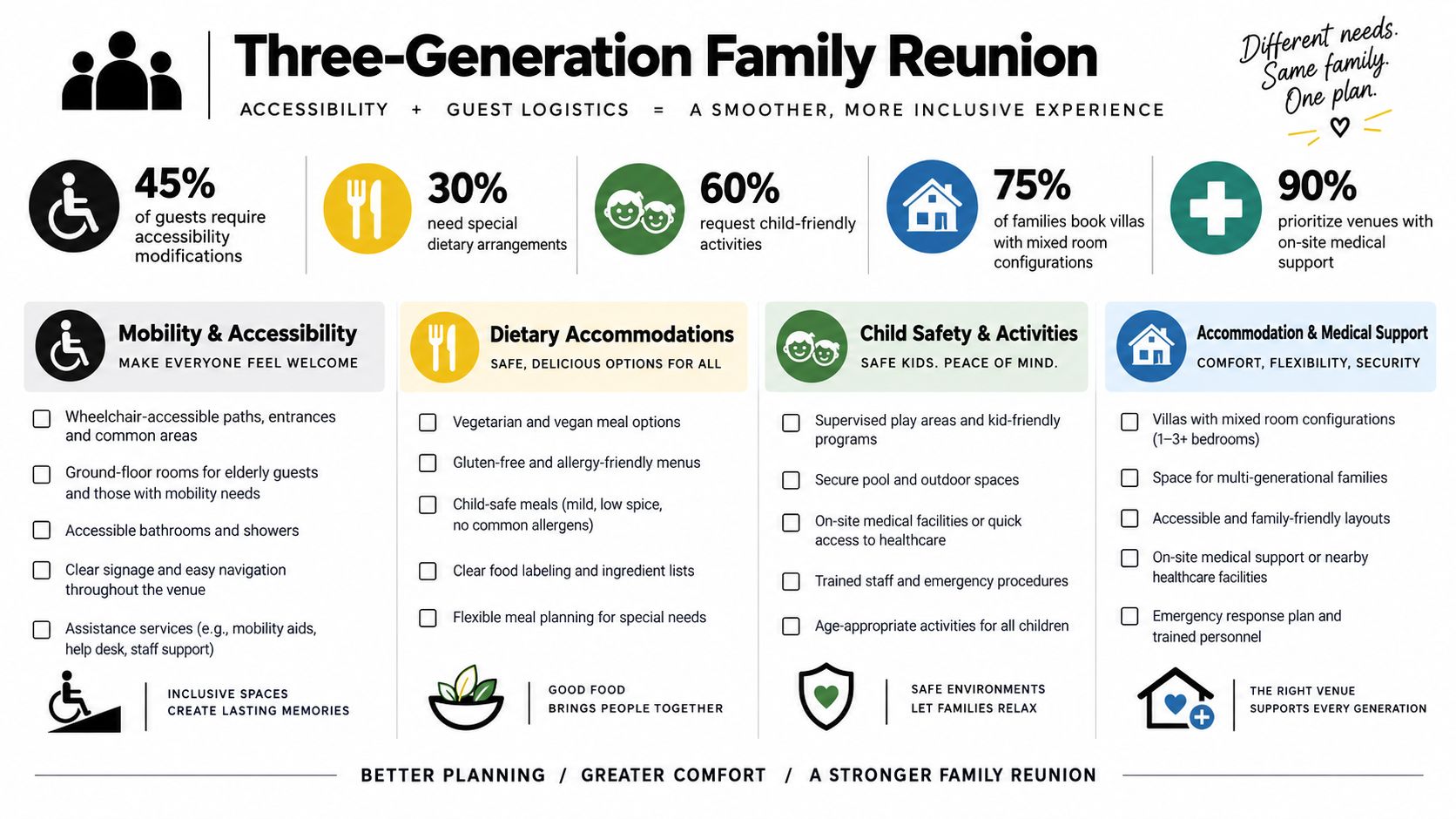
Accessibility, dietary planning, and child safety belong on the same checklist. Each one affects the room mix, the property layout, meal service, staffing, and the distance between private rooms and shared spaces.
Start with the route a grandparent will use. Check whether the bedroom, dining area, pool, and main gathering space connect with minimal stairs. Ask for ground-floor suites near the social center, walk-in showers, stable paths, seating at regular intervals, and realistic transfer times. In the Guanacaste or Nicoya region, confirm proximity to medical services rather than relying on a general statement that the property can assist.
Dietary questions need operational answers. Ask whether a private chef or hotel kitchen can handle gluten-free, kosher, halal, diabetic-friendly, and allergen-segregated preparation. Find out whether separate utensils, surfaces, storage, and service procedures are available. Collect preferences in one shared sheet, but keep medical details limited to the people who need them.
Written confirmation matters: A sales promise is not an operating plan. Ask the property's operations lead to confirm each requirement before you pay a deposit.
Children create a second layer of logistics. Check pool fencing, outlet covers, blackout curtains for nap schedules, shaded rest areas, and supervised zones. If you need nannies or sit-down meal shifts, confirm whether the estate or resort can provide vetted staff and how those services are supervised.
The trip-length decision also deserves more attention than it usually receives. One recent survey summary identifies 6 to 9 days as the preferred balance for 38.2% of intergenerational travelers, while 34.9% prefer 4 to 5 days. The same research emphasizes accessibility and reduced planning stress as major decision factors. Multigenerational travel guidance
Adopt one committee rule by month four: every accessibility, dietary, and safety request must be confirmed in writing by the property's operations lead, not only the sales contact, before the deposit goes in. That single habit prevents many expensive surprises.
Programming a Day That Works for Everyone
The best multigenerational day has two fixed points, meals and sunset. Everything between them should flex by age, energy, and interest.
At 7 a.m., early risers and grandparents can join a gentle bird-watching walk while younger children take part in a supervised tide-pool explorer session. Nobody needs to attend both, and nobody is treated as difficult for sleeping later.
Mid-morning splits into parallel tracks. One group moves into yoga, a sound bath, or a beachfront massage. Teenagers head to surf lessons or a zip-line course, while younger children rotate through a staffed nature lab. The point isn't to maximize activities. It's to give each generation something credible to look forward to without turning the reunion into a military schedule.
Lunch reunites the property. Use one long communal table with no assigned seating and three dietary stations, so the family shares a central moment without making every guest negotiate the same menu.
The afternoon should get quieter. Some guests can take a catamaran, horseback ride, or coffee-farm visit, while others use the pool, read in a hammock, or nap. In Costa Rica, private-guided family itineraries commonly combine rainforest canals, volcanic trails, chocolate tastings, sloth encounters, hot springs, rafting, canopy tours, zip lines, horseback riding, and volcano treks, which gives planners a broad activity palette without making every guest follow one route. Costa Rica family adventure itinerary examples
At sunset, everyone comes back for a toast, family slideshow, or local cooking class. That shared ritual does more for connection than filling every hour with entertainment.
The same design works for a brand or community gathering. A company building a loyal consumer community can use shared meals, optional adventure, and a local experience to create relationships that a conference room rarely produces. The host's job is to protect the meeting points and let the spaces between them breathe.
Sustainability and Charitable Touches That Add Meaning
Sustainability works best when guests can participate without adding another obligation to the committee. Costa Rica gives families practical ways to connect celebration with place, including wildlife rescue, sea turtle conservation, reforestation, and local food systems.
A per-family donation to a local wildlife rescue or sea turtle project can replace disposable welcome favors. A half-day reforestation outing can put grandparents and children on the same team, while a closing-night fund can let guests match part of the bar tab toward a chosen community cause.
Add-On | Planning Effort | Best Timing in Week | Generation Most Engaged |
|---|---|---|---|
Wildlife rescue donation | Low | Arrival or welcome dinner | All ages |
Sea turtle project contribution | Low | Closing dinner | Children and teenagers |
Reforestation outing | Moderate | Midweek morning | Grandparents, parents, and children |
Local cooking activity | Moderate | Shared afternoon | All ages |
Community fund | Low | Final-night toast | Adults and teenagers |
Vet every partner. Ask for relevant certifications, transparent reporting, a clear description of how funds are used, and evidence that the resort or estate has an existing relationship rather than a one-off transaction. A polished sustainability story without operational detail isn't enough.
A full-estate buyout makes this layer easier to manage because one kitchen and one operations lead can control sourcing, waste, meal service, and participation. A hotel block distributes those decisions across restaurants, departments, and vendors, which can make group-wide standards harder to enforce.
For families and brands, the value extends beyond the activity itself. A reunion becomes a story younger relatives can carry forward, and a brand retreat gains a credible community dimension when the contribution is specific, locally rooted, and transparent. The regenerative tourism framework offers useful language for evaluating whether a program creates local value rather than just reducing harm.
Sample Itineraries and the Next Decision to Make
A five-day reunion works well for a milestone celebration when guests want a concentrated experience without committing to a full week. Keep the first day light, place the main excursion before the celebration, and protect departure morning from ambitious plans.
A seven-night buyout gives three generations more room to alternate intensity. The family can include high-energy mornings, low-stimulation afternoons, a heritage-night conversation, and a community-service activity without making every day feel like an organized tour.
Day | 5-Day Milestone Reunion | 7-Night Multigen Buyout |
|---|---|---|
1 | Arrivals, settle-in time, welcome meal | Arrivals, villa orientation, relaxed dinner |
2 | Half-day jungle excursion, quiet afternoon | Surf lessons or waterfall hike, pool and wellness afternoon |
3 | Private lunches, optional wellness, free exploration | Slow morning, family history circle, flexible local activity |
4 | Sunset celebration dinner | Adventure morning, hammock or pool time, chef-led dinner |
5 | Slow breakfast and departure buffer | Community-service morning with a Costa Rican partner, unstructured afternoon |
6 | Not applicable | Catamaran, horseback ride, or coffee experience for interested guests |
7 | Not applicable | Heritage or cooking night, family toast, shared photographs |
8 | Not applicable | Slow breakfast, departures, and transfer buffer |
The five-day version suits an anniversary or milestone birthday crowd. Guests arrive, settle in, take one meaningful jungle excursion, keep a day open for private lunches or rest, and gather for a sunset celebration dinner before leaving slowly the next morning.
The seven-night version gives younger travelers room for surf lessons and waterfall hikes while elders have legitimate alternatives, not an afterthought called “free time.” A family history circle can give the reunion emotional shape, and a sea turtle patrol or similar community activity can connect the group to Costa Rica without turning the trip into a lecture.
Premium Costa Rica travel is structured enough that you should request a transparent proposal rather than rely on vague package language. Published luxury family itineraries commonly run 8 to 9 days from about US$3,272 to US$3,280 per person, while another 8-day luxury escape lists US$6,555 at regular price and up to US$8,986 depending on package details. Costa Rica luxury travel pricing examples Treat those figures as market examples, not a quote for your reunion. Ask what lodging, meals, transfers, guides, activities, taxes, and staffing are specifically included.
The highest question before booking is whether the host property can flex dining times, reserve dedicated staff, and adjust activity intensity by generation. No itinerary survives day two if the kitchen can't move dinner, the grandparents can't reach the main table, or the children's schedule has nowhere to go.
Demand supports that flexibility. A recent market report projects the global multigenerational luxury family travel market from $96.4 billion in 2025 to $212.3 billion by 2034, at a projected 9.2% compound annual growth rate, with resort and villa stays holding 44.8% of trip-type share. The report also estimates milestone-driven reunion travelers at 19.1% of the market. Multigenerational luxury family travel market outlook That growth won't make a poorly coordinated reunion feel personal. It makes careful format selection more important.
VIVARA offers a private full-estate buyout in Dominical, Costa Rica, for intimate family gatherings, with chef-led flexible dining, personalized planning, and nature-based activities suited to different generations. Visit VIVARA to compare a private reunion format with a conventional family reunion resort and decide which setting fits your group.

