The Vivara Content Team
Biodiversity Protection: A Traveler's Guide
Biodiversity Protection: A Traveler's Guide

You're standing on a darkening beach near Dominical, watching a sea turtle's nest stir beneath the sand. The moment feels private, almost timeless, yet it depends on choices made long before you arrived: whether the coast remains undeveloped, whether lights are controlled, whether local conservation teams have the resources to protect nesting habitat, and whether visitors support the people doing that work.
That's the practical meaning of biodiversity protection for a traveler. The rainforest, beaches, wildlife, food, and ocean experiences that make Costa Rica compelling aren't guaranteed. Your itinerary can place pressure on fragile ecosystems, or it can help finance the local stewardship that keeps them healthy. The most useful question isn't whether a retreat uses the word “sustainable.” It's whether your stay supports specific, visible outcomes.
Why Biodiversity Protection Matters to Your Costa Rica Trip
A coastal retreat can feel separate from conservation. You arrive for rest, adventure, a wellness reset, or time with people you care about. Then a guided walk reveals a sloth in the canopy, a scarlet macaw crosses the sky, or turtle tracks appear along the beach, and the connection becomes obvious. These experiences rely on functioning ecosystems, not scenery arranged for visitors.
Costa Rica's natural appeal comes from several systems working together. Forests provide habitat, rivers connect regions, wetlands filter water, and coastal environments support marine life. When one part weakens, travelers may notice fewer wildlife encounters, degraded views, less reliable outdoor activities, or heavier pressure on the places that remain accessible.
The traveler's real influence
Travel doesn't automatically protect nature. A large group can crowd a nesting beach, poorly managed lighting can disorient hatchlings, and careless food or waste practices can attract wildlife into unsafe contact with people. On the other hand, a carefully designed stay can direct money toward local employment, habitat care, wildlife rescue, and conservation education.
That distinction matters for affluent travelers because premium spending creates opportunity. A boutique retreat, private villa booking, wellness gathering, or full-estate event can support a local economy without treating nature as an unlimited resource. The value comes from curated access with accountable stewardship, not from consuming more of the natural environment.
Practical rule: Judge a nature-based experience by what it protects, who manages that work, and how your payment contributes.
What this guide will help you decide
You'll learn how biodiversity protection works from the global policy level down to a Costa Rican beach or rainforest trail. You'll also see why protected acreage alone doesn't guarantee effective conservation, how pollinator decline affects food systems, and what questions to ask before booking a retreat.
For couples, families, friends, corporate groups, and wellness leaders, the decision is concrete. Choose a property with a small enough footprint, locally rooted operations, meaningful community relationships, and a clear explanation of where guest revenue goes. A regenerative stay can still include whale watching, canyoning, horseback riding, surfing, rainforest hikes, or quiet time by the ocean. The difference lies in how those experiences are designed and funded.
What Biodiversity Protection Really Means
A Costa Rican retreat may seem to begin with a room, a meal, or a guided excursion. Its real setting is a living system. Biodiversity has three connected layers: genetic diversity, the different traits within a species; species diversity, the range of plants, animals, fungi, and microorganisms; and ecosystem diversity, the forests, rivers, wetlands, beaches, reefs, and other environments where life interacts.
Healthy ecosystems function like biological infrastructure. Roads move people, power grids move energy, and communications networks move information. Ecosystems move water, nutrients, seeds, carbon, and living organisms through an environment. They can regenerate when people protect those relationships and reduce the pressures that disrupt them.
Three responsibilities define meaningful protection
The Convention on Biological Diversity offers a practical framework for judging conservation work:
Conserve what exists. Protect intact forests, nesting beaches, wetlands, wildlife corridors, and marine habitat before damage becomes difficult to reverse.
Use biological resources sustainably. Let people benefit from nature without exhausting the systems that provide those benefits. A managed rainforest zip-line or guided hike can follow this principle when operators control visitor pressure and protect habitat.
Share benefits fairly. Communities and Indigenous peoples who hold knowledge, manage land, or protect resources should receive recognition and a fair share of the value created.
Costa Rica's Biodiversity Law No. 7788, enacted in 1998, reflects these objectives. It created a participatory governance framework that recognizes and compensates Indigenous and local community knowledge and practices, as described in this overview of Costa Rica's Biodiversity Law.
A community-run wildlife refuge makes benefit-sharing easier to see than a general “eco” label. Visitors pay for an experience, local guides earn income, and the community has a practical reason to maintain habitat and protect wildlife. The arrangement has substance when an operator can explain that connection.
How to recognize substance
Ask what the property protects, what it funds, and how it measures progress. “We love nature” expresses an attitude. “Guest revenue supports turtle conservation, local wages, or trained lifeguards” identifies a mechanism. For a retreat planner, that difference helps connect a booking decision with work that guests can understand and assess.
Food choices also create a connection between travel spending and local livelihoods. A retreat that sources farm-fresh ingredients, ocean-caught food, and responsibly gathered local products may keep more value within the community, provided sourcing remains transparent and ecologically responsible.
This short video offers another accessible way to understand the relationships among species, habitat, and human wellbeing.
The Main Threats and the Numbers Behind Them
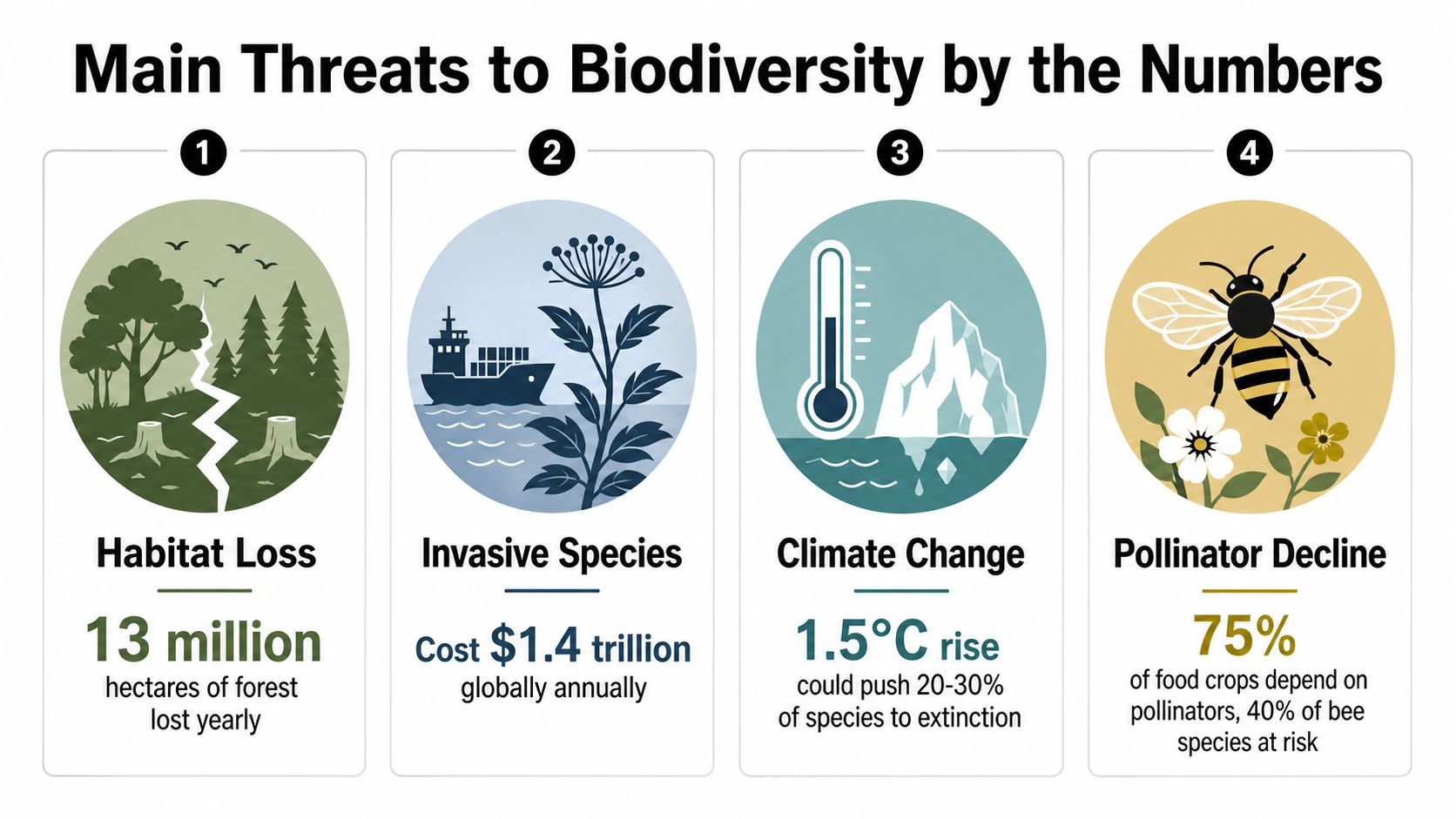
A retreat can sit beside a forest that looks intact from the road, while animals encounter a very different reality inside it. Habitat loss removes living space, and fragmentation divides the remaining forest into isolated patches. Smaller patches contain more exposed edges, altered conditions, and fewer routes between feeding, breeding, and shelter areas.
Forest Research recommends a clear order of action: protect high-quality habitat first, restore degraded habitat next, repair destroyed high-value sites after that, improve connections between sites, and create new habitat only afterward, as explained in its guidance on habitat fragmentation. For retreat planners, the implication is practical. A new garden beside a property cannot compensate for damaging an intact ecosystem.
Pollinators are part of the food system
Pollinators are more than a pleasant feature of a garden. The World Health Organization reports that more than 75% of global food crops rely on pollinators, which contribute an estimated US$235–577 billion annually to global agricultural output, according to the WHO biodiversity fact sheet.
A 2025 European Parliament briefing states that close to 35% of invertebrate pollinators, including bees and butterflies, face extinction globally, as reported in this briefing on pollinator decline. Habitat loss, pesticide misuse, parasites, pathogens, invasive alien species, and climate change place pressure on these species.
Travelers meet this issue at the dining table. A retreat's local food program depends on farms, forests, soil, water, and the relationships that support crops. Pollinator decline can therefore affect crop yields and local supply chains before it becomes a visible wildlife concern.
The wider economic exposure
Forests store 80% of terrestrial biodiversity and absorb about 2.6 billion tonnes of carbon dioxide each year, according to the WHO. The organization also reports that invasive alien species contribute to 60% of species extinctions and cause about US$423 billion in global economic damage annually.
Wetlands show how quickly ecological loss can become an economic issue. 35% have been lost since 1970, while the WHO estimates the global economic impact of biodiversity loss at about US$10 trillion per year. These figures connect protection with travel decisions. A stay can help maintain the ecosystems, food systems, climate resilience, and local livelihoods that make a destination viable, especially when guest revenue supports measurable work such as turtle conservation or lifeguard training.
How Policy Frameworks Shape Protection on the Ground
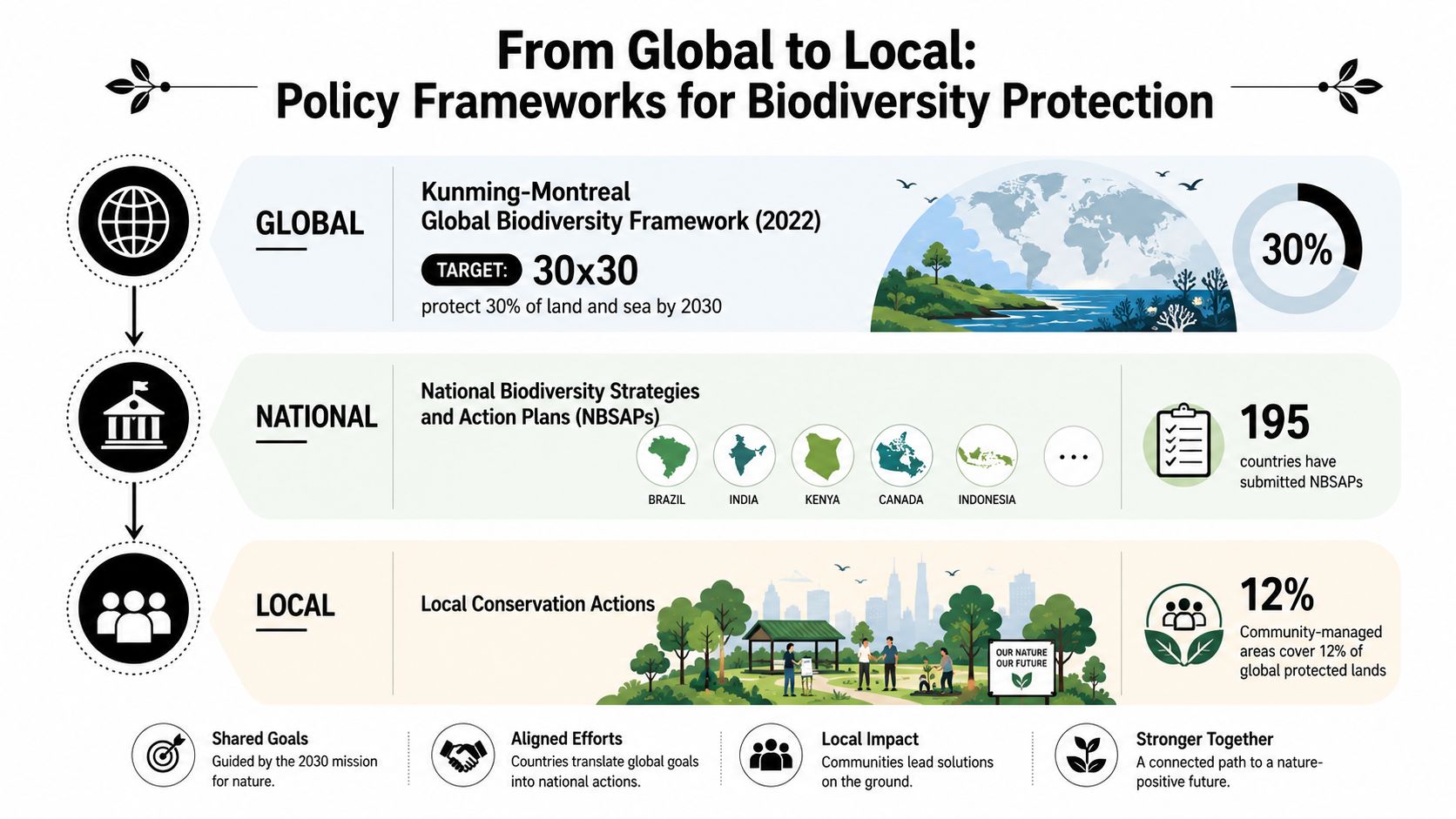
A traveler entering a national park, wildlife refuge, or marine reserve is seeing policy translated into daily work. International agreements establish shared goals, governments turn them into laws and institutions, and local managers apply them through permits, monitoring, restoration, staffing, and community partnerships.
The Kunming-Montreal Global Biodiversity Framework, adopted in December 2022, provides the main international roadmap for the 2020s. Its 23 action-oriented targets for 2030 include the 30 by 30 goal: conserving at least 30% of terrestrial and inland waters and 30% of marine and coastal areas, according to the Convention on Biological Diversity's targets.
From global targets to a Costa Rica itinerary
The framework also calls for restoring at least 30% of degraded ecosystems by 2030. Protection therefore involves more than drawing boundaries. It requires improving damaged habitat and maintaining the people, equipment, permits, and local cooperation that make conservation work.
Travelers do not need to memorize policy language. Park fees, permits, guided visits, and locally operated excursions can connect a trip with public conservation systems. Retreat planners can strengthen that connection by choosing operators that explain where guest revenue goes and what work it supports. One stay might help fund turtle conservation, beach monitoring, or lifeguard training, turning an abstract target into a visible local service.
Costa Rica's national translation
Costa Rica's Biodiversity Law No. 7788, enacted in 1998, applies the Convention on Biological Diversity's three core objectives: conserving biodiversity, using biological resources sustainably, and sharing benefits from genetic resources fairly. The law also recognizes local and Indigenous knowledge through participatory governance.
Costa Rica has protected roughly 25% to 26.6% of its land area through national parks, reserves, wildlife refuges, and related systems. A recent dataset cites 26.5% terrestrial protected coverage in 2024, while other country profiles place overall coverage around 25% to 26%, as shown in this Costa Rica protected-area data profile. One source reports protected areas covering 30% of Costa Rica's marine areas, reinforcing the country's biodiversity-first identity, as described by FuturePolicy's Costa Rica profile.
That policy history helps explain why a single itinerary can combine forest, coastline, wildlife, and community-based experiences. It also gives planners a practical test: ask how a property supports conservation beyond its legal setting. A locally grounded story of how Costa Rica regrew its forests shows why restoration and land management matter alongside protected status.
Why Acreage Alone Does Not Equal Protection
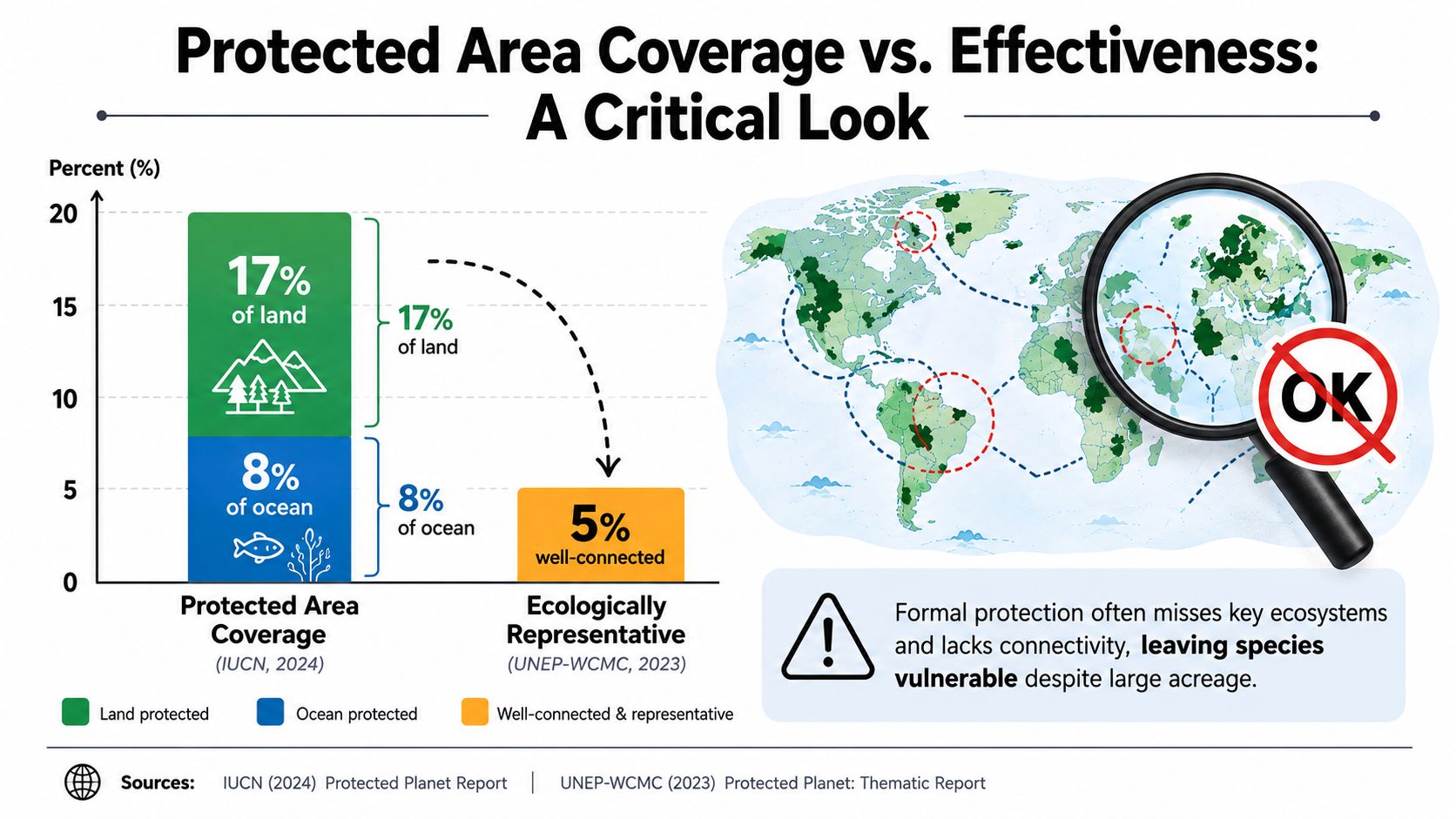
A boundary on a map does not patrol itself. A formally protected area may still lack reliable funding, trained staff, monitoring, maintenance, or enforcement. That gap separates designation from effective protection. For travelers and retreat planners in Costa Rica, the useful question is not only whether a stay sits near a reserve, but whether local systems have the capacity to care for the habitat.
Recent EU data project a biodiversity funding gap of about EUR 21.4 billion per year. Funding is projected to fall from EUR 31.8 billion in 2021 to EUR 28.5 billion by 2027, while estimated annual needs reach about EUR 54 billion, according to this analysis of biodiversity finance and protected-area progress. The Kunming-Montreal framework also set biodiversity-finance targets of at least $20 billion per year for developing countries by 2025 and $30 billion by 2030, showing why protected status must be matched by sustained investment.
The management question
A retreat planner can test the connection between a booking and conservation by asking:
Who manages the surrounding habitat?
Who pays for protection and monitoring?
Does the property employ local people at living wages?
Does it reduce pressure on water, food, energy, and waste systems?
Can the operator describe a conservation outcome connected to a guest stay?
These questions turn an abstract claim into something observable. A single stay might help fund turtle conservation or lifeguard training when the property has a clear local mechanism for directing revenue. Private land, regenerative hospitality, and community-funded programs can complement public conservation. They cannot replace a national park agency, but they can keep habitat intact, support livelihoods, reduce visitor pressure, and fund defined needs.
Connectivity makes the difference
Protected parcels also need ecological connections. A long-term replicated study summarized in this review of wildlife corridor evidence found that connected habitat patches had 14% more species than unconnected patches. Corridors reduced plant extinction risk by about 2% per year and increased patch colonization by about 5% per year.
A green strip is not automatically a functioning corridor. Width, target-species movement patterns, and the permeability of surrounding land all affect results. For a retreat, the practical choices include native planting, dark-sky practices, stream protection, and habitat links designed around local ecology. They should support the species already using the area, rather than serve as decorative additions after construction.
Acreage is an input. Protection is an ongoing service delivered by people, funding, governance, and ecological design.
Regenerative Hospitality in Practice
A useful case study is VIVARA's Dominical estate, designed for up to 14 guests across architecturally distinct villas. Its conservation model begins with a direct mechanism: each villa sponsors a rescued animal. Guest presence also funds lifeguard training, living wages for the local community, and turtle conservation along the coast.
That structure changes the booking conversation. The guest isn't being asked to make a separate donation after purchasing an experience. The stay itself creates the revenue stream that supports named local outcomes. A retreat planner can then evaluate the venue by asking what the guest's money enables, rather than relying on broad claims about being “green.”
Designing the stay around place
The setting matters because the experience is tied to a biodiversity-rich coastal environment. Guests can slow down with wellness practices, shared meals, and restorative time, or shape the itinerary around whale watching, canyoning, zip lining, horseback riding, paragliding, sunset cruises, and other outdoor experiences.
The property serves an intimate group rather than a mass audience. That supports a more personal form of hospitality, where guides and hosts can adapt activities to the group's pace and interests. Couples might prioritize privacy and ocean time. Families and multi-generational groups may want a mix of wildlife, adventure, and easy shared meals. Friends can build a celebration around the full estate, while coaches and brand leaders can create a focused environment for community-building and team connection.
Food is part of the conservation equation. VIVARA's cuisine uses farm-fresh, ocean-caught, and jungle-foraged ingredients, prepared by Michelin-trained culinary leaders without fixed menus. The approach reflects local availability and gives guests a more direct relationship with Costa Rican producers and ecosystems. For a closer look at the model, read this guide to farm-to-table dining.
Why brands should pay attention
Regenerative hospitality also creates a distinctive platform for brands, creators, coaches, and retreat hosts. Communities form around shared values, but they stay engaged when those values appear in real experiences. A conservation-linked retreat gives a brand a credible setting for relationship building, creative work, self-care, or team bonding without turning impact into a disconnected campaign.
The strongest model is transparent and specific. It explains who benefits, what activities are supported, and how the property manages its own footprint. That clarity helps premium-but-attainable hospitality compete on trust, niche fit, and thoughtful experience design rather than generic luxury language.
How Guests and Planners Can Support Biodiversity While Traveling
Use this checklist before booking a retreat, venue, or private group experience:
Look for named outcomes: Prefer turtle conservation, wildlife rescue, habitat restoration, or lifeguard training over an undefined sustainability pledge.
Ask about people: Check whether the operator supports local employment, living wages, guides, producers, and community knowledge.
Examine the setting: A property beside a real protected area should explain its relationship with that area.
Consider group size: Intimate groups can reduce pressure and make personalized, lower-impact activities easier to manage.
Request the mechanism: Ask what a single stay funds and whether the operator can describe the result clearly.
Choose guided access: Whale watching, rainforest hikes, and beach cleanups should follow local rules and avoid stressing wildlife.
A couple may value quiet coastal time and a guided turtle experience. A family may prefer short rainforest walks and community-led activities. A corporate group or wellness coach should assess whether the venue can support connection without overwhelming the surrounding environment.
A practical comparison
What to Check | Greenwashed Signal | Genuine Protection Signal |
|---|---|---|
Conservation funding | “We care about nature” with no named program | Guest revenue supports a specific conservation outcome |
Community benefit | Broad references to local culture | Clear local employment, living wages, or community partnerships |
Wildlife activities | Close contact promoted as entertainment | Guided encounters with rules that protect animals and habitat |
Food sourcing | “Local” used without explanation | Farm-fresh, ocean-caught, or responsibly gathered sourcing described clearly |
Property scale | Large experience with little detail on ecological pressure | Intimate hospitality with a defined approach to managing impact |
Guest contribution | Optional donation disconnected from the booking | The stay itself helps fund conservation and community work |
Before choosing a turtle experience, review this guide to turtle conservation in Costa Rica. Then compare venues on evidence, not atmosphere alone. The best Costa Rican retreat combines transformation, relaxation, adventure, community, and a funding model that helps preserve the natural world guests came to experience.
At VIVARA, an intimate Dominical estate for up to 14 guests, every villa sponsors a rescued animal while guest stays support lifeguard training, living wages, and turtle conservation. Explore the property's nature-rich villas, wellness and adventure experiences, and regenerative hospitality model to plan a Costa Rica retreat with measurable purpose.

