The Vivara Content Team
How to Design Self Development Workshops in Costa Rica
How to Design Self Development Workshops in Costa Rica

You return from a retreat with a notebook full of insights, a calmer nervous system, and a firm promise to change. Then Tuesday arrives. The inbox is full, the children need attention, your calendar has no space, and the new morning ritual disappears before it has faced ordinary life. That implementation gap is where many self development workshops lose their value.
Costa Rica can provide far more than a beautiful backdrop. A well-designed retreat uses intimate hospitality, guided nature, excellent food, and carefully paced facilitation to help guests convert reflection into behavior. The difference between a restorative escape and a meaningful personal reset lies in the container, the follow-through, and the honesty of the measurement.
Why the Venue Does Half the Work
A generic hotel room creates a familiar trap. The workshop may have skilled facilitation, thoughtful exercises, and a polished slide deck, but the participant returns to the same visual cues, interruptions, and social expectations that shaped the old behavior. The venue becomes a neutral box, while the curriculum carries an impossible burden.
A smaller property works differently because space, rhythm, and service influence attention. At an intimate retreat setting in Dominical, guests can move from a facilitated conversation to a quiet evening on a porch without passing through a crowded lobby or a rigid resort timetable. That transition matters. Reflection needs enough privacy to settle, while community needs enough shared space to develop naturally.
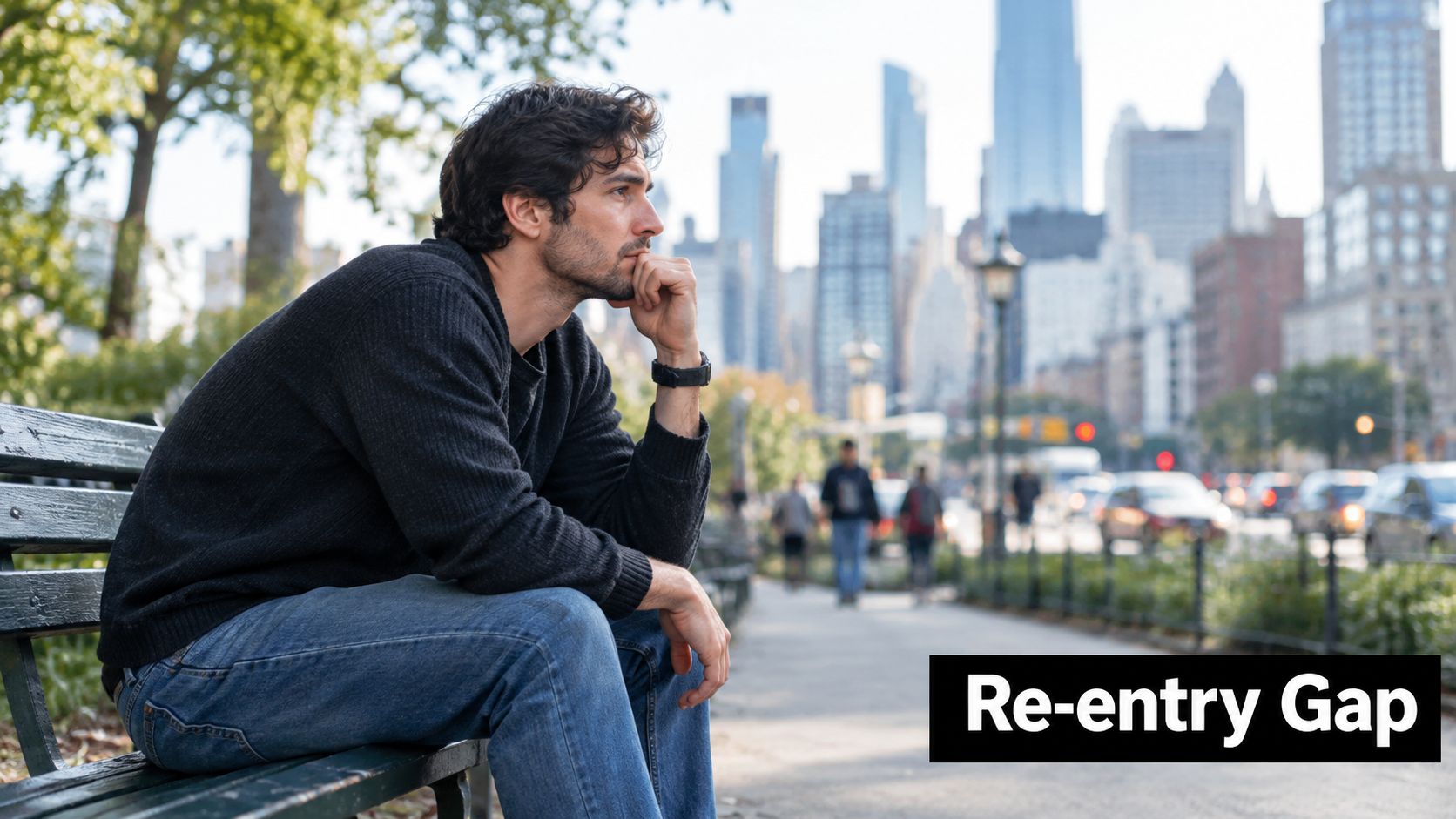
The container is part of the method
Participants rarely change because a room is luxurious. They change when the environment reduces friction around the behaviors the workshop is asking them to practice.
Privacy supports honesty: Guests can discuss difficult decisions without performing for a large audience or competing with a conference schedule.
Natural transitions protect energy: A walk, a meal, or time near the water can create useful space between emotionally demanding sessions.
Personalized service reduces logistics: When transport, meals, and activity coordination are handled well, participants can focus on the work rather than managing their stay.
Shared spaces build connection: A communal meal or unstructured conversation often reveals relationship patterns that formal exercises miss.
The intimate event space at VIVARA illustrates the distinction between accommodation and a facilitation container. The value isn't merely architectural. A carefully chosen setting gives the facilitator more control over pace, privacy, sensory load, and the balance between group work and solitude.
Practical rule: Choose a venue that makes the desired behavior easier to rehearse. If the workshop is about meaningful connection, design for shared meals and informal conversation. If it addresses burnout, protect quiet time as carefully as the curriculum.
The broader adult-learning market also shows why access and fit deserve attention. OECD data reported in 2023 found that slightly more than 1 in 10 adults aged 25 to 64 participated in non-formal education or training during the previous four weeks across countries with comparable data, with participation ranging from approximately 1% in Bulgaria and Türkiye to more than 20% in Denmark and about 30% in Sweden. The figures vary by geography, education, age, and gender, so a premium retreat shouldn't assume that every guest has the same confidence, time, or appetite for group intensity. OECD adult-learning participation data supports a practical conclusion: design the environment around the participant, not around the venue brochure.
Structuring Sessions for Behavioral Change
Insight doesn't equal execution. A participant can understand a pattern, feel inspired by a discussion, and still fail to act when the relevant situation appears at home. A well-built workshop therefore moves beyond reflection and goal setting into implementation intentions, plans that connect a recognizable cue with a precise behavior.
A meta-analysis of 94 independent studies reported a medium-to-large effect on goal attainment, with d = 0.65, and found benefits for starting goal pursuit, protecting it from distractions, and disengaging from ineffective strategies. The implementation-intention research also makes the central warning clear: a strong intention alone doesn't guarantee goal attainment.
Use one clear behavioral contract
A retreat participant shouldn't leave with ten resolutions. One to three observable behaviors are enough, each attached to a time, place, and measurement method.
Define one meaningful outcome. Replace “I want more balance” with an outcome the participant can recognize in ordinary life, such as protecting a recurring period for uninterrupted family time.
Name the principal obstacle. Ask what will most likely interfere. The answer may be late meetings, fatigue, phone use, travel, or an expectation that other people will adjust first.
Write the if-then plan. The format should connect a detectable cue to a precise response: “If it is 7:00 a.m. on weekdays, then I will complete 20 minutes of language practice.”
Rehearse the cue-response link. Have participants say the plan aloud, visualize the setting, and practice what happens when the obstacle appears.
Schedule the review before departure. The review should record initiation, completion, and obstacles, rather than asking only whether the participant felt motivated.
Vague promises fail because they don't produce a reliable trigger or outcome measure. “Be healthier” is an aspiration, not a plan. Counting completed actions gives the facilitator and participant something more useful than post-session confidence.
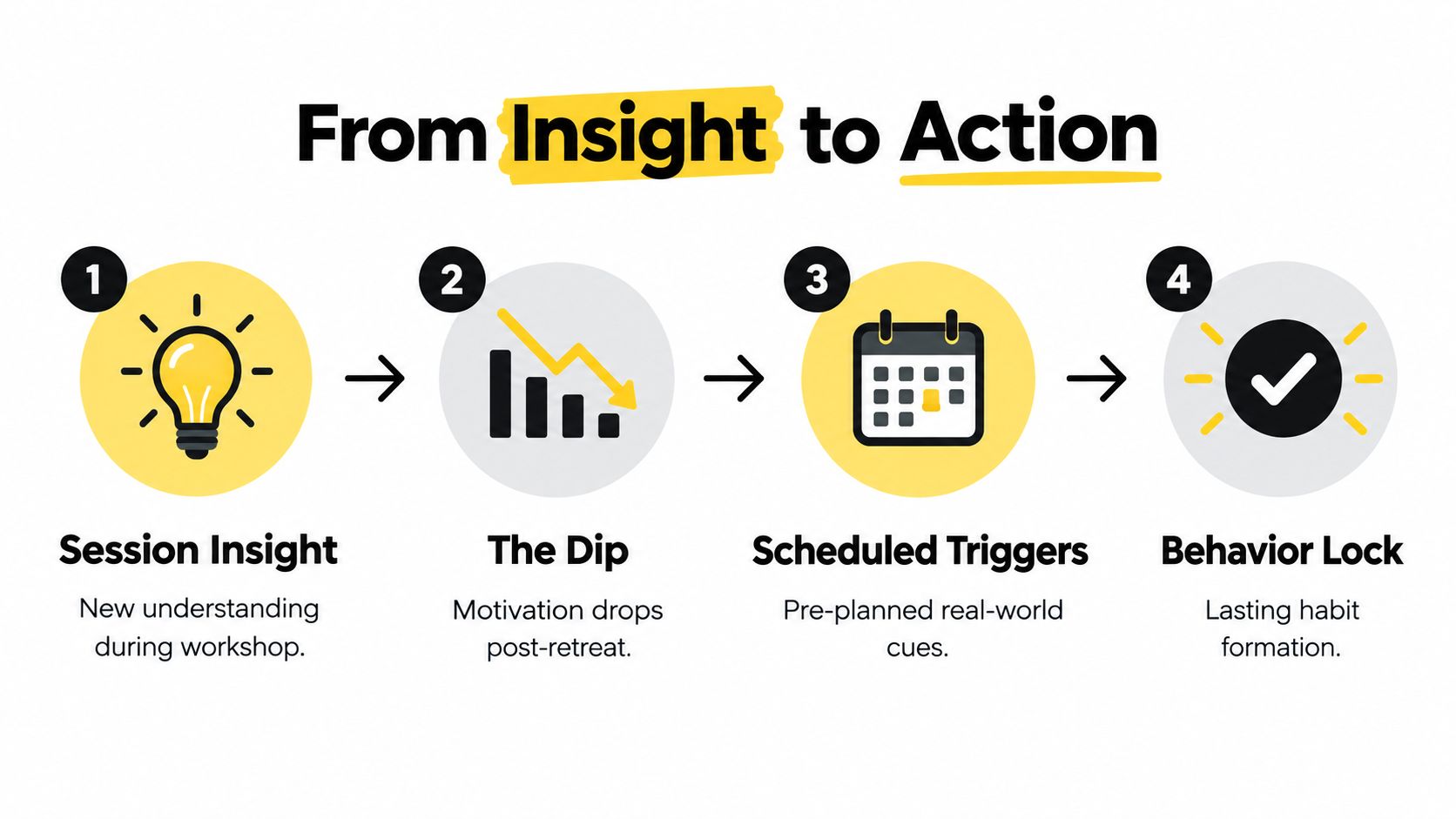
Build the plan into the retreat rhythm
A session on a shaded terrace might begin with reflection, move into a realistic scenario, and end with a written cue-response plan. The following morning, the group can test the plan in a different context, perhaps before a guided walk or after a shared breakfast. That repetition exposes weak wording while the facilitator can still adjust it.
For founders and teams, the same structure can support strategic commitments, communication routines, or recovery practices. A strategic planning retreat becomes more useful when strategic decisions are translated into named owners, visible cues, and review dates rather than left as an impressive conversation.
A workshop should measure what participants do after the insight, not how powerful the insight felt in the room.
Ensuring Long-Term Workshop Transfer
The most serious technical risk in self development workshops is weak transfer. Participants may learn something valuable in a protected setting, but normal environments contain different pressures, relationships, and cues. Transfer improves when the workshop anticipates those conditions instead of treating relapse as a character flaw.
The protocol has three phases: diagnostic, practice, and accountability. Each phase addresses a different failure point.
Start with the real context
Before arrival, collect a short diagnostic. Ask what the participant wants to change, where that behavior currently occurs, who else is involved, and what typically interrupts progress. Keep the questions practical and private. A facilitator doesn't need an autobiography to design a useful rehearsal.
During the retreat, use realistic scenarios drawn from those answers. A parent might practice setting a boundary during a rushed evening. An executive might rehearse a difficult conversation with a senior colleague. A couple might work through a recurring moment of disconnection without turning the exercise into public therapy.
Perceived learning, effective adult-learning and transfer strategies from the trainer, and relevance to the job are identified as important facilitators of learning utilization in independent evaluation research. Lack of relevance and poor trainer practice are prominent barriers, which is why generic motivational content rarely earns its space. Research on learning transfer and utilization reinforces a straightforward design choice: practice the behavior under conditions that resemble life after checkout.
Make accountability part of the product
The follow-up schedule should be agreed before the final session:
At 7 days: Record whether the behavior was initiated, completed, or blocked. Capture the obstacle without judgment.
At 30 days: Review the same indicator and determine whether the cue still works in the participant's normal environment.
At 60 days: Decide whether to maintain, modify, or discontinue the behavior based on evidence rather than enthusiasm.
A meta-analysis of mental contrasting with implementation intentions covering 21 studies, 24 effect sizes, and 15,907 participants found a small-to-medium effect on goal attainment, with g = 0.336. The method combines a desired future with an explicit present obstacle and an if-then response. These findings support follow-up, but they don't justify promising guaranteed transformation.
Don't report a single satisfaction score as proof of durable change. Separate immediate reaction, demonstrated skill, actual behavior, and sustained results. A participant may love the experience without changing the target behavior, and that distinction protects both the guest and the reputation of the facilitator.
Designing an Intimate Costa Rican Itinerary
Costa Rica's natural terrain gives facilitators an unusual curriculum resource. Approximately one-quarter of the country's territory is protected across categories that include national parks, wildlife refuges, biological reserves, wetlands, and biological corridors, according to SINAC's protected-area tourism information. The country's tourism authority also reports roughly 5% of the world's biodiversity and 26% of national territory protected. Costa Rica's sustainable tourism guidance shows why nature can be integrated into the learning design rather than used as decorative scenery.
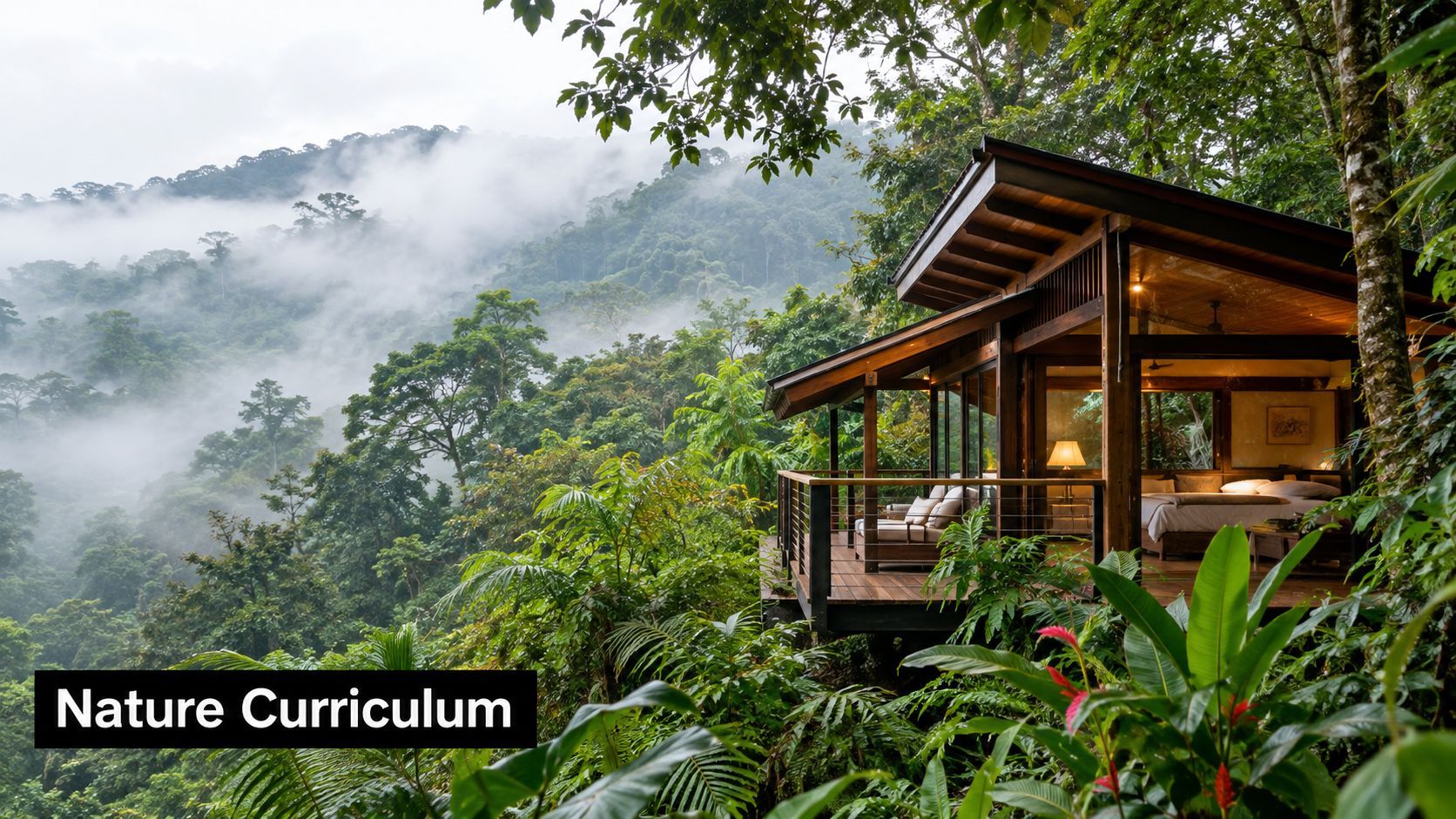
Alternate activation and recovery
A strong itinerary doesn't fill every hour with either workshops or excursions. It alternates demand and recovery so participants can process what happened.
Arrival day: Keep the schedule light. Offer a welcome meal, orientation, and a short grounding practice rather than a major emotional session.
Reflection day: Use journaling, meditation, breathwork, or facilitated group work while attention is fresh.
Adventure day: Add canyoning, zip lining, horseback riding, paragliding, or a demanding guided hike, then protect a quiet evening.
Connection day: Use a shared meal, wildlife observation, or a sunset cruise to explore listening, trust, and group dynamics.
Departure day: Review implementation plans, confirm check-ins, and leave enough time for a calm transition.
A guided wildlife observation can become a mindfulness exercise when the facilitator gives participants a simple attentional task instead of narrating every moment. A waterfall excursion can support a conversation about recovery only if the group has enough time afterward to rest and reflect. The activity must serve the intention.
The same principle applies to food. Farm-fresh, ocean-caught, and jungle-foraged ingredients can support a sense of place, while a flexible menu accommodates energy, dietary needs, and the emotional pace of the group. Premium hospitality earns its value when it removes friction without making participants passive.
Match the itinerary to the group
Couples may want privacy and relationship-focused practices. Families need varied energy levels and dependable downtime. Founders and teams may need reliable private space, connectivity when required, and a deliberate boundary between strategic work and restoration. Brands building community should decide whether their retreat is for customer loyalty, creator collaboration, education, or shared identity, then avoid forcing every purpose into one crowded itinerary.
Costa Rica's official tourism framework tracks average expenditure, length of stay, reasons for visitation, activities, park visits, and hospitality indicators. Those variables are useful when comparing a retreat. Ask how much time is facilitated, which excursions are included, whether operators are authorized, and how the itinerary contributes to local communities. A beautiful location is an asset. Intentional sequencing turns it into an experience design advantage.
Setting Value-Driven Pricing and Packages
Premium pricing becomes credible when the package makes its value visible. Travelers shouldn't have to guess whether they are paying for facilitation, accommodation, convenience, privacy, or a loosely assembled collection of add-ons.
Start with a transparent inventory:
Package component | What to clarify |
|---|---|
Accommodation | Villa type, room arrangement, privacy, and whether the rate is per person, per room, or private group |
Food and beverage | Meals included, dietary flexibility, beverages, and whether menus are fixed or customized |
Facilitation | Facilitator credentials, preparation time, session hours, materials, and follow-up |
Logistics | Airport transfers, local transport, equipment, gratuities, and activity coordination |
Experiences | Guided excursions, park admissions, weather contingencies, and minimum participation |
Group structure | Intimate shared retreat, private gathering, or full-estate buyout |
An accommodation-only package may look simple, but it transfers planning, coordination, and risk to the guest. An intimate group rate can provide more social energy and lower logistical complexity, while a full-estate buyout offers privacy, schedule control, and a clearer environment for a family, brand community, or executive team. Neither is automatically better. The right choice depends on whether the group values peer connection or control over the container.
Price the outcome without overstating it
A value-driven proposal connects each inclusion to a practical benefit. Personalized service can reduce decision fatigue. Curated activities can give the group shared material to discuss. Expert facilitation can create structure that a self-guided vacation won't provide. Regenerative elements, such as support for lifeguard training, living wages, rescued animals, and turtle conservation, can matter to guests who want their stay to have credible local relevance.
Costa Rica's tourism authority reports that 75% of visitors travel for vacation, pleasure, or leisure, while 13% travel for business or professional purposes. Official tourism statistics help planners distinguish a restorative leisure retreat from a professional gathering that needs workspace, connectivity, and structured outcomes.
Avoid promising a return that cannot be measured. Present the total cost, the number of facilitated hours, the included experiences, and the follow-up support. That approach positions the retreat as a curated program with clear components, not as an expensive hotel stay dressed up with wellness language.
Measuring Real Transformation Outcomes
A polished testimonial captures a feeling. It doesn't prove that a participant changed a behavior, maintained it, or found the intervention appropriate. Serious facilitators establish a baseline before arrival and use the same behavioral indicator after the retreat.
The measurement can remain private and non-clinical. Ask participants to record how often they complete the selected behavior, whether the planned cue appeared, what obstacle interfered, and what recovery action they took. For a team, track an agreed process such as whether a weekly decision meeting occurs. For a couple, the indicator might be a mutually defined conversation practice. The measure should belong to the participants, not become a public marketing asset.
Separate four kinds of evidence
Immediate reaction: Did the participant feel safe, engaged, and respected?
Demonstrated skill: Could the participant perform the practice during the retreat?
Actual behavior: Did the participant initiate and complete the agreed action afterward?
Sustained result: Did the behavior remain useful at the later review points?
This distinction helps facilitators report what changed, what didn't, and what remains uncertain. It also protects against turning a wellness experience into a clinical mental-health claim. The evidence on learning and wellbeing is mixed by intensity and participant group. Recent UK government analysis associated high-intensity job-related training with a 1% increase in life satisfaction overall, while low-intensity training was associated with declines for some younger, vocationally qualified, and highly deprived groups. The review also says benefits can't be directly quantified with confidence. The government analysis of learning, development, engagement, and wellbeing supports caution, not inflated ROI language.
For brands, this discipline strengthens community trust. The retreat ROI perspective on replacing digital touchpoints with in-person loyalty becomes more credible when a brand can describe participation, connection, and follow-through without exposing private personal data. Visitors should leave with one practical commitment, a realistic support structure, and an honest understanding of what the retreat can and cannot do.
VIVARA provides an intimate Dominical setting for facilitated self development workshops, custom itineraries, yoga, breathwork, meditation, group work, curated adventure, and chef-led dining for groups of up to 14 guests. Visit VIVARA to compare a private retreat, team gathering, or brand community experience and discuss a Costa Rican format built around meaningful transfer, not just a memorable stay.
