The Vivara Content Team
Strategic Planning Retreat: A Practical Roadmap for Leaders
Strategic Planning Retreat: A Practical Roadmap for Leaders

You've booked the beautiful property, invited the senior team, and blocked the calendar. Then someone asks the question that should have been answered first: What must be different when this retreat ends?
A strategic planning retreat earns its cost only when it produces decisions that change how people work after they return home. That matters whether you're aligning a leadership team, designing a brand community, planning a wellness-led business reset, or using a nature-rich destination to help people think beyond their usual operating habits. Costa Rica can provide the setting, but the setting won't create strategic clarity on its own.
The practical standard is simple: leave with a short list of choices, named owners, deadlines, and a review rhythm. Everything else is atmosphere.
Why Most Strategic Planning Retreats Fail Before They Start
A leadership team arrives at an attractive venue for three days. The group fills walls with sticky notes, debates growth, revisits old frustrations, and generates dozens of possible initiatives. On departure day, everyone feels productive. By the following week, nobody can say which ideas were approved, who owns them, or when progress will be reviewed.
That retreat didn't fail because the venue was wrong. It failed because the organizers confused activity with decision-making.
A strategic planning retreat is a decision engine, not an extended meeting. The work starts before anyone travels, with a clear purpose, a defined decision set, and enough factual preparation to prevent the room from becoming a live research project. Research covering more than 650 strategy workshops identifies clarity of goals and purpose, routinization, stakeholder involvement, and cognitive effort as variables that predict workshop outcomes, which supports a design focused on decision quality rather than discussion volume. The workshop research published by Wiley provides a useful foundation for that approach.
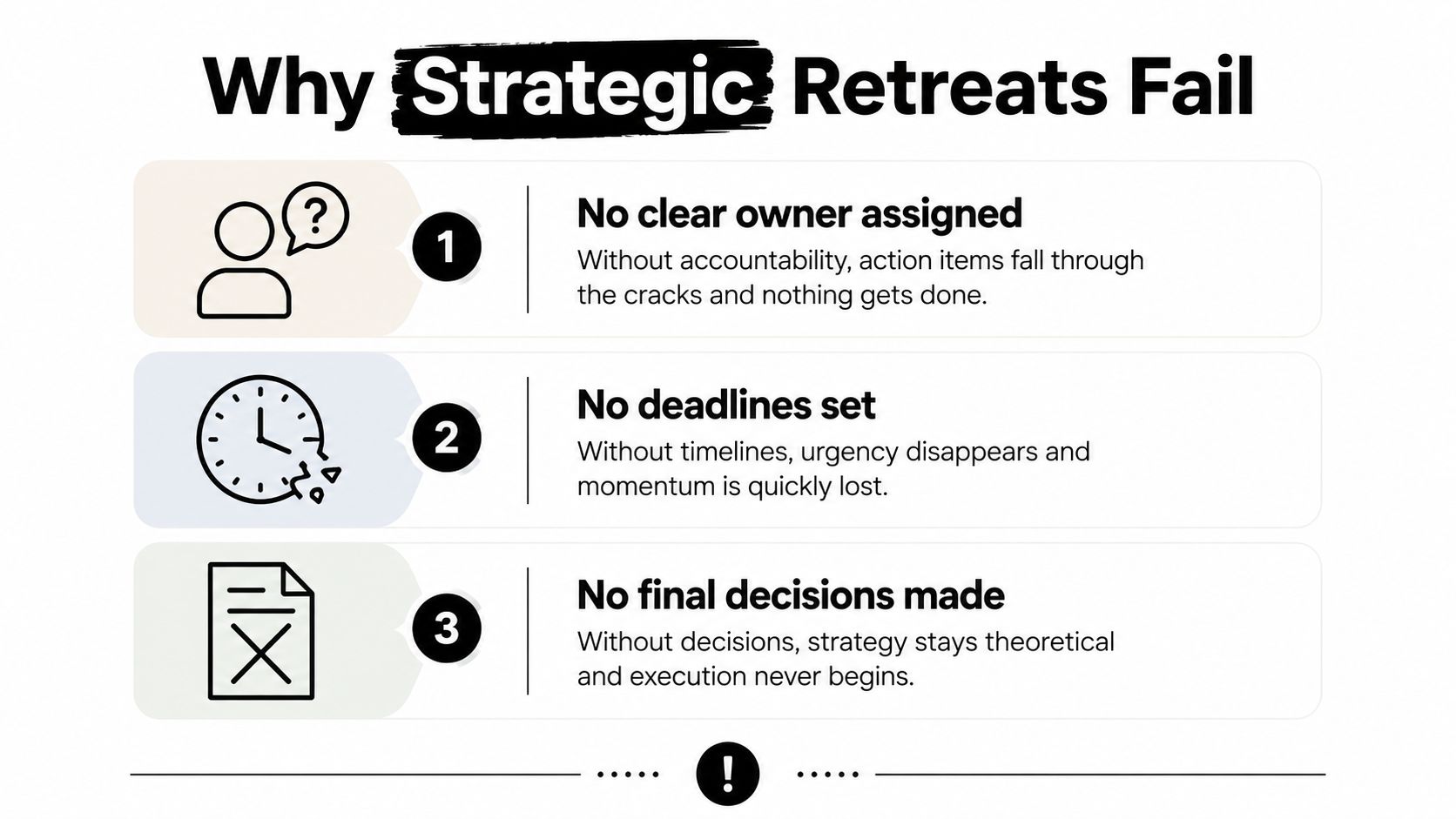
The predictable failure pattern
The same problems appear repeatedly:
Ambiguous purpose: Participants think they're setting strategy, while the executive team expects them to refine an existing plan.
Weak preparation: People receive background documents too late, so the first hours disappear into status updates.
Wrong participants: Seniority fills the room, but decision authority, subject expertise, or implementation ownership is missing.
No decision rights: The group discusses options without knowing who can approve, reject, or escalate a choice.
Zero follow-through: The final notes contain phrases such as “team to align further” instead of an owner, milestone, and date.
The cost is more than a wasted gathering. Company offsites already represent a material management investment. A 2022 survey found an average total retreat cost of $220,000, with average spending of $2,100 per employee on flights, hotels, and activities. The same survey reported that 81% of participating companies used a fully remote workforce, 43% organized at least two retreats that year, and 81% of retreats lasted at least three nights. PlanRetreat's 2022 offsite report shows why a polished but unproductive agenda is an expensive mistake.
The hard question: What decision will your team make at the retreat that it can't make in a normal operating meeting?
If nobody can answer that question, don't add better food, more activities, or another day. Rewrite the purpose.
Designing the Retreat Before Anyone Books a Flight
The venue should come after the decision architecture. Booking first creates a subtle trap, because the team starts shaping the strategy conversation around the room, travel schedule, and package already purchased.
Start with one purpose question. It should be sharp enough to guide exclusions. “How do we grow?” is too broad. “Which customer segments and operating model will fund our next phase of growth?” is more useful because it points toward choices.
Lock the decisions
List the three to five decisions the retreat must produce. Examples might include:
Which market or customer segment receives priority?
Which initiative loses funding or leadership attention?
What service standard must change?
Which partnership deserves formal investment?
What will the organization stop doing?
Then select participants by decision authority and execution responsibility, not by the organization chart. Include the people who understand the facts, the people who can approve the choice, and the people who'll carry it into operations. If a key decision-maker can't attend, name the delegate's authority in advance.
Assign two separate owners. The logistics owner handles travel, rooms, meals, technology, accessibility, and contingencies. The outcome owner protects the decision list, manages pre-work, and makes sure the final log is published. Combining both roles often leaves one of them neglected.
Prepare the room before the room exists
Circulate a concise pre-read roughly 10 days before the retreat. Practitioner guidance reports that distributing materials in advance can reduce in-room decision time by 30% to 40%, while a separate 2023 offsite report found that 48.4% of events were planned one to three months ahead and 45.3% lasted three days and two nights. PlanRetreat's 2023 report offers useful context for planning cadence and duration.
The pre-read should include the prior-year scorecard, customer insight memo, financial and operating constraints, relevant market signals, and a short PEST scan. Ask each participant to mark facts, assumptions, disagreements, and missing information. Don't ask for essays. Ask for material that improves the quality of the decisions.
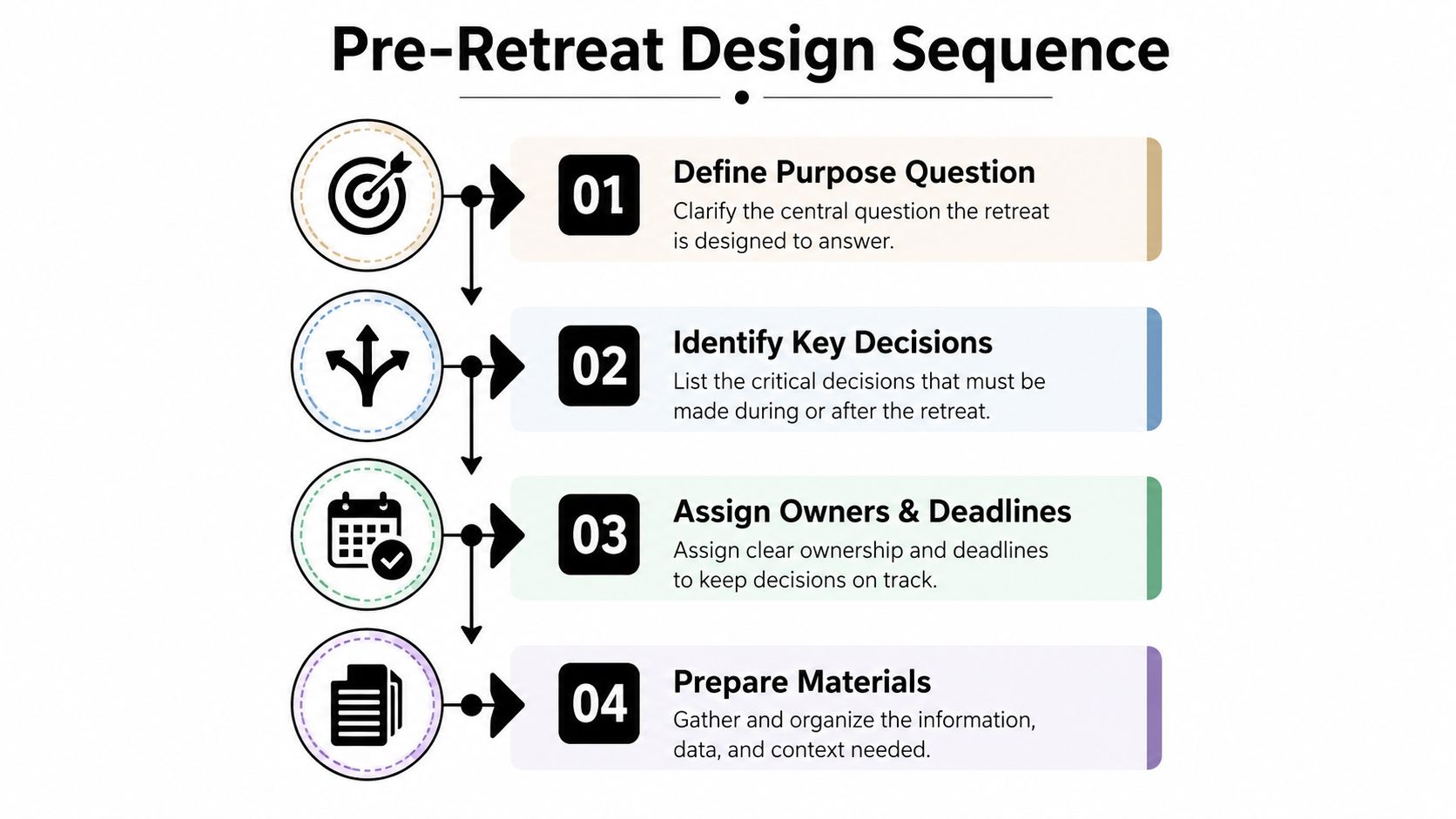
Seventy-two hours before departure, the outcome owner should sign off on a short pre-flight checklist:
Purpose question is approved.
Decisions and decision-makers are listed.
Pre-read has been received and reviewed.
Agenda assigns time to choices, not presentations.
Owners and deadlines are ready to capture.
Technology, dietary needs, accessibility, transfers, and backup arrangements are confirmed.
If those items aren't ready, the retreat isn't ready.
Choosing the Right Format From Half-Day to Multi-Day
Longer retreats aren't automatically better. Many teams over-invest in duration and under-invest in preparation, then use extra hours to revisit points they should have resolved before arrival.
Choose the shortest format that can support the decisions you've named.
Retreat Format Comparison
Format | Duration | Decision Capacity | Best For | Common Failure Mode |
|---|---|---|---|---|
Half-day | Several focused hours | One major decision or a tightly bounded reset | A mid-year recalibration, urgent choice, or leadership alignment | The team tries to solve a full annual strategy in too little time |
One-day | A concentrated working day | A small set of linked decisions | Annual reset, priority review, or new team alignment | Status updates consume the morning and force rushed decisions |
Two-day | A deeper working session with an overnight break | Multiple connected choices, trade-offs, and initial execution design | Complex annual planning, cross-functional alignment, or a new operating model | Participants mistake depth for permission to expand the priority list |
Multi-day | Several working days | A complex portfolio of decisions, relationship repair, or integration work | M&A integration, major leadership transition, or strategy requiring extensive evidence review | Fatigue, social programming, and repetition replace decision discipline |
A two-day format is often the practical sweet spot for management teams because it gives people room to examine evidence, challenge assumptions, and make trade-offs without turning the gathering into a prolonged conference. The research and practitioner guidance cited by Wiley's workshop study also supports treating retreat design as a structured workflow rather than an open-ended conversation.
A half-day works when the question is already narrow. For example, a leadership group might decide whether to keep, redesign, or stop a specific customer program. It won't work for an unprepared annual reset involving market position, staffing, service standards, and capital allocation.
A one-day retreat can produce serious results if you strip away presentations. Send the scorecard in advance, assign owners to answer factual questions, and reserve the central hours for competing options. Use the final portion to log decisions and establish the first checkpoint.
Decision rule: If you can't name the decisions, don't add days. Add pre-work.
Multi-day formats earn their place when the team must integrate complicated information or repair the conditions needed for honest debate. They don't earn their place because the destination is attractive. In Costa Rica, a longer stay may make sense for a combined work and restoration experience, but the strategic work still needs protected blocks, clear breaks, and a defined finish line.
Facilitation Methods That Force Real Trade-Offs
Good facilitation doesn't make difficult choices feel easy. It makes the choices visible, comparable, and impossible to avoid.
Begin with a strategy test. Ask the group to write down the three choices the retreat must resolve. If participants produce a long list, the facilitator should force prioritization before the agenda expands. A strategy is useful because it directs scarce attention, money, talent, and time. It can't do that if every attractive idea survives.
Use disagreement deliberately
A premortem works before the group becomes attached to a proposed direction. Ask participants to assume the strategy failed, then identify the conditions that caused the failure. This surfaces fragile assumptions about demand, staffing, service delivery, partnerships, cash flow, or leadership capacity without requiring someone to attack a colleague's preferred option directly.
A keep, change, stop exercise creates a sharper conversation than a broad brainstorming session. Each participant must identify what the organization should preserve, what needs redesign, and what must stop receiving resources. The value comes from the sacrifice. If the “stop” column stays empty, the team hasn't made a strategic choice.
For hospitality, wellness, or experience-led brands, replace abstract SWOT language with scenarios tied to actual operating conditions:
What happens if occupancy grows while service standards weaken?
Which guest mix best supports the brand and local relationships?
Where does personalization create value, and where does it create operational drag?
Which local partnerships deepen the experience rather than adding another activity?
What should the team protect if staffing becomes constrained?
A useful group exercise gives smaller teams opposing mandates, such as growth versus margin or consistency versus personalization. Every recommendation must state what it sacrifices. That requirement exposes plans that sound attractive only because they assume unlimited resources.
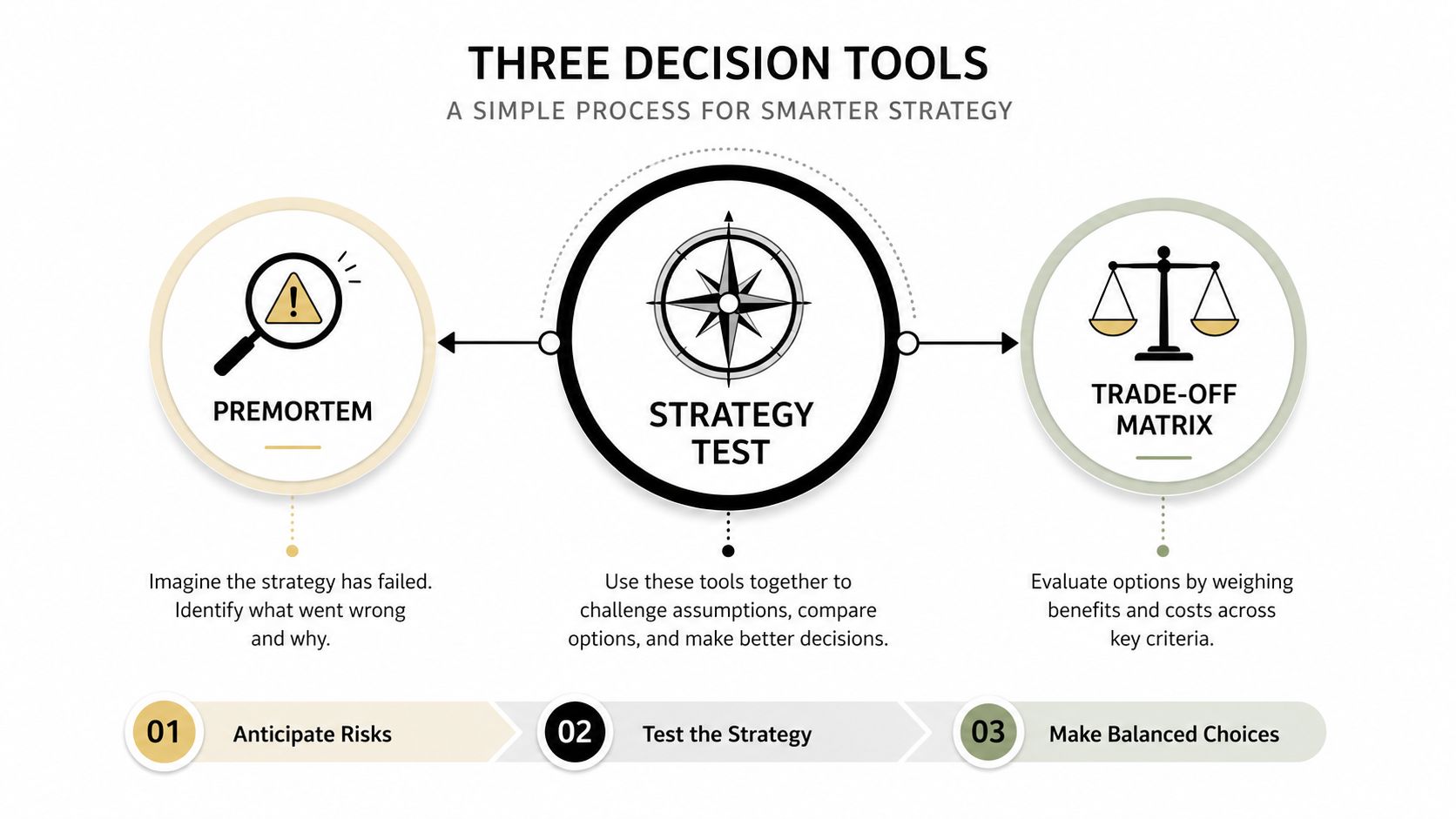
Capture closure while the conversation is live
Sequence the work from shared facts to competing options to explicit decisions. Record the rationale, owner, deadline, dependencies, and unresolved tension on the wall or shared document as the group works. A parking-lot list is acceptable only when every item has a next step and a person responsible for resolving it.
End each major session with a commitment check:
What decision did we make?
Who owns the next action?
What must happen first?
When will we review evidence?
Skip generic icebreakers, endless brainstorming, and anonymous voting. They may make participation feel comfortable, but they rarely resolve the trade-offs that justified taking leaders away from their normal work. For a destination-based approach to connection and innovation, VIVARA's perspective on team innovation in Costa Rica provides a useful example of how setting can support the work without replacing it.
Venue and Logistics Decisions That Shape the Outcome
A venue should be selected for the conditions it creates for decision-making, not for its amenity count.
Start with the working environment. You need uninterrupted meeting space, dependable connectivity, comfortable sightlines, privacy, good acoustics, and enough separation for smaller groups to work without constant interruption. A beautiful lounge with poor acoustics is still a poor strategy room.
Evaluate friction before aesthetics
Travel time, transfers, room quality, dietary handling, backup power, weather exposure, and accessibility all affect participation. Participants who arrive exhausted or spend the day solving connectivity problems won't contribute at their best. Ask the venue for practical details rather than relying on polished photography.
Arrive early and test the room. Check audio, displays, lighting, internet, seating, printed materials, and backup plans. Provide working decision packets even when the technology is reliable. People need documents they can annotate, compare, and reference while the conversation moves quickly.
Protect breaks and meals. A meal should restore attention, not become an unstructured extension of the most contentious debate. Assign a logistics lead who can solve problems without pulling the facilitator into every operational interruption.
For an intimate boutique setting such as VIVARA in the Dominican-style coastal context described by the retreat brief, the setting changes the working experience. Outdoor spaces can support scenario walks and informal small-group conversations. Local food, climate, transfers, and nearby activities can create meaningful connection for teams, brands, or communities. Those elements should be used intentionally, with indoor alternatives and connectivity confirmed before commitment. The venue's intimate event space is relevant when a group needs privacy and a more customized environment than a conventional conference room.
Practical standard: The destination should lower cognitive drag, not introduce a new category of problems.
Send participants a concise logistics brief covering arrival, packing, schedule, accessibility, emergency contacts, meeting expectations, and available personal time. If the retreat includes wellness, adventure, or community programming, make participation clear. Nobody should have to guess whether a canyoning excursion is optional or whether a working dinner is part of the strategic agenda.
Costa Rica offers a strong context for regenerative travel when the experience actively restores ecosystems and communities rather than merely avoiding harm. Fundación Corcovado's explanation of regenerative tourism is a useful reference for evaluating whether a retreat's social and environmental story is substantive.
Measuring Outcomes and Building a 90-Day Accountability Loop
The retreat succeeds when execution changes, not when the closing conversation feels inspiring.
Before the group arrives, record a baseline for every priority under consideration. Include the current condition, the target date, the accountable owner, and the evidence that would demonstrate progress. The evidence might involve completed initiatives, revised service standards, occupancy targets, customer retention signals, partnership milestones, or another measure connected directly to the decision.
Immediately afterward, publish a decision log, not a polished narrative. A narrative can sound coherent while hiding ambiguity. The log should make the work operational.
What every decision log needs
Decision: What did the group approve, reject, or defer?
Rationale: Which facts and trade-offs shaped the choice?
Owner: Who is accountable for progress?
Deadline: When must the next meaningful result appear?
Resources: What people, budget, authority, or tools are required?
Dependencies: Which other decisions or teams could block delivery?
First milestone: What observable action proves the work has started?
A decision without an owner is a preference. A decision without a milestone is an intention.
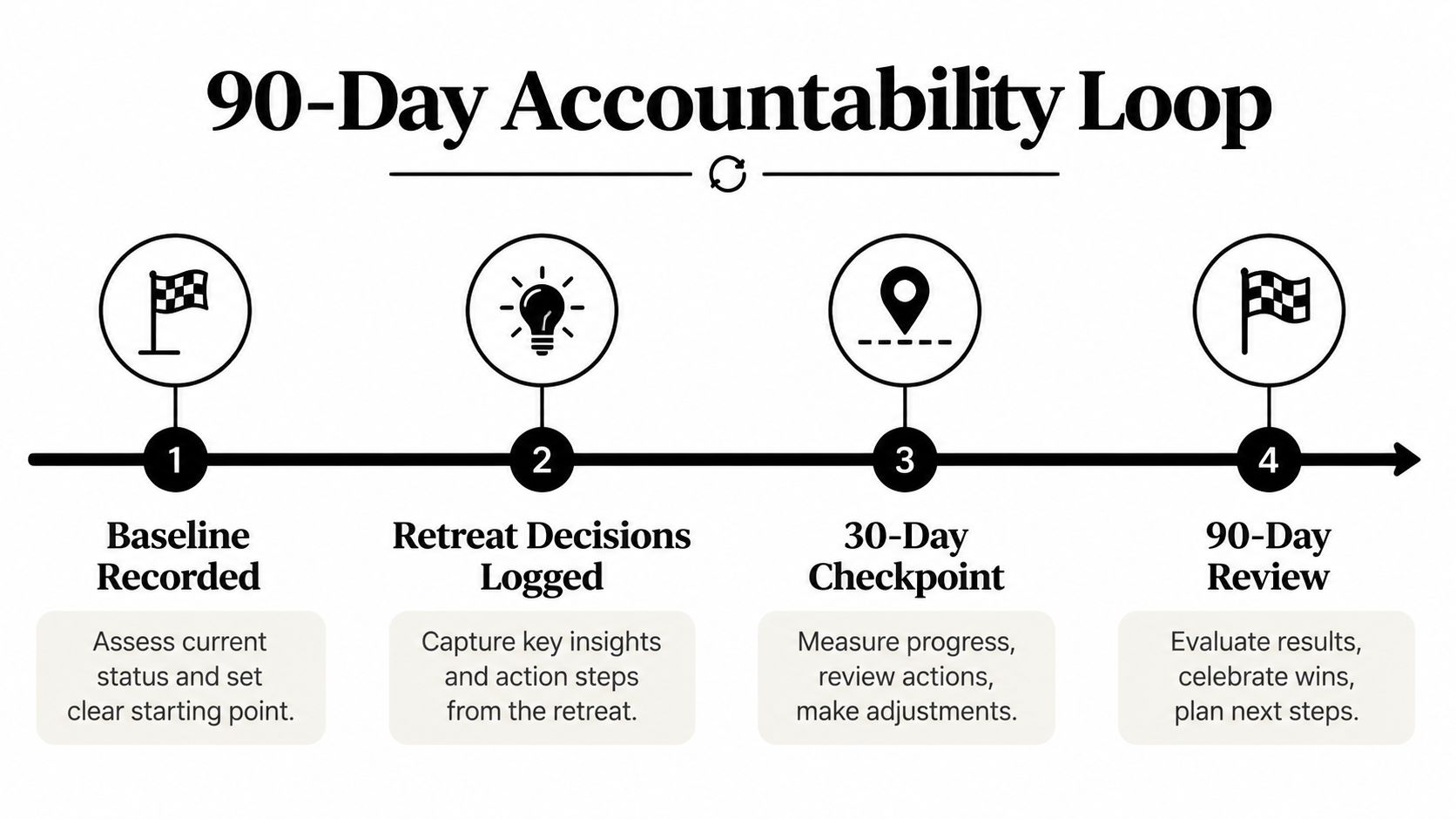
The 30-60-90 rhythm
During the first 30 days, owners launch the agreed work, remove blockers, and establish leading indicators. Leadership should ask whether the first actions happened, not whether everyone still likes the strategy.
At 60 days, review execution quality. Which assumptions held? Which changed? Has the team protected the resources required for delivery? If the original scope no longer fits the facts, adjust it openly instead of letting the initiative drift.
At 90 days, compare results with the original baseline. Continue, revise, or stop. That decision matters because stopping a weak initiative can release capacity for a priority that has stronger evidence.
A short monthly operating review should use the same participants, agenda, and decision rights as the retreat. Track a compact scorecard:
Decisions completed
Milestones delivered on time
Unresolved risks
Resource constraints
Measurable movement in the chosen business outcome
The strategic execution literature cited by ITONICS on strategic offsite design highlights the danger of leaving initiatives vague. It reports that only 23% of executives in a referenced survey said major strategic decisions were made during the planning process, while 45% said planning failed to track execution. The same source cites evidence that fewer than 30% of strategic transformations succeed in delivering intended results. Those figures don't prove that every retreat will fail, but they do justify a tougher standard for post-retreat measurement.
A retreat that produces attractive ideas without assigned work is an ideation session, not strategic planning.
For brands building communities, the loop also protects trust. A wellness or lifestyle brand can measure whether the chosen experience, partnership, or service change improves the relationship it intends to build. The setting may create emotional energy, but the scorecard proves whether that energy became durable operating behavior. A practical example of tying retreat value to relationship-building appears in VIVARA's discussion of retreat ROI and in-person loyalty.
Turning the Retreat Into a Recurring Operating Rhythm
An annual retreat is too infrequent to carry strategy by itself. Treat it as one node in a recurring operating cadence, with the same discipline repeated before, during, and after each gathering.
The first touchpoint is the 90-day scorecard review. Leaders examine the decisions, milestones, risks, and business movement recorded after the retreat. The second is a quarterly strategy check tied directly to those decisions. It isn't a new planning event. It's a controlled review of whether the chosen direction still fits the evidence.
Two weeks before the next retreat, hold a pre-retreat alignment session. Confirm what has changed, which decisions remain unresolved, and what new information participants must review. This prevents the next gathering from reopening settled questions without a reason.
Maintain an off-cycle decision log throughout the year. New proposals should record the decision required, owner, trade-off, and review date. That log gives the next retreat an evidence base and keeps leaders from treating the event as the only time strategic thinking is allowed.
Know when to move the date
Pull the next retreat forward when leadership changes, important milestones are repeatedly missed, or new competitive pressure invalidates a central assumption. Push it back when the team lacks the data needed for meaningful choices or when owners haven't completed the work from the prior cycle. A calendar date shouldn't override decision readiness.
The difference between weak and strong teams is visible here. Weak teams treat the retreat as an annual experience, then return to ordinary habits. Strong teams treat it as a repeatable decision protocol with consistent preparation, explicit trade-offs, ownership, and review.
Make one decision within the next 48 hours: lock the retreat date only if the purpose question is already clear, or assign the person who'll own the first 90-day outcome. Don't book the destination before someone owns the result.
VIVARA offers an intimate Costa Rica setting for private group retreats, with full-property programming, nature-based activities, customized dining, and space for restorative work alongside meaningful connection. If your team, brand, or community needs a destination that supports both thoughtful decisions and shared experience, visit VIVARA to explore the setting and start planning.

