The Vivara Content Team
7 Best Family Adventure Vacation Options
7 Best Family Adventure Vacation Options

The best family adventure vacation depends on your family's ages, activity level, comfort expectations, and appetite for guided logistics, not on how extreme the itinerary sounds. The family adventure tourism market is estimated at US$66,285.7 million in 2025, with projected growth to US$241,167.6 million by 2033 at an 18% CAGR (Grand View Research data), so families have more formats to choose from than ever.
The most popular advice often points families toward the biggest resort, the longest itinerary, or the most dramatic activity. That's the wrong test. A trip succeeds when toddlers, teenagers, parents, and grandparents can share meaningful experiences without spending the entire holiday waiting, recovering, or solving transport problems.
Costa Rica is particularly strong for that balance. Protected areas, wildlife, water, forests, local food, and restorative hospitality create room for both adventure and slower days. The country has 169 officially recognized protected wildlife areas covering 4,600,490 acres, giving families a substantial setting for nature immersion and conservation-minded travel (Costa Rican protected-area research).
This list compares seven distinct approaches, from a private Costa Rica estate to polished active touring, all-inclusive multigenerational travel, learning-led exploration, value-conscious small groups, river bonding, and wildlife conservation. VIVARA is the premium private choice, but Backroads, Tauck Bridges, National Geographic Family Journeys, Intrepid Travel, OARS, and Natural Habitat Adventures may fit better depending on your family's rhythm, destination priorities, and planning style.
1. VIVARA for private Costa Rica immersion
VIVARA is the strongest choice for families who want exclusive use, personal service, nature, and flexible adventure in one Costa Rica stay. Set above the surf in Dominical, this founder-led retreat uses a small collection of architecturally distinct villas to create a private environment where relatives can spend time together without sharing facilities with another group.
Jesse and Karen created the property after two decades of land stewardship. That history matters because the experience feels designed around place rather than assembled as a standard resort package. Families can slow down, celebrate, work on a shared project, or build active days around their own interests.
The itinerary can last three days or seven, with VIVARA's personalized “V-star” service coordinating an on-demand menu of experiences. Options include whale watching, canyoning, zip-lining, paragliding, horseback riding, waterfall hikes, sunset cruises, and private air charters. A family with young children might choose a gentle waterfall outing and a long villa afternoon, while families with teens can add more demanding activities.
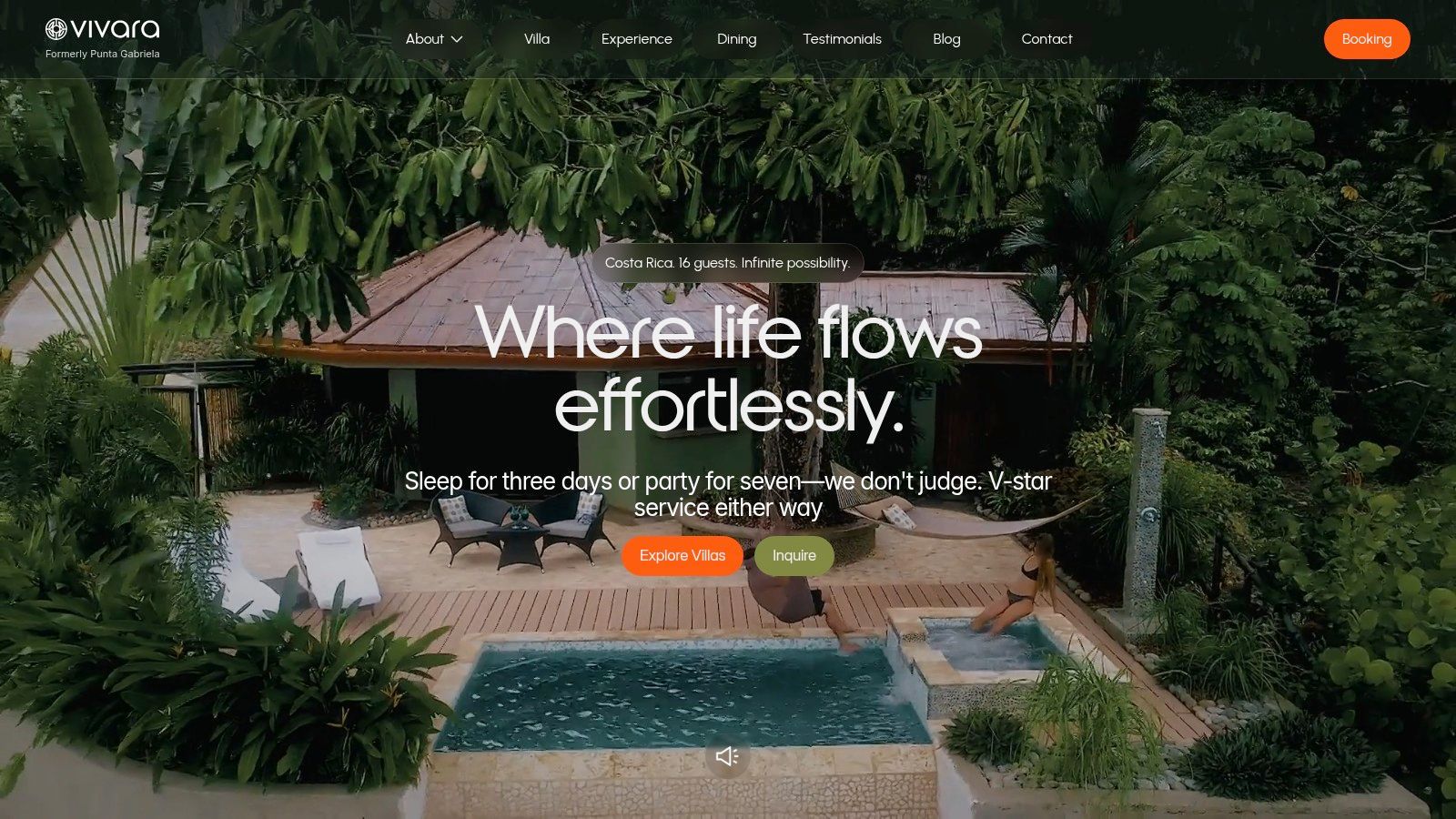
Why VIVARA stands apart
Dining is central rather than incidental. Michelin-trained culinary leaders, trained in New York kitchens, prepare farm-fresh, ocean-caught, and jungle-foraged food without fixed menus. The zero-waste approach also makes it easier to tailor meals around children, dietary requirements, changing appetites, and the family's preferred pace.
Every villa sponsors a rescued animal, while guest stays support lifeguard training, living wages, and turtle conservation. That gives families a practical way to connect comfort with community and wildlife benefit. Travelers who want to understand the adventure possibilities can also explore these Costa Rica adventure ideas before speaking with the team.
Practical rule: Build one anchor adventure per day, then protect time for food, swimming, conversation, and sleep.
VIVARA's trade-offs are clear. Pricing is available by inquiry and varies with season, group size, and add-ons, so families need to request a detailed proposal rather than compare a simple public rate. Materials reference both a 14-guest and 16-guest maximum, so confirm exact capacity and villa configuration when booking. The remote setting also rewards advance planning.
Best for: Families, multigenerational groups, private celebrations, wellness retreats, and brands creating an intimate gathering around shared experiences.
Planning framework: Use three days for a compact reset with one major activity and one restorative block daily. Use five days for a balanced Costa Rica immersion with nature, water, food, and local culture. Use seven days for a full private stay, especially when grandparents, young children, or a larger family group need unscheduled time.
2. Backroads for polished active touring
Backroads is the best fit for families who want daily movement with professional logistics already handled. Its guided biking, hiking, and multi-adventure trips are organized around different family life stages, including Kids & Teens, Teens & 20s, and Young Adults 20s+ departures.
The format works well when parents want an active holiday but don't want to research every route, hotel, transfer, equipment question, or backup plan. Families typically get shorter and longer route choices, capable trip leaders, and carefully selected accommodation ranging from casual properties to luxury hotels.
The main advantage is pacing choice
A family can start with a manageable route, extend it if energy is good, or choose a more relaxed alternative. That flexibility matters when one child races ahead, another needs encouragement, or a grandparent wants to participate without matching the group's fastest pace.
Backroads also offers scheduled group trips and private departures. A private departure is the better decision for a multigenerational family with specific dietary needs, uneven fitness, or a strong preference for controlling the daily rhythm. Scheduled departures provide social energy and a defined operating structure.
The company highlights youth savings of 10% to 20% on designated family trips, depending on rooming and trip conditions, so families should review the exact departure terms rather than assume the discount applies universally. Equipment support, including quality bikes and kid gear, reduces the burden of transporting specialized equipment.
Best for: Active families who value route variety, strong guides, comfortable hotels, and a reliable standard of service across destinations.
Trade-offs: Backroads generally costs more than a self-planned trip. The premium pays for coordination and leadership, but families seeking spontaneous days or minimal structure may find the itinerary too organized.
Planning framework: A three-day version works best as a focused active break with one primary route each day. Five days allows a better balance between biking or hiking and cultural or recovery time. Seven days suits families who want several activity types without turning every morning into a race.
Safety check: Review route difficulty, elevation, heat exposure, bike support, emergency procedures, and the availability of shorter alternatives before reserving. Ask whether private departures can adjust activity intensity for each age group.
3. Tauck Bridges for all-inclusive multigenerational travel
Tauck Bridges is the clearest recommendation for families who want one upfront price and minimal logistical friction. The company's guided family itineraries combine hands-on experiences for children with comfortable hotels, organized transfers, and high-touch service for adults.
The appeal is strongest for first-time international family travel and multigenerational groups where different adults might otherwise disagree about transport, meals, admissions, luggage, and gratuities. Tauck's published inclusions cover accommodations, activities, admissions, most meals, transfers, gratuities, and other core trip elements, although families should still read the departure-specific documentation carefully.
Comfort without constant decision-making
Tauck Bridges is not designed for families who want to improvise every afternoon. The structure is intentional. Guides manage the moving parts, while the itinerary gives children activities that feel participatory rather than passive. Adults get prime-location accommodation and a smoother touring experience.
That makes Tauck particularly effective when grandparents are joining, parents have limited planning time, or the family wants to avoid negotiating every expense during the trip. The trade-off is reduced spontaneity. A family that prefers private villas, long lunches, or changing plans at breakfast may find the fixed structure less appealing than VIVARA or a private Backroads departure.
Best for: Multigenerational families, first-time international travelers, and groups that prioritize inclusion clarity, comfort, and dependable service.
Trade-offs: The price is higher than many small-group operators, and the itinerary leaves less room for unscheduled exploration. Families should also confirm the balance between active days and touring days, especially when young children or older adults are traveling.
Planning framework: Choose three days only when the destination is easy to access and the family wants a short, structured introduction. Five days gives enough time for guided highlights and recovery. Seven days works for a major destination where transport, cultural visits, and family activities need to be coordinated carefully.
The right all-inclusive itinerary doesn't eliminate choice. It eliminates the choices that drain the family's attention.
Before booking, confirm room configuration, transfer lengths, meal coverage, activity minimums, and the amount of walking on each day. For a family with uneven mobility, ask exactly where participants can opt out without creating a difficult day for everyone else.
4. National Geographic Family Journeys with G Adventures for learning-led exploration
National Geographic Family Journeys with G Adventures is the best option for curious families who want adventure to explain the world, not just display it. These small-group itineraries are designed for children aged 7 and older, with a combination of active exploration, science, culture, storytelling, and hands-on learning.
Two Expedition Leaders support Family Journeys, and the program includes kid-focused materials before and during the trip. That structure gives children something to investigate and discuss, rather than treating them as passengers following an adult itinerary.
The format suits families who want wildlife, conservation, local culture, and geography woven into the daily experience. It also creates natural conversation between families in the group, which can be valuable for only children or children who enjoy meeting peers while traveling.
Learning is the organizing principle
The educational element doesn't mean the trip feels like school. The strongest itineraries use local guides, field observation, practical activities, and stories to make the destination memorable. Families should still inspect the physical rating and daily transport pattern, because “active” can mean very different things across destinations.
Best for: Children aged 7 and older, families who value interpretation and cultural context, and travelers who prefer facilitated group interaction.
Trade-offs: Lodging and service generally sit below luxury standards, and some meals aren't included. That makes the total cost less predictable than Tauck Bridges, so parents should budget separately for meals, drinks, and personal expenses.
Planning framework: A three-day trip works for a concentrated wildlife or cultural encounter. Five days is better for combining guided learning with unstructured family time. Seven days allows the children to settle into the group and gives the itinerary room for varied activity levels.
Safety check: Review walking distances, heat, water exposure, child age requirements, food arrangements, and the emergency support model. Ask whether an activity can be skipped while keeping the rest of the day practical.
The company's broad destination range means families can choose an experience based on interest rather than defaulting to a generic resort. For a conservation-minded family, the educational depth may justify accepting simpler accommodation.
5. Intrepid Travel for value-conscious small groups
Intrepid Travel is the most practical choice for families who want guided adventure, broad destination choice, and a lower level of luxury overhead. Its family catalog includes dedicated family and Teen itineraries, clear age minimums, physical ratings, and small-group travel led by trained family leaders.
This is a good match for parents who want a real itinerary but don't need every meal, transfer, or hotel detail wrapped into a premium package. Intrepid's style emphasizes local movement, age-appropriate activities, and responsible travel, with options across North America, Latin America, and other regions.
A useful middle ground
Intrepid offers more structure than a self-guided trip and generally less polish than a luxury operator. That can be exactly right for families who care about experiences more than high-end accommodation. Separate Teen itineraries can also add challenge for older children who would find a very gentle family departure uninspiring.
Some family trips offer child discounts, including examples of around 20% off, but the exact promotion depends on the departure and booking terms. Groups can approach 16 travelers during peak periods, so families should ask about the expected group size if intimacy is a priority.
Best for: Families seeking guided travel at a value-driven price, first international adventures, and travelers who want many destinations to compare.
Trade-offs: Fewer inclusions and less accommodation polish mean parents need to plan for extra meals, optional activities, and personal expenses. Group size may also feel less private than a VIVARA stay or a private departure.
Planning framework: Use three days for a compact city-and-nature combination with limited transfers. Five days is the strongest default for children because it provides variety without excessive fatigue. Seven days works for a richer regional itinerary, provided the family has reviewed travel days rather than counting only activity days.
A family considering canyoning or another technical activity should read the physical rating carefully and review the operator's equipment, guide credentials, transport, and weather policy. This Costa Rica canyoning guide can also help parents understand the questions to ask before adding a waterfall or rappelling experience.
6. OARS for river bonding
OARS is the right choice when the family wants one shared outdoor objective rather than a broad sightseeing itinerary. The outfitter specializes in whitewater rafting and multiday river trips across American rivers, with family departures ranging from gentler floats for younger children to more challenging rapids for teens.
River travel creates a naturally screen-free setting. Everyone shares the boat, follows the guide's instructions, contributes to camp routines when applicable, and spends long stretches watching the scenery change. That concentrated rhythm can strengthen family connection, but it can also expose differences in comfort, patience, and risk tolerance quickly.
Choose the river before choosing the dates
OARS publishes minimum ages by river and water level, and those requirements can change with conditions. Families shouldn't book based on a general “family-friendly” label alone. Confirm the current water conditions, expected rapid class, swimming ability expectations, weather, evacuation procedures, and the physical demands of getting in and out of the raft.
Trip lengths range from single-day outings to multiday journeys, with lodge and wilderness camping formats. Multi-day trips include gear and meals, while a lodge-based option is more appropriate for families who want river immersion without committing to a full camping experience.
Best for: Families with school-age children or teens who want focused bonding, outdoor challenge, and a break from screens.
Trade-offs: The experience depends on season and water levels. Camping trips also require a higher tolerance for shared facilities, changing weather, and limited privacy.
Planning framework: A three-day format gives families a meaningful river experience without requiring a full expedition mindset. Five days works for a balanced river trip with rest and camp exploration. Seven days is best reserved for families who already know they enjoy outdoor travel and can manage changing conditions together.
Pack quick-drying layers, secure footwear, sun protection, and medications in waterproof containers. Ask about guide-to-guest ratios, boat types, communication systems, dietary accommodations, and cancellation terms before paying a deposit.
7. Natural Habitat Adventures for wildlife conservation
Natural Habitat Adventures is the strongest choice for families who rank wildlife access, naturalist interpretation, and conservation above resort comfort or fast-paced activity. Its family category includes all-ages wildlife trips and private “Make It Private” options, with destinations ranging from African safaris and Alaska to the Galápagos and polar environments.
The company's small-group approach and expert expedition leaders appeal to families who want close observation rather than a checklist of attractions. A strong naturalist can transform a quiet wildlife encounter into a shared lesson in habitat, behavior, and conservation.
Costa Rica is especially well suited to this kind of travel. Tortuguero National Park lists turtle nesting season from June to October, while beach access is restricted from 6 p.m. to 6 a.m. between March 1 and October 31 (SINAC's Tortuguero guidance). A Caribbean coast guide also identifies leatherback and green turtle nesting windows from March 1 to October 31, with leatherback and green nesting continuing from April 1 to December 15 (Costa Rica turtle-observation guide).
Conservation requires realistic expectations
Wildlife travel isn't a guaranteed performance. Families need patience, early mornings, long drives, variable weather, and respect for access restrictions. That's a worthwhile trade for children who are fascinated by animals and parents who want the trip to support a broader understanding of place.
Best for: Multigenerational families, wildlife-focused travelers, conservation-minded children, and private groups seeking expert interpretation.
Trade-offs: Pricing tends to exceed mainstream small-group travel, and remote destinations may offer limited lodging inventory. Early planning is important, especially for family rooms and private departures.
Planning framework: A three-day wildlife trip should focus on one ecosystem rather than trying to cover too much ground. Five days creates room for observation, rest, and interpretation. Seven days suits families who want multiple habitats or a private itinerary with slower transitions.
Families can also explore biodiversity protection in Costa Rica to give children context before departure. Ask about walking requirements, boat transfers, mosquito protection, meal timing, child participation, and how the operator measures or supports conservation.
Top 7 Family Adventure Vacation Comparison
Provider | Implementation Complexity 🔄 | Resource Requirements ⚡ | Expected Outcomes ⭐ / 📊 | Ideal Use Cases 💡 | Key Advantages |
|---|---|---|---|---|---|
VIVARA | High, bespoke planning and coordination for private buyouts 🔄🔄🔄🔄 | High, premium pricing, advance booking, on‑site staff & curated experiences ⚡⚡⚡ | ⭐⭐⭐⭐, deeply personalized stays + measurable regenerative impact 📊 | Private luxury retreats, small weddings, wellness & conservation‑focused groups | Founder‑led authenticity; Michelin‑trained chef dining; conservation sponsorship model |
Backroads | Moderate, scheduled logistics with flexible daily routing 🔄🔄🔄 | High, premium trip cost, top‑tier equipment included ⚡⚡⚡ | ⭐⭐⭐⭐, polished, active family experiences; strong leader support 📊 | Active families wanting guided cycling/hiking or private multigenerational departures | Seamless logistics; expert guides; flexible route options |
Tauck Bridges | Low for traveler, fully guided, largely prearranged 🔄 | High, upfront all‑inclusive pricing (higher cost) ⚡⚡ | ⭐⭐⭐⭐, smooth, comfortable multigenerational travel; low friction 📊 | First‑time international family travel; multigenerational groups wanting ease | Most‑expenses‑included; high accommodation standards; turnkey logistics |
National Geographic Family Journeys (G Adventures) | Moderate, small‑group format with educational planning 🔄🔄🔄 | Mid, moderate pricing; some meals/extras may be excluded ⚡⚡ | ⭐⭐⭐⭐, strong educational engagement and small‑group interaction 📊 | Curious families with kids 7+ seeking learning + adventure | NatGeo‑trained leaders; kid‑focused materials; guaranteed departures |
Intrepid Travel | Moderate, clear ratings and family‑paced small groups 🔄🔄🔄 | Moderate, competitive pricing, frequent kid discounts ⚡⚡ | ⭐⭐⭐, reliable, value‑oriented family adventures; wide choices 📊 | Value‑minded families wanting responsible travel and variety | Good destination breadth; responsible travel focus; child‑sensitive pacing |
OARS | Low→Moderate, simple single‑day to more complex multi‑day logistics 🔄🔄 | Moderate, seasonal, gear & some meals included on multi‑day trips ⚡⚡ | ⭐⭐⭐⭐, strong bonding, screen‑free outdoor experiences 📊 | Families seeking rafting/river trips and unplugged nature time | Strong safety culture; range of difficulty; family‑friendly departures |
Natural Habitat Adventures | Moderate→High, expedition logistics for remote wildlife travel 🔄🔄🔄🔄 | High, premium pricing, small groups, early booking recommended ⚡⚡⚡ | ⭐⭐⭐⭐⭐, exceptional wildlife access and conservation emphasis 📊 | Families prioritizing close‑up wildlife, conservation and expert interpretation | Top naturalists; WWF partnership; tight groups for superior wildlife viewing |
Choose the Adventure That Fits Your Family Rhythm
The best family adventure vacation is the one that preserves participation across generations. Choose VIVARA for a private, premium Costa Rica reset with flexible adventure, chef-led dining, and a clear community and conservation purpose. Choose Backroads when active route choice and polished logistics matter most. Choose Tauck Bridges for maximum inclusion clarity and multigenerational ease.
Choose National Geographic Family Journeys when your children learn through questions, observation, and cultural connection. Choose Intrepid Travel for broader value and destination choice, especially when your family wants guided travel without a luxury format. Choose OARS for focused river bonding and a screen-free outdoor challenge. Choose Natural Habitat Adventures when wildlife, expert interpretation, and conservation define the trip.
A good decision comes from comparing the operating details, not just the destination photograph.
Children's ages and readiness: Match the minimum age, walking distance, water confidence, sleep routine, and physical rating to the least-ready traveler.
Three-to-seven-day balance: Plan one anchor activity per day, then leave room for meals, naps, weather changes, and unstructured family time.
Accommodation comfort: Confirm private bathrooms, room configuration, air conditioning, accessibility, laundry, pool access, and the distance between villas or rooms.
Realistic budget categories: Include lodging, guided activities, transfers, meals not covered, tips, equipment, insurance, flights, optional experiences, and contingency spending.
Weather and water conditions: Ask how rain, heat, river levels, surf, wildlife seasons, and park restrictions affect the itinerary.
Health and insurance: Review vaccination advice with an appropriate medical professional, emergency access, prescription storage, evacuation coverage, and pre-existing-condition terms.
Packing and footwear: Bring breathable layers, rain protection, secure walking shoes, water footwear where appropriate, sun protection, and clothes that can dry quickly.
Guide credentials: Ask about first-aid training, water-safety qualifications, child supervision procedures, language skills, and emergency communication.
Terms and flexibility: Read cancellation rules, deposit schedules, weather substitutions, minimum group requirements, and refund policies before booking.
Food and personalization: Share allergies, dietary restrictions, sensory needs, mobility limitations, celebration plans, and preferred activity intensity early.
Family travel is also a community-building opportunity. A private retreat can help relatives reconnect, while a brand gathering can use guided nature, food, and local culture to create more meaningful contact with customers, partners, or a team. The strongest experience design gives people enough structure to participate and enough freedom to feel present.
Compare fit and inclusions before you book. For families, groups, or brands planning a memorable Costa Rica gathering, VIVARA's intimate, community-connected model offers a distinctive way to combine privacy, adventure, restoration, and purpose.
VIVARA offers private villa stays in Dominical, personalized V-star service, chef-led regenerative dining, and an adaptable menu of family-friendly Costa Rica adventures. Visit VIVARA to explore a three-to-seven-day stay, private gathering, or full-estate experience built around your family's rhythm.

