Written by Adam Hua
Why Is Río Celeste So Blue? The Science Behind Costa Rica’s Painted River
Why Is Río Celeste So Blue? The Science Behind Costa Rica’s Painted River

Río Celeste looks fake.
Not disappointing-in-person fake. The opposite. It looks like somebody found the saturation slider for an entire river and pushed it too far.
The water inside Costa Rica’s Tenorio Volcano National Park can appear milky turquoise, pale cyan or almost electric blue depending on the light and recent rain. There is no dye. There is no blue pigment hiding in the water. There is barely any color at all when you scoop a small sample into a clear container.
The blue exists because sunlight, volcanic chemistry and microscopic mineral particles meet under exactly the right conditions.
The local legend says that when God finished painting the sky, he washed his brushes in Río Celeste. The real explanation took scientists much longer to uncover—and it may be even better.
Watch the Río Celeste visual explainer on Instagram, then keep reading. The part happening below the surface is where the story gets interesting.
First: Río Celeste Is Not Blue Because of a Dye
The obvious theories were wrong.
For years, people assumed the color came from a dissolved mineral or metal. Copper was a popular suspect because copper compounds can produce blue and green shades. Sulfur, calcium carbonate and volcanic chemicals were also offered as explanations.
Researchers from the University of Costa Rica and the National University of Costa Rica tested those possibilities. Their chemical analysis found only tiny amounts of color-producing metals such as copper, cobalt and nickel—not enough to explain what visitors see.
Then they noticed something more revealing: water collected from Río Celeste looked transparent in a small container.
That meant the river was not behaving like blue paint. The color had to be an optical effect created across a much larger body of moving water.
Río Celeste is not filled with blue material. It is built to scatter blue light.
El Teñidero: Where Two Clear Rivers Create a Blue One
The phenomenon begins at El Teñidero, or “the dyeing place.” The name makes it sound as if someone is pouring color into the river. What actually happens is more precise.
Two transparent streams meet here:
Río Buenavista arrives close to neutral, with a measured pH of about 6.8 in the landmark 2013 study. It carries extremely small mineral particles.
Quebrada Agria, which translates to “Sour Creek,” arrives from a volcanically active environment with a measured pH of about 3.1—strongly acidic for a natural stream.
When they combine, the new river settles near pH 5.0. Almost immediately after the confluence, the water begins to look blue.
The common shorthand says “an acidic river meets an alkaline river.” That is catchy, but not quite accurate. Río Buenavista was measured as near-neutral, not strongly alkaline. Quebrada Agria supplies the acidity that changes what the suspended material does.
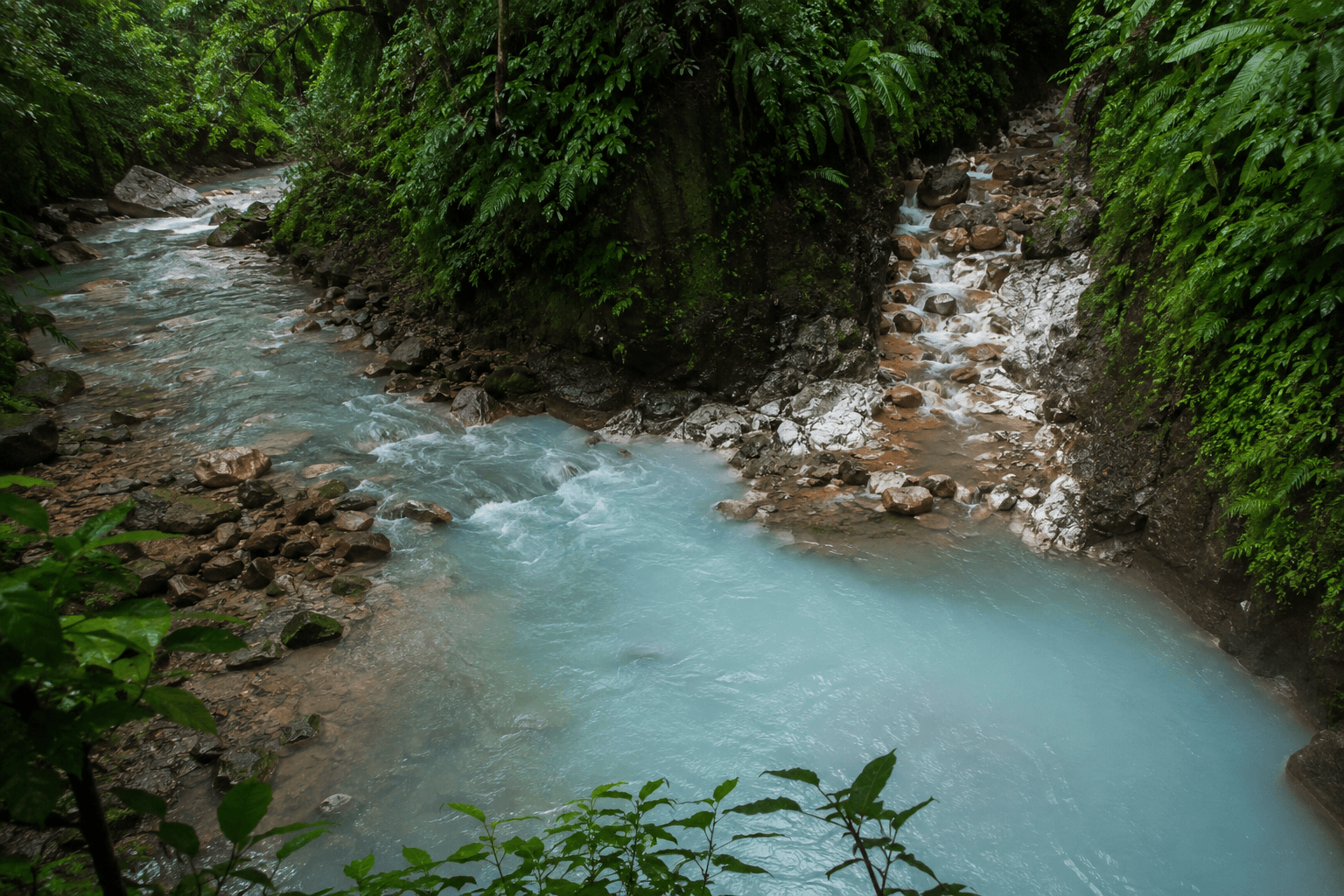
Editorial visualization of El Teñidero, where Río Buenavista and Quebrada Agria form Río Celeste.
The 566-Nanometer Sweet Spot
Before El Teñidero, the suspended particles measured in Río Buenavista averaged around 184 nanometers across. That is extremely small—far smaller than the width of a human hair—and the stream still looks clear.
After the pH drops at the confluence, the particles become larger. The 2013 researchers measured an average size around 566 nanometers in Río Celeste.
That number is the key.
Visible light has wavelengths between roughly 400 and 700 nanometers. Once the suspended particles grow to a size comparable with those wavelengths, they interact with sunlight much more efficiently. Instead of light simply passing through the water, portions of it scatter in different directions.
The river’s particle distribution is particularly effective at scattering light in the blue part of the visible spectrum. Your eyes receive that scattered light, and the entire channel appears turquoise-blue.
The physical process is called Mie scattering, named after German physicist Gustav Mie.
It is related to the optical effects that make clouds look white, give some glacial lakes their blue-green color and create hazy halos around water droplets. The exact appearance depends on particle size, concentration, the material’s optical properties and the available light.
At Río Celeste, the ingredients happen to align spectacularly.
So What Are the Particles?
The suspended material is primarily associated with aluminosilicates—compounds built from aluminum, silicon and oxygen—with smaller contributions from materials such as iron oxides.
Aluminosilicates are not exotic. They are common in rocks, soils and volcanic landscapes. What is unusual is the sequence that Río Celeste creates:
Volcanic and biological processes supply the necessary chemical ingredients.
Two clear streams carry different pieces of the system toward El Teñidero.
Mixing changes the chemistry and pH.
Submicroscopic particles form or enlarge to an optically useful size.
Those particles scatter incoming sunlight strongly enough for the river to appear blue.
No single ingredient is the magic. The system is.
The 2023 Update: The River Is More Alive Than We Thought
The 2013 study solved the core optical mystery. It showed that Río Celeste’s color comes from Mie scattering by suspended aluminosilicate particles rather than dissolved blue chemicals.
But scientists kept working.
A 2023 study published in Environmental Microbiome examined the river system with more detailed chemical and microbiological methods. The newer research found that sulfur-oxidizing microorganisms and diatoms help prepare the ingredients that ultimately form the light-scattering particles.
In Quebrada Agria, sulfur-oxidizing microbes convert reduced sulfur compounds into sulfuric acid, helping create its acidity. In Río Buenavista, diatoms—microscopic organisms with silica-rich structures—contribute to the river’s silica cycle.
When the streams meet, their independently produced chemical ingredients react. Colloidal aluminosilicate particles rapidly precipitate, and those suspended particles scatter the light.
In other words, Río Celeste is not only geology plus physics. Biology is working upstream before the color ever appears.
That is a better story than “acid meets alkaline.” The river’s color is an emergent result of a volcanic ecosystem.
Why the River Looks Milky Instead of Clear Blue
Río Celeste is not the transparent blue of a swimming pool or tropical shallows. Its color has a pale, mineral body to it—sometimes almost like watered-down paint.
That milky quality comes from particles scattering light throughout the water column. Some material eventually settles onto rocks and the riverbed, leaving pale mineral deposits around El Teñidero and downstream.
The blue also changes with viewing conditions:
Direct sunlight can intensify the apparent turquoise.
Overcast light often makes the river look softer and milkier.
Heavy rain can add sediment and dilute or overwhelm the optical effect, temporarily turning the water gray or brown.
Viewing angle and water depth change how much scattered light reaches your eyes.
The river is real, but it is not a fixed hex code.
That variability is part of the experience. If you want detailed guidance on weather, trail conditions and when the color is most likely to show, use Vivara’s complete Río Celeste hike guide. This article explains the phenomenon; that one helps you plan the day.
Can You Swim in Río Celeste?
Not inside Tenorio Volcano National Park.
Swimming is prohibited along the protected park trail. That rule protects visitors from currents and geothermal hazards while also reducing damage to a sensitive river system.
There are privately operated swimming and tubing areas farther downstream, outside the national park, where conditions and local rules differ. Do not assume that a photograph of someone swimming was taken inside the protected area.
The better move inside the park is to follow the full story on foot: the waterfall, blue lagoon, geothermal Borbollones and El Teñidero itself.
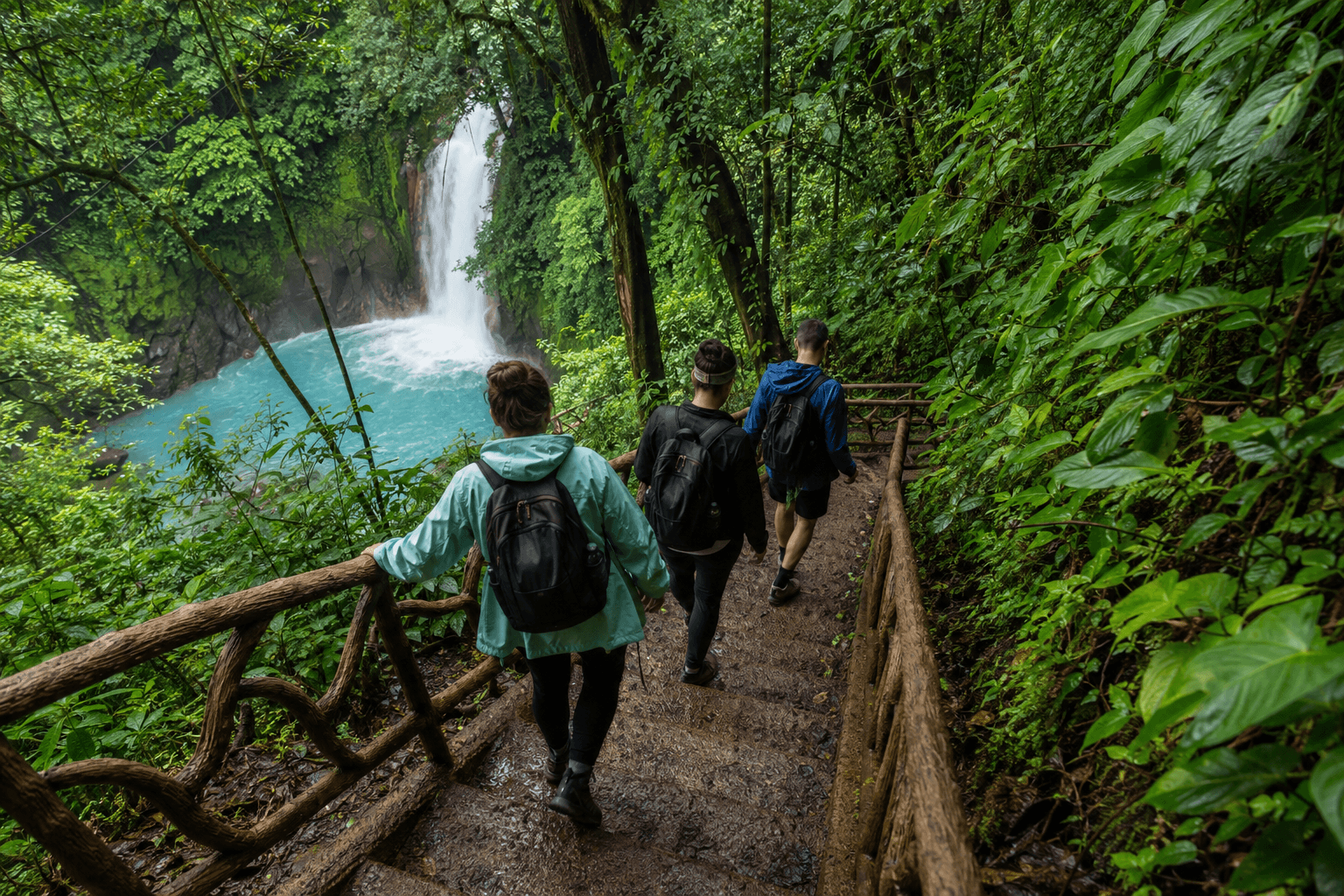
The waterfall descent provides the most famous view, but El Teñidero explains why the view exists.
What to See Beyond the Waterfall
Most visitors come for the waterfall—and it earns the attention. A white column drops through dense rainforest into a blue pool that seems to generate its own light.
But stopping there gives you the photograph without the plot.
Continue toward El Teñidero if trail conditions, time and mobility allow. The principal landmarks build a sequence:
Catarata Río Celeste: The iconic waterfall and steep staircase viewpoint.
Laguna Azul: A calmer section where the color can feel even more concentrated.
Borbollones: A geothermal area where gases rise through the water. Follow posted restrictions and do not approach beyond authorized areas.
El Teñidero: The confluence where two clear tributaries form the blue river.
The full route turns Río Celeste from a beautiful object into a process you can watch unfold.
How to Visit Without Letting Instagram Plan the Day
Río Celeste is inside Tenorio Volcano National Park in northern Costa Rica. It is not a casual roadside waterfall.
SINAC currently lists park entry from 8:00 a.m. to 2:00 p.m., with visitors required to leave by 4:00 p.m. Entry is controlled, and reservations may be required through Costa Rica’s online national-park system. Hours, prices and access rules can change, so confirm details on the official Tenorio Volcano National Park page before traveling.
Practical rules:
Arrive early, especially in peak season.
Wear closed-toe shoes with real grip.
Expect humidity, mud and a substantial staircase.
Carry a light rain layer and water.
Stay on the marked trail.
Do not swim inside the park.
Give yourself time to continue past the waterfall to El Teñidero.
For a larger menu of experiences to combine with the visit, explore Vivara’s guide to Costa Rica experiences and activities. If you are traveling from May through November, read what Costa Rica’s green season really means before building the route around one weather forecast.
How Río Celeste Fits With a Vivara Stay
Vivara sits in Dominical in Costa Rica’s Southern Zone. Río Celeste is far to the north, so this is not the excursion to wedge between breakfast and dinner.
Treat it as part of a broader Costa Rica itinerary: visit Tenorio while moving through the northern region, then continue south for the private jungle-and-coast rhythm of Vivara. You can also build it as a carefully planned full-day excursion, but the distance makes an overnight northern stop the more relaxed choice for many travelers.
That contrast works. Río Celeste gives you movement, volcanic chemistry and a regulated national-park trail. Vivara gives you privacy, open-air living, shared meals and room for the experience to settle.
Read what to expect at Vivara before shaping the rest of the trip, or use Vivara’s 10 Costa Rica adventure ideas to balance ambitious days with slower ones.
Frequently Asked Questions
Why is Río Celeste blue?
Río Celeste appears blue because suspended aluminosilicate particles scatter sunlight through a physical phenomenon called Mie scattering. At El Teñidero, acidic Quebrada Agria mixes with near-neutral Río Buenavista, changing the water chemistry and producing or enlarging particles to roughly the same scale as visible-light wavelengths.
Is Río Celeste naturally blue?
Yes. The color is completely natural. It is not caused by dye or blue pigment. A small sample of the river water can appear nearly transparent because the visible color depends on sunlight interacting with particles throughout a larger volume of water.
What happens at El Teñidero?
El Teñidero is where the clear Río Buenavista and Quebrada Agria tributaries meet. Their mixing changes the pH and chemistry, creating the suspended particles that make the downstream river appear sky-blue.
Is one Río Celeste tributary alkaline?
Not according to the frequently cited 2013 measurements. Río Buenavista measured near-neutral at about pH 6.8, while Quebrada Agria measured acidic at about pH 3.1. The combined river measured around pH 5.0 shortly after mixing.
What is Mie scattering?
Mie scattering describes how light interacts with particles that are similar in size to visible-light wavelengths. At Río Celeste, suspended particles averaging around 566 nanometers scatter sunlight in a way that produces the river’s intense blue appearance.
Does Río Celeste stay blue after rain?
Not always. Heavy rain can introduce brown sediment and change particle concentrations, temporarily muting or masking the turquoise color. The blue often returns as conditions stabilize, but no responsible guide can guarantee an exact shade on a particular day.
Can visitors swim at the Río Celeste waterfall?
No. Swimming is prohibited within Tenorio Volcano National Park. Some downstream areas outside the park allow water activities under separate private or local rules.
The Legend Was Not Wrong. It Was Just Early.
The story says God washed the sky from his brush here.
Science says two clear streams carry products of volcanic geology and microbial life into a single mixing point. Acid changes the chemistry. Mineral particles appear at the scale of visible light. Sunlight hits them, blue wavelengths scatter, and an ordinary-looking sample becomes an impossible-looking river.
One explanation is poetry. The other is physics, chemistry and biology working at once.
Río Celeste earns both.
Explore Vivara or contact the team to design your Costa Rica itinerary.

